
Lab-in-the-Loop (LITL) Market Size to Worth USD 15.98 Billion by 2035, CAGR of 27.1%
Published : 28 Jul 2026
Author : Simone Lamb



What is the Lab-in-the-Loop (LITL) Market Size?
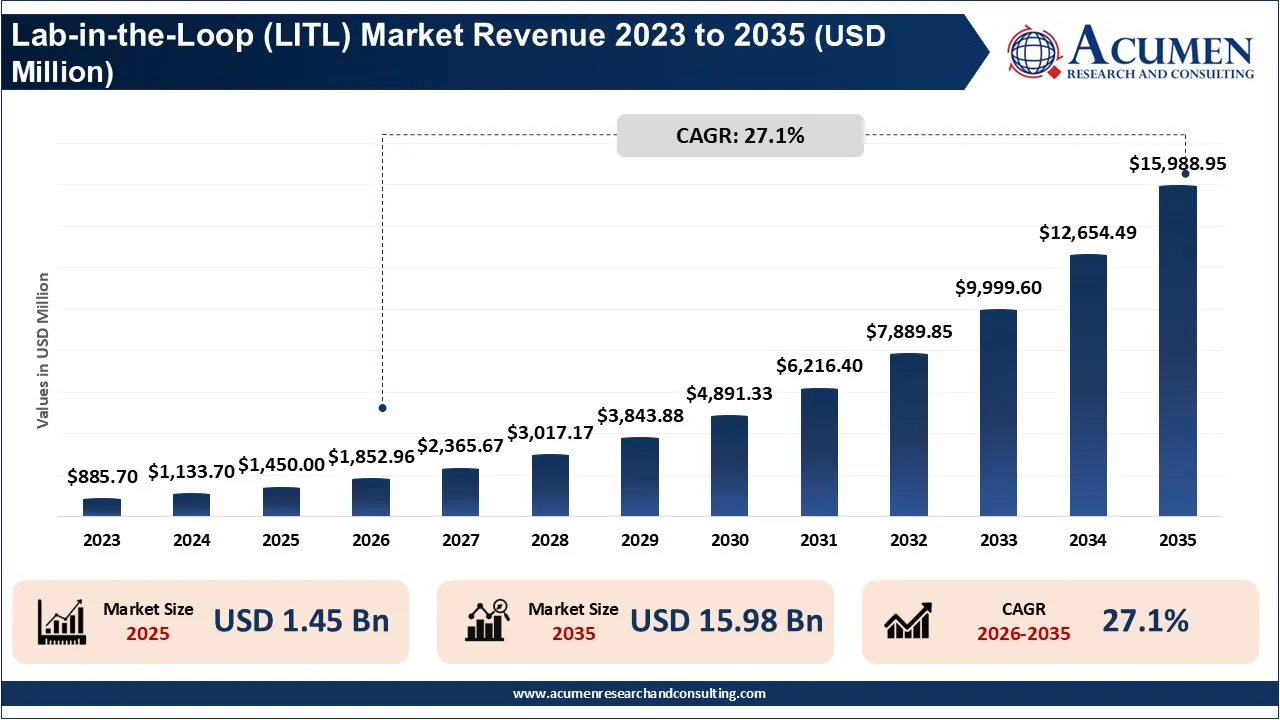
The global lab-in-the-loop market size is expanding from USD 1,450 million in 2025 to over USD 15,988.95 million by 2035 and is growing at a CAGR of 27.1% during the forecast period 2026 to 2035. The Lab-in-the-Loop (LITL) market is witnessing rapid growth due to increasing adoption of AI-driven laboratory automation, autonomous experimentation, and digital research platforms across the pharmaceutical and biotechnology industries. Continuous advancements in artificial intelligence, robotics, cloud computing, and high-performance computing are enabling faster scientific discovery, improving experimental accuracy, and reducing research timelines.
What Is the Lab-In-The-Loop (LITL) Market?
Lab-in-the-Loop (LITL) represents the amalgamation of AI, automation, robotics, laboratory instrumentation, and high-performance computers into fully automated, closed-loop experimental settings. Within this ecosystem, real-time laboratory experimental results continuously fuel the learning of an AI model and in turn, outputs derived from the AI model drive subsequent experiments.
This iterative cycle of experiment, data, learning, and automation enables rapid and efficient research and development workflows for applications across the life sciences (e.g.drug discovery, genomics, personalized medicine, synthetic biology, biomarker discovery etc.). Increased need for automation, digitally-transformed lab workflows and for an acceleration in AI-driven scientific innovation is fostering increased market growth.
Key Takeaways
- By region North America dominated the Lab-in-the-Loop (LITL) market with the largest share of 41% in 2025. This dominance is driven by the presence of major pharmaceutical and biotech firms, a robust digital research ecosystem, and the early implementation of AI driven automated laboratory techniques. The demand for integrated lab automation, fully automated discovery, and an ever expanding pool of digital labs continues to secure its dominant position.
- By region, Asia Pacific is expected to grow at the fastest CAGR of 30.8% during the forecast period. Investments in cutting edge life sciences are fueling the implementation of automated research tools and lab automation solutions across this region, thereby pushing the market forward, particularly in Japan, China, and India. The continued development of sophisticated life sciences technologies, combined with rising demand for automated scientific testing, is likely to see exponential growth.
- By component, the software and AI platforms held the highest market share of 32% in 2025. AI based software solutions act as the brain of LITL platforms helping to streamline and improve scientific experiments and automated discovery processes.
- By component, cloud/GPU compute infrastructure segment will experience highest CAGR during forecast period. With increasingly advanced artificial intelligence based experiments and ongoing molecular and other types of research, the computing needs for powerful and distributed computing is significantly increasing. Given the trend towards research platforms being delivered in the cloud for increased access and scale, this will likely become even greater.
- By deployment, On-premise remained the segment with the largest share, a whopping 52% in 2025. The large size and existing infrastructure of most pharma/biotech organizations keeps them heavily rooted in on-premise deployments to safeguard intellectual property, data security, and regulatory compliance. However, growing pressure to make labs smarter and more agile will challenge this dominance.
- By deployment, cloud-based garnered a market share of 28% in 2025 and is expected to record the fastest growth rate during the forecast period. On the back of scalable cloud-based computing environments and enhanced collaborative capabilities, cloud based deployment models offer flexibility.
- By application, the drug discovery & development segment recorded the highest share of 35% in 2025. As new drug discovery is an expensive and time consuming process, lab-in-the-loop platforms help automate the experimentation required, accelerating the research lifecycle significantly.
- By application, genomics & precision medicine segment held 20% share in 2025 and is anticipated to showcase highest growth during forecast period. Genomics and personalized medicine approaches to discovering novel drugs require advanced AI based laboratory experimentation and data analysis which further boosts the demand for automated science platforms.
- By end-user, pharmaceutical companies generated the highest revenue share of 35% in 2025. The need for increased efficiency and productivity has driven pharmaceutical companies to extensively utilize lab-in-the-loop technologies for automated research operations. Significant investment in digitally transformed labs will continue to solidify this position in the market.
- By end-user, biotechnology companies are expected to witness a considerable growth in CAGR of 30.2% during forecast period. As research in autonomous discovery platforms gains momentum across various fields of biology, the sector is poised to drive the lab-in-the-loop market growth. The significant inflow of investment into cutting-edge technologies in the sector and strong interest from ventures, academia and corporates.
Can Closed-Loop Autonomous Laboratories Redefine Scientific Discovery?
Perhaps the biggest, game-changing prospect of the Lab-in-the Loop (LITL) space is in the form of the closed-loop autonomous laboratory. This closed loop consists of experimental outputs from the laboratory which are continuously provided to artificial intelligence models. This in turn enables these algorithms to generate hypotheses, devise experiments, automatically execute the experimental protocol on a robotic platform, and then refine experimental plans.
In a typical drug discovery or genomics, or other life sciences workflow these platforms allow the cycles of learning to occur at very high speed thereby saving weeks and months of time, enhancing reproducibility, and decreasing costs.
Lab-in-the-Loop Market Regional Outlook
North America was the leading market for Lab-in-the-Loop (LITL) in 2025. It's well established pharmaceutical industry, mature biotechnology ecosystem, and early adoption of AI-enabled lab automation technologies, driven by prominent pharmaceutical companies, research centers, AI tech providers and cloud service firms making substantial investments in autonomous labs and intelligent research platforms and governmental investments in life science R&D, robust intellectual property (IP) rights and digitalized infrastructure are continuing to bolster the market.
Europe was another major market driven by expanding investments in biotechnology, collaborative research in life sciences and growing efforts to expand precision medicine approaches, digitization of labs, and significant investment in the life science sector.
Asia Pacific is poised to register the highest growth during the forecast period. Increasing investments in the biotechnology sector, pharmaceutical manufacturing expansion and governmental support for AI-enabled healthcare and R&D will further drive the market growth. Countries like China, Japan, India, South Korea and Singapore have been making large investments in precision medicine, genomics, lab automation and artificial intelligence.
Latin America is adopting LITL technologies at a moderate pace driven by healthcare modernization efforts and an expanding pharmaceutical R&D, whereas the Middle East and Africa will grow steadily due to investments in the life science research infrastructure, innovations in healthcare delivery and the ongoing digitalization of laboratories.
Who are the Top Companies in the Lab-in-the-Loop Market?
Companies in the Lab-in-the-Loop (LITL) market leverage partnerships with lab automation solution providers, AI software developers, cloud computing providers, and life science organizations to drive and accelerate autonomous scientific discovery. Key players in this space include Thermo Fisher Scientific Inc., Danaher Corporation, Benchling Inc., NVIDIA Corporation, Microsoft Corporation, Google LLC, IBM Corporation, Schrdinger, Inc., Insilico Medicine, and Recursion Pharmaceuticals, Inc.
These firms develop advanced AI solutions for lab automation, cloud computing, molecular modeling and simulation, lab information management systems (LIMS), and high-performance computing infrastructure that supports autonomous experiment execution. Collaborations are frequently formed between pharmaceutical and biotech companies, universities and research institutions, and AI service and software firms to bring intelligent laboratory ecosystems to the market.
Segments Covered
By Component
- Software & AI Platforms
- Cloud/GPU Compute Infrastructure
- Services & Integration
- Laboratory Automation Hardware
- Licensing & Outcome-Based Revenue
By Deployment
- On-Premise
- Cloud-Based
- Hybrid
By Application
- Drug Discovery & Development
- Genomics & Precision Medicine
- Materials Science
- Chemical Research
- Battery & Energy
- Synthetic Biology
By End User
- Pharmaceutical Companies
- Biotechnology Companies
- CROs/CDMOs
- Academic & Research Institutes
- Government Laboratories
- Industrial R&D Centers
By Region
- North America
- Europe
- Asia-Pacific
- Latin America
- Middle East & Africa
Contact Us:
Mr. Richard Johnson
Acumen Research and Consulting
India: +91 8983225533