
Surgical Navigation Systems Market Size to Hit USD 4.98 Billion by 2035
Published : 26 Oct 2026
Author : Lucas Hoffmann



What is the Surgical Navigation Systems Market Size?
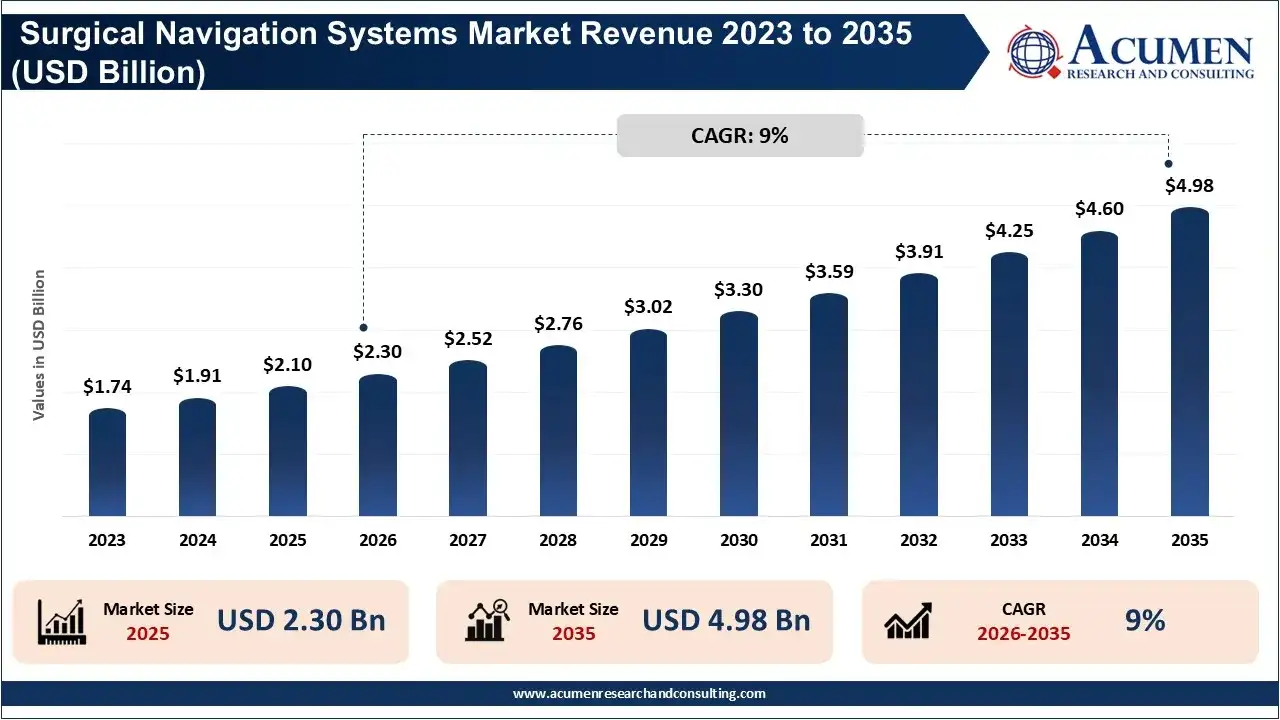
The global surgical navigation systems market size was accounted for USD 2.10 billion in 2025 and is projected to hit USD 4.98 billion by 2035; growing at a CAGR of 9% during the forecast period from 2026 to 2035. The surgical navigation systems market is being driven by increasing demand for image-guided precision, complex minimally invasive procedures, advanced intraoperative imaging, and greater integration of navigation with robotics and AI-enabled surgical technologies.
What Is Changing in 2026?
The surgical navigation systems market is moving beyond conventional image guidance toward more connected and intelligent intraoperative platforms that combine imaging, tracking, surgical planning, and real-time navigation. Hospitals and surgical centers are increasingly adopting technologies that can translate preoperative CT or MRI data into actionable guidance during procedures, particularly where anatomical precision is critical.
Navigation is also becoming more closely integrated with robotic-assisted surgery, intraoperative imaging, and software-based planning tools, creating a more connected digital workflow inside the operating room. In 2026, this shift is becoming particularly visible in spine, cranial, orthopedic, and ENT procedures, where accurate localization and instrument positioning can be important to surgical execution.
Surgical Navigation Systems Market: Where Are These Systems Being Used?
- Neurosurgery: Surgical navigation is widely used in neurosurgery to help surgeons localize brain structures, plan trajectories, and relate instruments to preoperative imaging. These capabilities are particularly valuable during procedures involving tumors, deep anatomical structures, and areas located close to critical neurological pathways.
- Spine Surgery: In spine procedures, navigation supports vertebral localization, implant trajectory planning, and instrument positioning. Integration with intraoperative imaging and robotics is increasingly creating connected workflows that allow surgical teams to plan procedures digitally and execute them with image-based guidance.
- Orthopedic Surgery: Orthopedic navigation supports alignment, implant positioning, and patient-specific surgical planning across procedures such as joint replacement. Navigation technologies are increasingly being combined with robotics, 3D modeling, and AI-based anatomical recognition to provide surgeons with more detailed intraoperative information.
- ENT Surgery: Navigation systems are used in ENT procedures where surgeons work around complex sinus, skull-base, and other anatomically sensitive structures. CT-based imaging and instrument tracking can provide continuous anatomical reference during procedures, helping surgeons correlate the surgical field with preoperative images.
Segmental Outlook
| Segment | Leading Segment | 2025 Share | Driver |
|---|---|---|---|
| By Component | Hardware | 58% | Demand for navigation workstations, tracking systems, imaging equipment, sensors, and specialized surgical instruments supports the leading position of hardware. |
| By Tracking Technology | Electromagnetic Navigation | 41% | The ability to track surgical instruments without requiring direct line of sight supports electromagnetic navigation in procedures where optical tracking can be constrained. |
| By Navigation/Imaging Method | CT-Based Navigation | 29% | High-resolution anatomical imaging and established use across cranial, spinal, ENT, and orthopedic procedures continue to support CT-based navigation. |
| By Application | Neurosurgery | 35.5% | The need for precise anatomical localization, trajectory planning, and instrument guidance during complex neurosurgical procedures supports strong adoption. |
| By Procedure | Cranial Procedures | 28% | Navigation is particularly valuable around critical brain structures, tumors, and skull-base anatomy where accurate localization and instrument positioning are essential. |
| By System Configuration | Standalone Navigation Systems | 57% | Demand for dedicated navigation, tracking, image registration, and surgical guidance capabilities supports the continued use of standalone systems. |
| By End User | Hospitals | 45% | High surgical volumes, advanced imaging infrastructure, specialized operating rooms, and multidisciplinary surgical capabilities support hospital adoption. |
What Will Surgical Navigation Systems Look Like by 2030?
- AI-Enhanced Surgical Guidance: Navigation systems are expected to increasingly incorporate AI for anatomical recognition, image segmentation, surgical landmark identification, and planning support, helping transform navigation from a positioning tool into a more intelligent intraoperative information layer.
- Navigation and Robotics Convergence: Surgical navigation and robotics are likely to become increasingly interconnected, allowing preoperative plans, anatomical positioning, instrument tracking, and robotic execution to operate through more unified digital workflows across complex surgical procedures.
- Real-Time Multimodal Imaging: Future systems are expected to combine preoperative CT and MRI data with intraoperative imaging, enabling surgical teams to update anatomical information during procedures and maintain more relevant visualization as anatomy changes throughout an operation.
- Patient-Specific Surgical Planning: Advances in 3D modeling, AI-assisted image analysis, and digital planning are likely to enable increasingly patient-specific navigation workflows, particularly for complex cranial, spinal, orthopedic, and minimally invasive procedures.
- Connected Operating Rooms: Surgical navigation is likely to become increasingly integrated with imaging systems, robotic platforms, surgical instruments, operating-room software, and data platforms, creating connected environments where multiple technologies contribute to a unified surgical workflow.
Surgical Navigation Systems Market Regional Outlook
North America dominated the surgical navigation systems market
North America dominated the surgical navigation systems market with a 41.6% share in 2025, supported by advanced healthcare infrastructure, established adoption of image-guided surgery, and strong investment in surgical navigation and related technologies. The region benefits from a high concentration of hospitals and specialized surgical centers with access to advanced imaging, robotic platforms, and digitally enabled operating-room infrastructure.
The region is also at the forefront of integrating navigation with robotics and AI-enabled software. Recent regulatory activity illustrates this direction, with Medtronic's Stealth AXiS system receiving U.S. FDA clearance for spine procedures in February 2026 and subsequently expanding to cranial and ENT procedures in March. The platform brings planning, navigation, and robotics together, reflecting the broader movement toward integrated surgical technologies.
Asia-Pacific’ Potential in Surgical Navigation Systems Market
Asia-Pacific is anticipated to be the fastest-growing regional market, with a projected CAGR of 12.6% from 2026 to 2035. Growth is supported by hospital modernization, increasing surgical volumes, expansion of advanced imaging infrastructure, and greater availability of technologically sophisticated procedures across major healthcare markets.
The region is also becoming increasingly important for the deployment of digitally enabled surgical technologies. As tertiary-care hospitals and private healthcare networks expand their capabilities, demand is expected to increase for navigation systems that can support complex orthopedic, spinal, cranial, and minimally invasive procedures. Greater integration between imaging, navigation, robotics, and software could further accelerate adoption across leading Asian healthcare markets.
Recent Developments
- In February 2026, Medtronic received U.S. FDA clearance for the Stealth AXiS surgical system for spine procedures. The platform combines surgical planning, navigation, and robotics into a single system, signaling a shift toward integrated technologies rather than standalone navigation platforms.
- In June 2026, DePuy Synthes announced U.S. commercial availability of VELYS Hip Navigation with AI Assistance. The system uses AI to support image interpretation and anatomical landmark identification, illustrating how AI is being incorporated directly into navigation workflows to improve procedural consistency and efficiency.
Key Companies
- Brainlab
- Medtronic
- Stryker
- Zimmer Biomet
- Smith+Nephew
- GE HealthCare
- Siemens Healthineers
- Philips
- Globus Medical
- Johnson & Johnson MedTech
Segments Covered in the Report
By Component
- Software
- Hardware
- Services
By Tracking Technology
- Electromagnetic Navigation
- Optical Navigation
- Hybrid Navigation
- Other Tracking Technologies
By Navigation/Imaging Method
- CT-Based Navigation
- Fluoroscopy-Based Navigation
- MRI-Based Navigation
- Imageless Navigation
- Ultrasound-Based Navigation
- Multimodal/Image-Fusion Navigation
- Other Navigation Methods
By Application
- Neurosurgery
- Orthopedic Surgery
- Spine Surgery
- ENT Surgery
- Dental & Maxillofacial Surgery
- Other Surgical Applications
By Procedure
- Cranial Procedures
- Spinal Procedures
- Knee Procedures
- Hip Procedures
- ENT & Skull Base Procedures
- Dental & Maxillofacial Procedures
- Other Procedures
By System Configuration
- Standalone Navigation Systems
- Integrated Navigation Systems
By End User
- Hospitals
- Ambulatory Surgical Centers
- Specialty Clinics & Surgical Centers
- Academic & Research Medical Centers
- Others
By Region
- North America
- Europe
- Asia-Pacific
- Latin America
- Middle East & Africa
Contact Us:
Mr. Richard Johnson
Acumen Research and Consulting
India: +91 8983225533