
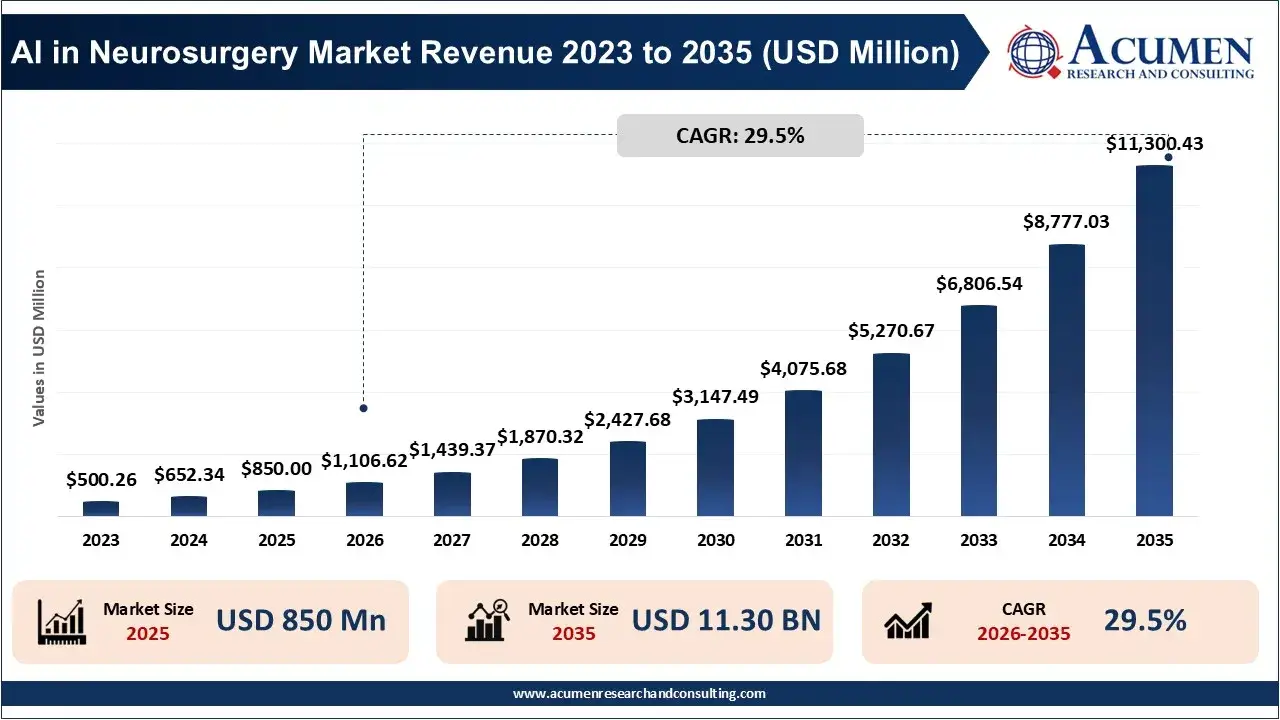
AI in Neurosurgery Market is Reaching USD 11,300.43 Million at 29.5% CAGR
Published : 13 Oct 2026
Author : Raghuram Nair



What is the AI in Neurosurgery Market Size?
The global AI in neurosurgery market size was estimated at USD 850 million in 2025 and is projected to surge USD 11,300.43 million by 2035, while expanding at a CAGR of 29.5% over the forecast period 2026 to 2035.
What Is Changing in 2026?
The AI in neurosurgery market is entering a more clinically focused phase as artificial intelligence moves beyond diagnostic imaging and preoperative analysis toward real-time assistance during complex procedures. AI is increasingly being integrated across medical image interpretation, tumor segmentation, surgical planning, navigation, intraoperative visualization, and outcome prediction, creating a connected intelligence layer across the neurosurgical workflow.
A notable development in 2026 demonstrates this transition: researchers at University College London and University College London Hospitals reported the first use of AI to support a neurosurgeon in real time during live brain-tumor surgery. The system analyzed live surgical video and highlighted critical structures at the base of the brain, illustrating how AI can move from analyzing preoperative scans to providing information during an active procedure.
Which AI Technologies Are Reshaping Neurosurgery?
- Machine Learning and Deep Learning: Machine learning and deep learning are increasingly applied to neuroimaging, tumor classification, anatomical segmentation, outcome prediction, and surgical planning. These technologies can identify complex patterns across large clinical datasets and support neurosurgeons with patient-specific information throughout diagnostic and treatment workflows.
- Computer Vision: Computer vision is expanding AI's role from static medical images to live surgical environments. It can support recognition of anatomy, tumors, surgical instruments, tissue characteristics, and procedural stages, creating opportunities for real-time intraoperative guidance and contextual information during complex neurosurgical procedures.
- AI-Powered Image Segmentation: AI-based segmentation can automatically identify tumors, lesions, anatomical structures, and functional regions from MRI and other imaging modalities. Automated or semi-automated segmentation can support more consistent visualization and provide inputs for diagnosis, surgical planning, navigation, treatment targeting, and postoperative assessment.
- Predictive Analytics: Predictive AI is increasingly being explored for estimating surgical risks, treatment outcomes, disease progression, complications, and patient recovery. By combining clinical records, imaging information, and other patient characteristics, predictive models can provide additional evidence to support individualized treatment planning and postoperative management.
AI in Neurosurgery Market Segmental Outlook
| Segment | Leading Segment | 2025 Share | Driving Factor |
|---|---|---|---|
| By Component | Software | 57% | Increasing integration of AI across medical image analysis, surgical planning, navigation, clinical decision support, and outcome prediction is strengthening demand for software-based neurosurgical intelligence. |
| By Deployment | On-Premise | 48% | Healthcare providers continue to prioritize direct control over sensitive patient data, computing infrastructure, cybersecurity, and integration with existing clinical systems, supporting on-premise deployment of AI technologies. |
| By Technology | Machine Learning & Deep Learning | 43% | Broad application across medical image analysis, tumor segmentation, prediction, trajectory planning, pattern recognition, and clinical decision support is supporting the leading position of ML and DL technologies. |
| By Application | Diagnosis & Preoperative Assessment | 21% | Increasing use of AI for medical image interpretation, tumor detection, anatomical segmentation, risk assessment, and patient-specific surgical evaluation is driving adoption before procedures begin. |
| By Neurosurgical Procedure | Neuro-Oncology Surgery | 26% | Growing application of AI in brain-tumor detection, segmentation, surgical planning, navigation, intraoperative visualization, and tissue assessment is supporting strong adoption across neuro-oncology procedures. |
| By Imaging Modality | MRI | 34% | MRI provides detailed visualization of brain structures, tumors, lesions, and neurological abnormalities, making it an important source of imaging data for AI-based diagnosis, segmentation, planning, and surgical decision support. |
| By End User | Hospitals | 61% | Advanced neurosurgical departments, specialized clinical teams, sophisticated imaging infrastructure, and greater investment capacity enable hospitals to integrate AI-enabled diagnostic and surgical technologies. |
AI in Neurosurgery Market: What Will Change by 2030?
- By 2030, AI in neurosurgery is expected to move toward increasingly connected and multimodal systems that combine imaging, clinical information, surgical video, navigation, and predictive analytics. Rather than functioning as isolated diagnostic tools, AI platforms may increasingly support multiple stages of the neurosurgical pathway, from patient assessment and personalized planning to intraoperative guidance and postoperative outcome analysis.
- Real-time surgical intelligence is likely to become one of the most important areas of development. The 2026 UCL-UCLH clinical trial demonstrates the direction of this evolution, with AI analyzing live surgical video to identify critical anatomy during brain-tumor surgery. Future systems could expand these capabilities to recognize instruments, tissue interactions, procedural stages, and changing anatomical conditions while keeping the surgeon responsible for clinical decisions.
AI in Neurosurgery Market Regional Outlook
North America: Advanced Neurosurgical Infrastructure Supports Market Leadership
North America dominated the AI in neurosurgery market with a 46.0% share in 2025, supported by advanced neurosurgical infrastructure, established adoption of image-guided technologies, sophisticated medical-imaging capabilities, and strong investment in AI-enabled healthcare solutions. The region's concentration of major hospitals, academic medical centers, medical-device companies, and AI research institutions provides an environment conducive to clinical development and adoption.
The region is also benefiting from increasing integration of AI into diagnostic imaging, surgical planning, navigation, and clinical decision support. The United States has an established ecosystem for developing and validating AI-enabled medical technologies, while leading academic centers continue to investigate real-time AI and robotics for complex neurosurgical procedures. Recent U.S. research and technology development increasingly focus on moving AI from retrospective analysis toward intraoperative applications.
- United States: The United States leads regional development through its concentration of academic neurosurgical centers, AI research programs, medical-device companies, and clinical investigations into AI-assisted imaging, navigation, robotics, and intraoperative decision support.
Asia-Pacific: Rapid Digitalization Creates a High-Growth Neurosurgical AI Opportunity
Asia-Pacific is projected to be the fastest-growing regional market, registering a 34.2% CAGR during 2026–2035. Expansion of healthcare infrastructure, increasing adoption of advanced medical imaging, growing investment in healthcare AI, and demand for more precise neurological diagnosis and treatment are supporting the region's rapid development.
The region also presents a significant opportunity because AI can help extend specialized capabilities across large and geographically diverse patient populations. China, Japan, South Korea, India, and other markets are increasing investment in medical AI, digital healthcare, robotics, and advanced imaging, creating opportunities for AI-enabled neurosurgical planning, diagnosis, navigation, and decision support.
- China: China is a leading regional market, supported by expanding medical-AI capabilities, advanced imaging infrastructure, healthcare technology investment, and growing development of AI applications for neurological diagnosis and treatment.
Where Is Investment Moving in AI in Neurosurgery?
Swiss neurotechnology company Clee Medical closed a seed financing round in February 2026 to advance its Neuro Access platform, which combines real-time intraoperative brain imaging with AI-powered navigation. The financing was led by High-Tech Gründerfonds, with participation from Zürcher Kantonalbank, Kickfund, FONGIT, Venture Kick, and existing investor Wyss Geneva. The funding is intended to support product development, clinical validation, and regulatory preparation.
Panda Surgical was awarded funding through the Innovate UK Biomedical Catalyst in September 2026 to develop an AI co-pilot for robotic neurosurgery through an 18-month collaboration with University College London Hospitals. The system is designed to help neurosurgeons navigate and maintain orientation during robotic procedures while keeping the surgeon in control. The reported award was nearly £378,000.
AI in Neurosurgery Market Key Players
- Brainlab: Brainlab develops digital surgery, imaging, navigation, and planning technologies that support neurosurgical workflows and provide infrastructure for integrating advanced data-driven capabilities.
- Medtronic: Medtronic combines neurosurgical navigation, imaging, surgical technologies, and digital capabilities across its broader portfolio, supporting the integration of advanced technologies into neurological procedures.
- Stryker: Stryker provides neurosurgical technologies spanning navigation, imaging, surgical instruments, and procedural systems, creating an established platform for incorporating digital and AI-enabled capabilities.
- GE HealthCare: GE HealthCare contributes advanced medical imaging and healthcare technology that can provide the imaging data and clinical infrastructure required for AI-supported neurological diagnosis and treatment planning.
- Siemens Healthineers: Siemens Healthineers develops MRI, CT, imaging software, and digital healthcare technologies that support AI-enabled analysis and increasingly data-driven neurological workflows.
- Philips: Philips provides advanced imaging, image-guided therapy, and healthcare informatics technologies that can support AI integration across neurological diagnosis, visualization, and intervention.
- NVIDIA: NVIDIA provides accelerated computing platforms and AI infrastructure used by researchers and medical-technology developers to process imaging, video, and other data in real-time healthcare applications; the UCL real-time neurosurgical AI system runs on an NVIDIA Clara IGX platform.
Segments Covered in the Report
By Component
- Software
- Medical Image Analysis & Segmentation Software
- Neurosurgical Planning & Simulation Software
- Navigation & Guidance Software
- Intraoperative AI & Computer Vision Software
- Clinical Decision-Support Software
- Surgical Analytics & Outcome Prediction Software
- Other Software
- Hardware
- AI-Enabled Neurosurgical Robotic Systems
- AI-Enabled Navigation & Imaging Systems
- Sensors, Cameras & Tracking Devices
- AI Computing & Processing Hardware
- Other Hardware
- Services
- Implementation & Integration Services
- Support, Maintenance & Upgrade Services
- Training & Consulting Service
- Managed & AI Optimization Services
- Other Services
By Deployment
- On-Premise
- Cloud-Based
- Hybrid
By Technology
- Machine Learning & Deep Learning
- Computer Vision
- Natural Language Processing
- Generative AI
- Other AI Technologies
By Application
- Diagnosis & Preoperative Assessment
- Surgical Planning & Simulation
- Intraoperative Navigation & Guidance
- AI-Assisted Robotic Neurosurgery
- Intraoperative Imaging & Computer Vision
- Clinical Decision Support
- Postoperative Monitoring & Outcome Prediction
- Others
By Neurosurgical Procedure
- Neuro-Oncology Surgery
- Cerebrovascular Surgery
- Spine & Spinal Cord Surgery
- Functional Neurosurgery
- Epilepsy Surgery
- Neurotrauma Surgery
- Pediatric Neurosurgery
- Other Neurosurgical Procedures
By Imaging Modality
- MRI
- CT
- Intraoperative Ultrasound
- Optical & Video Imaging
- Multimodal/Fusion Imaging
- Others
By End User
- Hospitals
- Ambulatory Surgical Centers
- Specialty Neurosurgery & Neurology Centers
- Academic & Research Medical Centers
- Others
By Region
- North America
- Europe
- Asia-Pacific
- Latin America
- Middle East & Africa
Contact Us:
Mr. Richard Johnson
Acumen Research and Consulting
India: +91 8983225533