
Clinical Decision Support System Market Size to Hit USD 5.26 Billion by 2035, Growing at a CAGR of 7.1%
Published : 10 Jul 2026
Author : Simone Lamb



What is the Clinical Decision Support System Market Size?
The global clinical decision support system market size was estimated at USD 2.64 billion in 2025 and estimated to be USD 5.26 billion by 2035; growing at a CAGR of 7.1% over the forecast period from 2026 to 2035. Clinical Decision Support Systems (CDSS) market includes a range of software platforms and comprehensive health solutions that empower physicians, nurses, and a wide spectrum of clinicians in making evidence-based care decisions. CDSS solutions use patient data to provide clinicians with real-time advice. The system may interoperate with clinical information systems, including EHR systems, computerized physician order entry systems (CPOE), laboratory information systems, and more.
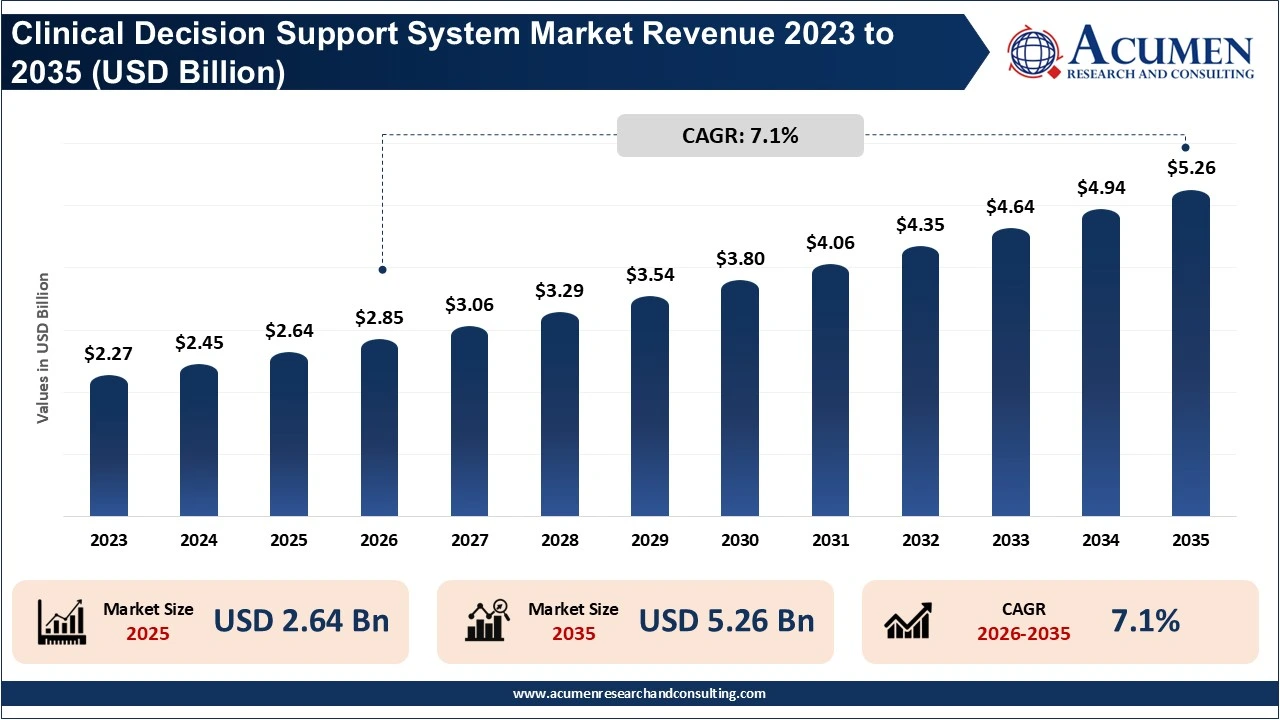
This market includes software, hardware, as well as associated implementation and maintenance services delivered via on-premise, cloud, or hybrid delivery model. The expansion of digital technologies in healthcare and the growing prevalence of artificial intelligence, combined with growing focus on improving patient safety and diminishing the prevalence of medical errors, is likely to boost the global demand for clinical decision support systems across hospitals, ambulatories, and other healthcare facilities.
Key Takeaways
- By region, North America commanded the lion’s share in the global clinical decision support system market with a market stake of 41.2% in 2025, which is anticipated to be around 36.0% of the total market by the end of 2035. The growing EHR penetration and supportive government regulations concerning e-health and the health IT sector have been encouraging health organizations to invest in CDSS technologies.
- By region, Asia-Pacific is projected to experience robust growth during the forecast period. The region’s market share from 21.0% in 2025 to reach a size of 30.0% by the end of 2035. A CAGR of 11.4% between 2026 and 2035. Rapid advancements in healthcare infrastructure and the rise in the adoption of smart clinical tools in Asia-Pacific are key drivers for the CDSS market in this region. Government incentives promoting the digital transformation of the healthcare sector coupled with an increasing rate of digitization are also boosting regional CDSS adoption.
- By product, the integrated EHR with CDSS led the market and contributed for around 36% share in 2025. These integrated EHR systems with clinical decision support systems enable clinicians to enhance workflow efficiency, patient safety and optimize clinical decision making based on real-world evidence. Growing awareness on EHR systems integration to provide clinical guidance with decision support for clinicians in healthcare settings across the globe is the main factor fueling the market growth for the EHR with CDSS segment.
- By product, integrated CDSS with CPOE & EHR are anticipated to experience the strongest growth rate during the forecast period and this market share is projected to increase from 30.0% in 2025 to 48.0% by 2035. This rise in the market share is expected at a CAGR of 9.6% during the forecast period. Demand for a well-integrated system for clinical workflow optimization, for automation in medication management systems and to ensure accurate treatment suggestions for improved clinical practice, is leading to substantial market adoption for the integrated CDSS with CPOE and EHR segment.
- By component, the software component led the market and held a share of approximately 61% in 2025. This segment is projected to reach a market size of 57.0% by 2035. The growth is driven by technological advancements, and the increasing integration of artificial intelligence, Big Data analytics and predictive algorithms into CDSS platforms.
- By component, services are expected to show a healthy CAGR of 9% during the forecast period, growing from 29.0% in 2025 to 34.0% by 2035. The demand for system integration, training, consulting and other support services is a significant factor contributing to the growth of the services segment. As healthcare organizations continue to adopt CDSS, there will be a growing demand for professional services to assist in implementation, integration, maintenance, and training to maximize the benefits of these systems.
- By type, diagnostic CDSS accounted for the largest share in 2025, with 56% of the overall market share. This segment is predicted to reach a market share of 55.0% by 2035, at a CAGR of 6.4%. Increased focus on accurate diagnosis and early disease detection in the healthcare sector contributes to the growth of the diagnostic CDSS market.
- By type, therapeutic CDSS held 44.0% of the market share in 2025. This segment is expected to witness a healthy growth of 7.5% CAGR, reaching 45.0% by 2035. Growing need for personalized medication regimens and chronic disease management services has pushed up the usage of therapeutic CDSS systems. Personalized treatment is a rising concept and this has further increased the use of therapeutic CDSS in healthcare.
- By deployment mode, on-premise deployment garnered the highest market share of 42% in 2025. This segment is expected to contribute around 33.0% to the overall market by 2035, experiencing a moderate growth at a CAGR of 3.7%. Larger healthcare facilities and government organizations with established infrastructure tend to prefer on-premise deployments due to data security concerns and customization needs.
- By deployment mode, the cloud-based segment captured 38% of the total market in 2025. The cloud-based deployment is projected to reach 48.0% by the end of the forecast period, expanding at a considerable CAGR of 9.0%. Factors such as cost-effectiveness, scalability, remote accessibility, and ease of implementation are contributing to the increasing adoption of cloud-based CDSS solutions in healthcare.
- By model, the knowledge-based CDSS models dominated the market with a share of approximately 65% in 2025. This segment is likely to achieve around 56.0% by 2035. Knowledge-based CDSS rely on a set of rules and medical knowledge to generate recommendations. The ability of these systems to leverage a vast database of clinical guidelines, medical literature, and expert knowledge for evidence-based recommendations drives their widespread adoption.
- By model, the non-knowledge-based CDSS models are anticipated to grow at a significant pace with a market share expected to rise from 35.0% in 2025 to 44.0% by 2035. A CAGR of 9.4%. Machine learning and AI algorithms are increasingly being integrated into non-knowledge-based systems to analyze complex data and derive predictive insights for decision support. The integration of machine learning, data mining, and predictive analytics allows these systems to learn from large datasets and make data-driven clinical decisions, leading to increased accuracy and personalized care.
- By level of interactivity, the active CDSS level of interactivity had the highest market share of around 69% in 2025, with this share likely to be reduced to 62.0% by the end of 2035, a moderate CAGR of 6.0%. Active CDSS automatically prompt the clinicians with relevant clinical information and alerts to assist their decision-making. Automatic prompts and reminders offered by active CDSS allow the clinicians to reduce medication errors and to streamline the overall clinical decision making process.
- By level of interactivity, the passive CDSS held the second-largest share of approximately 31.0% in 2025, with this share expected to decline slightly to 38.0% by the end of 2035, a CAGR of 7.5%. Passive CDSS offer an information base which is passively used by clinicians to support decision making in a case by case basis. They present to the clinicians as per the clinician’s queries.
- By application, medication management support held a significant market share of 28.0% in 2025. The segment is anticipated to witness a market share of around 25.0% by the end of 2035, with a CAGR of 5.5%. Increasing incidences of medication errors, a growing focus on patient safety and need for efficient drug management systems drive the demand for medication management support in the CDSS market. This CDSS assists health care providers with drug-drug interaction alerts, adverse drug event warnings and appropriate dosing information for safe prescribing practices.
- By application, clinical guidelines & pathway support accounted for the second-largest share of approximately 18.0% in 2025, and is expected to rise to 19.0% by 2035, with a CAGR of 6.9%. Growing emphasis on standardizing treatment protocols, optimizing patient care delivery and improving evidence-based decision-making practices drives the demand for clinical guidelines and pathway support systems.
How Will Artificial Intelligence and Predictive Analytics Transform the Future of Clinical Decision Support Systems?
Driven by Artificial Intelligence (AI), machine learning, and predictive analytics, growth opportunities in the clinical decision support systems market are arising as clinical providers evolve from using simple rule-based recommendations to providing more intelligent and personalized guidance to patients. CDSS with integrated intelligence can manage vast datasets like patient medical records, lab reports, diagnostic imaging, and current patient health data to effectively risk-predict disease, personalize treatment approaches, foretell likely adverse outcomes, and boost precision medicine implementation.
Driven by increasing investments in value-based payment models, population health initiatives, and healthcare digital transformation efforts, demand for AI decision-support tools for healthcare providers are forecast to experience steep expansion. Developers of open-standards, cloud-based and AI-supported CDSS software that seamlessly integrate into current healthcare IT architecture are expected to see considerable growth.
Clinical Decision Support System Market Regional Outlook
Why has North America garnered the largest share of clinical decision support system market?
North America garnered the largest share of clinical decision support system market and recorded 41.2% of the global revenue in 2025 and it is anticipated to witness a stable share in 2035, representing 36.0% of the global market share by registering a CAGR of 5.5% between the forecast period 2026-2035. Factors contributing to North America's dominance include the adoption of electronic health records and strong IT infrastructure, government focus on digital health and interconnectivity, adoption of AI based systems in clinical setting and expansion in number of investments by leading healthcare companies.
Factors including widespread implementation of EHR, high healthcare IT spending and government focus on digitization have fueled market growth in the region, while ongoing investments in digital technologies are anticipated to offer future opportunities.
Why is Asia Pacific projected to register the fastest growth in the clinical decision support system market?
The Asia Pacific held 21.0% share of the clinical decision support system market in 2025 and it is projected to register the fastest growth during the forecast period with a CAGR of 11.4% and accounting 30.0% of the market share in 2035. Key factors including development of robust healthcare infrastructure and the presence of electronic health records adoption in emerging economies like China, India and the growing investment in the digital health technologies have enabled Asia pacific to emerge as an attractive market for clinical decision support systems.
Government support for digital healthcare initiatives and adoption of these technologies by hospitals in countries like China, Japan, India, South Korea and other Southeast Asian countries will further propel the growth in the region. Increased patient volumes, rising healthcare spending and demand for data driven clinical decision support system will further drive the market in the Asia Pacific region.
Who are the top companies performing in the clinical decision support system market?
Key players in the market such as Oracle Health (formerly Cerner Corporation), Epic Systems Corporation, Wolters Kluwer N.V., Elsevier B.V., Koninklijke Philips N.V., Siemens Healthineers AG, GE HealthCare Technologies Inc., International Business Machines Corporation (IBM), MEDITECH, and Zynx Health Incorporated are developing sophisticated clinical decision support solutions.
These providers are implementing technologies like AI, ML, clinical knowledge repositories, and predictive analysis to empower healthcare providers to facilitate effective diagnosis, plan treatment strategies, optimize drug delivery, and streamline clinical workflows. The robust expansion in digital health innovation and healthcare ecosystem integration are likely to boost the market penetration of CDSS solutions globally.
Segments Covered
By Product
- Standalone CDSS
- Integrated EHR with CDSS
- Integrated CPOE with CDSS
- Integrated CDSS with CPOE & EHR
By Component
- Hardware
- Software
- Services
By Type
- Diagnostic CDSS
- Therapeutic CDSS
By Deployment Mode
- On-premise
- Cloud-based
- Hybrid/Web-based Systems
By Model
- Knowledge-based CDSS Solutions
- Non-Knowledge-based CDSS Solutions
By Level of Interactivity
- Active CDSS
- Passive CDSS
By Application
- Medication Management Support
- Clinical Guidelines & Pathway Support
- Diagnostic Decision Support
- Clinical Reminders & Preventive Care Support
- Predictive Risk Analytics
- Treatment Planning & Care Management
- Others
By End User
- In Patient
- Ambulatory Care Settings
By Region
- North America
- Europe
- Asia-Pacific
- Latin America
- Middle East & Africa
Contact Us:
Mr. Richard Johnson
Acumen Research and Consulting
India: +91 8983225533