
LASIK Eye Surgery Devices Market Size to Surge at USD 4,220.02 Million by 2035, Driven by Advanced Laser Technology
Published : 19 Oct 2026
Author : Lucas Hoffmann



What is the LASIK Eye Surgery Devices Market Size?
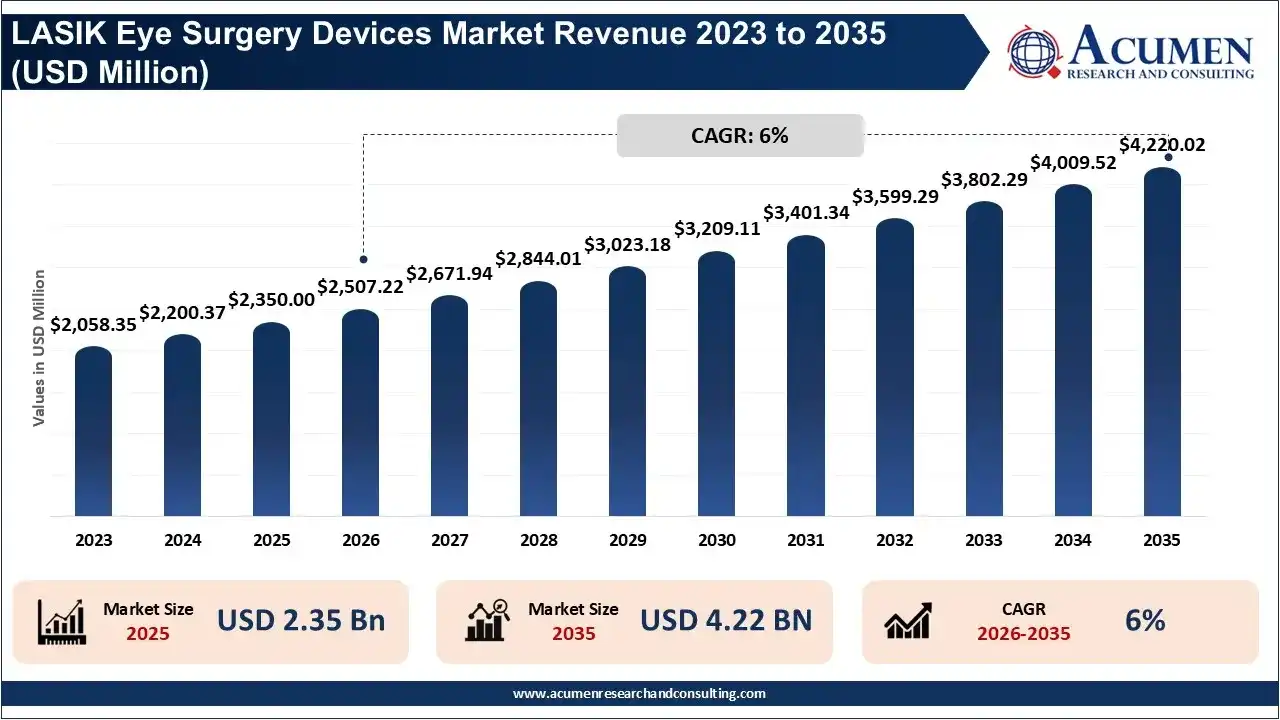
The global LASIK eye surgery devices market size was estimated at USD 2,350 million in 2025 and is projected to surge at USD 4,220.02 million by 2035, while expanding at a promising CAGR of 6% during the forecast period of 2026-2035. The LASIK eye surgery devices market is being driven by rising demand for precise, minimally invasive vision correction, increasing adoption of advanced laser technologies, and growing preference for personalized refractive procedures.
Overview & Scope
The LASIK eye surgery devices market encompasses laser systems, treatment technologies, diagnostic tools, and procedure-specific platforms used to evaluate and correct refractive vision errors through laser-assisted corneal procedures. The market is increasingly shifting from conventional refractive correction toward digitally planned and highly customized treatment workflows that combine corneal imaging, wavefront analysis, treatment planning software, and advanced laser delivery.
Femtosecond lasers have become an important part of modern LASIK workflows by enabling precise corneal flap creation without mechanical blades, while excimer laser systems remain central to controlled corneal reshaping. At the same time, wavefront-guided and topography-guided approaches are expanding the role of patient-specific measurements in treatment planning.
- For instance, advanced refractive platforms can combine detailed corneal mapping with customized ablation profiles to help ophthalmologists tailor treatment to individual optical and anatomical characteristics. These developments are encouraging LASIK centers and ophthalmic providers to upgrade equipment toward more integrated, precise, and digitally enabled platforms.
What Will Change by 2030?
- More Personalized Treatment Planning: LASIK workflows are expected to increasingly use detailed corneal mapping, wavefront measurements, and patient-specific optical data to develop customized treatment profiles and improve the precision of refractive correction.
- Greater Integration of Diagnostics and Lasers: Future LASIK platforms are likely to connect diagnostic imaging, treatment planning software, and laser delivery more closely, reducing workflow fragmentation and enabling ophthalmologists to move from assessment to treatment with greater digital integration.
- Expansion of Topography-Guided Procedures: Topography-guided LASIK is positioned for greater adoption as advanced corneal mapping enables treatment planning that accounts for individual corneal surface characteristics and supports increasingly customized approaches to refractive correction.
- Smarter Ophthalmology Workflows: Digital planning, automated image analysis, treatment analytics, and emerging AI capabilities could increasingly support ophthalmologists across patient assessment and procedure preparation, while clinical judgment remains central to treatment decisions.
Segmental Outlook
| Segment | Leading Segment | 2025 Share | Driver |
|---|---|---|---|
| By Product | Femtosecond Laser Systems | 43.0% | Growing preference for precise, bladeless corneal flap creation is supporting adoption of femtosecond laser systems across modern LASIK procedures. |
| By Treatment Technology | Wavefront-Guided LASIK | 43% | Increasing demand for customized vision correction is supporting wavefront-guided LASIK because treatment profiles can be tailored to individual optical characteristics. |
| By Procedure Type | Femtosecond/Bladeless LASIK | 69% | Rising adoption of all-laser procedures and demand for controlled, precise flap creation are strengthening the use of bladeless LASIK workflows. |
| By Vision Error | Myopia | 42% | The large and growing global prevalence of nearsightedness continues to generate substantial demand for refractive correction procedures and associated LASIK technologies. |
| By End User | Ophthalmic Clinics & LASIK Centers | 44% | Specialized refractive surgery infrastructure, dedicated ophthalmic equipment, trained personnel, and relatively high procedure volumes support adoption within ophthalmic clinics and LASIK centers. |
What Challenges Could Limit LASIK Device Adoption?
LASIK device adoption continues to face challenges related to the high upfront cost of advanced laser platforms, maintenance and servicing requirements, and the need for specialized ophthalmic expertise. Smaller clinics may face greater difficulty justifying capital-intensive equipment where procedure volumes are limited. Adoption can also be influenced by patient eligibility, clinical outcomes, regulatory requirements, and differences in healthcare spending across markets.
In emerging economies, affordability of procedures and uneven access to advanced ophthalmic infrastructure can further limit penetration of premium LASIK technologies. Newer platforms also require sufficient clinical evidence and physician familiarity before they achieve broader adoption, particularly when introducing advanced imaging, customized treatment algorithms, or AI-enabled decision-support capabilities.
Regional Outlook
North America: Mature Infrastructure Continues to Support Advanced LASIK Adoption
North America dominated the LASIK eye surgery devices market with a 44.0% share in 2025, supported by mature refractive surgery infrastructure, established ophthalmic clinics, and broad availability of advanced laser platforms. The region benefits from a developed ecosystem of ophthalmologists, specialized LASIK centers, diagnostic equipment providers, and technology manufacturers, creating favorable conditions for continued equipment adoption and replacement.
- United States: The United States leads North American adoption due to its extensive network of ophthalmology practices and refractive surgery centers, established availability of advanced laser platforms, and strong demand for customized vision correction technologies.
Asia-Pacific: Expanding Eye-Care Capacity Creates the Fastest-Growing Regional Opportunity
Asia-Pacific accounted for 23.0% of the LASIK eye surgery devices market in 2025 and is projected to register the fastest CAGR of 9.5% from 2026 to 2035. The region's growth is supported by expanding ophthalmic infrastructure, increasing availability of advanced refractive surgery technologies, and a large population affected by myopia and other correctable refractive errors.
Growing healthcare investment and expansion of private eye-care networks are also creating opportunities for modern LASIK platforms. As access to specialized ophthalmic services improves across major Asian markets, providers are increasingly incorporating advanced diagnostics, femtosecond lasers, and customized treatment technologies into refractive surgery workflows. The region's combination of patient demand, expanding clinical capacity, and technology upgrades provides a strong foundation for continued device adoption.
- China: China represents a major Asia-Pacific opportunity, supported by its large myopic population, expanding ophthalmology infrastructure, increasing availability of refractive surgery services, and growing adoption of advanced vision correction technologies.
Key Companies
- Alcon: Alcon is a major ophthalmic technology company offering refractive surgery platforms, including laser technologies and related solutions supporting customized vision correction procedures.
- Johnson & Johnson Vision: Johnson & Johnson Vision develops ophthalmic technologies and refractive surgery solutions designed to support laser vision correction and broader eye-care workflows.
- ZEISS: ZEISS provides advanced ophthalmic imaging, diagnostics, surgical visualization, and laser technologies that support refractive surgery planning and treatment.
- Bausch + Lomb: Bausch + Lomb participates in the ophthalmic devices market with technologies and products serving eye-care professionals and surgical applications.
- SCHWIND eye-tech-solutions: SCHWIND specializes in refractive laser systems and customized treatment technologies, including platforms designed for advanced corneal correction.
- NIDEK: NIDEK develops ophthalmic diagnostic and surgical equipment, including laser and imaging technologies used across refractive and broader eye-care applications.
- Ziemer Ophthalmic Systems: Ziemer develops femtosecond laser platforms and ophthalmic technologies supporting minimally invasive and customized corneal procedures.
- Topcon: Topcon provides ophthalmic diagnostic and imaging technologies that support patient assessment, clinical decision-making, and treatment planning.
- iVIS Technologies: iVIS Technologies focuses on advanced corneal diagnostics, treatment planning, and laser vision correction technologies designed around personalized refractive procedures.
Segments Covered in the Report
By Product
- Excimer Laser Systems
- Femtosecond Laser Systems
- Microkeratomes & Mechanical Flap-Creation Devices
- Other LASIK Devices
By Treatment Technology
- Wavefront-Guided LASIK
- Wavefront-Optimized LASIK
- Topography-Guided LASIK
- Conventional/Standard LASIK
- Other Advanced/Customized LASIK Technologies
By Procedure Type
- Femtosecond/Bladeless LASIK
- Microkeratome/Blade-Based LASIK
- Other LASIK Procedures
By Vision Error
- Myopia
- Hyperopia
- Astigmatism
- Presbyopia & Other Refractive Errors
By End User
- Ophthalmic Clinics & LASIK Centers
- Hospitals
- Ambulatory Surgical Centers
- Academic & Research Institutes
- Others
By Region
- North America
- Europe
- Asia-Pacific
- Latin America
- Middle East & Africa
Contact Us:
Mr. Richard Johnson
Acumen Research and Consulting
India: +91 8983225533