
AI-assisted Surgery Market Size to Reach USD 39.31 billion by 2035; Growing at a CAGR of 26.8%
Published : 14 Oct 2026
Author : Lucas Hoffmann



What is the AI-assisted Surgery Market Size?
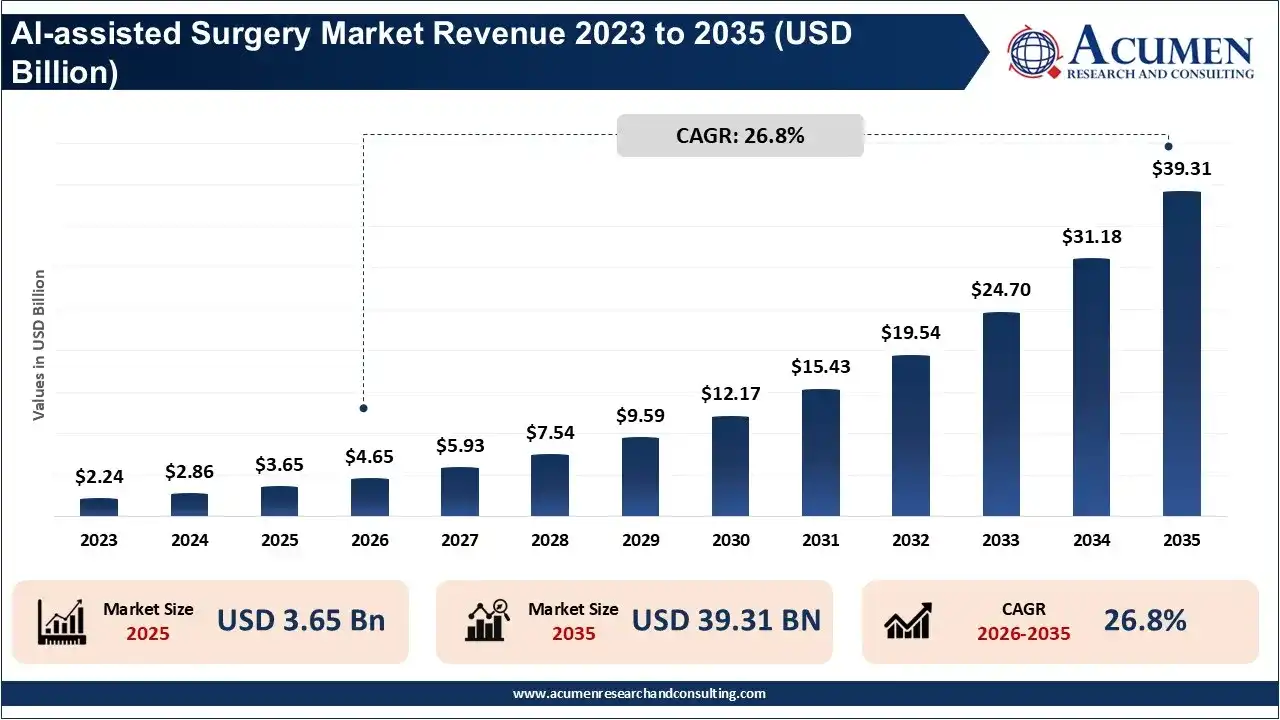
The global AI-assisted surgery market size was accounted for USD 3.65 billion in 2025 and is observed to reach around USD 39.31 billion by 2035; growing at a notable CAGR of 26.8% over the forecast period from 2026 to 2035. The AI-assisted surgery market is driven by the growing integration of artificial intelligence with robotic surgery, medical imaging, surgical navigation, and real-time clinical decision-support systems. Increasing demand for minimally invasive procedures, improved surgical precision, personalized treatment planning, and data-driven intraoperative decision-making is accelerating the adoption of AI-enabled surgical technologies across healthcare facilities.
What Is Changing in 2026?
The AI-assisted surgery market is shifting from conventional robotic assistance toward increasingly intelligent surgical systems that combine computer vision, real-time data analysis, surgical navigation, predictive analytics, and software-controlled robotic platforms. In 2026, the market is increasingly defined by the ability of AI to interpret surgical information and support surgeons during different stages of a procedure rather than simply providing mechanical assistance.
The transition is also becoming visible in regulation and commercial activity. The FDA issued draft guidance in September 2026 covering premarket submissions for robotically assisted surgical devices, while separately preparing a December 2026 workshop focused on autonomous and remotely teleoperated robotic medical devices. These developments indicate that increasingly sophisticated software-controlled and AI-enabled surgical systems are becoming an important area of regulatory attention.
AI-Assisted Surgery Market Future Outlook
Integrated AI Surgical Platforms: AI-enabled surgical platforms will increasingly integrate computer vision, predictive analytics, navigation, and real-time decision support to provide surgeons with contextual information throughout procedures.
- Growing Role of Surgical Software: Surgical software is expected to become a larger component of robotic platforms as healthcare providers seek data-driven workflow optimization, procedure analytics, and personalized surgical planning.
- Expansion of Computer Vision: Computer vision will increasingly support real-time identification of anatomy, instruments, tissue characteristics, procedural stages, and potential surgical events during minimally invasive procedures.
- Progress Toward Autonomous Surgery: Autonomous surgical capabilities are expected to progress gradually, with human surgeons continuing to oversee critical decisions while AI performs increasingly sophisticated assistance and automation tasks.
- Strategic Value of Surgical Data: Large procedural datasets will become strategically important as medical technology companies use surgical video, imaging, and outcomes data to train and improve AI models.
- Expansion Beyond Major Hospitals: AI-assisted surgery adoption will expand beyond major hospitals as modular robotic systems and software platforms become more accessible to ambulatory and specialty surgical centers.
AI-Assisted Surgery Market Segmental Outlook
| Segment | Dominant Segment | 2025 Share | Key Growth / Adoption Factor |
|---|---|---|---|
| By Component | Software | 48% | Increasing integration of AI algorithms across surgical planning, navigation, imaging, analytics, and clinical decision support. |
| By Deployment | On-Premise | 46% | Healthcare providers prefer direct control over sensitive clinical data, infrastructure, security, and system integration. |
| By Technology | Machine Learning & Deep Learning | 42% | Widespread applications in surgical imaging, prediction, pattern recognition, planning, and decision support. |
| By Application | AI-Assisted Robotic Surgery | 27% | Integration of intelligent planning, computer vision, navigation, analytics, and software-enabled assistance into robotic surgical platforms. |
| By Surgery Type | General Surgery | 23% | High procedure volumes and broad application of robotic assistance, imaging, navigation, planning, and AI-enabled decision support. |
| By Surgical Approach | Robotic-Assisted Surgery | 44% | Established deployment of robotic platforms and increasing integration of AI-based planning, computer vision, navigation, imaging, and analytics. |
| By End User | Hospitals | 64% | High surgical volumes, advanced clinical infrastructure, and greater capacity to deploy AI-enabled robotic, imaging, navigation, and decision-support technologies. |
Which AI Technologies Are Reshaping Assisted Surgery?
- Computer Vision: Enables surgical systems to interpret video feeds, identify anatomical structures, recognize instruments, track surgical steps, and provide real-time intraoperative information.
- Machine Learning: Supports predictive models for surgical planning, patient risk assessment, complication prediction, procedure optimization, and postoperative outcome analysis.
- Deep Learning: Enables advanced analysis of surgical images, medical scans, tissue characteristics, and complex clinical datasets that require pattern recognition at scale.
- Generative AI: Creates opportunities for surgical knowledge retrieval, clinical documentation, procedure planning, information summarization, and context-aware decision support.
- Real-Time AI Analytics: Processes intraoperative data continuously to identify procedural events, provide alerts, support navigation, and deliver contextual information during surgery.
- AI-Powered Surgical Navigation: Combines imaging, anatomical mapping, computer vision, and tracking technologies to help surgeons improve positioning and procedural precision.
- Autonomous AI: Enables surgical systems to perform increasingly sophisticated predefined tasks with reduced direct intervention, while current development remains focused on controlled and supervised applications.
AI-Assisted Surgery Market: Where Is Adoption Increasing Fastest?
North America dominated the AI-assisted surgery market with a 45.0% share in 2025, supported by advanced healthcare infrastructure, established robotic-surgery programs, strong medical-device development capabilities, and high investment in surgical technology. The region also benefits from the presence of major surgical robotics and medical-device companies developing AI-enabled platforms, surgical navigation technologies, and connected operating-room systems.
The region's leadership is increasingly supported by regulatory and technological activity surrounding next-generation robotic surgery. The FDA is actively evaluating the regulatory considerations associated with robotically assisted surgical devices and is specifically preparing to examine autonomous and remote teleoperation capabilities. This creates an important development environment for AI-assisted surgery as manufacturers progress from surgeon-controlled robotic systems toward increasingly software-driven surgical capabilities.
Asia-Pacific accounted for 21.0% share in 2025 and is projected to register the fastest CAGR of 30.3% from 2026 to 2035, driven by expanding healthcare infrastructure, increasing adoption of robotic and minimally invasive procedures, rising investment in medical technology, and growing demand for advanced surgical capabilities. China, Japan, South Korea, India, and other regional markets are developing increasingly sophisticated healthcare technology ecosystems, creating opportunities for AI-enabled surgical platforms.
The region is also becoming an important destination for investment and commercialization of surgical robotics. Increasing healthcare digitization, expansion of specialized hospitals, and demand for improved surgical precision are supporting the deployment of robotic and AI-assisted technologies. The relatively lower penetration of advanced robotic surgery in many Asia-Pacific markets also creates significant room for future adoption as costs decline and technology providers expand regional distribution and training networks.
AI-Assisted Surgery Investment Landscape
- September 2026: Medtronic announced an approximately $700 million investment in a strategic partnership with Cornerstone Robotics, including rights to distribute its Sentire surgical system in selected markets outside the U.S. The partnership strengthens Medtronic's robotic-assisted surgery portfolio and connected surgical ecosystem.
- September 2026: Montreal-based Scopia Surgical closed an oversubscribed C$2.65 million pre-seed financing round to advance its real-time AI-powered surgical navigation technology for minimally invasive and robotic surgery.
Segments Covered in the Report
By Component
- Software
- Surgical Planning Software
- Intraoperative AI Software
- Surgical Navigation & Guidance Software
- AI Clinical Decision-Support Software
- Surgical Analytics Software
- Other Software
- Hardware
- AI-Enabled Surgical Robotic Systems
- AI-Enabled Navigation & Imaging Systems
- Sensors & Cameras
- Computing & Processing Hardware
- Other Hardware
- Services
- Implementation & Integration Services
- Training & Consulting Services
- Support Services
- Maintenance & Upgrade Services
- Managed & AI Optimization Services
- Other Services
By Deployment
- On-Premise
- Cloud-Based
- Hybrid
By Technology
- Machine Learning & Deep Learning
- Computer Vision
- Natural Language Processing
- Generative AI
- Other AI Technologies
By Application
- Preoperative Planning & Risk Assessment
- Intraoperative Navigation & Guidance
- AI-Assisted Robotic Surgery
- Surgical Decision Support
- Surgical Imaging & Visualization
- Workflow & Procedure Optimization
- Postoperative Analytics & Outcome Prediction
- Other Applications
By Surgery Type
- General Surgery
- Orthopedic Surgery
- Neurosurgery
- Cardiovascular Surgery
- Urological Surgery
- Gynecological Surgery
- Gastrointestinal Surgery
- Thoracic Surgery
- Other Surgeries
By Surgical Approach
- Robotic-Assisted Surgery
- Laparoscopic & Endoscopic Surgery
- Open Surgery
- Other Surgical Approaches
By End User
- Hospitals
- Ambulatory Surgical Centers
- Specialty Clinics & Surgical Centers
- Academic & Research Medical Centers
- Other End Users
By Region
- North America
- Europe
- Asia-Pacific
- Latin America
- Middle East & Africa
Contact Us:
Mr. Richard Johnson
Acumen Research and Consulting
India: +91 8983225533