
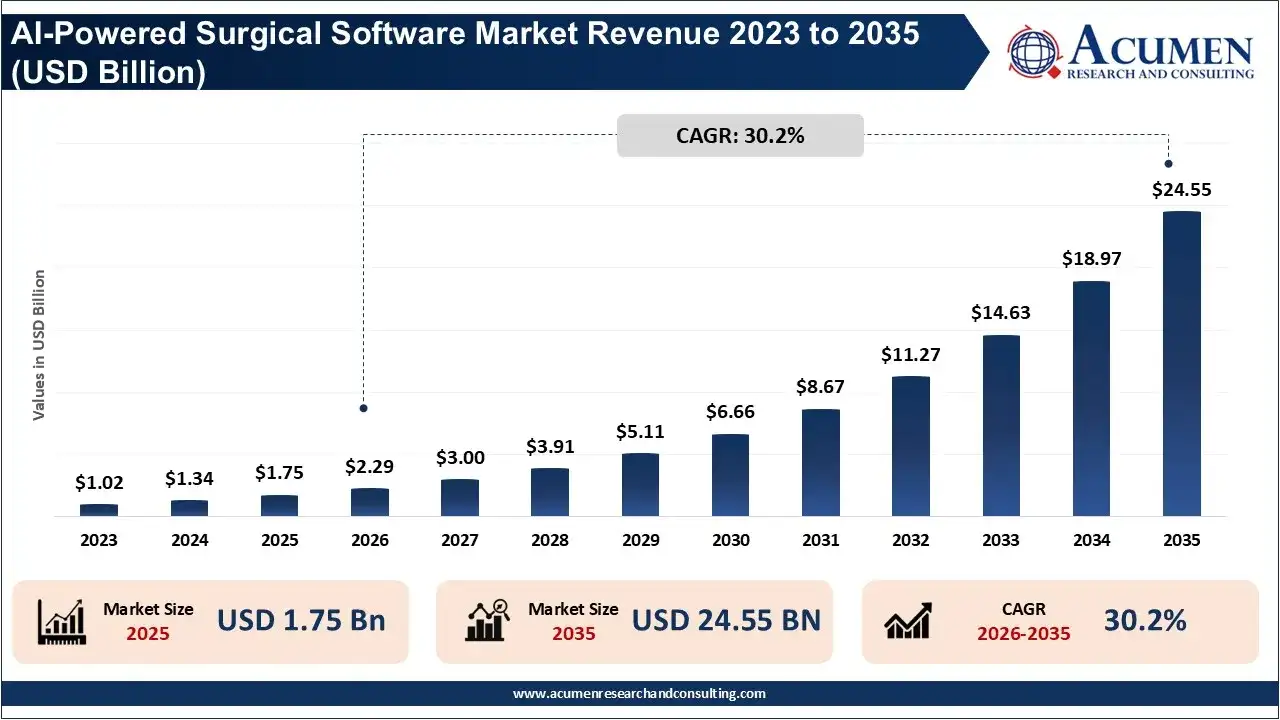
AI-Powered Surgical Software Market Size to Surpass USD 24.55 billion by 2035, Reflecting a CAGR of 30.2%
Published : 14 Oct 2026
Author : Lucas Hoffmann



What is the AI-Powered Surgical Software Market Size?
The AI-powered surgical software market size was accounted for USD 1.75 billion in 2025 and is expected to surpass USD 24.55 billion by 2035, expanding at a CAGR of 30.2% over the forecast period from 2026 to 2035. The AI-powered surgical software market is being driven by growing demand for data-driven surgical planning, real-time image analysis, robotic assistance, personalized treatment pathways, and software that can connect preoperative, intraoperative, and postoperative workflows.
AI-Powered Surgical Software Market Overview
AI-powered surgical software is moving beyond its traditional role in preoperative planning and image analysis toward becoming an active layer of intelligence across the surgical workflow. Modern platforms can combine medical imaging, patient-specific anatomy, surgical plans, computer vision, clinical data, and intraoperative information to support surgeons before and during procedures. This shift is also encouraging healthcare technology companies to connect planning software with navigation systems, robotic platforms, imaging technologies, and postoperative analytics.
Medtronic, for example, launched its GAiTEWAY software platform in June 2026 to connect AI-driven surgical planning, clinical insights, and postoperative analytics across its AiBLE ecosystem. In July 2026, the company also introduced Touch Surgery Aide, an AI-native operating-room computing platform designed to provide real-time AI support during procedures.
Where Is AI-Powered Surgical Software Creating Value?
- Surgical simulation: Simulation platforms allow clinicians to evaluate different procedural strategies before surgery. AI can help model anatomical conditions, visualize potential approaches, and support procedure-specific training, creating opportunities to test decisions in a controlled digital environment before applying them to actual patients.
- Intraoperative decision support: Real-time software is beginning to analyze surgical video, instrument movement, imaging, and procedural context while an operation is underway. This creates a pathway toward AI-assisted alerts, visualization, guidance, and decision support without removing the surgeon from the decision-making process.
- Robotic surgery: AI-powered software is becoming increasingly important within robotic-assisted procedures, where computer vision, navigation, image analysis, and intelligent planning can improve the information available to surgeons. Intuitive Surgical, for example, has outlined an AI framework based on data from more than 20 million da Vinci procedures.
Segmental Outlook
| Segment | Leading Segment | 2025 Share | Key Driver |
|---|---|---|---|
| By Software Type | Surgical Planning & Simulation Software | 24.0% | Growing demand for AI-enabled surgical planning, simulation, patient-specific anatomical assessment, and preoperative decision support. |
| By Deployment | On-premise | 43% | Healthcare providers' focus on data security, infrastructure control, clinical-system integration, and management of sensitive surgical and patient data. |
| By Technology | Machine Learning & Deep Learning | 43% | Extensive use in medical image analysis, surgical planning, clinical decision support, pattern recognition, and outcome prediction. |
| By Application | AI-Assisted Robotic Surgery | 25.0% | Increasing integration of AI with robotic platforms for surgical planning, visualization, computer vision, navigation, and intraoperative assistance. |
| By Surgery Type | General Surgery | 22% | High procedure volumes and expanding adoption of AI-powered planning, navigation, visualization, and robotic surgical technologies. |
| By Surgical Approach | Robotic-Assisted Surgery | 43% | Rising adoption of robotic platforms and integration of AI-based navigation, computer vision, surgical planning, and intraoperative support. |
| By End User | Hospitals | 62% | High surgical volumes, advanced clinical infrastructure, multidisciplinary teams, and greater investment capacity for AI-enabled surgical technologies. |
What Will Change in AI-powered Surgical Software Market by 2030?
- Planning will become more predictive: Surgical planning software is likely to move from simply displaying anatomy toward predicting procedural requirements, identifying potential risks, and comparing alternative approaches using patient-specific clinical and imaging data.
- AI will move into the operating room: The biggest shift will be the expansion of AI from preoperative applications into real-time surgical support. Medtronic's Touch Surgery Aide already points toward this model by combining computer vision, multimodal AI, and accelerated computing for intraoperative applications.
- Surgical software will become more connected: Standalone applications are likely to give way to connected ecosystems linking planning, imaging, navigation, robotics, intraoperative data, and postoperative analytics. This will allow information generated at one stage of care to inform decisions at another.
- Surgical intelligence will become a distinct technology layer: The market is moving toward software that does more than automate individual tasks. Johnson & Johnson's 2026 work on its Polyphonic ecosystem reflects this direction, with the company describing surgical intelligence as an interconnected layer built around surgical data, video, devices, and AI insights.
- Human oversight will remain central: Adoption will depend not only on algorithmic performance but also on transparency, validation, regulatory clearance, cybersecurity, workflow compatibility, and surgeon control. AI is more likely to gain acceptance where it augments clinical judgment rather than attempting to replace it.
Regional Outlook
North America dominated the AI-powered surgical software market with a 45.0% share in 2025, reflecting its established healthcare infrastructure, high adoption of advanced surgical technologies, strong presence of medical-device companies, and substantial investment in healthcare AI. The region also benefits from a mature ecosystem connecting surgical robotics, medical imaging, cloud infrastructure, clinical software, and data analytics. Regulatory activity in the United States is also creating a growing base of cleared AI-enabled surgical technologies. For example, the FDA database records the Precision AI Surgical Planning System as having received a 510(k) decision in January 2026.
- United States: The U.S. remains the region's primary technology and investment hub, with major surgical technology companies developing AI-enabled planning, robotic surgery, computer vision, and real-time decision-support applications.
Asia-Pacific accounted for 22.0% of the market in 2025 and is projected to be the fastest-growing regional market, expanding at a 34.7% CAGR from 2026 to 2035. Growth is being shaped by expanding hospital infrastructure, rising surgical volumes, increasing investment in medical technology, and the gradual adoption of robotic and AI-assisted procedures. Healthcare providers across major Asian economies are also looking for technologies that can improve surgical consistency and extend specialist capabilities.
- China: Expanding investment in healthcare AI, medical robotics, imaging technologies, and domestic medical-device development is creating a strong foundation for AI-enabled surgical software adoption.
What Are Companies Investing In?
- In July 2026, Medtronic introduced Touch Surgery Aide, an AI-native computing platform built on NVIDIA infrastructure to support real-time AI during procedures. Its first application, Instrument Exit Point, uses computer vision to alert surgeons when selected robotic instruments move outside the visible field of view.
- In May 2026, Johnson & Johnson announced a collaboration with the Department of Health Abu Dhabi, AWS, and NVIDIA to develop an open surgical intelligence network around its Polyphonic digital ecosystem. The initiative is designed to connect operating rooms and accelerate AI development across the surgical journey.
Key Companies
The competitive landscape includes medical-device manufacturers, robotic surgery companies, surgical software providers, imaging specialists, and technology companies developing AI infrastructure for healthcare. Key participants include Medtronic, Intuitive Surgical, Johnson & Johnson, Stryker, Siemens Healthineers, GE HealthCare, Philips, NVIDIA, Microsoft, IBM, Caresyntax, Activ Surgical, Proximie, Zimmer Biomet, and Brainlab. Their strategies increasingly center on combining surgical planning, medical imaging, computer vision, navigation, robotics, data analytics, and AI-enabled decision support into connected clinical ecosystems rather than offering isolated software applications.
Segments Covered
By Software Type
- Surgical Planning & Simulation Software
- Intraoperative AI & Computer Vision Software
- Surgical Navigation & Guidance Software
- AI Clinical Decision-Support Software
- Surgical Analytics & Outcome Intelligence Software
- Others
By Deployment
- On-Premise
- Cloud-Based
- Hybrid
By Technology
- Machine Learning & Deep Learning
- Computer Vision
- Natural Language Processing
- Generative AI
- Other AI Technologies
By Application
- Preoperative Planning & Assessment
- Intraoperative Guidance & Navigation
- AI-Assisted Robotic Surgery
- Surgical Imaging & Visualization
- Clinical Decision Support
- Surgical Workflow Optimization
- Postoperative Analytics & Outcome Prediction
- Others
By Surgery Type
- General Surgery
- Orthopedic Surgery
- Neurosurgery
- Urological Surgery
- Gynecological Surgery
- Cardiovascular Surgery
- Gastrointestinal Surgery
- Thoracic Surgery
- Other Surgical Specialties
By Surgical Approach
- Robotic-Assisted Surgery
- Laparoscopic & Endoscopic Surgery
- Open Surgery
- Other Surgical Approaches
By End User
- Hospitals
- Ambulatory Surgical Centers
- Specialty Surgical Centers & Clinics
- Academic & Research Medical Centers
- Others
By Region
- North America
- Europe
- Asia-Pacific
- Latin America
- Middle East & Africa
Contact Us:
Mr. Richard Johnson
Acumen Research and Consulting
India: +91 8983225533