
Eubiotics Market Size to Reach USD 12.53 Billion by 2035, Growing at a CAGR of 6.9%
Published : 03 Nov 2026
Author : Simone Lamb



What is the Eubiotics Market Size?
The global eubiotics market size was valued at USD 6.41 billion in 2025 and is expected to reach around USD 12.53 billion by 2035, expanding at a CAGR of 6.9% during the forecast period of 2026-2035. Growth is driven by rising global meat, milk, and aquaculture output, the shift away from antibiotic growth promoters, and increasing demand for feed additives that improve gut health, nutrient absorption, and feed conversion efficiency in poultry, swine, ruminants, and aquaculture.
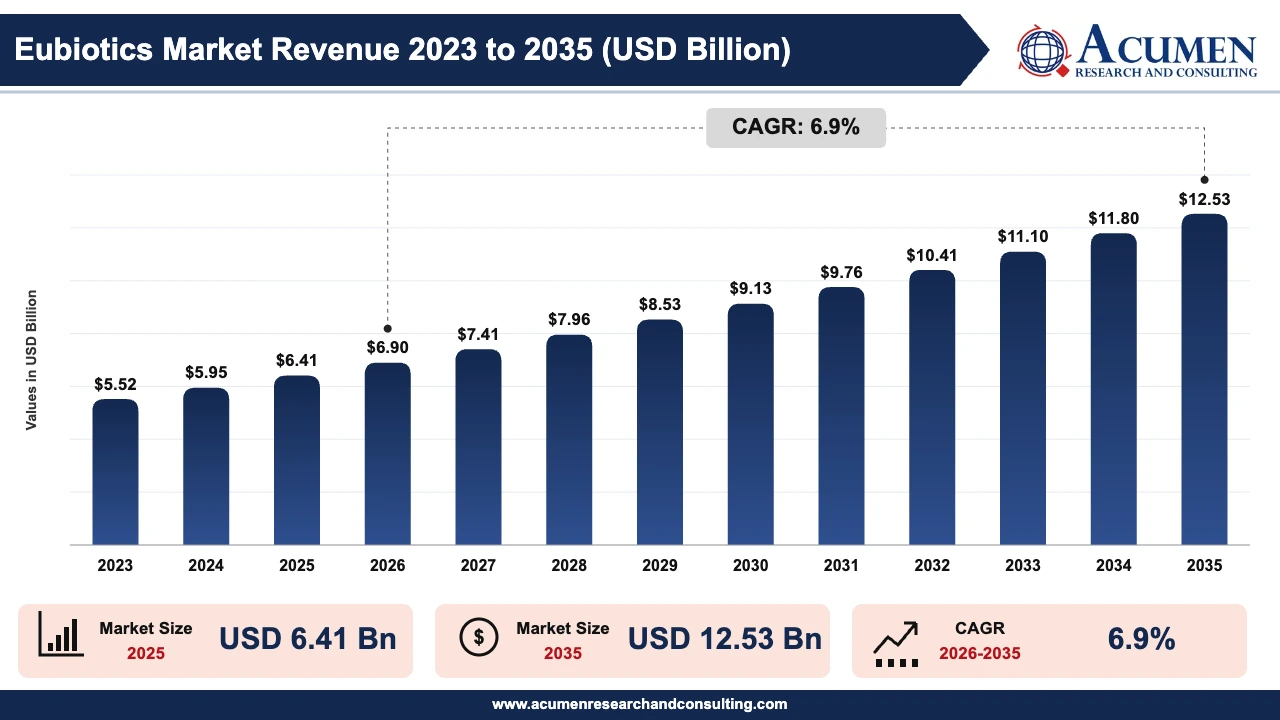
Eubiotics Market Key Highlights
- Europe dominated the eubiotics market with a 39.0% revenue share in 2025.
- Asia-Pacific is the fastest-growing region, with its share rising from 32.0% in 2025 to 37.0% by 2035 at an 8.6% CAGR.
- Probiotics led the product type segment with a 40.0% share in 2025, while phytogenics are growing fastest at a 7.7% CAGR.
- Poultry was the largest livestock segment with a 37.0% share in 2025; aquaculture is the fastest-growing at an 11.3% CAGR.
- Nutrition & gut health accounted for 43.0% of demand by function, and dry eubiotics held 78.0% of the market by dosage form in 2025.
What is the Eubiotics Market and What Drives It?
The eubiotics market covers animal feed additives, feed supplements, and feeding solutions that help maintain a healthy balance of intestinal microflora, improve digestive health, raise nutrient absorption efficiency, and increase overall animal productivity.
This category typically includes probiotics, prebiotics, organic acids, essential oils and phytogenics, postbiotics, and similar microbial or botanical feed ingredients used in livestock, poultry, and aquaculture diets. These products form a fast-growing part of the wider animal feed additives market.
The use of eubiotics is closely tied to the need to improve animal efficiency and welfare while increasing food production with less reliance on antibiotic growth promoters. Because feed represents the single largest cost in commercial livestock production, even a small improvement in feed conversion ratio (FCR) can deliver significant economic returns for producers, which is a key reason adoption continues to accelerate.
Global Livestock Production Trends Supporting Eubiotics Adoption
- Global meat production continues to expand: Global meat production reached 374 million tonnes in 2024, an increase of approximately 7 million tonnes from 2023. Higher production volumes increase demand for feed additives that support animal health, feed conversion, and production efficiency.
- Poultry is becoming a leading source of animal protein: OECD-FAO projects poultry to account for more than half of the additional meat produced over the coming decade, supported by shorter production cycles and favorable feed conversion efficiency. This creates a significant application base for eubiotics in poultry nutrition.
- Global milk production reached 985 million tonnes in 2024: Dairy represents another major application area for eubiotics, because improving rumen and intestinal health supports feed utilization, animal productivity, and herd performance.
- Livestock production is becoming more intensive: OECD-FAO projects global animal inventories to rise by around 10%, while protein output is expected to increase by 14% over its outlook period. This gap indicates greater productivity per animal, raising the importance of feed efficiency, animal health management, and nutritional interventions.
- Global feed demand is expected to increase: The OECD-FAO Outlook projects a 13% increase in global protein-equivalent feed demand, reflecting expanding herds and greater intensification of livestock and aquaculture production. Higher feed use creates additional opportunities for additives that improve digestion and nutrient availability.
- Asia will account for most future meat production growth: OECD-FAO estimates that 55% of global meat production growth through 2034 will occur in Asia, with poultry accounting for a major portion of the increase. This concentration of growth supports demand for cost-effective feed additives that improve livestock productivity.
Can Antibiotic Reduction Create a New Growth Opportunity for Eubiotics?
Demand for alternatives to antibiotic growth promoters is one of the brightest opportunities for eubiotics in commercial animal nutrition. As livestock producers focus on improving gut health, feed utilization, and animal performance, probiotics, prebiotics, organic acids, and phytogenic solutions offer a practical alternative. The European Union banned the use of antibiotics as growth promoters in animal feed in 2006, creating a mature market for these alternatives across European countries.
This regulatory framework helps eubiotic suppliers develop targeted formulations for poultry, pigs, cattle, and the wider livestock sector. Growing emphasis on sustainable food production in emerging economies that are rapidly intensifying their animal farming sectors will further support market growth, alongside rising adoption of feed solutions focused on productivity and animal health.
Market Dynamics: Driver, Restraint, and Opportunity
Driver: Rising Adoption of Antibiotic-Reduction and Gut-Health Solutions
The growing emphasis on antibiotic-reduction strategies is steadily increasing the inclusion of probiotics, prebiotics, organic acids, phytogenics, and postbiotics in feed programs. These additives help balance gut microflora, aid nutrient utilization, support immunity, and boost feed conversion efficiency. The shift is especially visible in intensive poultry and swine production, where small gains in FCR and animal performance can produce substantial economic returns, driving demand for multi-functional eubiotic blends.
Restraint: Inconsistent Product Performance and Formulation Complexity
Eubiotic efficacy can vary with animal species, age, genetics, feed composition, dosage, farm conditions, and environment. Manufacturers therefore need extensive field testing to prove repeatable benefits, which increases R&D costs and makes it more complex for manufacturers to scale products across species and geographies.
Opportunity: Aquaculture and Microbiome-Based Precision Nutrition
Aquaculture is one of the most promising opportunities, with its share of the eubiotics market expected to rise from 9% in 2025 to 13% by 2035. Intensive fish and shrimp farming requires solutions that improve feed utilization, digestion, disease resistance, and microbial balance while reducing antibiotic use, a trend closely linked to the expanding aquafeed market. At the same time, the industry is moving toward "precision eubiotics" that combine several active ingredients in a single solution to support gut health, immunity, and productivity together.
Eubiotics Market Segmental Outlook
| Segmentation | Dominant Segment | Market Share (2025) | Fastest-Growing / Key Trend |
|---|---|---|---|
| By Product Type | Probiotics | 40% | Phytogenics growing at a 7.7% CAGR as producers adopt plant-derived additives. |
| By Livestock | Poultry | 37% | Aquaculture growing at an 11.3% CAGR, rising to a 13% share by 2035. |
| By Function | Nutrition & Gut Health | 43% | Production & performance is second with a 30% share, driven by FCR and weight-gain outcomes. |
| By Dosage Form | Dry | 78% | Liquid share rising from 22% to 25% by 2035 with drinking-water and on-farm dosing. |
Eubiotics Market Regional Outlook
Europe Eubiotics Market Trends
Europe accounted for a 39.0% revenue share of the eubiotics market in 2025, supported by well-established compound feed manufacturing. The region's mature animal nutrition market, combined with strong producer demand for alternatives to antibiotic growth promoters, has been the main growth engine.
Because the European Union has prohibited antibiotic growth promoters since 2006, it has built an established market where probiotics, prebiotics, organic acids, and phytogenics compete to improve gut health and feed efficiency. A sophisticated feed industry and intensive livestock systems make Germany, France, Spain, Italy, the Netherlands, and the UK key countries, as each maintains robust dairy, cattle, poultry, and swine industries.
Asia-Pacific Eubiotics Market Trends
Asia-Pacific is expected to be the fastest-growing regional market, increasing its share from 32.0% in 2025 to 37.0% by 2035 at a CAGR of 8.6%. Growth is supported by large livestock and poultry populations, the development of a commercialized feed sector, rising consumption of animal protein, and technological advancements in animal husbandry.
Major demand comes from poultry, swine, dairy, aquaculture, and other livestock industries across China, Japan, India, South Korea, and Australia. China is the largest demand center in the region, accounting for around 43.25% of the regional market in 2025. Asia-Pacific holds high growth potential because it combines a large livestock base with growing investments in organized animal husbandry and feed manufacturing.
Top 5 Countries Supporting the Eubiotics Market
| Country | Key Factors Supporting Eubiotics Adoption |
|---|---|
| China | China's large-scale poultry, swine, aquaculture, and feed industries make it one of the most important eubiotics markets in Asia-Pacific. Efforts to improve livestock productivity and reduce unnecessary antimicrobial use are supporting demand for functional feed additives. |
| India | India's expanding dairy and poultry sectors, increasing commercial feed production, and growing focus on livestock productivity are creating opportunities for probiotics, organic acids, phytogenics, and other eubiotic solutions. |
| Germany | Germany benefits from an advanced compound-feed industry, intensive livestock production, stringent animal-health standards, and a strong emphasis on reducing antibiotic use in animal production. |
| United States | The U.S. has highly industrialized poultry, swine, dairy, and beef production systems, where feed efficiency and animal performance directly influence production economics. Its established feed-additive industry also supports specialized eubiotic formulations. |
| France | France has a large agricultural and livestock base, established feed manufacturing capabilities, and increasing emphasis on sustainable animal production and antibiotic reduction, supporting continued adoption of eubiotic solutions. |
Emerging Trends in the Eubiotics Market
- Rise of postbiotics: Heat-stable postbiotic ingredients are gaining attention because they withstand feed pelleting and storage better than live cultures, while still supporting gut integrity and immunity.
- Synergistic multi-ingredient blends: Suppliers are combining probiotics, organic acids, and phytogenics in single products designed to deliver more consistent results across different farm conditions.
- Data-backed performance claims: Producers increasingly expect proven return on investment, encouraging trials and digital tools that link eubiotic use to FCR, mortality, and growth outcomes, alongside wider adoption of livestock monitoring technologies.
- Sustainability and emissions goals: Better nutrient utilization can reduce nitrogen and phosphorus excretion, helping producers meet environmental targets and supporting the broader animal health agenda.
- Growing companion animal use: Gut-health ingredients are expanding into premium pet food and supplements, where companion animals are expected to increase their share from 4% to 5% of the eubiotics market by 2035.
Globally Prominent Companies in the Eubiotics Market
Globally recognized companies participating in the eubiotics and animal nutrition space include DSM-Firmenich, BASF SE, Cargill Incorporated, ADM, Evonik Industries AG, Chr. Hansen Holding A/S, Novus International, Inc., Kemin Industries, Inc., Alltech, Inc., and Lallemand Inc. These companies hold strong positions across feed additives, probiotics, prebiotics, organic acids, phytogenic ingredients, microbial solutions, and specialized animal nutrition products.
Eubiotics Market Future Outlook
Between 2026 and 2035, the eubiotics market is expected to nearly double in value as feed producers and livestock integrators move from single-ingredient additives to complete gut-health programs. Rising demand for animal protein in Asia, stricter antibiotic stewardship worldwide, and the rapid growth of aquaculture will continue to widen the application base. Companies that can demonstrate consistent, species-specific performance and offer stable, easy-to-dose formulations are best placed to capture this growth.
Frequently Asked Questions
How big is the eubiotics market?
The global eubiotics market was valued at USD 6.41 billion in 2025 and is projected to reach USD 12.53 billion by 2035.
What is the growth rate of the eubiotics market?
The eubiotics market is expected to grow at a CAGR of 6.9% from 2026 to 2035.
Which region leads the eubiotics market?
Europe led with a 39.0% share in 2025, while Asia-Pacific is the fastest-growing region at an 8.6% CAGR.
Which product type dominates the eubiotics market?
Probiotics dominated with a 40.0% share in 2025, while phytogenics are the fastest-growing product type at a 7.7% CAGR.
Segments Covered in the Eubiotics Market
By Product Type
- Probiotics
- Prebiotics
- Organic Acids
- Phytogenics
- Postbiotics
- Other Eubiotics
By Livestock
- Poultry
- Swine
- Ruminants
- Aquaculture
- Companion Animals
- Other Animals
By Function
- Nutrition & Gut Health
- Immunity
- Production & Performance
- Environmental & Other
By Dosage Form
- Dry
- Liquid
By Region
- North America
- Europe
- Asia-Pacific
- Latin America
- Middle East & Africa
Contact Us:
Mr. Richard Johnson
Acumen Research and Consulting
India: +91 8983225533