
Prescription Drugs Market Size to Surpass USD 2,633.0 Billion by 2035 | CAGR 6.95%
Published : 11 Nov 2026
Author : Simone Lamb



What is the Prescription Drugs Market Size?
The global prescription drugs market size was valued at USD 1,342.6 billion in 2025 and is projected to reach around USD 2,633.0 billion by 2035, rising from USD 1,438.2 billion in 2026 and expanding at a CAGR of 6.95% from 2026 to 2035. The prescription medicines market is entering a decade of steady, innovation-led growth. A rising chronic disease burden, a fast-ageing population, and a strong pipeline of new medicines, led by GLP-1 therapies for diabetes and obesity, are lifting both prescription volumes and spending. At the same time, government price negotiation and a wave of patent expiries are reshaping how revenue is shared between branded medicines, generics, and biosimilars.
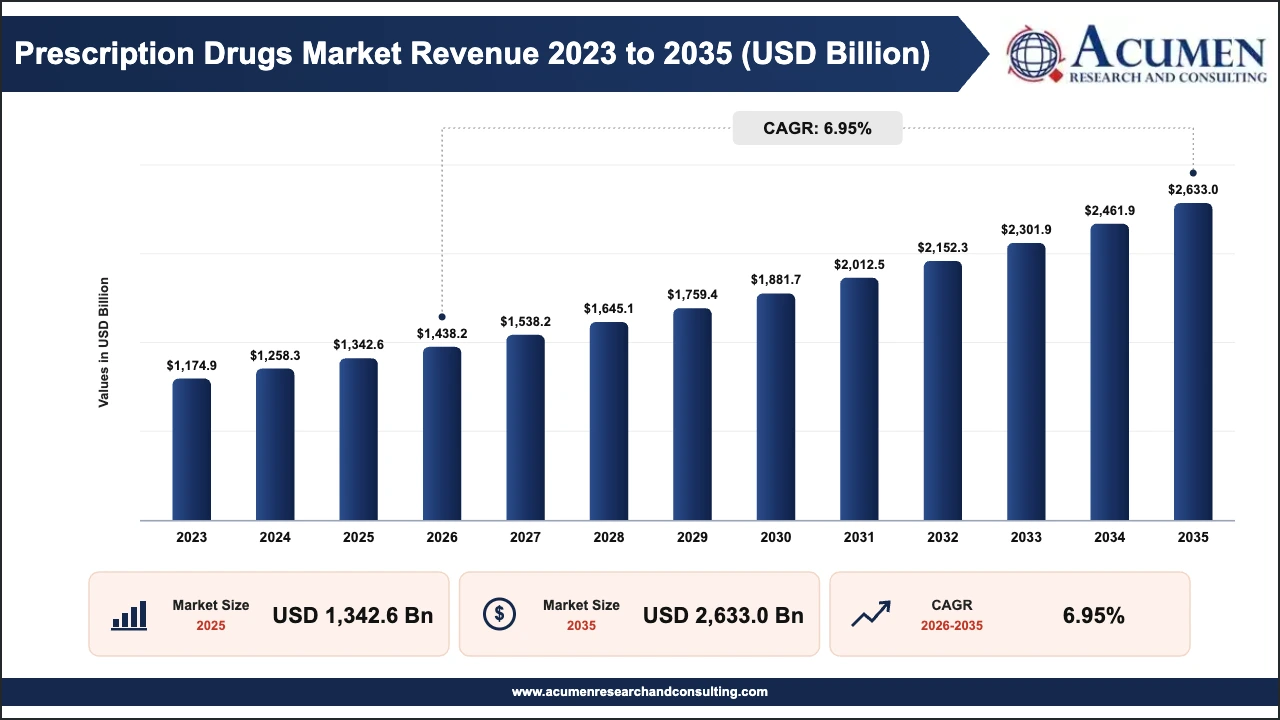
Prescription Drugs Market Overview: The Backbone of Modern Healthcare
Prescription drugs are medicines that can be dispensed only against a valid prescription from a licensed healthcare professional, because their safe and effective use requires medical supervision. The market covers branded (patented) innovator medicines, generic drugs, biologics and biosimilars, and orphan drugs for rare diseases. These medicines are used across therapy areas such as oncology, diabetes, immunology, infectious diseases, and cardiovascular disorders, and reach patients through hospital pharmacies, retail pharmacies and drug stores, and a fast-growing online channel.
Demand is rooted in long-term disease management. Cancer alone accounted for approximately 20 million new cases and 9.7 million deaths in 2022, according to the WHO's International Agency for Research on Cancer, while diabetes affects close to 589 million adults worldwide, according to the International Diabetes Federation's 2025 Diabetes Atlas. The WHO also projects that one in six people globally will be aged 60 or over by 2030. Older patients usually live with several chronic conditions and take more medicines per person, which steadily increases prescription volumes in every major region.
Innovation is the second growth engine. New medicines for obesity and diabetes, antibody drug conjugates, bispecific antibodies, and cell and gene therapies are adding high-value revenue streams and opening treatment options for conditions that were previously hard to treat.
What Is Driving Prescription Drug Demand?
- Rising chronic disease burden: Cancer, diabetes, obesity, and cardiovascular disease require long-term treatment, sustaining demand for prescription medicines year after year.
- A fast-ageing population: Older adults use more medicines per person and often take several treatments at once, increasing spending in mature and emerging markets alike.
- The GLP-1 boom: Incretin-based medicines for type 2 diabetes and obesity have become the single largest growth driver in the industry, and new oral formulations are widening access beyond injectables.
- A strong innovation pipeline: Oncology, immunology, and rare disease launches continue to add premium-priced products, supported by faster regulatory pathways.
- Wider access in emerging markets: Expanding health insurance coverage and rising healthcare budgets across Asia-Pacific, Latin America, and the Middle East are bringing large new patient populations into treatment.
What Challenges Could Slow Prescription Drug Spending?
The prescription drugs market also faces strong headwinds. In the United States, the first Medicare-negotiated prices for 10 high-spend medicines took effect on January 1, 2026, under the Inflation Reduction Act, and a second group of 15 drugs, including semaglutide, is scheduled for negotiated prices from 2027. Several blockbuster brands also face loss of exclusivity before 2030, shifting revenue to lower-priced generic drugs and biosimilars. The high cost of specialty medicines limits access in lower-income countries, while concentrated supply of active pharmaceutical ingredients, tariff uncertainty, rising R&D costs, and counterfeit medicines sold through unregulated online channels add further pressure. These factors are expected to moderate price growth for mature brands, but they also free up healthcare budgets for new medicines and widen access to affordable treatment.
Key Highlights of the Prescription Drugs Market Report
- North America held a 45.0% share in 2025, generating USD 604.2 billion in revenue.
- Asia-Pacific is the fastest-growing region, with a projected CAGR of 8.3% from 2026 to 2035, and is expected to reach USD 658.2 billion by 2035.
- Other prescription drugs (branded and patented medicines) accounted for 64.0% of revenue in 2025, valued at USD 859.3 billion.
- Orphan drugs are the fastest-growing product type, with a CAGR of 10.9% from 2026 to 2035.
- Oncology was the largest therapy area, with a 21.0% share valued at USD 281.9 billion in 2025.
- Anti-diabetics, including GLP-1 based diabetes and obesity medicines, are the fastest-growing therapy, with a CAGR of 10.2%.
- Online pharmacies are expected to grow at a CAGR of 10.8%, raising their share from 14.0% in 2025 to 20.0% by 2035.
Prescription Drugs Market Segmental Outlook: Where Is Demand Concentrated?
| Segmentation | Leading segment | Market share (2025) | Growth opportunity |
|---|---|---|---|
| Product Type | Other Prescription Drugs (Branded and Patented) | 64.0% | Orphan drugs are the fastest-growing, at a CAGR of 10.9%, as rare disease therapies gain approval |
| Therapy | Oncology | 21.0% | Anti-diabetics are the fastest-growing, rising to a 19.0% share by 2035 on GLP-1 demand |
| Distribution Channel | Retail Pharmacies & Drug Stores | 48.0% | Online pharmacies are the fastest-growing, at a CAGR of 10.8% |
| Region | North America | 45.0% | Asia-Pacific is the fastest-growing region, at a CAGR of 8.3% |
By product type, branded and patented medicines dominate spending because of high-value biologics and innovator drugs in oncology, immunology, and metabolic disease. Generics accounted for 27.0% of the market in 2025, valued at USD 362.5 billion, and make up the large majority of prescriptions dispensed by volume. Orphan drugs held 9.0% of revenue in 2025 and are expected to reach a 13% share by 2035, supported by regulatory incentives and advances in gene and cell therapy.
By therapy, oncology leads as immune checkpoint inhibitors, targeted therapies, and antibody drug conjugates move into earlier lines of treatment and cancer immunotherapy use grows. Anti-diabetics accounted for 14.0% of revenue in 2025, valued at USD 188.0 billion, and are expected to gain share fastest as anti-obesity drugs and oral GLP-1 medicines reach more patients. Immunosuppressants held 9.0%, while vaccines (5.0%), anticoagulants (4.0%), and sensory organ drugs (3.0%) made up the rest of the named therapy areas.
By distribution channel, retail pharmacies and drug stores dispense the bulk of chronic-care prescriptions, while hospital pharmacies, with a 38.0% share in 2025, handle high-value specialty, oncology, and infused biologic therapies. Online pharmacies are gaining ground through e-prescriptions, home delivery, and manufacturer direct-to-patient programs, a shift that is also lifting the e-pharmacy sector.
Where the Next Wave of Prescription Drug Opportunities Is Emerging
- Oral GLP-1 medicines: The U.S. FDA approved Novo Nordisk's Wegovy pill (oral semaglutide) in December 2025 and Eli Lilly's once-daily Foundayo (orforglipron) in April 2026, after a review of about 50 days under the Commissioner's National Priority Voucher program. Pills are expected to widen access to obesity and diabetes treatment.
- Orphan and rare disease therapies: Premium pricing, regulatory incentives, and gene and cell therapy advances make rare diseases the fastest-growing product segment.
- Biosimilars: Upcoming patent expiries for major biologics create opportunities for biosimilar developers and for payers looking to reduce treatment costs.
- Patient-friendly formulations: Drugmakers are converting intravenous biologics to subcutaneous versions, such as Merck's Keytruda Qlex, approved by the FDA in September 2025, to shorten treatment time and ease the load on infusion centers.
- Digital prescribing: E-prescriptions, telehealth consultations, and direct-to-patient programs are moving a growing share of prescriptions online.
Investment Wave: Reshoring Pharmaceutical Manufacturing
Drugmakers are committing record sums to manufacturing and research, particularly in the United States, as they respond to tariff risks and supply chain concerns. Eli Lilly announced plans in February 2025 to build four new U.S. manufacturing sites, taking its U.S. manufacturing commitments since 2020 to more than USD 50 billion. Johnson & Johnson said in March 2025 that it will invest more than USD 55 billion in U.S. manufacturing, R&D, and technology over four years. Roche announced a USD 50 billion U.S. investment in April 2025, Novartis committed USD 23 billion to U.S. manufacturing and R&D infrastructure in the same month, and AstraZeneca announced a USD 50 billion U.S. investment by 2030 in July 2025. These investments are expected to strengthen domestic supply and support capacity for new launches through 2035.
Regional Outlook
North America Prescription Drugs Market: The Largest Revenue Base
North America held the largest share of the prescription drugs market, at 45.0% in 2025, valued at USD 604.2 billion. The region leads because of high per-capita drug spending, rapid adoption of new branded therapies, a dense pipeline of FDA approvals, broad insurance coverage, and strong uptake of GLP-1, oncology, and specialty biologic medicines. The United States is the world's largest market for prescription medicines. Medicare price negotiation is moderating prices for selected high-spend drugs, while large new investments in domestic manufacturing are strengthening supply.
Asia-Pacific Prescription Drugs Market: The Fastest-Growing Region
Asia-Pacific accounted for 22.0% of the global market in 2025, generating USD 295.4 billion, and is projected to reach USD 658.2 billion by 2035, growing at a CAGR of 8.3%. Expanding insurance coverage, rising chronic disease prevalence, growing healthcare spending, and a fast-developing domestic pharmaceutical industry are driving growth. China is becoming a global hub for novel drug innovation and out-licensing, Japan's ageing population sustains high medicine use, and India's large generics manufacturing base supplies affordable medicines worldwide.
Country Markets to Watch
- United States: The largest market, where GLP-1 therapies, oncology, and specialty biologics drive spending, while Medicare price negotiation and biosimilar use moderate prices for mature brands.
- China: Rapid growth in innovative drug development and licensing, supported by regulatory reforms and National Reimbursement Drug List negotiations.
- Germany: Europe's largest pharmaceutical market, with early access to new medicines and strong biosimilar uptake.
- Japan: A mature market where an ageing population supports demand and regular price revisions encourage generic use.
- India: A global leader in generic drug manufacturing, with rising domestic demand and a growing focus on specialty and biosimilar production.
Prescription Drugs Market Competitive Landscape
The prescription drugs market is led by large research-based pharmaceutical companies with broad portfolios across oncology, immunology, metabolic disease, and vaccines. Competition is shaped by the race in obesity and diabetes, where Eli Lilly and Novo Nordisk lead with injectable and oral GLP-1 medicines, by oncology leaders such as Merck & Co., AstraZeneca, Roche, and Bristol Myers Squibb, and by companies preparing for patent expiries through acquisitions, new launches, and lifecycle strategies such as subcutaneous formulations.
Recent developments include the FDA approval of Eli Lilly's oral GLP-1 pill Foundayo in April 2026, the start of Medicare-negotiated prices for the first 10 selected drugs in January 2026, the FDA approval of the Wegovy pill in December 2025, and the approval of subcutaneous Keytruda Qlex in September 2025.
Key companies profiled in the report include Eli Lilly and Company, Novo Nordisk A/S, Johnson & Johnson, Merck & Co., Inc., Pfizer Inc., AbbVie Inc., AstraZeneca, F. Hoffmann-La Roche Ltd, Novartis AG, Sanofi, Bristol Myers Squibb, and GSK plc.
Segments Covered
By Product Type
- Generics
- Orphan
- Other Prescription Drugs
By Therapy
- Oncology
- Anti-diabetics
- Vaccines
- Sensory Organs
- Immunosuppressants
- Anticoagulants
- Others
By Distribution Channel
- Hospital Pharmacies
- Retail Pharmacies & Drug Stores
- Online Pharmacies
By Region
- North America
- Europe
- Asia-Pacific
- Latin America
- Middle East & Africa
Contact Us:
Mr. Richard Johnson
Acumen Research and Consulting
India: +91 8983225533