
Biofuels Market Size to Reach USD 326.46 Billion by 2035 | 5.95% CAGR
Published : 29 Dec 2025
Author : Acumen Research And Consulting



What is the Biofuels Market Size?
The global biofuels market is expected to grow from USD 184.21 billion in 2025 to more than USD 326.46 billion by 2035, reflecting a steady CAGR of 5.95%.
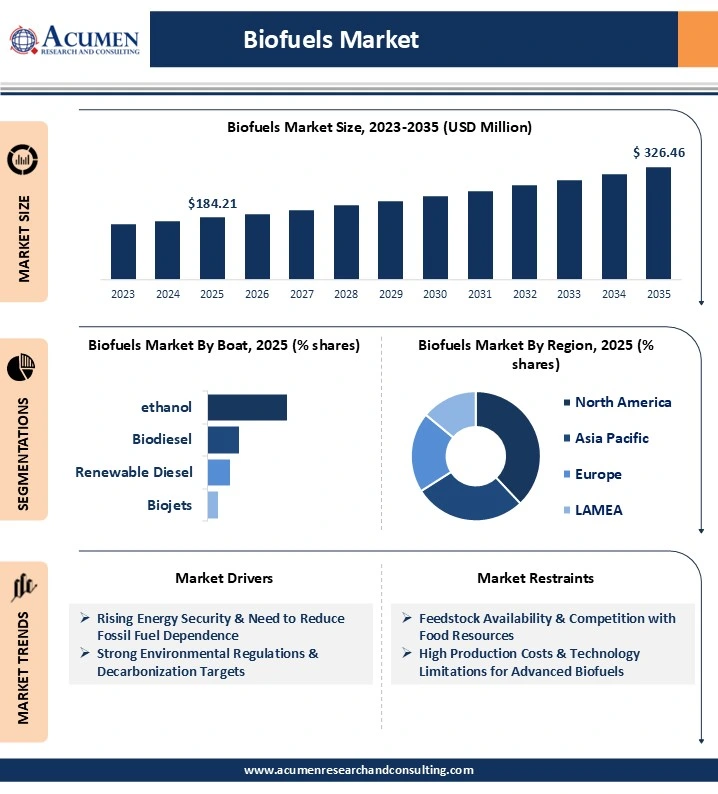
The growth of biofuels market is being fueled by the increasing global pressure on the transportation and energy sectors to decarbonize, increased awareness of climate change, and governments actively pursuing mandating blending, subsidies, and emissions reductions. Therefore, an increased demand for liquid low carbon fuels is expected to accelerate as countries reach towards net zero carbon, such as biodiesel, ethanol, renewable diesel, and sustainable aviation fuel. Meanwhile, advancement of conversion technologies including cellulosic processing, waste-to-fuel systems, and enzymatic hydrolysis have lowered production costs and increased energy yields while creating opportunities for large-scale applications of agricultural residues, municipal waste and non-food biomass. The combination of policy pressure, sustainability needs, and technology advancement has created a favorable environment for the global expansion of biofuels throughout the transportation, aviation, industrial heating and marine sectors.
Neste has recently advanced its leadership position within the biofuels industry by announcing a new cooperative venture with Chevron Lummus Global (CLG). Through this partnership, CLG and Neste will jointly develop next-generation technology that converts lignocellulosic waste such as agricultural residues and forestry residues to renewable diesel and sustainable aviation fuel. The announcement of this joint venture represents a major milestone in terms of scaling the availability of advanced biofuels that do not require the use of food crops, and supports both energy independence and carbon emissions reduction. Furthermore, continuous innovation in feedstock flexibility, co-processing technologies and biomass pre-treatment processes has made them commercially viable. Therefore, in conjunction with increasing government incentives to produce and market biofuels, and increased investments in establishing the supporting infrastructure for bio-refineries, logistics networks, and aviation fuel infrastructure, these innovations will create a supportive environment for accelerating the growth and adoption of biofuels over the next decade.
Biofuels Market Statistics
- The global biofuels market is valued at USD 194.11 Billion in 2026.
- North America region holds around 38% of the global biofuels market share in 2025.
- Asia Pacific region accounts for about 28% of the global market share and is expected to grow at a CAGR of over 7.5% from 2026 to 2035.
- By fuel type, the ethanol segment represents 54% of the total biofuels market share in 2025.
- By end-use, the transportation segment holds 71% market share in 2025.
What are the Biofuels Market Dynamics?
Global Climate Mandates Accelerate Biofuel Adoption as Industries Shift Away from Carbon-Intensive Fossil Fuels
One of the biggest factors driving growth of the biofuels industry is strict government regulations and blending mandates supporting the global decarbonization movement. Emission-reduction targets and biofuel blending requirements are aggressive across the globe on gasoline, diesel and jet fuel. With tax incentives, renewable fuel standards and carbon-credit programs, these policies create extensive, long-term demand for ethanol, biodiesel, renewable diesel and SAF. As countries continue transitioning to cleaner energy systems, biofuels will continue to be one of the fastest growing and readily accepted drop-in fuels for decarbonizing particularly difficult to decarbonize industries such as aviation and transportation and thereby will dramatically increase the overall growth of the biofuels market.
Advanced Waste-Based Biofuels Create Massive Growth Opportunity as Aviation Demands Cleaner Energy Solutions
A significant opportunity lies within the rapid growth in the production of advanced biofuels which made from waste feedstock, agricultural residue, algae, and lignocellulosic biomass. Advanced biofuels have the ability to produce much greater reductions in carbon emissions than traditional biofuels and circumvent the issues of using food as fuel. The increased need for Sustainable Aviation Fuel (SAF) and the influx of funding for new conversion technologies is creating multiple high-value growth opportunities for SAF production. As governments create incentives to produce SAFs and companies begin to create low-carbon supply chains, advanced biofuels represent a multi-billion dollar market with a long-term potential for commercial success.
Biofuels Market Segmentation
The global market for biofuels has been segmented into fuel type, basis of generation, end-use, and region.
- Fuel type is classified into ethanol, biodiesel, renewable diesel, and biojets.
- Basis of generation is divided into first generation, second generation, and third generation.
- End-use is classified into transportation, aviation, and others (power generation, heating, green chemistry).
- Geographically, The biofuels market is split into Europe, North America, Latin America, APAC, and the Middle East and Africa.
Biofuels Market Regional Outlook
North America currently has the largest share of the biofuels market. Due to regulations, advanced biorefineries and the capacity to produce significant amounts of ethanol and biodiesel especially within the United States. North America has the advantage of an abundant supply of feedstock as well as vast areas where corn and soybean are grown, along with strong provisions mandating blending like the U.S. Renewable Fuel Standard. In addition, recent investment in the production of low-carbon fuels, along with the creation of Sustainable Aviation Fuel programs, and government-sponsored programs to promote this fuel, have all further solidified North America's leadership in technology development and production output.
The Asia-Pacific region is positioned to be the fastest-growing market for biofuels because of rapid industrialization and growing energy demands, coupled with increasing government initiatives aimed at reducing dependency on fossil fuels. Countries such as India, China, Indonesia, and Thailand have implemented and expanded biodiesel and ethanol blending targets to help meet carbon-reduction targets and address energy security concerns. Large investments are now being made into second-generation biofuels, as well as growing SAF (sustainable aviation fuel) projects and developing sustainable feedstocks from agricultural wastes and oils, are driving the growth of the biofuels market throughout Asia Pacific. As government parliament policies become stricter and domestic production volumes increase, Asia Pacific will become an important center for biofuels innovation and the development of biofuels capacity.
Biofuels Market Players
- ADM
- Valero
- POET LLC
- Neste
- Green Plains Inc.
- Chevron Corporation (Chevron Renewable Energy Group)
- Cargill Incorporated
- Wilmar International Ltd
- The Andersons Inc.
- Verbio AG
- Borregaard AS
- Aemetis Inc
Biofuels Market Key Insights
| Parameter | Details |
|---|---|
| Size in 2025 | USD 184.21 Billion |
| Forecast by 2035 | USD 326.46 Billion |
| CAGR During 2026 - 2035 | 5.95% |
| Largest Fuel Type Segment (% Share 2025) | Ethanol– 54% |
| Largest Region Size (2025) | North America – 38% |
| Fastest Growing Region (% CAGR) | Asia Pacific – 7.5% |
| Key Players Covered | ADM, Valero, POET LLC, Neste, Green Plains Inc., Chevron Corporation (Chevron Renewable Energy Group), Cargill Incorporated, Wilmar International Ltd, The Andersons Inc., Verbio AG, Borregaard AS, and Aemetis Inc. |
Contact:
Mr. Richard Johnson
Acumen Research and Consulting
India: +91 8983225533