
Flex Fuel Market Size to Surge USD 116.79 billion by 2035, CAGR of 10.7%
Published : 24 Jul 2026
Author : Lucas Hoffmann



What is the Flex Fuel Market Size?
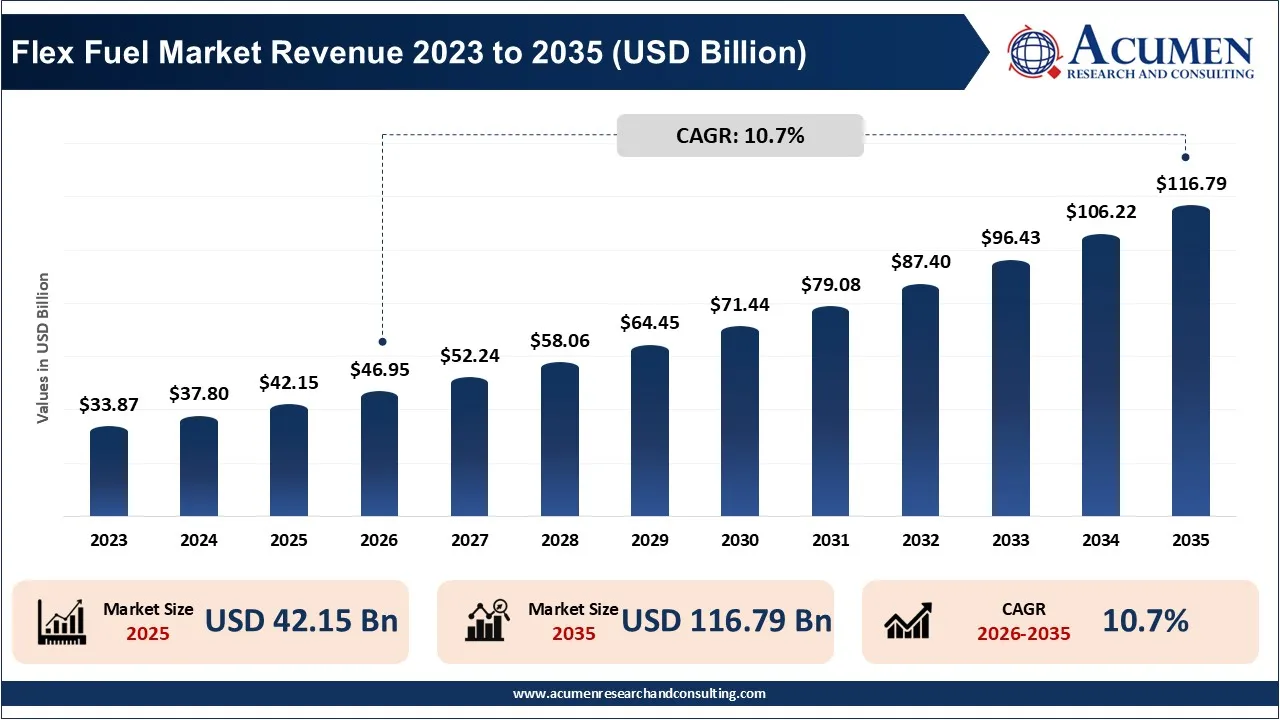
The global flex fuel market size was reached at USD 42.15 billion in 2025 and is projected to surge around USD 116.79 billion by 2035, growing at a CAGR of 10.7% over the forecast period of 2026-2035. Increasing demand for low-carbon transportation solutions and energy security is driving automakers to develop ethanol-compatible vehicles while encouraging investments in renewable fuels to reduce dependence on conventional fossil fuels.
What Drives the Growing Adoption of Flex Fuel Vehicles Worldwide?
Flex fuel vehicles are expected to see a rise in global demand as more and more countries are pushing for an increased use of biofuels owing to increasing ethanol blending targets, growth in biofuel output and government incentives towards minimizing dependence on foreign oil imports.
As per the IEA’s outlook on the global biofuel market for the period 2023-2028, global biofuel demand is projected to go up by 23% to 204 billion litres, an additional 38 billion litres in renewable fuel demand, driven by the large demand of ethanol as a biofuel.
Brazil is already leading the market with over 80% of its light-duty fleet equipped with flex-fuel vehicles and E100 and E85 (blend of ethanol and gasoline) fuelled vehicles readily available, due to one of the world’s largest and most complex ethanol supply chains, a testament to its sugarcane ethanol production industry.
Manufacturers are also pushing towards strengthening the market with some including Toyota, Volkswagen, Stellantis, Ford, General Motors and Maruti Suzuki developing flex-fuel and flex-fuel hybrid vehicle models to augment electrification while making the most of existing fuel stations.
With more governments stepping up their involvement in encouraging bioethanol usage, more investments are made in building infrastructure for its production, distribution and the availability of E20, E85 and E100 will help fuel global growth of the flex-fuel vehicle market.
Flex Fuel Vehicle (FFV) Adoption Trends
- Brazil continues to be the undisputed leader of FFV use and has fully transitioned the mainstream passenger vehicle fleet to the technology. It commands over 70% of vehicle fleet share in the country due to easy access to ethanol and an established distribution infrastructure.
- The Brazilian vehicle fleet enjoys very high penetration of FFV manufacturing. Toyota, Volkswagen, Stellantis, General Motors, Renault, Hyundai and many others are producing vehicles with ethanol-compatible engines for Brazil’s passenger vehicle market.
- Almost all new light vehicles sold in Brazil are now flex fuel capable (run on gasoline, ethanol, or any combination).
- The U.S. is a high-value FFV market, with millions of cars and light trucks able to run on ethanol and existing government support for ethanol blending and E85 fuel infrastructure. Ford, GM and Stellantis are major U.S. FFV producers (mostly pick-up trucks and commercial vehicles).
- India is an up-and-coming flex fuel market driven by its ethanol blending goals and an effort to push toward ethanol based mobility. Automakers in the country have been encouraged to produce vehicles with ethanol-compatible engines; many major companies such as Maruti Suzuki, Toyota, Hyundai, Tata Motors, Mahindra, Hero MotoCorp, and TVS have already developed and tested flex fuel prototypes in India.
- Europe and Japan are focusing more on flex fuel for hybrid applications where it could augment existing electric and ICE propulsion technologies and contribute to emission reductions over a lifecycle basis.
How Is the Flex Fuel Market Supporting Global Decarbonization Goals?
The flex fuel market is helping with decarbonization efforts globally by mitigating the contribution of GHG from the transport sector to global energy related CO 2 emissions, estimated by the International Energy Agency (IEA) to be 23% of the total globally. This is achieved by displacing some of the conventional gasoline with renewable ethanol, a bio-based fuel, in existing infrastructure such as internal combustion engine vehicles.
Further investments within the market support the global decarbonization effort with investments being made in 2nd generation (2G) ethanol which is made from agricultural residues such as bagasse from sugarcane, rice straw and corn stover, leading to minimal waste and minimizing land-use associated impacts. As governments continue to strengthen renewable fuel mandates and invest in sustainable fuel infrastructure, the flex fuel market is expected to remain an important pathway for achieving net-zero transportation goals while complementing the transition toward electric mobility.
Flex Fuel Market Regional Outlook
Latin America represented the largest segment in the global flex fuel market at 55% in 2025 and continues to be the most mature market in the world. The market is well-endowed with a mature supply chain ranging from feedstock production and ethanol refining to fuel distribution and vehicle production, creating the global precedent for commercial flex fuel implementation. Increased domestic consumption and a strong renewable fuel ecosystem are projected to help Latin America hold its ground.
The Asia Pacific region is expected to record the highest CAGR at 18.1% during 2026–2035. This region is gaining momentum as a significant region for growth and is witnessing a faster adoption of biofuel due to increased large-scale ethanol blending initiatives and significant production capacity investments undertaken by governments. Furthermore, growth in production of new vehicles, establishment of renewable fuel infrastructure and greater engagement of automakers in production of these vehicles will contribute significantly towards growth of Asia Pacific.
Competitive Landscape
- Toyota Motor Corporation: The Japanese automaker is concentrating on ethanol hybrid vehicles with flex fuel capability, with an emphasis on the Brazilian market to decrease pollution levels.
- Volkswagen Group: German automaker has a robust presence in the Brazilian market with vehicles compatible with ethanol and is actively producing high ethanol blend engine technology.
- Stellantis N.V.: In Latin America, Fiat and Jeep are leading players due to their flex fuel model offerings. The automaker is heavily invested in ethanol compatible and hybrid flex fuel powertrains.
- Ford Motor Company: The American manufacturer has several flex fuel vehicles in the North American market, fostering the adoption of ethanol across passenger and commercial segments.
- General Motors (GM): The American automobile company produces vehicles compatible with ethanol and continues to experiment with alternative fuels apart from their electric vehicles strategy.
- Maruti Suzuki India Limited: India’s biggest automaker has introduced ethanol-compatible vehicles to align with the nation’s ethanol blending goals and its potential to integrate flex fuel usage.
- Razen S.A.: One of the major producers of ethanol, the company is scaling its sugarcane ethanol capacity and investing in technologies that are enabling the creation of next generation ethanol.
- Archer Daniels Midland (ADM): It operates ethanol facilities on a massive scale and has a dedicated focus on low carbon fuel technology.
- POET LLC: It’s the second largest U.S. Ethanol producer, and they concentrate on expanding bio-refineries and the carbon reduction in ethanol.
- Valero Energy Corporation: They run ethanol facilities across the U.S. And have interests in generating renewable fuels and creating infrastructure for low carbon fuels.
Segments Covered
By Fuel Type
- Ethanol-Based Flex Fuel
- E10–E27 Blends
- E85
- E100
- Methanol-Based Flex Fuel
- M15
- M30–M85
- M100
By Vehicle Type
- Passenger Vehicles
- Light Commercial Vehicles (LCVs)
- Heavy Commercial Vehicles (HCVs)
By Technology
- Factory-Built Flex-Fuel Vehicles
- Flex-Fuel Conversion Vehicles
By Region
- North America
- Europe
- Asia Pacific
- Latin America
- Middle East & Africa
Contact Us:
Mr. Richard Johnson
Acumen Research and Consulting
India: +91 8983225533