
Food Packaging Market Size to Surpass USD 735.23 Billion by 2035, CAGR of 5.6%
Published : 15 Jul 2026
Author : Lucas Hoffmann



What is the Food Packaging Market Size?
The global food packaging market size was calculated at USD 425 billion in 2025, it is expected to surpass around USD 735.23 billion by 2035; growing at a CAGR of 5.6% over the forecast period of 2026-2035. The increasing demand for sustainable, recyclable, and bio-based packaging materials is driving innovation as food manufacturers focus on reducing environmental impact while complying with stringent packaging regulations.
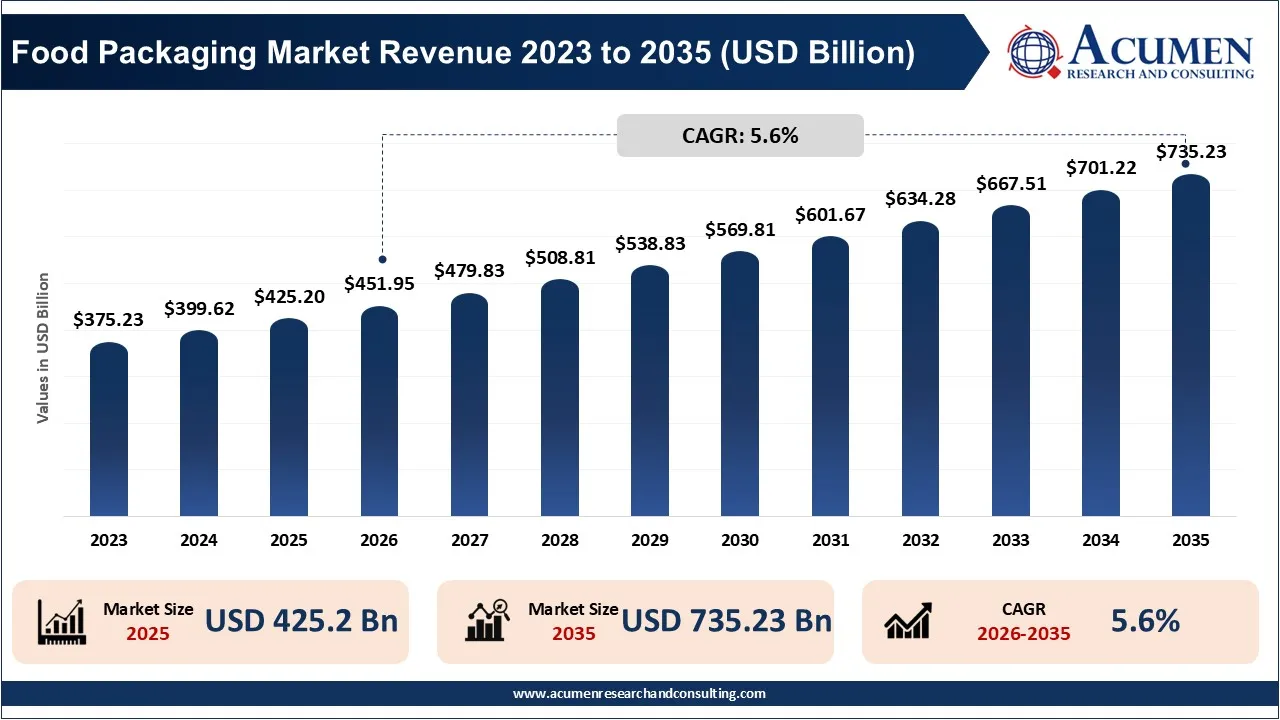
The food packaging market is defined as an ecosystem of all organizations and processes associated with the designing, manufacturing, and supply of packaging materials and solutions intended to guard, conserve, transport, hold, showcase, and sell food merchandise all through the provision range. The food packaging market consists of diverse kind of packs, for instance versatile packaging, solid plastics, papers and paperboard, glass, metallic, biodegradable packaging, and aggregate packaging.
The market is undergoing a significant transformation as sustainability, food safety, and technological innovation become central to packaging development. Manufacturers are increasingly investing in recyclable, compostable, bio-based, and mono-material packaging solutions to reduce environmental impact and comply with evolving regulations aimed at minimizing packaging waste and promoting circular economy practices.
Food Packaging Market Statistics
- Asia Pacific led the food packaging market, holding a 39% share in 2025. This was due to the large food manufacturing bases, rising organized retail spaces, and significant investments being made into flexible packaging production in the region.
- The second-largest market share was attributed to Europe, at 24% in 2025, as a result of its strong commitment to circular economy policies, widespread use of fiber-based packaging, and highly advanced food safety standards.
- The Middle East & Africa region is expected to expand at the highest CAGR, at 7.3%, over the forecast period. This is as a consequence of rapid urbanization, a burgeoning food service sector, and a surge in investments in modern packaging facilities.
- Plastics represented the dominant material, making up 42% of the market share in 2025, owing to their flexibility in design, excellent moisture resistance, and capability to effectively protect a wide variety of food products.
- The second most significant share, at 29% in 2025, was from paper & paperboard, influenced by the increased use of recyclable packaging and growing consumer demand for paper alternatives.
- Flexible packaging was the top choice, with a 49% market share in 2025, as a result of superior printability, reduced logistics expenses, and suitability for a broad array of food items.
- Rigid packaging captured a 39% market share in 2025, second only to flexible packaging. This was attributed to superior product protection, longer shelf-life properties, and widespread use in packaged beverages and dairy products.
- Semi-rigid packaging is anticipated to grow the fastest, with a projected CAGR of 7.4% during the forecast period, driven by its growing application in fresh produce, baked goods, and high-quality ready-to-eat meals.
- Bags and pouches accounted for the largest market share of 24% in 2025. This was due to increased demand for portable packaging, improved shelf-life functionality, and a rise in demand for flexible food packaging solutions.
- Boxes and cartons held a 18% market share in 2025, the second highest, owing to their light weight, ease of transportation, and expanded use in the packaged food and beverage industry.
- By packaging technology, conventional packaging remained the dominant player in 2025 with a 49% share due to its long-term commercial application, scalability, and cost-effectiveness for mass food production.
- Modified atmosphere packaging (MAP) ranked second with an 18% share in 2025, driven by the rising consumption of minimally processed foods and the necessity to maintain product freshness during transport and storage.
- Among the food type, meat, poultry, and seafood had the largest market share of 17% in 2025, fueled by increased consumption of protein-rich diets and the growing need for high-barrier packaging technologies to ensure product quality.
- Ready-to-eat and convenience foods secured the second-largest market share of 16% in 2025 due to factors such as busy lifestyles, increasing availability of retail options, and a preference for packaged meal solutions.
How is Sustainable Packaging Revolutionizing the Food Packaging Market?
Now that sustainability is one of the main drivers, governments, consumers and manufacturers of food and beverages around the world consider sustainability to be an indispensable characteristic of their packaging. Instead of conventional single-use plastic packaging, environmentally friendly and sustainable alternative materials such as reusable, recyclable, biodegradable and compostable packaging or renewable raw materials and materials derived from renewable raw materials such as plants are being used to achieve the sustainability goals of reducing carbon emissions and plastic waste and to fulfill increasing government demands.
The application of circular economy principles favors using packaging for foods that can be used several times, recycling or energy recovery, which conserves resources and prevents disposal in landfills. At the same time, brands are investing in packaging that uses a minimum of resources, in packaging made of mono-materials and recycled content as well as in packaging made of materials made from renewable raw materials, without any compromises in terms of shelf life or product safety.
- Around 80% of a product's environmental impact is determined during the packaging design stage, highlighting the importance of sustainable material selection.
- More than 70% of global consumers report that they are willing to purchase products packaged in environmentally friendly materials.
- The European Union aims for all packaging to be reusable or recyclable by 2030 under its circular economy strategy.
- The packaging industry accounts for approximately 40% of global plastic consumption, making it one of the primary sectors driving demand for sustainable alternatives.
Food Packaging Market Regional Outlook
Why Asia Pacific food packaging market captured the largest share?
Asia Pacific food packaging market captured the largest market share of around 39% in 2025 due to increasing organized retail and growing demand for processed food and beverage products in countries like China, India, South Korea and Japan coupled with rise in disposable incomes, rapidly growing consumer base, and urbanized population.
Increasing purchasing power, increasing rate of urbanization and a shift in food habits have led to increasing consumption of processed foods in major economies such as China, India, South Korea and Japan. Moreover, the expanding distribution channels including super markets, hyper markets and on-line shopping platform and food delivery services are driving the demand for food packaging materials that are lightweight, resilient and sustainable.
Food packaging manufacturers are investing in the adoption of innovative recycling processes, packaging materials and automation in manufacturing processes across the region to adhere with the increasing environmental regulations.
Why Europe region recorded the second-largest share in the global food packaging market?
Europe region recorded the second-largest share in the global food packaging market in 2025 and it holds 24% market share. Continuous efforts by governments, food producers and consumers to make more environmentally-responsible packaging is driving the European food packaging market.
Increasing stringent regulations to curb down the use of plastics and promotion of circular economy for packaging materials by the government have resulted into growing demand for fiber-based packaging materials, biodegradable packaging materials and mono-material packaging solutions in this region. Europe is also witnessed growing trends for innovative technologies such as smart packaging, active packaging and advanced barrier materials which help in prolonging the shelf life and decreasing food waste.
Food Packaging Market Competitive Landscape
Growing global demand for food, increased disposable incomes and population expansion, expanding urbanization, and the emergence of packaged food are fueling the growth of the food packaging market across the globe. The food packaging market is characterized by the presence of a few global giants as well as the number of regional suppliers.
Companies such as Amcor plc, Berry Global Inc., Sealed Air Corporation, Mondi Group, Sonoco Products Company, Smurfit Westrock, Tetra Pak International S.A.,Huhtamaki Oyj, DS Smith plc, and Graphic Packaging Holding Company are leading this global market.These players are investing in material innovation, sustainability, automation, and circular economy strategies in order to enhance their share of the market.
Furthermore, key players are investing in recyclable packaging, fiber based materials, lightweight materials, high performance materials, which provide for high food safety while decreasing impact on the environment. Also, the major market participants are increasing their manufacturing capacities and forming joint ventures to broaden their geographic reach.
In addition, to drive market share, new product launches are taking place and companies are leveraging sustainable materials in production and incorporating automation technologies. Smart packaging, and advanced barrier packaging are among few technological advancements by players in the industry and the continued focus on circular packaging solutions is also increasing the viability of such innovations in the food packaging market.
Segments Covered
By Material
- Plastic
- Paper & Paperboard
- Glass
- Metal
- Biodegradable & Compostable Materials
- Others
By Packaging Type
- Flexible Packaging
- Rigid Packaging
- Semi-Rigid Packaging
By Product Format
- Bags & Pouches
- Bottles & Jars
- Cans
- Boxes & Cartons
- Trays & Clamshells
- Cups & Tubs
- Wraps & Films
- Sachets & Stick Packs
- Others
By Packaging Technology
- Modified Atmosphere Packaging (MAP)
- Vacuum Packaging
- Active Packaging
- Intelligent/Smart Packaging
- Aseptic Packaging
- Retort Packaging
- Conventional Packaging
By Food Type
- Fruits & Vegetables
- Meat, Poultry & Seafood
- Dairy Products
- Bakery & Confectionery
- Ready-to-Eat & Convenience Foods
- Frozen Foods
- Snacks
- Beverages
- Others
By Region
- North America
- Europe
- Asia-Pacific
- Latin America
- Middle East & Africa
Contact Us:
Mr. Richard Johnson
Acumen Research and Consulting
India: +91 8983225533