
Malaysia Online Food Delivery Market Size to Reach USD 7.8 Billion by 2035 growing at 8.8% CAGR - Acumen Research and Consulting
Published : 03 Nov 2026
Author : Raghuram Nair



What is the Malaysia Online Food Delivery Market Size?
The Malaysia online food delivery market size was estimated at USD 3,330 million in 2025 and is expected to surpass USD 7,796.26 million by 2035; growing at a CAGR of 8.8% during the forecast period from 2026 to 2035. The Malaysia online food delivery market is being driven by rising smartphone-based ordering, expanding digital payment adoption, wider restaurant participation, and consumers' growing preference for convenient on-demand food fulfilment.
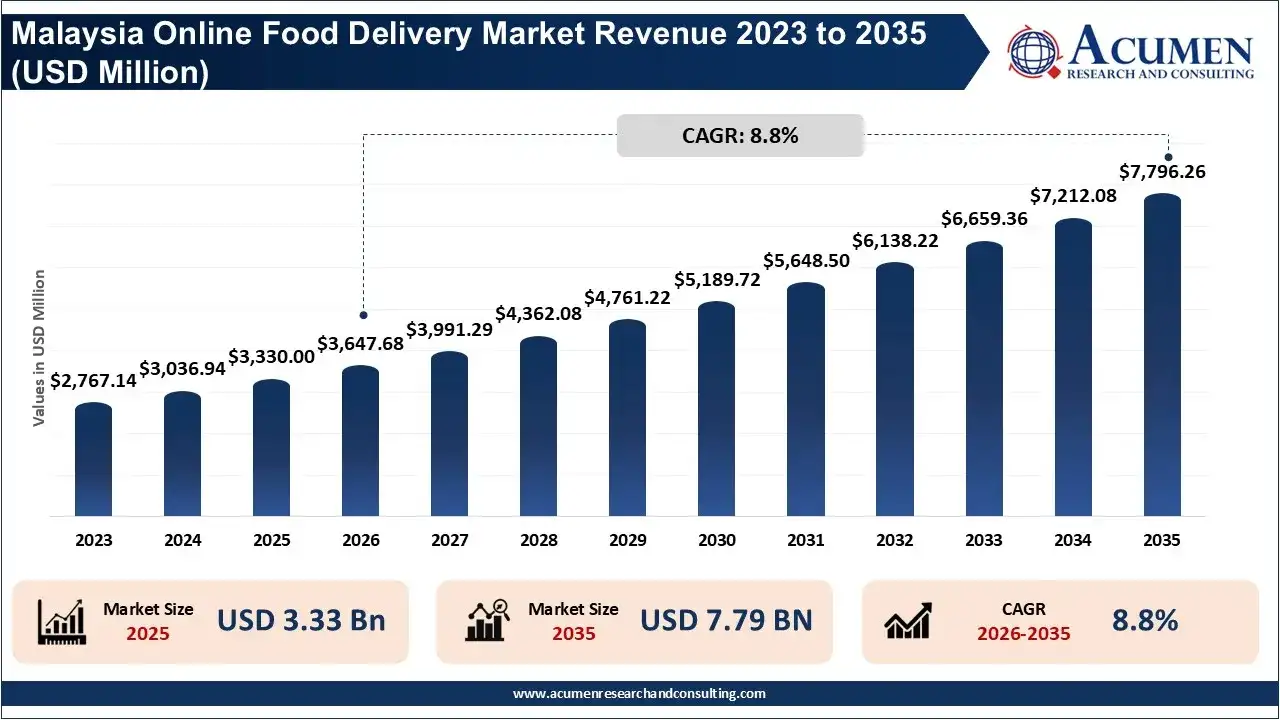
What Is Driving the Growth of Malaysia's Online Food Delivery Market?
The Malaysia online food delivery market refers to the digital ecosystem through which consumers discover restaurants, browse menus, place food orders, make digital payments, and receive meals through platform-enabled delivery services. The market encompasses independent restaurants and chains, online food delivery platforms, aggregator and third-party logistics (3PL) models, mobile ordering applications, digital payment systems, and on-demand as well as scheduled delivery services.
Market growth is being supported by increasing smartphone usage, expanding mobile banking and e-wallet adoption, wider acceptance of QR-based payments, growing restaurant participation on digital platforms, and rising consumer preference for convenient, app-based ordering. The continued integration of ordering, payment, promotions, loyalty programs, location tracking, and delivery notifications is also strengthening the role of digital platforms across Malaysia's foodservice ecosystem.
Strategic Outlook and Consulting Perspective
- Digital-first ordering expansion: Mobile applications are expected to remain central to market development as consumers increasingly use integrated platforms for restaurant discovery, ordering, payment, and delivery tracking.
- Restaurant digitization opportunity: Independent restaurants can increasingly leverage delivery platforms and 3PL networks to expand their customer reach without developing proprietary digital ordering or delivery infrastructure.
- Third-party logistics expansion: The growing role of aggregator + 3PL models creates opportunities for logistics providers to improve fleet utilization, route optimization, delivery coverage, and fulfillment efficiency.
- Cashless ecosystem development: Increasing adoption of e-wallets, mobile banking, and DuitNow QR is creating a stronger digital payment foundation for online food delivery transactions.
- Customer retention as a strategic priority: Platforms can strengthen recurring demand through loyalty programs, personalized promotions, subscriptions, rewards, and data-driven recommendations.
- On-demand fulfillment remains central: The dominance of instant orders highlights the importance of delivery speed, real-time tracking, rider availability, and fulfillment reliability.
- Cuisine diversification: While Western/fast food leads demand, strong participation from Malay/Malaysian and Chinese cuisine creates opportunities for platforms to expand localized restaurant discovery and personalized food recommendations.
How are Localized Market Strategies Shaping Malaysia's Online Food Delivery Market?
Market-specific options are also gaining prominence as online food delivery platform operators adapt their network of restaurants, promotions, deliveries and customer engagement models to Malaysia's increasingly diverse local market. Grab Food, foodpanda and Shopee Food, for example, can offer a concentrated network of partner restaurants in densely-populated city centres like Kuala Lumpur and Petaling Jaya while expanding coverage in secondary cities and smaller towns, catering to demand in an increasingly widespread customer base.
Localized discounts and promotions on food from Malaysia, China, India and other regions will also help platforms to target customer groups in different locations, in addition to offering search-of-season cuisine options and partnering with small, independent restaurants.
Malaysia Online Food Delivery Market Segmentation
| Segmentation | Dominant Segment | 2025 Share | Why It Dominated |
|---|---|---|---|
| By food service provider | Independent restaurants | 58% | Broad availability, localized menus, competitive pricing, and strong participation across Malaysia's foodservice ecosystem support independent restaurants. |
| By delivery type | Platform-to-consumer delivery | 76% | Consumers increasingly rely on digital platforms to manage restaurant discovery, ordering, payment, and delivery through a single interface. |
| By operating model | Aggregator + 3PL | 46.0% | Restaurants can access flexible delivery capacity without the cost and operational complexity of maintaining dedicated rider fleets. |
| By ordering platform | Mobile apps | 82% | Integrated ordering, payment, tracking, loyalty programs, promotions, and notifications make mobile apps the primary digital ordering channel. |
| By order type | On-demand/instant orders | 88% | High consumer preference for convenience and immediate fulfillment makes instant ordering the predominant delivery format. |
| By cuisine/food category | Western/fast food | 25% | Familiar menus, quick preparation, broad restaurant availability, and strong appeal among digitally active consumers support demand for Western and fast food. |
| By payment method | E-wallets | 35% | Fast, convenient, and increasingly integrated digital payments support greater use of e-wallets for online food orders. |
| By digital payment adoption | Active mobile banking users | 25 million | Growing mobile banking adoption strengthens the digital payment infrastructure supporting online food ordering and delivery transactions. |
| By QR payment adoption | DuitNow QR | 3 billion transactions | Expanding QR payment acceptance provides consumers and businesses with a convenient digital payment mechanism across the foodservice ecosystem. |
| By customer age | Millennials | 42% | High smartphone usage, digitally enabled lifestyles, and frequent demand for convenience contribute to millennials forming the largest customer group. |
What Opportunities Are Emerging for Food Delivery Platforms and Restaurant Operators?
The internet food delivery value chain is evolving and companies across platforms, restaurants, logistics providers, and digital payments companies have the potential to extract higher value. For instance, they may offer aggregator aggregators and 3PL delivery networks, which enable independent restaurants to expand their catchment beyond their immediate location without the capital costs of dedicated rider fleets, while increasing monetization for food delivery platforms via loyalty programs, subscriptions, targeted incentives, and sponsored placement in feeds and search.
The rising availability of digital-payment methods such as e-wallets and QR payments offer an additional avenue for faster checkout and targeted infeed offers. Meanwhile, restaurants may leverage customer ordering data to identify the most popular cuisine types and menu items, and adopt new operating hours and location-specific offers, while logistics providers can explore routes and demand forecasting.
What is the Competitive Landscape of Malaysia's Online Food Delivery Market?
- Platform competition: Competition is shaped by restaurant network breadth, customer reach, delivery coverage, pricing, promotions, and app experience, with GrabFood, foodpanda, and ShopeeFood representing prominent platform participants in Malaysia.
- Restaurant acquisition: Platforms compete to onboard independent restaurants and chains, expanding cuisine variety and consumer choice. GrabFood highlights thousands of restaurant partners across Malaysia, while foodpanda operates an extensive restaurant marketplace.
- Delivery infrastructure: Aggregator + 3PL models create differentiation through delivery capacity, rider availability, fulfillment speed, and geographic coverage. GrabFood assigns delivery partners to restaurant orders, while ShopeeFood similarly connects orders with delivery partners.
- Mobile application capabilities: App-based ordering remains a major competitive factor, with GrabFood, foodpanda, and ShopeeFood integrating restaurant discovery, ordering, payment, order status, and delivery-related functions.
- Digital payment integration: E-wallets and other digital payment options increasingly influence checkout convenience and transaction efficiency. GrabFood, for example, integrates GrabPay alongside other payment options.
Segments Covered in the Report
By Food Service Provider
- Chain Restaurants
- Independent Restaurants
- Cloud/Dark Kitchens
- Home-based/Micro Food Businesses
By Delivery Type
- Restaurant-to-Consumer
- Platform-to-Consumer
By Operating Model
- Aggregator + 3PL
- Aggregator + In-house Delivery
- Restaurant-owned Direct Delivery
- Hybrid/Other
By Ordering Platform
- Mobile App
- Website
- Other Digital Channels
By Order Type
- On-demand/Instant
- Scheduled
- Pre-order/Subscription
By Cuisine/Food Category
- Malay/Malaysian
- Chinese
- Indian
- Western/Fast Food
- Japanese/Korean/Other Asian
- Others
By Payment Method
- Cash on Delivery
- Credit/Debit Card
- E-wallet
- Online Banking/Other Digital
By Customer Age
- Gen Z
- Millennials
- Gen X
- Baby Boomers
- Other/Unclassified
Contact Us:
Mr. Richard Johnson
Acumen Research and Consulting
India: +91 8983225533