
Military Sensors Cybersecurity Solutions Market Size to Surge USD 9,373.29 Million by 2035, Reflecting a CAGR of 8%
Published : 17 Sep 2026
Author : Lucas Hoffmann



What is the Military Sensors Cybersecurity Solutions Market Size?
The global military sensors cybersecurity solutions market size was accounted for USD 4,330 million in 2025 and is projected to surge USD 9,373.29 million by 2035; reflecting a CAGR of 8% during the forecast period 2026 to 2035.
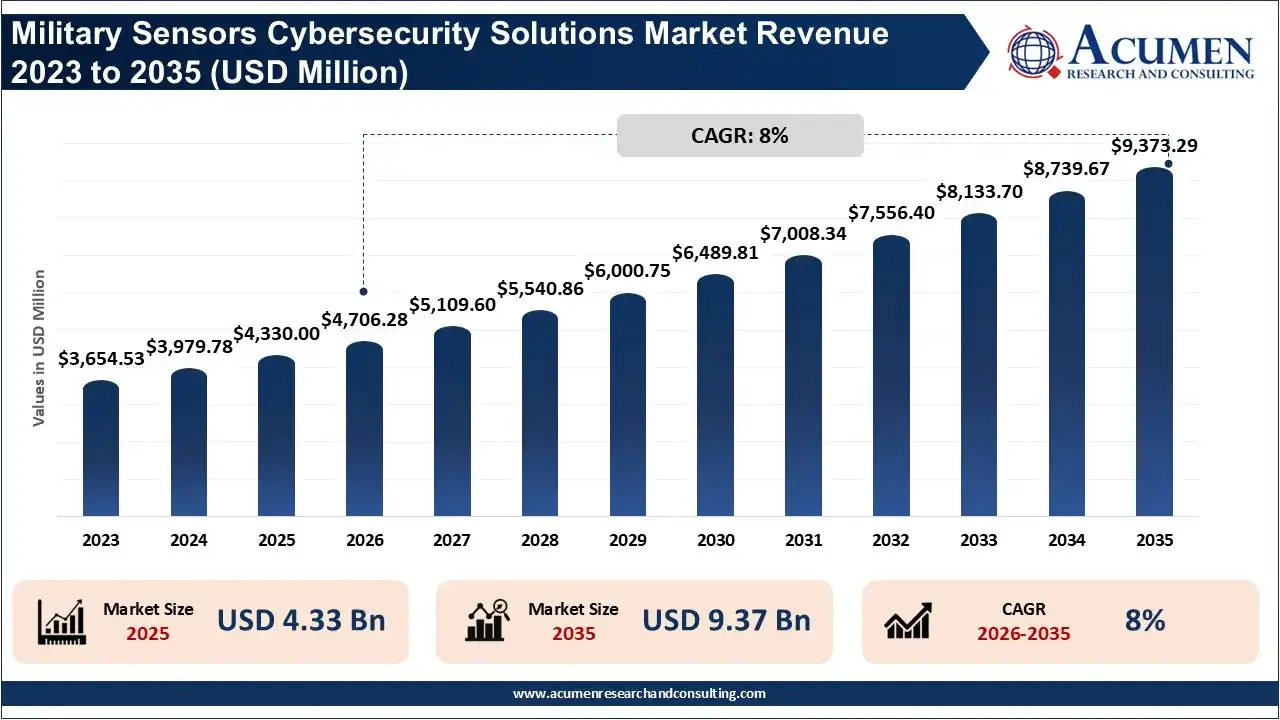
The importance of the military sensors cybersecurity solutions market is growing in defense as defense forces increasingly utilize connected sensors on their platforms such as airplanes, drones, navy vessels, armored personnel carriers, missiles and its delivery systems, surveillance, and battle communications systems.
Increasingly interconnected and integrated with AI, edge computing, autonomy, and real-time data sharing architectures, defense sensing is transforming into a critical component of defense modernization by securing sensors, data, their transmissions and interfaces from any form of cyberattack and unauthorized access.
Defense organizations/governments will increasingly move away from perimeters based traditional security towards continuous monitoring, device authentication, network segmentation, secure data transmission and zero trust architecture. The U.S. Department of Defense has integrated zero trust across information, operational technologies, and weapon systems, as part of its framework that covers security devices, network protection, automation and AI/ML support.
Is Defense Supply-Chain Security Becoming a Market Opportunity?
Supply chain security for defense is becoming a market opportunity given that military sensor systems are reliant on intricate networks of semiconductors, embedded software, firmware, communications hardware and other third-party technology. Security flaws introduced into these components during manufacturing, or through manipulated hardware or software, pose a risk to sensitive command and control systems. It is therefore a requirement the defense community is growing.
Already the Department of Defense in the U.S. is increasing cybersecurity demands for the defense industrial base, via the Cybersecurity Maturity Model Certification program, while increasing focus on dependence on foreign hardware and software are driving defense customers toward improved supplier trust verification processes, component trace-ability and the secure development and monitored use of components.
While other continents are moving with varied urgency at present in Europe and Asia similar initiatives are under way with the hope of strengthening control over critical technology, and stimulating indigenous capabilities. All these developments represent market opportunities for providers of the security components and services of hardware authentication, firmware security, secure by design elements, software supply chain monitoring and trusted hardware verification as military sensor manufacturers are asked to show security from cradle to grave in products.
Where Will Investment Flow in the Military Sensors Cybersecurity Market?
- Zero-trust security architectures designed to continuously authenticate military sensors, devices, users, and connected platforms.
- Secure embedded systems and hardware security to protect sensor firmware, processors, controllers, and other mission-critical components.
- Cybersecurity for autonomous and unmanned systems, including drones, unmanned ground vehicles, naval platforms, and autonomous defense systems.
- Sensor data encryption and secure communications to protect sensitive information transmitted between sensors, command centers, weapons platforms, and tactical networks.
- Firmware and software security focused on secure boot, firmware authentication, vulnerability management, and protection against malicious code.
- Edge cybersecurity solutions that enable real-time protection and threat detection closer to sensors deployed in remote or contested battlefield environments.
- Electronic warfare and anti-spoofing technologies designed to protect military sensors from jamming, spoofing, electromagnetic interference, and manipulated inputs.
- Defense supply-chain cybersecurity to secure semiconductors, embedded software, sensor components, and third-party technologies throughout the military sensor lifecycle.
- Legacy sensor modernization as defense organizations upgrade older military platforms with cybersecurity capabilities without completely replacing existing sensor infrastructure.
Military Sensors Cybersecurity Solutions Market Regional Outlook
Which Regions Will Lead Military Sensors Cybersecurity Solutions Investment Through 2035?
The military sensors cybersecurity solutions market was led by North America, with 39% market share in 2025. Driven by sophisticated defense infrastructure, high defense expenditures, presence of major defense technology players, and extensive usage of networked military sensor systems across armed forces, the demand for robust cybersecurity solutions across the networks is on the surge.
With growing emphasis on modernization of cyber security systems in defense systems, and integration of connected defense platforms and autonomous technologies for secure data protection of mission-critical Military sensors are leading towards rapid growth.
Can Asia-Pacific Become the Fastest-Growing Military Sensors Cybersecurity Market?
Asia-Pacific garnered 27% of the market share in military sensors cybersecurity solutions in 2025 and is predicted to grow at the highest regional CAGR of 9.2% from 2026-2035. Rapid defense modernization across developing nations, continuous growth of deployment of advanced military sensors for battle enhancement, higher spending on unmanned and autonomous military systems, digitization of military infrastructures and high need to focus on cybersecurity resilience in battle against hostile actors such as nation-state actors are among the major drivers of the market.
Countries like China, India, Japan, South Korea and Australia are highly spending on advanced defence hardware which further paves the way for military sensor cyber security solution companies.
Top Countries Driving Military Sensors Cybersecurity Solutions Demand
| Country | Key Demand Drivers |
|---|---|
| United States | High defense spending, advanced military sensor networks, autonomous systems, cybersecurity modernization, and strong presence of defense and cybersecurity companies |
| China | Rapid military modernization, expansion of unmanned systems, electronic warfare capabilities, and increasing investment in advanced defense electronics and cybersecurity |
| India | Rising defense modernization, indigenous defense manufacturing, expansion of military drones and surveillance systems, and growing focus on securing connected defense infrastructure |
| Japan | Advanced defense electronics, increasing investment in unmanned and network-centric warfare capabilities, and stronger focus on cyber resilience and protection of critical military systems |
| South Korea | Growing defense technology investments, development of autonomous and unmanned platforms, advanced military electronics, and increasing cybersecurity requirements across connected defense systems |
Which Military Sensor Applications Will Generate the Most Cybersecurity Solutions Demand?
- Radar and surveillance sensors: Increasing deployment across air-defense, border surveillance, missile detection, and battlefield monitoring systems will drive demand for secure data transmission, intrusion detection, and anti-spoofing capabilities.
- Electro-optical and infrared (EO/IR) sensors: Used extensively for target identification, reconnaissance, and night-vision applications, these sensors require protection against data interception, manipulation, and unauthorized access.
- Unmanned aerial vehicle (UAV) sensors: The rapid adoption of military drones is creating significant cybersecurity requirements for onboard cameras, navigation sensors, communication systems, and sensor-data links.
- Electronic warfare sensors: Growing electronic warfare capabilities will increase demand for cybersecurity solutions that protect sensors against jamming, spoofing, electromagnetic interference, and malicious manipulation.
- Navigation and positioning sensors: GPS/GNSS and inertial navigation systems are critical to aircraft, missiles, drones, and ground platforms, creating demand for anti-spoofing, secure communications, and resilient positioning technologies.
- Missile guidance and targeting sensors: The mission-critical nature of these systems is expected to encourage investment in secure sensor architectures, encrypted data exchange, firmware protection, and real-time threat monitoring.
- Aircraft and aerospace sensors: Connected sensors across military aircraft require protection against cyberattacks that could compromise flight data, navigation, communications, and mission systems.
- Naval and maritime sensors: Radar, sonar, navigation, and surveillance sensors deployed on naval vessels and underwater platforms will generate cybersecurity demand as maritime systems become increasingly networked and digitally integrated.
Segments Covered
By Solution Type
- Hardware
- Software
- Services
By Sensor Type
- Radar
- Electro-Optical / Infrared Sensors (EO-IR)
- Electronic Warfare & Signals Intelligence Sensors
- Sonar & Underwater Sensors
- Navigation & Positioning Sensors
- Acoustic & Seismic Sensors
- CBRN Sensors (Chemical, Biological, Radiation, Nuclear)
- Others
By Platform
- Airborne
- Naval
- Submarine
- Ground
- Missile/Air Defense
- Space
- Others
By Region
- North America
- Europe
- Asia-Pacific
- Latin America
- Middle East & Africa
Contact Us:
Mr. Richard Johnson
Acumen Research and Consulting
India: +91 8983225533