
Vehicle-to-Vehicle (V2V) Market Size, Share, Forecast 2026 - 2035
Vehicle-to-Vehicle (V2V) Market (By Vehicle Type: Hatchback/Sedan, SUVs, LCV, HCV; By Technology: Dedicated Short-Range Communication (DSRC), Cellular Communication; By Application: Traffic Safety, Traffic Efficiency, Infotainment and Payments, Others) - Global Industry Analysis, Size, Share, Analysis, Trends and Forecast 2026 - 2035
- Last Updated: 09 Jan 2026
- Report Code: ARC3890
- Category: Automotive And Transportation
Vehicle-to-Vehicle (V2V) Market Size and Forecast 2026 To 2035
The global vehicle-to-vehicle (V2V) market is valued at USD 68.35 billion in 2025 and is projected to reach USD 376.03 billion by 2035, expanding at a compound annual growth rate (CAGR) of 18.6% during the forecast period from 2026 to 2035.
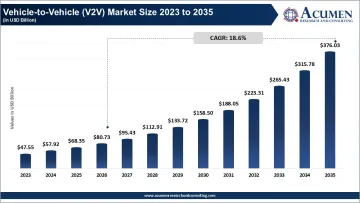
Vehicle-to-Vehicle (V2V) Market Highlights
- In 2025, North America leads the vehicle-to-vehicle (V2V) Market with an over 42% revenue share.
- Asia Pacific region is expected to have the fastest-growing CAGR of 21.9% from 2026 to 2035 for V2V market.
- By vehicle type, the hatchback/sedan segment accounts for nearly 40% share of the total V2V market.
- By sales channel, the OEM hold around 75% of market share, aftermarket represent the remaining 25%.
- By technology, the dedicated short-range communication (DSRC) segment holds 60% market share, followed by cellular communication with 40%.
Vehicle-to-Vehicle (V2V) Market Overview
The growth of the vehicle-to-vehicle (V2V) market is primarily driven by a growing importance placed on safety enhancements through the use of V2V communications that enable vehicles to exchange information such as their instantaneous speed, location, braking effectiveness, and roadway conditions with each other. Government efforts and policies in North America, Europe, and some parts of Asia to promote connected & intelligent transportation systems support greater adoption of the V2V technology. Increased sales of Advanced Driver Assistance Systems (ADAS) and increasing consumer interest in vehicle safety technology also contribute to the growth in the market for V2V. Finally, automobile manufacturers are now incorporating V2V technology in their vehicles in order to receive better safety ratings and position themselves for future autonomous vehicle technologies.
Furthermore, the another growth factors such as the rapid progress that has occurred in connected vehicle technology including V2X to the extent that it is supported by the development of 5G networks. Cities and governments are investing in the connected infrastructure needed to meet rising demand for smart mobility, traffic efficiency, and reduced congestion. The rapid growth in SUV and electric vehicle sales in the Asia Pacific region and the growing number of communication module manufacturers at the OEM level has created an environment where V2V product sales will experience a pronounced increase during the forecast period.
The vehicle-to-vehicle (V2V) market includes technologies and systems that allow vehicles to communicate wirelessly with one another to exchange real-time data to enhance road safety, traffic flow, and the overall driving experience.
Vehicle-to-Vehicle (V2V) Market Dynamics
Market Drivers
Technological Advancements in Vehicle-to-Vehicle Systems
The rapid development of vehicle-to-vehicle communication technology has major key drivers for growth in the vehicle-to-vehicle market. Developments of DSRC, C-V2X, 5G, AI, and real-time data analytics have allowed vehicles to exchange real-time, life-saving information about speed, braking, traffic congestion, and collision warnings. These developments greatly increase the safety of vehicles on the road, decrease human error, and support ADAS. As automotive manufacturers are becoming more confident in their ability to incorporate intelligent or automated V2V communications into their vehicles, this has increased the market's acceptance of V2V technology.
Increasing Government Regulations and Road Safety Initiatives
Globally, governments are enhancing regulations on road safety in an effort to reduce both traffic fatalities and congestion, this has caused increased interest and growth of vehicle-to-vehicle technologies. By providing pilot programs to test the efficacy of intelligent transportation systems, requiring OEMs to meet safety standards through regulation, and developing integrated infrastructures to support connected vehicle ecosystems, regulatory authorities are influencing the path of technology with the introduction of intelligent transportation systems. Additionally, partnerships among automotive manufacturers, telecommunications companies, and government agencies are a driving force behind the development and large-scale deployment of V2V systems. As concerns mount regarding vehicle density in urban areas, increased urbanization, and an increase in the pursuit of autonomous vehicles, regulatory authorities play a critical role in advancing the deployment of comprehensive V2V systems.
Market Restraints
High Implementation Costs and Infrastructure Requirements
The financial burden associated with installing vehicle-to-vehicle (V2V) technology will have a significant impact on market growth. This burden falls heavily on companies that must purchase costly communication devices and develop custom software programs to interface with their vehicles' systems, they also need to create cyber security standards and establish physical infrastructures such as roadside units and communication networks. Many automakers will also need to make expensive modifications to their existing vehicle platforms to accommodate the installation and future upgrades of V2V technology, which will increase the total investment for each automaker. Consequently, the financial hurdles that accompany the adoption of V2V technology could impede its adoption rate, particularly among price-sensitive markets and small fleet operators, especially those concerned with return on investment considerations.
Data Security, Privacy, and Standardization Challenges
The concerns about data privacy and cyber security are major challenges to the development of the vehicle-to-vehicle market. V2V systems depend upon near-constant transmission and exchange of data between vehicles, which can lead to security concerns regarding unauthorized access, misuse of data, and attack vulnerabilities. In addition, the current inability to establish universal standards is related to the co-existence of both DSRC technology and cellular-based technology, resulting in issues with regional and manufacturer interoperability. Furthermore, the fact that each country has different rules about data protection will make implementation even harder. Such challenges could make people less confident in connected vehicle technologies, which could slow down their acceptance.
Market Opportunities
Growth of Smart Transportation and Connected Mobility Ecosystems
The transition towards smart cities and intelligent transportation systems globally provides significant opportunities for growth in the vehicle-to-vehicle (V2V) market. Local and regional governments, along with city planners, are beginning to invest heavily in connected mobility solutions to improve traffic congestion, decrease pollution, and create a safer road environment through accident prevention features. Additionally, V2V technology will play an important role within this ecosystem with the ability to coordinate traffic events in real time and enable vehicle automation. As digital traffic management platforms begin to proliferate within major metropolitan areas, the demand for integrated V2V solutions should increase at an accelerating rate.
Expansion of Electric and Autonomous Vehicles in Emerging Economies
The rapid growth of electric and autonomous vehicles in developing regions of the Asia-Pacific, South America, and the Middle East provides significant and ongoing opportunities for growth for the V2V marketplace. While governments provide incentives and build out infrastructure to help increase consumer acceptance of electric vehicles (EVs), the autonomous vehicle industry will rely upon vehicles communicating with each other in real-time to support the technology. Additionally, as automobile manufacturers develop new vehicle platforms with enhanced connectivity capabilities, the expected adoption of V2V technology will create continued opportunities for growth for players in the V2V marketplace.
Vehicle-to-Vehicle (V2V) Market Report Scope
| Attribute | Details |
|---|---|
| Vehicle-to-Vehicle (V2V) Market Size 2025 | USD 68.35 Billion |
| Vehicle-to-Vehicle (V2V) Market Forecast 2035 | USD 376.03 Billion |
| Vehicle-to-Vehicle (V2V) Market CAGR During 2026 - 2035 | 18.6% |
| Analysis Period | 2023 - 2035 |
| Base Year | 2025 |
| Forecast Data | 2026 - 2035 |
| Segments Covered | By Vehicle Type, By Technology, By Application, By Sales Channel, and By Geography |
| Regional Scope | North America, Europe, Asia Pacific, Latin America, and Middle East & Africa |
| Key Companies Profiled | Qualcomm Technologies, Inc., Toyota Motor Corporation, Ford Motor Company, General Motors, NXP Semiconductors, Cohda Wireless, Autotalks, Harman International, LG Electronics, Huawei Technologies Co., Ltd., Continental AG, and Robert Bosch GmbH |
| Report Coverage | Market Trends, Drivers, Restraints, Competitive Analysis, Player Profiling, Covid-19 Analysis, Regulation Analysis |
Vehicle-to-Vehicle (V2V) Market Regional Analysis
- The North America vehicle-to-vehicle (V2V) market size was valued at USD 28.71 billion in 2025 and is projected to reach USD 139.13 billion by 2035, expanding at a compound annual growth rate (CAGR) of 17% from 2026 to 2035.
- The Asia-Pacific vehicle-to-vehicle (V2V) market size was reached at USD 17.09 billion in 2025 and is forecasted to surpass USD 120.33 billion by 2035 with a CAGR of 21.9% during the forecast period 2026 to 2035.
- The Europe vehicle-to-vehicle (V2V) market size was estimated at USD 13.67 billion in 2025 and is expected to hit USD 67.68 billion by 2035, expanding at a compound annual growth rate (CAGR) of 17.3% from 2026 to 2035.
North America has the largest share of the global V2V technology market because of its history in adopting connected vehicle technologies, Original Equipment Manufacturers (OEMs), and supportive governmental programs aimed at improving road safety and developing smart transportation solutions. The region is characterized by advanced communication infrastructure, extensive pilot study programs, and government support for deploying V2V and Vehicle-to-Everything (V2X) technologies, especially from the U.S. government. A high penetration rate of Advanced Driver Assistance Systems (ADAS) and rapidly increasing investments in Autonomous Vehicle Technology further solidify North America’s position as the world leader of the V2V Technology Market.
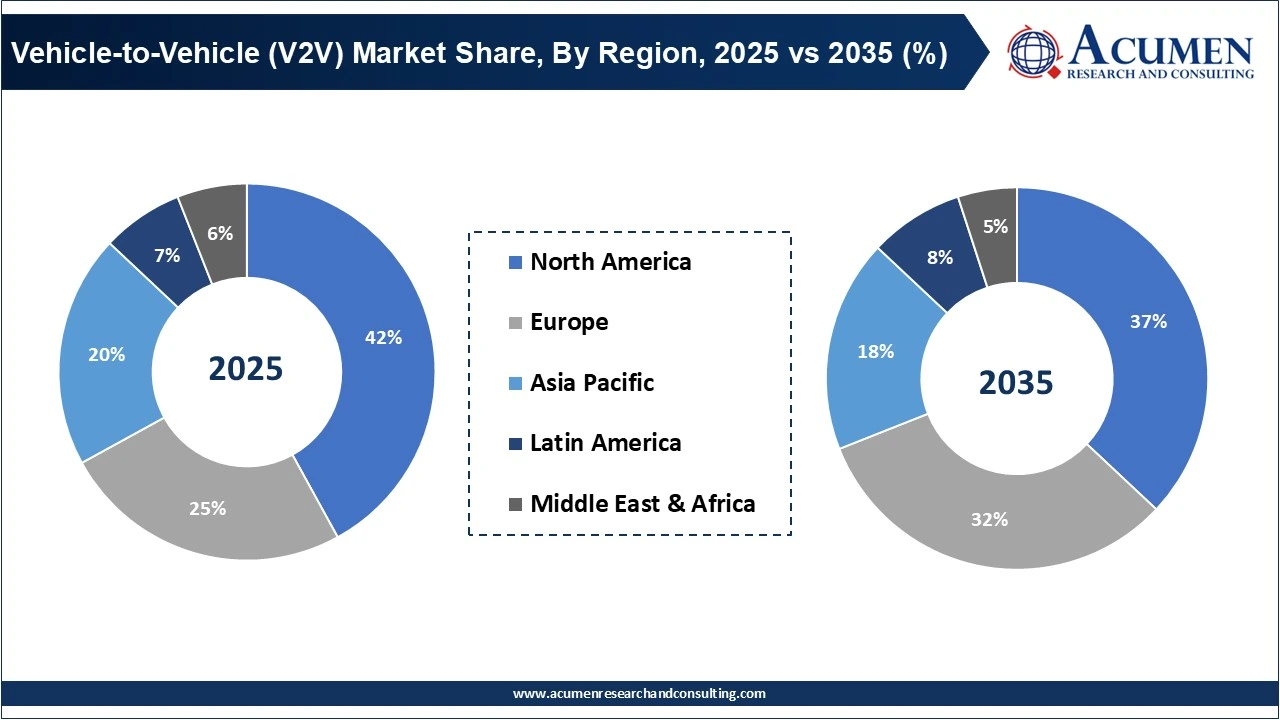
The vehicle-to-vehicle market is growing fastest in Asia-Pacific region because of urbanization, increases in the production of vehicles, and growth in countries such as China and Japan. In South Korea, the introduction of smarter mobility solutions by the government, along with supporting policies for connected and electric vehicles, will drive the rapid deployment of 5G networks and the adoption of V2V technologies based on cellular technology. Europe is continuing to grow steadily with its current regulations surrounding the automobile industry and its push for intelligent transportation systems, whereas Latin America and the Middle East/Africa markets are growing gradually due to better connections and infrastructure to enable automotive technologies.
Vehicle-to-Vehicle (V2V) Market Segmental Insights
The worldwide market for vehicle-to-vehicle is split based on vehicle type, technology, application, sales channel, and geography.
Vehicle Type Insights
Hatchback and sedan vehicles account for the major share of the global vehicle-to-vehicle (V2V) market due to their high volume of production and use in densely populated urban areas. Many of these vehicles offer enhanced safety features like real-time communication systems and collision alerts, which contribute significantly to the overall demand in this market. Due to manufacturer commitments to enhance road safety and meet regulatory mandates by equipping hatchbacks and sedans with V2V technologies, hatchback and sedan vehicles will continue to maintain their dominance throughout the V2V market on a global scale.
| Vehicle Type | Market Share, 2025 (%) | Key Highlights |
|---|---|---|
| Hatchback / Sedan | 40% | Dominant due to high global sales volumes and early adoption of V2V safety and connectivity technologies. |
| SUVs | 30% | Fastest-growing driven by increasing SUV penetration and higher integration of advanced driver-assistance systems. |
| LCV | 20% | Adoption supported by fleet management, logistics optimization, and commercial vehicle safety applications. |
| HCV | 10% | Gradual growth driven by increasing focus on heavy vehicle safety and connected fleet solutions. |
The SUV segment is the fastest-expanding segment of the automotive industry, with a growing number of consumers choosing larger, more luxurious vehicles equipped with advanced driver-assistance systems (ADAS). Growth in global sales, combined with increased uptake of V2V connectivity and safety tech, will drastically drive growth for this market. Additionally, OEMs provide these vehicles with real-time communication solutions and automated safety options, which will open up new avenues of growth in this market segment.
Technology Insights
Dedicated Short-Range Communication (DSRC) segments for the largest percentage of the V2V market due to its early launch, reliability, and accepted technology standard in intelligent transportation systems. The technology has many deployments throughout North America & Europe and is primarily used for latency-sensitive vehicle-to-vehicle safety applications, including collision avoidance and emergency braking alerts. As such, this technology has continued to be the dominant form of communication technology when it comes to connected vehicles due to both the traditional reliability associated with DSRC and existing regulatory support.
| Technology | Market Share, 2025 (%) | Key Highlights |
|---|---|---|
| Dedicated Short-Range Communication (DSRC) | 40% | Dominant due to early deployment, proven low-latency performance, and established intelligent transport standards. |
| Cellular Communication (C-V2X) | 40% | Fastest-growing driven by 5G rollout, scalability, and strong support from telecom operators and automakers. |
The cellular communications C-V2X is expanding the fastest segment of vehicle-to-vehicle market, primarily due to the rapid expansion of the 5G networks, and because it allows enhancements in how far cars can communicate with other cars. The telecommunications and automotive industries are eager to promote C-V2X adoption and connect passenger cars and trucks. Additionally, C-V2X allows for instantaneous communication between autonomous vehicles, traffic management systems, and smart mobility systems, all of which represent significant areas for growth within the V2V segment.
Application Insights
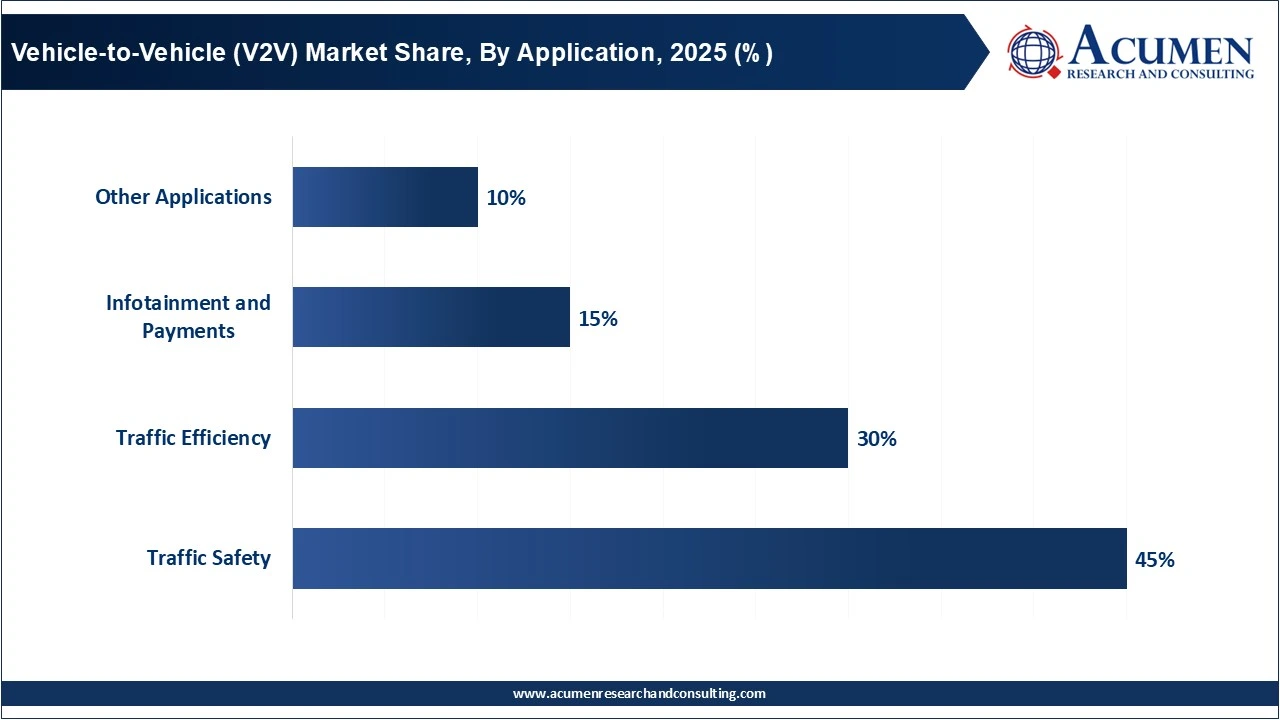
The traffic safety segments occupy the largest share of the V2V market since preventing accidents and reducing the number of deaths on the road are two of the main objectives of vehicle-to-vehicle communication. Furthermore, the deployment of many vehicle-to-vehicle safety application types, including collision warning and emergency braking, is already underway. In addition to this, much of the activity is supported by regulatory requirements for safety, which ensure that traffic safety applications will continue to occupy a leading position in the V2V market for many years to come.
| Application | Market Share, 2025 (%) | Key Highlights |
|---|---|---|
| Traffic Safety | 45% | Dominant as collision avoidance, emergency alerts, and hazard warnings are the primary V2V use cases. |
| Traffic Efficiency | 30% | Fastest-growing due to increasing urban congestion and demand for smart traffic management solutions. |
| Infotainment & Payments | 15% | Growth supported by connected vehicle services and in-vehicle digital ecosystems. |
| Others | 10% | Includes platooning, cooperative driving, and emerging V2V-enabled mobility applications. |
Traffic efficiency is the fastest-growing segment of the V2V market due to the increase in urban congestion worldwide and the growing need for optimized traffic flow. Through V2V capabilities, traffic efficiency solutions can provide real-time coordination between vehicles, optimize routes, and manage congestion. These solutions are increasingly being implemented in smart city projects and intelligent transport programs, therefore growing much quicker than other solution applications.
Sales Channel Insights
The OEM segment possesses the largest share of the V2V market because of connected vehicle systems are typically integrated at the point of manufacture. OEMs are increasingly becoming the channel for deploying V2V technology due to the significant benefits of factory-installed solutions, including limited to guaranteed compatibility with existing systems, security from cyber threats, and compliance with the regulatory framework established by the relevant authorities. This segment's strength reflects the ongoing growth in the adoption of V2V technology by both vehicle manufacturing and fleet operators on a global basis.
| Sales Channel | Market Share, 2025 (%) | Key Highlights |
|---|---|---|
| OEM | 75% | Dominant as V2V systems are increasingly integrated during vehicle manufacturing for safety and compliance. |
| Aftermarket | 25% | Fastest-growing driven by retrofitting demand for existing vehicles and commercial fleets. |
The aftermarket segment is the fastest-growing segment of V2V market due to the increasing need for fleet operators and private individuals to update their vehicles to provide connectivity to other vehicles. These opportunities exist for V2V technology retrofitting in areas of the world that have had limited uptake by original equipment manufacturers (OEMs). The growth of aftermarket solutions will be largely attributed to their low cost compared with other vehicle ownership costs, greater flexibility than OEMs offer, and increased need for person-focused smart mobility solutions throughout developing countries.
Vehicle-to-Vehicle (V2V) Market Players
- Qualcomm Technologies, Inc.
- Toyota Motor Corporation
- Ford Motor Company
- General Motors
- NXP Semiconductors
- Cohda Wireless, Autotalks
- Harman International
- LG Electronics
- Huawei Technologies Co., Ltd.
- Continental AG
- Robert Bosch GmbH
Vehicle-to-Vehicle (V2V) Market Recent Developments
- In April 2024, Continental AG launched a new V2V communication module capable of real-time data exchange for autonomous vehicle fleets, aimed at improving vehicle coordination and safety on the road.
- In March 2025, NVIDIA announced a strategic partnership with BMW to co-develop V2V and V2X safety communications, integrating NVIDIA DRIVE software with BMW’s next-gen platforms to enable real-time cross-vehicle data sharing for collision avoidance and adaptive cruise control.
Vehicle-to-Vehicle (V2V) Market Segmentation
By Vehicle Type
- Hatchback/Sedan
- SUVs
- LCV
- HCV
By Technology
- Dedicated Short-Range Communication (DSRC)
- Cellular Communication
By Application
- Traffic Safety
- Traffic Efficiency
- Infotainment and Payments
- Others
By Sales Channel
- OEM
- Aftermarket
By Region
- North America
- U.S.
- Canada
- Europe
- U.K.
- Germany
- France
- Spain
- Rest of Europe
- Asia-Pacific
- India
- Japan
- China
- Australia
- South Korea
- Rest of Asia-Pacific
- Latin America
- Brazil
- Mexico
- Rest of LATAM
- The Middle East & Africa
- South Africa
- GCC Countries
- Rest of the Middle East & Africa (ME&A)
Looking for discounts, bulk pricing, or custom solutions? Contact us today at sales@acumenresearchandconsulting.com
Frequently Asked Questions

Other Automotive And Transportation Reports
August 2020
March 2020
December 2024
September 2020