
Sustainable Packaging Market Size, Share, Trends and Forecast 2026 to 2035
Sustainable Packaging Market (By Material: Paper & Paperboard, Plastics, Glass, Metals, Others; By Packaging Format: Corrugated Boxes & Cases, Folding Cartons & Paperboard Boxes, Bags, Pouches & Sacks, Bottles, Jars & Containers, Trays, Tubs & Clamshells, Others; By Packaging Structure: Rigid Packaging, Flexible Packaging, Semi-Rigid Packaging; By Packaging Level: Primary Packaging, Secondary Packaging, Tertiary Packaging; By End-Use Industry: Food & Beverages, Healthcare & Pharmaceuticals, Personal Care & Cosmetics, E-commerce, Retail & Logistics, Consumer Electronics & Appliances, Industrial & Manufacturing, Others) - Global Industry Analysis, Size, Share, Regional Analysis, Trends and Forecast 2026 - 2035
- Last Updated: 15 Oct 2026
- Report Code: ARC1618
- Category: Packaging
Sustainable Packaging Market Size & Forecast
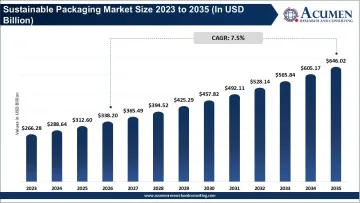
The global sustainable packaging market size was valued at USD 312.60 billion in 2025 and is expected to reach USD 646.02 billion by 2035; expanding at a CAGR of 7.5% during the forecast period of 2026 to 2035.
- Base Year Market Size (2025): $312.60 billion
- Current Year Market Size (2026): $338.20 billion
- Estimated Year Market Size (2035): $646.02 billion
- Forecast Period CAGR (2026-2035): 7.5%
Report Highlights
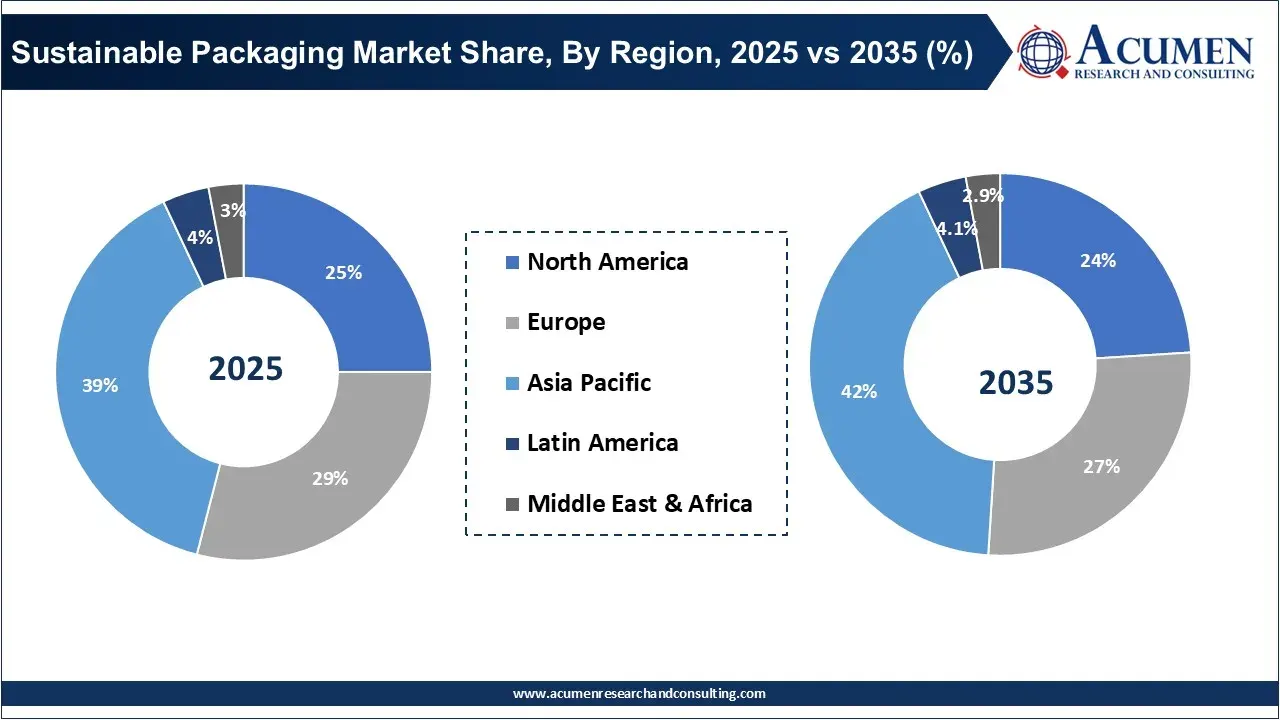
- By region: Asia-Pacific dominated the sustainable packaging market with a 39.0% share in 2025, generating $121.91 billion in revenue. It is also the fastest-growing region, with an 8.3% CAGR projected from 2026 to 2035, and is expected to reach $271.33 billion by 2035.
- By material: Paper and paperboard dominated the material segment with a 43.0% share in 2025. Its share is projected to increase to 47.0% by 2035, supported by demand for fiber-based packaging and recyclable material options.
- By packaging format: Corrugated boxes and cases led the packaging format segment with a 30.0% share in 2025. Folding cartons and paperboard boxes are projected to grow fastest among the listed formats, at an 8.8% CAGR from 2026 to 2035.
- By packaging structure: Rigid packaging dominated the segment with a 55.0% share in 2025, reflecting its broad use in containers, bottles, jars, and protective packaging. Flexible packaging ranked second with a 34.0% share.
- By packaging level: Primary packaging accounted for the largest share at 48.0% in 2025, followed by secondary packaging at 32.0%. Demand reflects the need to protect products while improving packaging material efficiency and recyclability.
- By end-use industry: Food and beverages dominated the end-use segment with a 43.0% share in 2025, driven by packaging requirements across food products and beverages. E-commerce, retail, and logistics ranked second, accounting for 18.0% of the market.
What is Sustainable Packaging Market?
The sustainable packaging market comprises materials, products, and packaging solutions designed to minimize environmental impact while maintaining product protection, safety, and functionality. It includes recyclable, reusable, compostable, biodegradable, and recycled-content packaging made from materials such as paper and paperboard, plastics, glass, and metal. Market growth is driven by increasing demand for environmentally responsible products, corporate sustainability commitments, packaging waste reduction initiatives, and regulations promoting recycling and material efficiency. Food and beverages, personal care, healthcare, retail, and e-commerce are key end-use industries adopting sustainable packaging to address changing consumer expectations and environmental requirements.
Recent Trends
- Paper-Based Substitutes: Manufacturers are expanding paper-based packaging solutions to replace conventional plastic formats in food service, e-commerce, and consumer goods. Advances in barrier coatings and fiber molding are improving moisture resistance, product protection, and suitability for applications previously dependent on plastic.
- Mono-Material Packaging: Packaging manufacturers are increasingly designing flexible packs using a single polymer type to simplify sorting and mechanical recycling. These structures can preserve packaging functionality while reducing material combinations that complicate recycling processes and limit recovered-material quality.
- Reusable Packaging Systems: Businesses are exploring refillable containers, returnable transport packaging, and deposit-based reuse models to reduce dependence on single-use formats. Digital tracking, standardized containers, and reverse logistics systems are helping organizations manage collection, cleaning, and redistribution.
Sustainable Packaging Materials Comparison
| Packaging Material | Key Sustainability Advantages | Limitations | Common Applications |
|---|---|---|---|
| Paper and paperboard | Renewable fiber sources, widely recyclable grades, and suitability for recycled content | Moisture and grease resistance may require coatings; fiber quality can decline after repeated recycling | Cartons, shipping boxes, paper bags, food packaging |
| Recycled and recyclable plastics | Lightweight, durable, and adaptable to different packaging formats; recycled content can reduce demand for virgin plastic | Recycling depends on polymer type, packaging design, collection systems, and contamination levels | Bottles, containers, films, pouches |
| Glass | Reusable and recyclable without the same material degradation associated with many other materials | Heavy to transport and energy-intensive to manufacture; breakage can create handling challenges | Beverage bottles, food jars, cosmetics containers |
| Metal, including aluminum and steel | Durable, highly recyclable, and suitable for repeated material recovery | Primary metal production can be energy-intensive; collection and sorting affect recovery | Beverage cans, food cans, aerosol containers |
| Bio-based plastics | Can reduce reliance on fossil-based feedstocks when made from renewable resources | Bio-based does not automatically mean biodegradable or compostable; feedstock and processing impacts vary | Selected food packaging, films, containers |
| Compostable materials | May offer an end-of-life route through suitable composting systems for specific applications | Often require particular composting conditions; local collection and processing infrastructure may be limited | Food-service items, selected food-waste packaging |
| Reusable packaging | Can reduce single-use packaging demand when containers complete enough reuse cycles | Requires collection, cleaning, reverse logistics, and durable design | Refillable bottles, transport crates, reusable delivery containers |
Sustainable Packaging Market Dynamics
Growth Drivers
- Environmental Regulations: Governments are introducing packaging waste reduction requirements, extended producer responsibility schemes, recycled-content provisions, and restrictions on selected single-use plastics. These measures encourage manufacturers and brand owners to redesign packaging materials and invest in compliant alternatives.
- Brand Sustainability Commitments: Consumer-facing companies are incorporating packaging redesign into broader environmental targets, encouraging suppliers to develop recyclable, reusable, lightweight, and responsibly sourced materials. Packaging has become a visible area for companies seeking to demonstrate progress toward waste reduction and resource efficiency.
- E-Commerce Expansion: Growth in online shopping is increasing demand for protective shipping materials, mailers, cushioning, and secondary packaging. Businesses are adopting recyclable paper-based formats, right-sized packaging, and material-efficient designs to reduce shipping waste and improve packaging efficiency.
Market Restraints
- Higher Material Costs: Sustainable packaging materials and specialized manufacturing processes can cost more than established conventional alternatives. Price differences may be particularly challenging for high-volume, price-sensitive products, where even small increases in packaging expenditure can affect margins.
- Recycling Infrastructure Gaps: Limited collection, sorting, composting, and recycling infrastructure can prevent sustainable packaging from achieving its intended environmental benefits. Materials designed for recovery may still enter landfills when local waste-management systems cannot process them effectively.
- Performance Limitations: Some sustainable materials struggle to match conventional packaging in moisture resistance, oxygen barriers, durability, shelf life, or heat tolerance. These limitations can restrict adoption in products requiring strict preservation, contamination control, or extended distribution periods.
Market Opportunities
- Agricultural Waste Utilization: Crop residues, bagasse, rice husks, and other agricultural by-products offer opportunities to develop fiber-based packaging materials. Converting waste streams into packaging inputs can diversify raw-material supply and create additional value for agricultural processors.
- Smart Packaging Integration: Combining sustainable materials with freshness indicators, traceability features, and product-condition monitoring can help reduce spoilage and improve supply-chain visibility. These solutions create opportunities for packaging that supports both material sustainability and better product management.
- Refill and Reuse Models: Retailers, food service operators, and consumer-goods companies can expand refill stations, reusable delivery containers, and returnable packaging programs. Standardized formats and efficient collection networks can help businesses reduce disposable packaging consumption across recurring transactions.
Market Challenges
- Recycling Compatibility: Packaging components such as adhesives, inks, labels, coatings, and multilayer structures can interfere with sorting and material recovery. Manufacturers must coordinate material selection and package design to ensure that complete packaging formats are compatible with available recycling systems.
- Supply Chain Consistency: Sustainable packaging producers must secure reliable supplies of recycled fibers, recycled polymers, and renewable feedstocks with consistent quality. Variations in availability, contamination, pricing, and material specifications can complicate manufacturing schedules and large-scale commercialization.
- Environmental Claim Verification: Companies face increasing scrutiny over claims such as recyclable, compostable, biodegradable, and carbon-neutral packaging. Demonstrating these claims requires credible testing, transparent lifecycle information, and evidence that materials can achieve the stated outcomes under relevant disposal conditions.
Sustainable Packaging Adoption by Industry
- Food and Beverage Industry: The food and beverage industry adopts sustainable packaging to reduce packaging waste, improve recyclability, and meet growing demand for environmentally responsible products. Common solutions include recyclable paperboard cartons, lightweight containers, recycled-content plastics, aluminum cans, reusable beverage bottles, and compostable food-service packaging.
- E-commerce and Retail Industry: E-commerce and retail companies use sustainable packaging to reduce shipping waste and minimize unnecessary packaging materials. Key solutions include recyclable corrugated boxes, paper-based mailers, right-sized packaging, recycled-content materials, and reusable shipping containers.
- Personal Care and Cosmetics Industry: Personal care and cosmetics brands are adopting refillable containers, recyclable bottles, recycled plastics, paper-based cartons, and packaging made with reduced material content. These solutions help brands address sustainability commitments while maintaining product quality and visual appeal.
- Healthcare and Pharmaceutical Industry: Healthcare and pharmaceutical companies are exploring sustainable packaging through lightweight designs, recyclable secondary packaging, responsibly sourced paperboard, and reduced-material packaging formats. Adoption requires careful consideration of sterility, contamination prevention, product stability, traceability, and regulatory compliance.
Sustainable Packaging Market Segmental Insights
Material Insights
Paper & Paperboard: Paper and paperboard dominated the sustainable packaging materials segment with a 43.0% share in 2025, projected to increase to 47.0% by 2035. Adoption is supported by renewable fiber sourcing, established recycling systems, and broad use in cartons, corrugated boxes, and paper-based protective packaging across food, retail, and e-commerce applications.
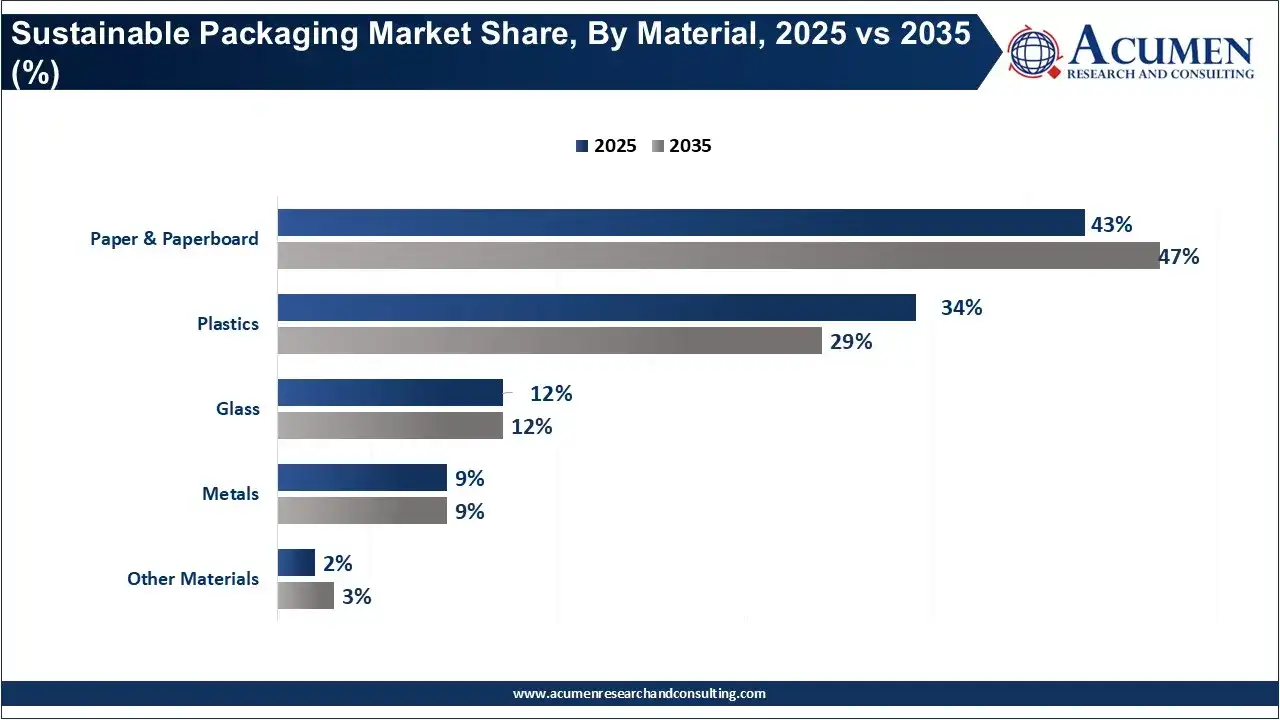
Plastics: Plastics represented the second-largest material category, accounting for 34.0% of the market in 2025. Their lightweight structure, durability, flexibility, and protective performance support continued use in bottles, films, pouches, and containers. However, the projected share declines to 29.0% by 2035 as packaging buyers increasingly evaluate recyclability, recycled content, and alternative materials.
Packaging Format Insights
Corrugated Boxes & Cases: Corrugated boxes and cases dominated the packaging format segment with a 30.0% share in 2025, rising to a projected 31.0% by 2035. Their broad use in shipping, storage, retail distribution, and e-commerce supports demand. Recyclable fiber-based construction and compatibility with established paper recovery systems further strengthen their role in sustainable transport packaging.
Folding Cartons & Paperboard Boxes: Folding cartons and paperboard boxes held a 17.0% share in 2025 and are projected to grow at the fastest rate among the listed formats, with an 8.8% CAGR from 2026 to 2035. Demand is supported by applications in packaged food, personal care, pharmaceuticals, and consumer goods, where lightweight, printable, and recyclable packaging can support sustainability goals.
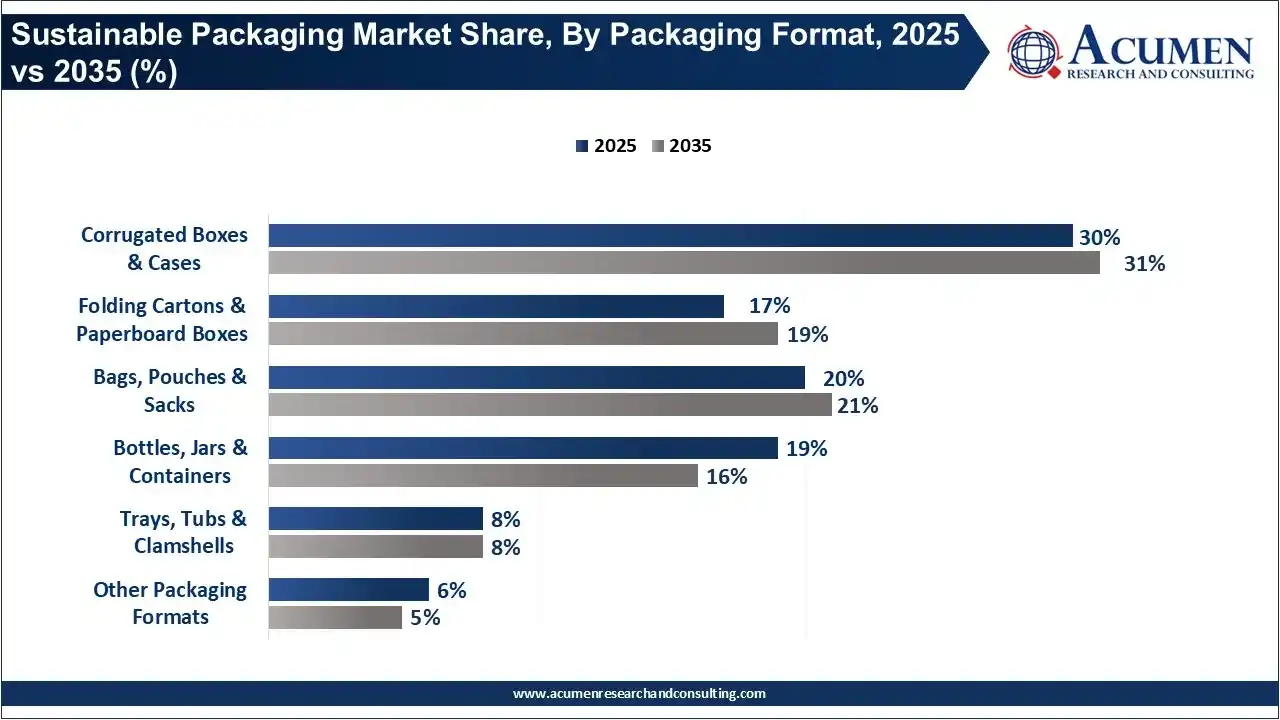
Bags, Pouches & Sacks: Bags, pouches, and sacks accounted for a 20.0% share in 2025, making them the second-largest packaging format. Their use across food products, groceries, agricultural goods, and consumer products supports demand. Recyclable paper bags, material-efficient pouches, and packaging redesign offer opportunities, although barrier performance and material recovery remain important considerations.
Packaging Structure Insights
Rigid Packaging: Rigid packaging dominated the segment with a 55.0% share in 2025. Bottles, jars, containers, and rigid boxes provide structural protection, convenient handling, and compatibility with established filling and distribution systems. Sustainable alternatives include recyclable metal and glass, recycled-content plastics, and packaging designs that reduce material use without compromising product safety.
Flexible Packaging: Flexible packaging represented the second-largest category, with a 34.0% share in 2025. Its lightweight construction can reduce material consumption and transportation weight compared with certain rigid alternatives. Demand is supported by applications in food, personal care, and household products, while recyclable mono-material structures and improved collection systems are important to addressing end-of-life challenges.
Packaging Level Insights
Primary Packaging: Primary packaging dominated the segment with a 48.0% share in 2025. As the packaging in direct contact with, or immediately containing, a product, it must protect quality, safety, and usability. Sustainable options include recyclable containers, lightweight bottles, paper-based formats where suitable, and refillable designs that meet product-specific performance requirements.
Secondary Packaging: Secondary packaging accounted for a 32.0% share in 2025, making it the second-largest category. It groups, protects, and presents individual products during storage, merchandising, and distribution. Corrugated cartons, paperboard boxes, and recyclable outer packaging provide opportunities to reduce material complexity and improve recovery, particularly in retail, food, personal care, and e-commerce supply chains.
End-Use Industry Insights
Food & Beverages: Food and beverages dominated the end-use industry segment with a 43.0% share in 2025. High packaging volumes across fresh foods, processed products, snacks, and beverages support demand for recyclable cartons, paperboard packaging, metal cans, glass containers, and recycled-content plastics. Adoption depends on food safety, moisture and oxygen barriers, shelf life, and recycling availability.
E-commerce, Retail & Logistics: E-commerce, retail, and logistics represented the second-largest end-use category, with an 18.0% share in 2025. Parcel deliveries and distribution networks create demand for corrugated boxes, recyclable mailers, right-sized packaging, and reusable transport solutions. Businesses are redesigning packaging to reduce excess material, protect goods in transit, and improve recovery across shipping and returns.
Healthcare & Pharmaceuticals: Healthcare and pharmaceuticals accounted for an 11.0% share in 2025. Adoption focuses on recyclable secondary packaging, lightweight cartons, and more efficient shipping materials while maintaining stringent requirements for product integrity, sterility, traceability, and regulatory compliance. Changes to primary packaging can be more complex because materials must meet specific safety and stability requirements.
Sustainable Packaging Market Regional Insights
Which Region Dominated the Sustainable Packaging Market in 2025?
Europe dominated the sustainable packaging market by region in 2025, accounting for 29.0% of global revenue, equivalent to $90.65 billion. The region's position reflects established packaging recovery systems, circular-economy initiatives, corporate sustainability commitments, and regulatory pressure to improve packaging recyclability and reduce waste. Germany and France are important markets within Europe's packaging compliance landscape, where producer responsibility and packaging waste requirements influence material selection and product design.
Europe's market is projected to reach $174.43 billion by 2035, expanding at a CAGR of 6.6% from 2026 to 2035. Its share is expected to moderate to 27.0% by 2035, indicating that other regions, particularly Asia-Pacific, are projected to expand more rapidly. Opportunities include recyclable paper-based packaging, recycled-content materials, reuse systems, and packaging formats designed to meet evolving environmental requirements.
Which Region Is Expected to Grow Fastest in the Sustainable Packaging Market?
Asia-Pacific is projected to be the fastest-growing regional market for sustainable packaging, with a CAGR of 8.3% from 2026 to 2035. The region accounted for 39.0% of global market revenue in 2025, valued at $121.91 billion, making it the second-largest region by the supplied 2025 share figures only if Europe is excluded from the comparison; based on the data, Asia-Pacific is actually the largest region in 2025. Its market is projected to reach $271.33 billion by 2035, increasing its share to 42.0%.
Growth opportunities are supported by expanding e-commerce, rising packaged-food consumption, manufacturing activity, and efforts to improve packaging collection and recycling. China, India, Japan, and South Korea represent important country markets, although regulations, infrastructure, and adoption patterns differ. Demand is expected to span corrugated shipping boxes, paperboard cartons, recyclable plastics, and packaging formats designed to reduce material use.
Top 5 Countries in Sustainable Packaging Regulations and Compliance
| Country | Key Regulations and Compliance Requirements | Impact on the Sustainable Packaging Market |
|---|---|---|
| Germany | Packaging Act (VerpackG), producer registration, participation in approved packaging recovery systems, and reporting obligations for applicable packaging. | Encourages companies to improve packaging recyclability, increase recovery, and meet producer responsibility requirements. |
| France | Anti-Waste for a Circular Economy (AGEC) Law, extended producer responsibility (EPR), recycling information, and restrictions on selected single-use plastic products. | Supports recyclable packaging, reuse systems, improved waste sorting, and reduced reliance on selected disposable formats. |
| United Kingdom | Packaging Extended Producer Responsibility (pEPR), packaging waste reporting, and Plastic Packaging Tax for qualifying plastic packaging that contains less than 30% recycled plastic. | Encourages businesses to reduce packaging waste, improve recycling outcomes, and consider recycled-content materials. |
| United States | Federal and state-level requirements, including state EPR programs and recycled-content mandates. California, Oregon, and other states have introduced packaging-related obligations. | Creates demand for recyclable designs, recycled-content plastics, packaging data reporting, and compliance solutions tailored to individual states. |
| Japan | Act on the Promotion of Sorted Collection and Recycling of Containers and Packaging, alongside requirements for businesses and municipalities involved in packaging waste collection and recycling. | Promotes material recovery, waste sorting, efficient packaging design, and recycling-oriented packaging systems. |
Top Companies
- Amcor
- International Paper
- Smurfit Westrock
- Mondi
- Sealed Air
- Sonoco Products Company
- Ball Corporation
- Crown Holdings
- Tetra Pak
- Berry Global
Recent Developments
- August 2026: The European Union's Packaging and Packaging Waste Regulation began applying on August 12, 2026, introducing requirements covering packaging design, recyclability, recycled content, reuse, labeling, and waste reduction. The regulation is expected to influence packaging design and compliance strategies for companies selling products in the EU.
- August 2026: IPL Schoeller and PureCycle Technologies announced the SnapPack Square EVO container line incorporating 20% recycled polypropylene resin. The launch provides brands with a packaging option designed to help address emerging recycled-content requirements and extended producer responsibility regulations
Segments Covered
By Material
- Paper & Paperboard
- Plastics
- Glass
- Metals
- Other Materials
By Packaging Format
- Corrugated Boxes & Cases
- Folding Cartons & Paperboard Boxes
- Bags, Pouches & Sacks
- Bottles, Jars & Containers
- Trays, Tubs & Clamshells
- Other Packaging Formats
By Packaging Structure
- Rigid Packaging
- Flexible Packaging
- Semi-Rigid Packaging
By Packaging Level
- Primary Packaging
- Secondary Packaging
- Tertiary Packaging
By End-Use Industry
- Food & Beverages
- Healthcare & Pharmaceuticals
- Personal Care & Cosmetics
- E-commerce, Retail & Logistics
- Consumer Electronics & Appliances
- Industrial & Manufacturing
- Others
Looking for discounts, bulk pricing, or custom solutions? Contact us today at sales@acumenresearchandconsulting.com
Frequently Asked Questions

Related Market Research Reports
June 2024
October 2026
October 2026
July 2026
May 2026
December 2025
November 2025
May 2025