
Automated Storage and Retrieval System Market Size, Share, Report 2026 to 2035
Automated Storage and Retrieval System Market (By Type: Unit Load ASRS, Mini Load ASRS, Vertical Lift Modules, Carousel ASRS, Robotic ASRS, Cube-based ASRS, Others; By Operability: Fixed-Aisle ASRS, Mobile ASRS; By End Use Industries: E-commerce & Retail, Automotive, Food & Beverages, Healthcare & Pharmaceutical, Electronics & Semiconductor, Third-Party Logistics, Manufacturing, Aerospace & Defense, Others) - Global Industry Analysis, Size, Share, Regional Analysis, Trends and Forecast 2026 - 2035
- Last Updated: 29 May 2026
- Report Code: ARC3930
- Category: Semiconductor and Electronics
Automated Storage and Retrieval System Market Size, Forecast 2026 to 2035
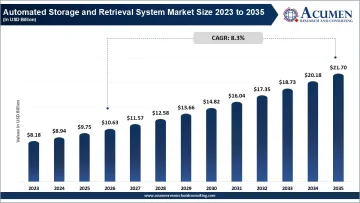
The global automated storage and retrieval system market size was valued at $ 9.75 billion in 2025 and is estimated to surpass around $ 21.70 billion by 2035 growing at a CAGR of 8.3% from 2026 to 2035. The market is seen to grow rapidly with the integration in automotive and e-commerce/retail sectors that heavily rely on automation for precision material and rapid delivery requirements. The market holds potential of expansion as a massive wave of operators are retrofitting existing, traditional warehouses.
Report Highlights
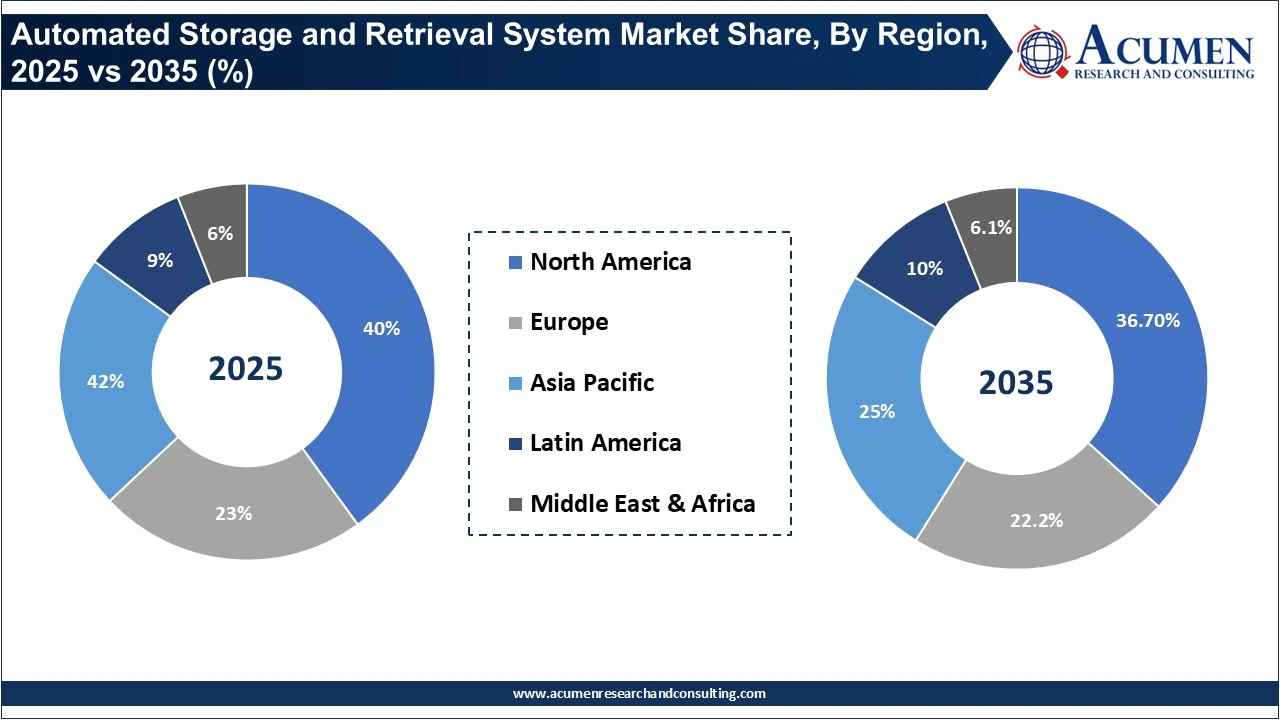
- By region, North America dominated the market with 40% share in 2025 owing to the presence of major companies and advanced technologies, especially in e-commerce sector. The region is seen to grow at the CAGR of 7.2% during the forecast period.
- By region, Asia Pacific is expected to grow at the fastest rate during the forecast period at a CAGR of 9.8%. This surge is propelled by immense state investments in logistics infrastructure, smart factories, and localized manufacturing hubs.
- By type, the unit load ASRS segment dominated the market with 28% share in 2025 due to rising demand for high-capacity palletized storage systems across large warehouses and manufacturing facilities.
- By type, the cube-based ASRS segment is expected to witness the fastest rate of growth at the CAGR of 12.4% during the forecast period owing to the increasing deployment of scalable robotic warehouse automation systems.
- By operability, the fixed-aisle ASRS segment dominated the market with 72% market share in 2025 owing to its widespread deployment in high-volume industrial storage operations.
- By operability, the mobile ASRS segment held 28% share in 2025 and expected to grow at a CAGR of 16% over the forecast period due to rising adoption of autonomous mobile robots and dynamic inventory technologies.
- By end use industry, the e-commerce and retail segment dominated the market with the largest share of 32% in 2025 due to rapid growth in online shopping rate and investments in automated fulfilment centers.
- By end use industry, the manufacturing segment accounted for the second-largest market share of 22% in 2025 owing to increasing implementation of industrial automation, smart factory technologies, and automated material handling systems across production facilities.
Market Overview
The automated storage and retrieval systems (ASRS) market describes the area of design and implementation of computer-controlled devices that automatically place, stock, retrieve and monitor inventory within warehouse, manufacturing and distribution centers. The technologies that fall within the scope of ASRS include unit load systems, mini load systems, robotic retrieval systems, shuttle systems, cube-based storage systems and vertical lift modules that increase warehousing efficiency, accuracy and productivity.
The growing demand in the automated storage and retrieval systems (ASRS) market is largely propelled by increased volumes of e-commerce transactions, lack of laborers, growing expense of warehouse operations and increasing use of industry 4.0 techniques in manufacturing and logistics sectors globally. Emerging technologies, such as Artificial intelligence, robotics, autonomous mobile robots (AMR), IoT driven warehouse management systems, and smart logistics system are paving the way for fully automated warehouses.
Global Investment & Adoption Trends in Automated Storage and Retrieval System
| Category | Secondary Data / Statistics | Major Countries with Investments & Adoption |
|---|---|---|
| Global Warehouse Automation Investment | Global warehouse automation investments exceeded US$ 35 billion in 2025 | United States, China, Germany, Japan |
| E-commerce Fulfillment Centers | More than 70% of large e-commerce warehouses globally are adopting automated storage technologies | United States, China, India, United Kingdom |
| Labor Cost Reduction | Companies implementing ASRS systems report operational labor cost reductions of 25%–40% | United States, Germany, Japan |
| Warehouse Space Optimization | ASRS systems can improve storage density by nearly 60% compared to traditional warehousing | Singapore, Japan, South Korea |
| Autonomous Mobile Robots (AMRs) | Global AMR deployment in warehouses surpassed 500,000 units in 2025 | China, United States, South Korea |
Market Dynamics
Driver
Rapid Growth of E-commerce and Warehouse Automation
Growing e-commerce and omnichannel operations is the main driving factor of the automated storage and retrieval system market growth. An increasing demand for day and next day delivery, which is being driven by consumer expectations, requires retailers and logistics providers to implement and upgrade their warehouse infrastructure and enhance warehouse inventory management. The automation of warehouse operations using ASRS technologies enables enterprises to shorten order fulfillment times and reduce operational downtime, along with the optimum utilization of warehouse space and high inventory accuracy. Increasing labor shortage in the warehouse and higher warehouse wages, on the other hand, has compelled various businesses to adopt automated material handling systems, which can eliminate human intervention.
Restraint
High Initial Investment
The expensive initial installation costs related to ASRS technology are one of the most prominent factors limiting growth in this market, especially among SMEs. Automated storage and retrieval systems demand significant upfront investment into such components as robotics, warehouse structure changes, software, conveyor systems and controls. The integration with current warehouse management systems (WMS), enterprise resource planning systems (ERP) and operation is also an integration, which takes a lot of technicality and time.
Opportunity
Rising Adoption of AI-Driven Smart Warehouses and Robotics
The proliferation of smart logistics and AI powered warehouse automation systems has led to the emergence of great opportunities for the automated storage and retrieval systems market to grow. Businesses are heavily investing in intelligent robotics and automated mobile robots, Machine Learning solutions, and intelligent warehouse management systems in order to gain competitive edge and overcome supply chain disruptions. Adoption of smart factories and Industry 4.0 have catalyzed the need for ASRS system to integrate with IoT, cloud based systems, digital twins, and real time analytic systems. Rising demand of intelligent automation in the industrial sector, combined with increasing government incentives for the automation in emerging economies, is expected to create new market opportunities for ASRS solution providers worldwide.
Regional Analysis
- The North America automated storage and retrieval system market size was valued at $3.90 billion in 2025 and is estimated to surpass around $7.96 billion by 2035 growing at a CAGR of 7.2% from 2026 to 2035.
- The Europe automated storage and retrieval system market size was estimated at $2.24 billion in 2025 and is expected to hit around $4.82 billion by 2035 growing at a CAGR of 7.8% from 2026 to 2035.
- The Asia-Pacific automated storage and retrieval system market size reached at $2.15 billion in 2025 and is anticipated to reach around $5.42 billion by 2035 growing at a CAGR of 9.8% from 2026 to 2035.
North America Led the Market in 2025; U.S. to Remain the Largest Shareholder:
With the largest market share of 40% in 2025 North America dominated the automated storage and retrieval system market and is projected to grow at a CAGR of 7.2% over the forecast period, driven by increased investment in smart warehouses, robotic material handling, and advanced supply chain optimization technologies. North America is quickly becoming a global leader in warehouse automation innovation as labor costs rise, and companies face increasing pressure to improve efficiency and accelerate order delivery timelines.
The increasing popularity of online retail and omnichannel shopping has led to a surge in the demand for automated storage and retrieval systems which can process large volumes of inventory quickly and efficiently. The region is seeing a rapid rise in large-scale fulfillment centers, and cold storage warehouses for the management of grocery delivery, pharmaceutical distribution, and temperature-controlled inventory. Labor shortages and the growing trend in increasing labor costs is accelerating the move to automation for material handling.
U.S. Market Analysis:
The United States is leading the North American automated storage and retrieval system market owing to its extremely well-developed logistics network, mature e-commerce ecosystem, and aggressive investments in automation for its warehouses. With over USD 1.1 trillion in online retail sales, the U.S. E-commerce industry is driving massive demand for intelligent warehouses and rapid fulfillment solutions. Leading retailers such as Amazon, Walmart, and Target Corporation are heavily investing in robotic storage and retrieval technology across its expanding fulfillment centers to meet high consumer demand for one day and two day deliveries.
The U.S. Is currently observing massive adoption of AMRs, AGVs, robotic pickers, and AI-enabled warehouse management systems across various distribution centers. Estimates suggest that there are more than 20,000 large fulfillment centers throughout the United States with an increasing percentage being automated.
Rapid Industrialization & E-commerce Expansion to Support the Market in Asian Countries:
Asia Pacific is estimated to witness the fastest CAGR of 9.8% over the forecast period, owing to accelerated industrialization, expansion of e-commerce business, increasing deployment of warehouse automation and substantial investment by governments in logistics infrastructure and smart manufacturing infrastructure. Furthermore, rapidly growing production of manufactured products, expanding network of retail distribution, and rise in usage of industrial automation in countries like China, India, Japan, South Korea have led to high demand of ASRS systems. The brisk growth of e-commerce platforms and digital business networks across Asia Pacific region is leading to establishment of enormous automated warehouses capable of managing million inventories on daily basis.
Moreover, rapid increase in the adoption of Industry 4.0, along with the increasing labor prices in most major economic regions, is fueling the implementation of robotic ASRS systems in factories. Also, the rapidly expanding population, growing middle-income segment and advancing retail networks are further propelling the long term growth of the market in Asia Pacific region.
Major Government Initiatives Supporting ASRS Market in Asia Pacific:
| Country | Government Initiative | Key Highlight | Impact on the Industry |
|---|---|---|---|
| China | Made in China 2025 | Smart manufacturing and industrial automation | Increasing deployment of robotic warehouses and automated logistics systems |
| India | National Logistics Policy | Logistics modernization and supply chain efficiency | Rising investments in automated warehouses and distribution infrastructure |
| Japan | Society 5.0 Initiative | AI, robotics, and smart industrial ecosystems | Growing adoption of intelligent factory automation and robotic storage systems |
| South Korea | Smart Factory Expansion Strategy | Automation of manufacturing facilities | Increased demand for ASRS in electronics and semiconductor industries |
| Singapore | Logistics Industry Digital Plan | Smart logistics and warehouse digitalization | Expansion of AI-enabled automated fulfillment centers |
Segmental Analysis
Type Insights
The unit load ASRS segment was the dominant segment in automated storage and retrieval systems market with 28% market share in 2025 due to its increasing implementation across large-scale warehousing, distribution centers and industrial storage spaces. Unit load ASRS systems are primarily designed to handle the large inventory and pallet loads efficiently in such locations as automobile, food & beverage, manufacturing and third party logistics sector. For instance, major fulfillment centers of world retailers adopt unit load ASRS systems coupled with robotic pallet handling to cater the high speed inventory movement and avoid operational down time.
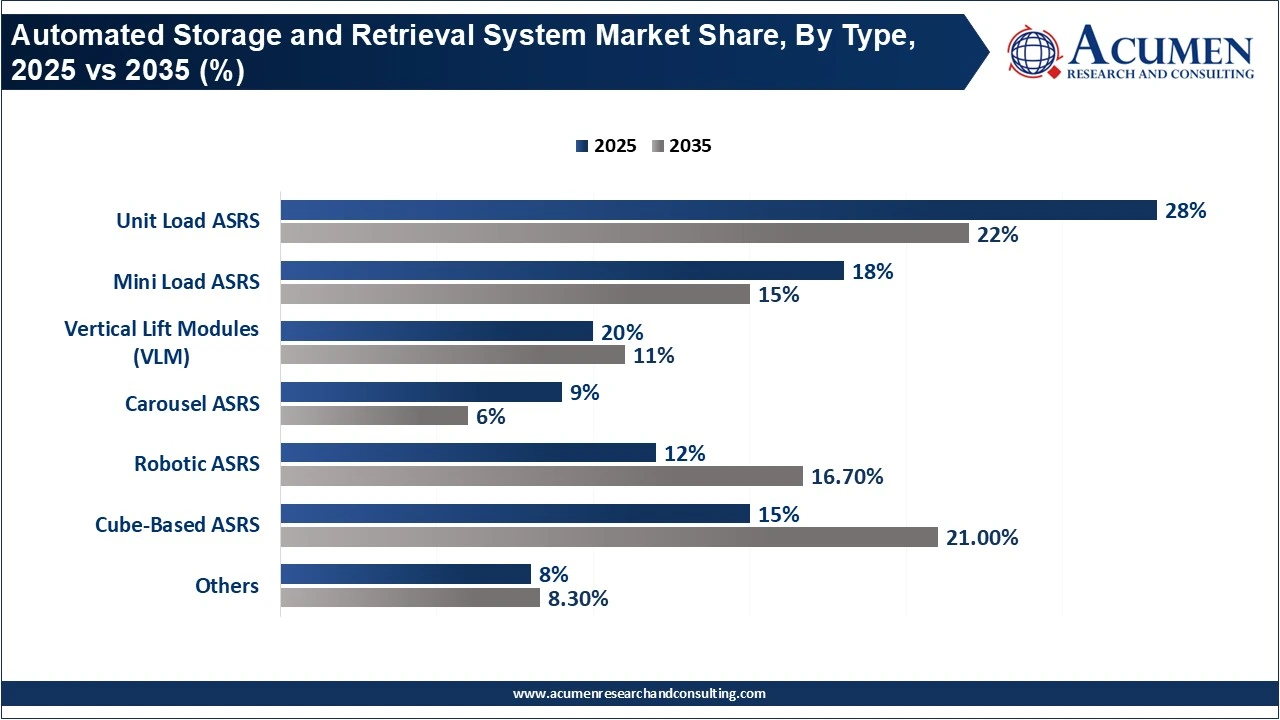
The mini load ASRS segment captured second largest market share of 18% in 2025. This growing segment is primarily attributed to the growing demand for the compact, high speed storage systems to handle the smaller inventory such as carton, tray and bin. The mini load ASRS systems find wide applications across pharmaceutical, electronic, e-commerce, health care industries, to enable accurate inventory handling and rapid retrieval operations. Increasing importance of order picking automation and inventory optimization is expected to fuel the adoption of mini load ASRS technologies in modern warehousing facilities.
The cube-based ASRS segment is anticipated to witness the highest growth over the forecast period, registering the CAGR of 12.4%. The fast growth of cube-based ASRS segment is attributed to its high flexibility, scalability and space efficiency. Cube-based ASRS systems employ robotic systems which navigate through a grid like storage structure to achieve rapid inventory retrieval and high density storage; therefore, these systems are adopted widely by the e-commerce companies and high volume fulfillment centers to efficiently utilize the warehousing capacity.
Operability Insights
The fixed aisle ASRS segment held the maximum market share of 72% in 2025 as it is heavily used by large warehouses, manufacturing facilities, and industrial warehouses. The fixed aisle ASRS operate in a way of a pre-defined route storage and retrieval pathway and thus facilitate efficient storage and retrieval operations with high degree of orderliness. These systems are commonly preferred for high volume storage operations and demand efficiency, reliability, and performance in terms of operational stability. The benefits offered by fixed aisle ASRS are: higher storage density, reduced operational error, improved inventory accuracy and control, and enhanced productivity in warehouse operations. Industries like automobile manufacturing, food & beverages, pharmaceuticals and heavy industries utilize fixed aisle ASRS for their large volumes of inventory management.
The mobile ASRS segment had the market share of 28% in 2025 and it is expected to grow with the fastest CAGR of 16% over the forecast period. The segment's growth is attributed to growing demand for a flexible and adaptable automation in warehouses which can fulfill a wide variety of operations. Mobile ASRS systems use AMRs, robotic shuttles and mobile retrieving technologies that autonomously traverse through the warehouse irrespective of any path. These are gaining prominence in e-commerce fulfillment centers with a higher movement and flexibility of inventory movement.
End Use Industry Insights
The e-commerce & retail segment held the dominant share with the largest market share of 32% in 2025 driven by the massive growth of online shopping, omnichannel retailing and high-volume order fulfillment. E-commerce firms are highly investing in state-of-the-art warehouse automation technologies to attain optimum inventory accuracy, speedy delivery timelines and efficiency on reduced operational costs. ASRS systems are of critical importance in fulfillment centers in managing speedy storage, picking, sorting and retrieval of goods without any human interaction.
The manufacturing segment held the second-largest market share of 22% in 2025 driven by enhanced adoption of industrial automation and smart factory technologies. Manufacturing firms are significantly investing in ASRS systems to optimize material handling operations, improve production downtime, and enhance workflow efficiency. The automotive, heavy machinery, electronics and industrial equipment manufacturing industries are the dominant adopters of ASRS technologies in managing the storage of raw materials, work-in-progress inventory management and finished goods handling.
Key Players
- Daifuku Co., Ltd.
- SSI SCHAEFER Group
- Dematic
- Honeywell Intelligrated
- KNAPP AG
- Vanderlande Industries
- Murata Machinery, Ltd.
- Toyota Industries Corporation
- Kardex Group
Recent News
- March 2026- Daifuku's latest next-generation AI automated storage and retrieval system(AS/RS) was announced to offer improved warehouse productivity, maintenance prediction, and inventory accuracy for both e-commerce and manufacturing warehouses. It uses a combination of robotics, ML and real-time warehouse analytics for improved warehouse storage.
- January 2026- AutoStore and Siemens formed a strategic partnership that will support in increasing the intelligent warehouse automation and digital logistics solution. The cooperation between the two will focus on bringing together robotics, AI software and Automated cube-based AS/RS technology for improved distribution center fulfillment worldwide.
Segments Covered in the Report
By Type
- Unit Load ASRS
- Mini Load ASRS
- Vertical Lift Modules
- Carousel ASRS
- Robotic ASRS
- Cube-based ASRS
- Others (Shuttle-based ASRS)
By Operability
- Fixed-Aisle ASRS
- Mobile ASRS
By End Use Industries
- E-commerce & Retail
- Automotive
- Food & Beverages
- Healthcare & Pharmaceutical
- Electronics & Semiconductor
- Third-Party Logistics
- Manufacturing
- Aerospace & Defense
- Others
By Region
- North America
- Asia Pacific
- Europe
- Latin America
- Middle East and Africa
Looking for discounts, bulk pricing, or custom solutions? Contact us today at sales@acumenresearchandconsulting.com
Frequently Asked Questions

Other Semiconductor and Electronics Reports
May 2026
September 2023
January 2023
April 2024