
Automated Turf Harvester Market Size, Share, Forecast Report 2025 - 2033
Automated Turf Harvester Market (By Product Type: Roll Turf Harvesters, Slab Turf Harvesters; By Technology: Semi-Automatic Turf Harvesters, Fully Automatic Turf Harvesters; By Fuel Type: Diesel-Powered Turf Harvesters, Electric Turf Harvesters; By Application: Residential, Commercial, Golf Courses, Sports/Athletics) - Global Industry Analysis, Size, Share, Regional Analysis, Trends and Forecast 2025 To 2033
- Last Updated: 23 Apr 2026
- Report Code: ARC3916
- Category: Construction and Manufacturing
Automated Turf Harvester Market Size and Forecast 2025 - 2033
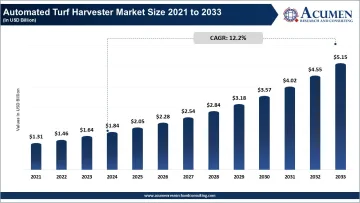
The global automated turf harvester market size accounted for USD 2.05 billion in 2025 and is estimated to reach around USD 5.15 billion by 2033 growing at a CAGR of 12.2% from 2025 to 2033.
An automated turf harvester is a specialized machine that collects sod or grass in the shape of large rolls or slabs from turf farms. Unlike manual or semi-automated equipment, these machines can cut, roll, stack, and transport turf onto pallets with little human involvement. They are supplied with cutting-edge technology such as sensors, GPS navigation, and digital control systems, ensuring high precision and operational efficiency. Fully automated turf harvesters reduce labor costs, boost output, and maintain consistent turf quality. These machines commonly employed by commercial grass growers and landscaping specialists, contribute to meeting the rising demand for sod in residential areas, commercial developments, and sports fields by allowing for faster and more consistent harvesting.
Automated Turf Harvester Market Report Highlights
- The global automated turf harvester market is expected to reach USD 5.15 billion by 2033, with a CAGR of 12.2% from 2025 to 2033.
- The North America automated turf harvester market was valued at approximately USD 681.17 million in 2024.
- The Asia-Pacific market is projected to grow at a CAGR of over 13.0% from 2025 to 2033.
- The roll turf harvesters product type sub-segment accounted notable of the automated turf harvester market share in 2024.
- Based on the technology, the fully automatic turf harvesters generate considerable revenue.
- Increasing government support for farm automation in developed economies is a popular automated turf harvester market trend that fuels the industry demand.
Automated Turf Harvester Market Insights
The automated turf harvester market is expanding rapidly, fueled by advances in agricultural automation and rising demand for high-quality turf in a variety of applications. Key drivers of this growth include rising demand for instant turf solutions in residential and commercial landscaping projects, labor shortages in agriculture prompting the use of automated harvesting equipment, technological advancements such as GPS and IoT integration improving operational efficiency, and the growing popularity of sports facilities and golf courses that require high-quality turf.
However, the market is limited in a variety of ways. Small farms' popularity is limited by their high initial investment and upkeep costs. Furthermore, limited awareness and availability in growing areas limit market penetration, while operating inefficiencies on uneven terrain may impede machine performance.
Despite these challenges, there are promising opportunities for market expansion. Turf farming's expansion into urban green infrastructure and public parks, rising interest in electric and eco-friendly turf harvesters due to sustainability trends, the incorporation of AI and machine learning for predictive maintenance and autonomous navigation, and increased government support for farm automation in developed economies all represent significant growth opportunities.
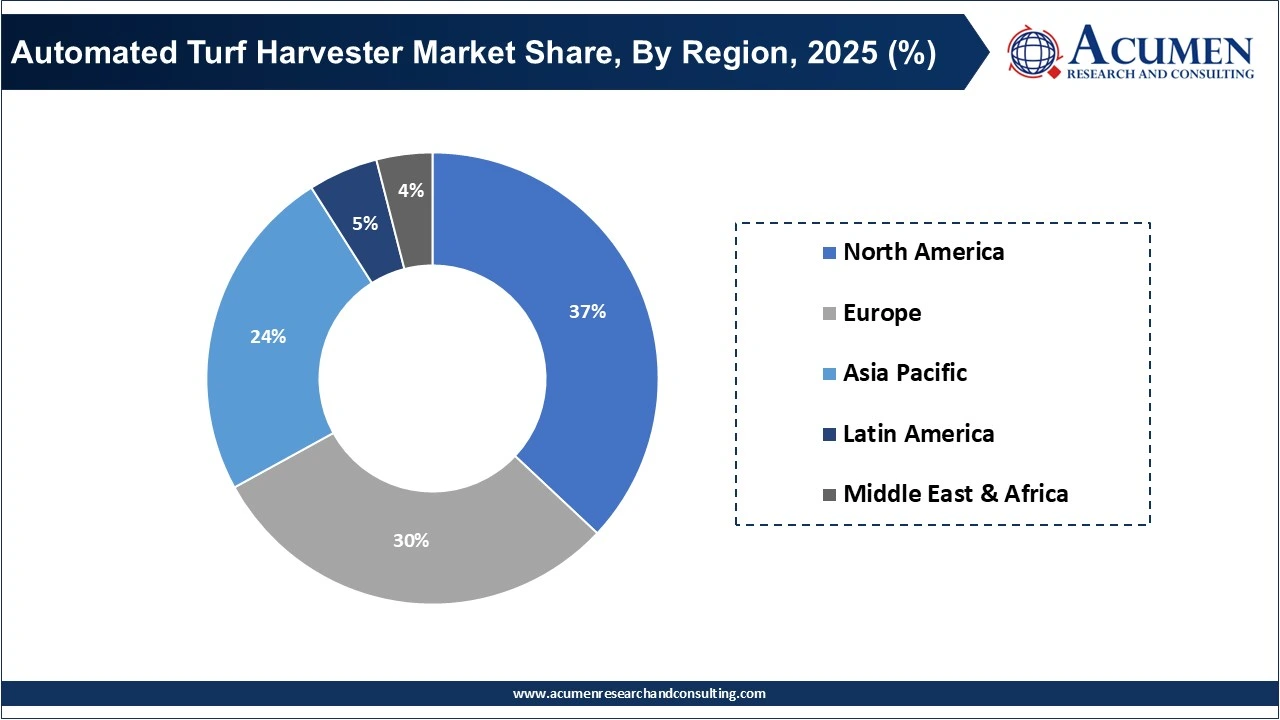
In terms of regional dynamics, North America now dominates the market, owing to the large number of turf producing farms and strong demand from residential consumers. Europe is expected to grow the fastest during the forecast period, owing to increased residential building and expanded turf farming markets. Meanwhile, expanding Asia-Pacific countries like China and India are emerging as growth hubs as a result of economic expansion and greater per capita income, which stimulates golf participation and the creation of athletic facilities, increasing demand for grass harvesters even further.
Automated Turf Harvester Market Dynamics
Market Drivers
- Rising demand for instant turf solutions in residential and commercial landscaping projects
- Labor shortages in agriculture driving adoption of automated harvesting equipment
- Technological advancements like GPS and IoT integration enhancing operational efficiency
- Growing popularity of sports facilities and golf courses requiring high-quality turf
Market Restraints
- High initial investment and maintenance costs limiting adoption by small farms
- Limited awareness and availability in emerging markets hindering market penetration
- Operational inefficiencies on uneven terrains affecting machine performance
Market Opportunities
- Expansion of turf farming in urban green infrastructure and public parks
- Rising interest in electric and eco-friendly turf harvesters due to sustainability trends
- Integration of AI and machine learning for predictive maintenance and autonomous navigation
Automated Turf Harvester Market Report Scope
| Attribute | Details |
|---|---|
| Automated Turf Harvester Market Size 2025 | USD 2.05 Billion |
| Automated Turf Harvester Market Forecast 2033 | USD 5.15 Billion |
| Automated Turf Harvester Market CAGR During 2025 - 2033 | 12.2% |
| Analysis Period | 2021 - 2033 |
| Base Year | 2025 |
| Forecast Data | 2025 - 2033 |
| Segments Covered | By Product Type, By Technology, By Fuel Type, By Application, and By Geography |
| Regional Scope | North America, Europe, Asia Pacific, Latin America, and Middle East & Africa |
| Key Companies Profiled | Redexim, Trilo Machines, Progressive Turf Equipment Inc., Turf Tick Products B.V., Vanmac B.V., R&R Products, Inc., Kesmac Inc., Autonomous Solutions, Inc. (ASI), FireFly Automatix, Inc., and Trebro Manufacturing, Inc. |
| Report Coverage | Market Trends, Drivers, Restraints, Competitive Analysis, Player Profiling, Covid-19 Analysis, Regulation Analysis |
Automated Turf Harvester Market Segmentation Insight
The worldwide market for automated turf harvester is split based on product type, technology, fuel type, application, and geography.
Product Type Insight
Roll turf harvesters are expected to account for the greatest share of the automated turf harvester market due to their efficiency and adaptability for large-scale operations. These machines are commonly employed on commercial turf farms, sports fields, and golf courses that require significant turf coverage. Roll harvesters have advantages such as simple freight, faster installation, and less turf damage during transport. Commercial turf producers appreciate their ability to harvest big areas in less time and with less effort. Furthermore, the global expansion of sports infrastructure and recreational areas increases demand for rolled turf, reinforcing roll turf harvesters' market supremacy.
Technology Insight
The fully automatic turf harvesters are expected to capture the largest share of the market. This growth is driven by the increasing demand for efficient and labor-saving equipment within the turf farming and landscaping industries. These machines combine innovative technology including GPS navigation, automatic stacking, and real-time performance monitoring to cut manual labor and operational time. They offer tremendous benefits by improving lawn quality while reducing human error and labor expenses. Their precision, high-volume turf harvesting capabilities make them ideal for commercial turf farms and sports field maintenance. As the industry continues to embrace smart agricultural technology, the global need for fully automated turf harvesting systems is expected to increase significantly.
Fuel Type Insight
The electric turf harvester segment is expected to see significant growth over the automated turf harvester market forecast period. This increase is largely driven by rising environmental concerns and a global move toward more sustainable agricultural practices. Electric turf harvesters produce fewer emissions than traditional diesel-powered machines, making them a preferred choice for businesses focused on reducing their environmental impact. Improvements in battery technology have also enhanced electric harvesters' efficiency and working time, making them more practical and cost-effective. With governments around the world imposing stricter emission regulations and encouraging the adoption of green technologies, the market for electric lawn harvesters is likely to expand rapidly. This trend is especially visible in industrialized countries where sustainability is a primary focus, resulting in a greater acceptance of electric-powered turf harvesting equipment.
Application Insight
The commercial segment is expected to emerge as the most popular application in the industry. This is mostly due to increased demand for high-quality turf in commercial landscaping projects such as office buildings, shopping malls, and public parks. Commercial turf farms require efficient and large-scale harvesting systems to meet the growing demand for well-kept green spaces. Automated turf harvesters help these businesses increase output, reduce labor costs, and maintain uniform turf quality. Furthermore, as urbanization and infrastructure development accelerate, demand in this area rises. As businesses prioritize sustainable and effective landscaping practices, the commercial sector is expected to drive market growth in the coming years.
Automated Turf Harvester Market Regional Insight
Why does North America dominates in the automated turf harvester market?
North America dominates the market, owing to a high density of sports fields, golf courses, and commercial landscaping projects. The turf cultivation industries in the United States and Canada are highly established, with a high level of use of automated harvesting technology. Government aid, such as the Sub-Mission on Agricultural Mechanization (SMAM), has promoted the use of modern machinery in turf farming operations. The region's emphasis on efficiency and quality in turf management strengthens its market dominance.
Why is the Europe automated turf harvester market experiencing sustainable growth?
Europe follows suit, with countries such as the United Kingdom, Germany, and France investing in automated lawn harvesting systems. The abundance of golf courses and sports fields, along with a strong emphasis on sustainable landscaping practices, increases demand for efficient lawn management equipment. Government measures encouraging agricultural mechanization and environmental sustainability support market growth in this region.
Why is Asia-Pacific region witnessing rapid growth in the automated turf harvester market?
The Asia-Pacific region is witnessing rapid growth in the automated turf harvester market, particularly in countries like China, India, and Australia. Economic growth, urbanization, and increased participation in sports like as golf and cricket are all pushing up demand for high-quality turf. Government efforts to promote agricultural mechanization and infrastructure development are hastening the use of automated harvesting systems.
What are the current trends in the LAMEA automated turf harvester market?
While some locations today have lesser market shares, there is plenty of possibility for expansion. South American countries such as Brazil and Argentina are growing their sports infrastructure, which is increasing demand for turf management solutions. Similarly, governments in the Middle East and Africa are investing in sports facilities and landscaping projects, which open up potential for automated turf harvester adoption.
Automated Turf Harvester Market Top Players
- Redexim
- Trilo Machines
- Progressive Turf Equipment Inc.
- Turf Tick Products B.V.
- Vanmac B.V.
- R&R Products, Inc.
- Kesmac Inc.
- Autonomous Solutions, Inc. (ASI)
- FireFly Automatix, Inc.
- Trebro Manufacturing, Inc.
Market Segmentation
By Product Type
- Roll Turf Harvesters
- Slab Turf Harvesters
By Technology
- Semi-Automatic Turf Harvesters
- Fully Automatic Turf Harvesters
By Fuel Type
- Diesel-Powered Turf Harvesters
- Electric Turf Harvesters
By Application
- Residential
- Commercial
- Golf Courses
- Sports/Athletics
By Region
- North America
- U.S.
- Canada
- Europe
- U.K.
- Germany
- France
- Spain
- Rest of Europe
- Asia-Pacific
- India
- Japan
- China
- Australia
- South Korea
- Rest of Asia-Pacific
- Latin America
- Brazil
- Mexico
- Rest of LATAM
- The Middle East & Africa
- South Africa
- GCC Countries
- Rest of the Middle East & Africa (ME&A)
Looking for discounts, bulk pricing, or custom solutions? Contact us today at sales@acumenresearchandconsulting.com
Frequently Asked Questions

Other Construction and Manufacturing Reports
February 2024
April 2020
May 2022
February 2020