
Automotive Laser Headlight Market Size, Share, Trends, Report 2026 To 2035
Automotive Laser Headlight Market (By Vehicle Type: Passenger Cars, Commercial Vehicles; By Propulsion Type: Internal Combustion Engine (ICE) Vehicles, Hybrid Electric Vehicles (HEVs), Plug-in Hybrid Electric Vehicles (PHEVs), Battery Electric Vehicles (BEVs), Fuel Cell Electric Vehicles (FCEVs); By Technology: Laser Spot Lighting, Laser-LED Hybrid Headlights, Matrix Laser Headlights, Digital Laser Headlights; By Headlamp Module Power: Up to 35 W, 36–50 W, Above 50 W; By Sales Channel: OEM, Aftermarket) - Global Industry Analysis, Size, Share, Growth, Trends, Regional Analysis And Forecast 2026 To 2035
- Last Updated: 27 Jul 2026
- Report Code: ARC1591
- Category: Automotive And Transportation
Automotive Laser Headlight Market Size, Forecast 2026 To 2035
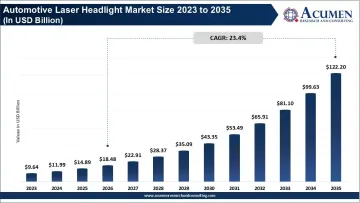
The global automotive laser headlight market size was valued at USD 14.89 billion in 2025, it is estimated to reach at USD 122.20 billion by 2035. The market is observed to grow at a CAGR of 23.4% during the forecast period of 2026-2035.
Report Highlights
- By region, Europe dominated the automotive laser headlight market with a 43% revenue share in 2025, driven by the strong presence of premium automotive manufacturers, advanced lighting technology suppliers, and stringent vehicle safety regulations.
- By region, Asia Pacific is expected to register the fastest CAGR of 26.8% during the forecast period, supported by rapid electric vehicle production, increasing luxury vehicle sales, and growing investments in intelligent automotive lighting technologies.
- By vehicle type, passenger cars dominated the market with a 72% share in 2025, owing to the widespread adoption of laser headlights in luxury sedans, SUVs, and premium passenger vehicles.
- By vehicle type, commercial vehicles accounted for the second-largest market share of 28% in 2025, driven by increasing demand for advanced lighting systems to improve road safety and support fleet modernization.
- By propulsion type, internal combustion engine (ICE) vehicles dominated the market with a 58% share in 2025, supported by the high production of premium ICE vehicles and continued integration of laser headlight technology by leading automakers.
- By propulsion type, hybrid electric vehicles (HEVs) held the second-largest market share of 17% in 2025, driven by rising consumer demand for fuel-efficient vehicles, increasing hybrid vehicle production, and the integration of advanced lighting technologies in premium hybrid models.
- By technology, laser-LED hybrid headlights dominated the automotive laser headlight market with a 60% share in 2025, attributed to their superior illumination performance, energy efficiency, and compatibility with adaptive lighting systems.
- By technology, laser spot lighting/laser high beam systems accounted for the second-largest market share of 25% in 2025, supported by increasing adoption in premium vehicles requiring long-range illumination and enhanced nighttime visibility.
- By headlamp module power, the 36–50 W segment dominated the market with a 45% share in 2025, owing to its optimal balance between illumination performance, energy efficiency, and thermal management.
- By headlamp module power, the above 50 W segment is expected to grow at the fastest CAGR of 47.5% during the forecast period, driven by rising demand for high-performance laser lighting systems in luxury, electric, and autonomous vehicles.
- By sales channel/installation type, the original equipment manufacturer (OEM) segment dominated the market with an 85% revenue share in 2025, supported by factory integration of laser headlights in premium and luxury vehicle models.
- By sales channel/installation type, the aftermarket segment accounted for the second-largest market share of 15% in 2025, driven by increasing demand for premium vehicle upgrades and replacement of advanced lighting systems.
Market Dynamics
Driver
Increasing Adoption of Advanced Driver Assistance Systems (ADAS) and Premium Vehicle Technologies
With increasing integration of advanced driver assistance systems (ADAS) and intelligent safety features in vehicles, demand for automotive laser headlights is seeing rapid increase. The headlights are known to offer a light range of up to 600 meters which is about double of standard LED systems, enhancing nighttime visibility for drivers and enabling features such as adaptive high beams, pedestrian detection, and self-driving modes. Increased integration of lighting technology by major automakers in luxury and EVs is likely to accelerate demand for laser headlight system across the globe.
Restraint
High System Costs and Limited Adoption in Mass-Market Vehicles
While superior in technology, laser headlights are significantly more costly compared to LED and HID solutions as the lighting utilizes highly complex optical systems, laser diodes, a cooling apparatus and highly advanced electronics for controlling these elements. Thus, manufacturing costs and high installation complexities have confined the applications to luxury as well as other high end car models. A few more challenges including prolonged regulatory approval procedures and exorbitant replacement costs also have a detrimental effect on its penetration into the lower priced and economy car segments.
Opportunity
Rising Electrification and Development of Intelligent Digital Lighting Systems
The rapid growth of battery electric vehicles (BEVs), autonomous driving technologies, and software-defined vehicles presents significant opportunities for automotive laser headlight manufacturers. Automakers are increasingly integrating digital lighting systems capable of adaptive beam shaping, communication with pedestrians, projection functions, and enhanced vehicle intelligence. Continuous advancements in laser optics, miniaturization, and semiconductor technologies are expected to reduce costs while expanding laser headlight adoption across next-generation electric and autonomous vehicles.
Regional Analysis
Europe accounted for 43% of the global automotive laser headlight market in 2025, and will be a significant regional market. The region’s large market size is attributed to its abundance of automotive makers of high-end vehicles like BMW, Mercedes-Benz, Audi, Porsche and Volkswagen. These makers had been early adopters of laser lighting tech in their high-end, fast models.
Also Europe, strict vehicular safety guidelines have been contributing the boost. Along with increasing interest from buyers in ADAS (advanced driver-assistance systems) and continued expenditure on lighting research and development in vehicles, Europe’s demand for the car lights technology has been pushed high. Europe already possesses developed automobile supply chain and various major lights makers like Valeo, HELLA, Marelli and ams OSRAM, helping quickly advertise their own lighting solutions for cars.
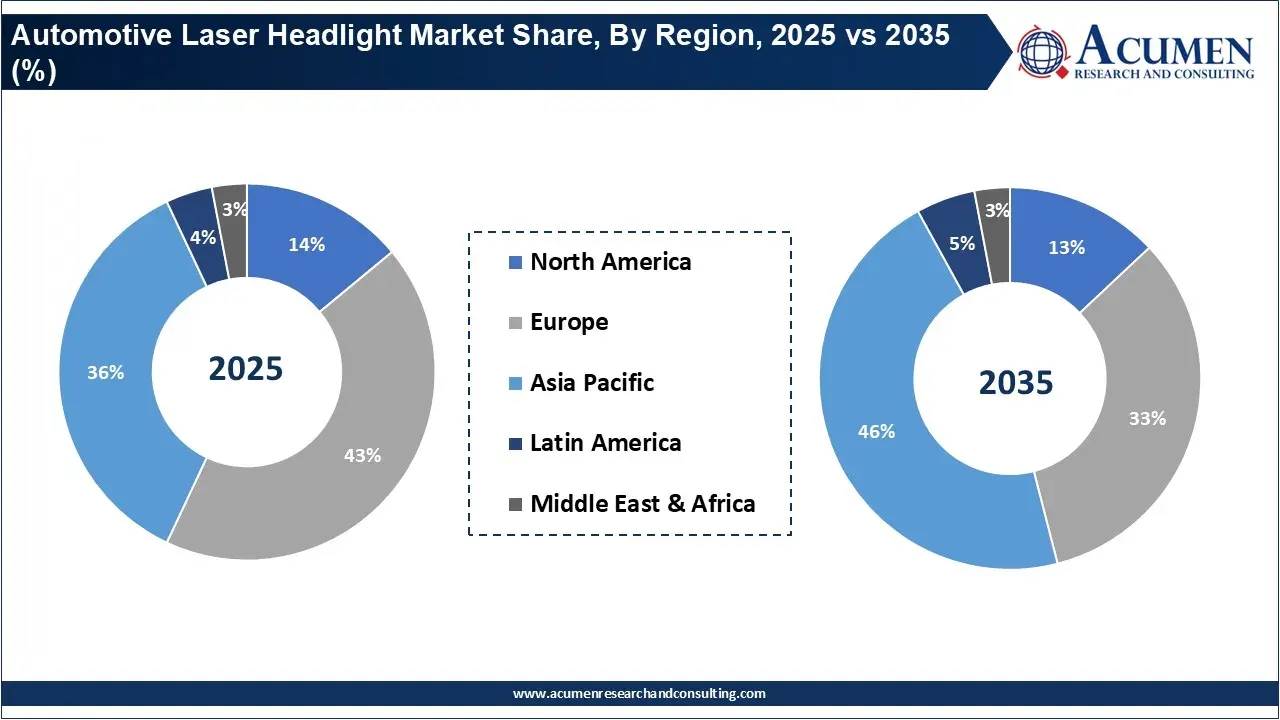
The market in Asia Pacific is estimated to expand at CAGR of 26.8 % from 2026 to 2035. Growth in the premium vehicle segment, EV sector, and adoption of cutting-edge safety standards are supporting rapid growth in the regional automotive laser headlights market. Several countries including China, Japan, and South Korea invest heavily in future automotive lighting. Many automakers from those nations have introduced cars with advanced laser lighting systems.
Higher disposable earnings, soaring sales of electric vehicles (EVs), and supportive government efforts encouraging enhanced vehicular safety standards will fuel growth in the local market. OEM, car lights designers' expanding contributions add to the increased adoption of laser light beam vehicle headlamps.
Segmental Analysis
Vehicle Type Insights
Passenger cars dominated the global automotive laser headlight market, holding a market share of 72% in 2025. Increased penetration of premium lighting solutions in luxury sedans, SUVs, and high-end passenger cars is one of the key factors driving this segment. Laser headlights provides enhanced illumination, better beam range, and safer driving experience as compared to LED lighting.
Therefore, they are being widely adopted in premium passenger cars, luxury vehicles majorly in sedans & SUVs. Automakers of luxury cars have adopted laser lighting in their most selling flagship model. Technological advancement driven by consumer preference will continue to drive passenger car market during the projected period.
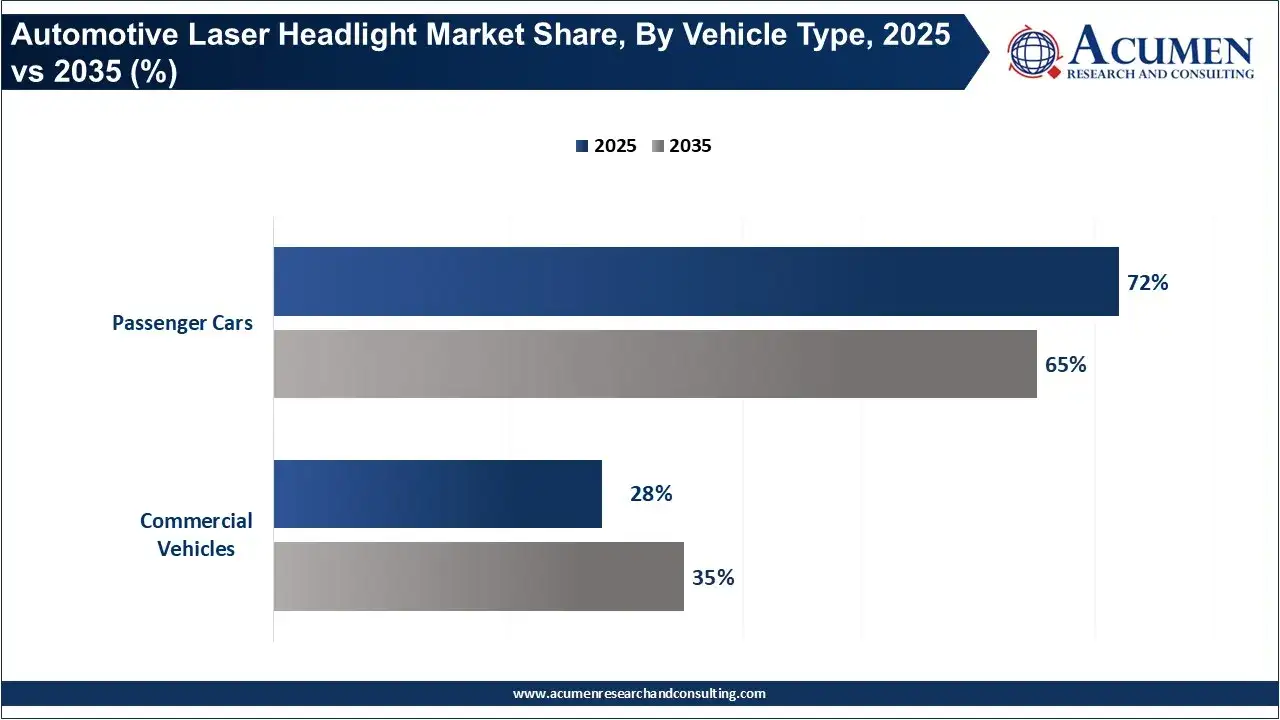
Commercial vehicles accounted for a share of 28% in 2025. Due to longer hauling distances and increased safety regulations in transportation, commercial vehicle OEMs are widely adopting advanced lighting technologies. Furthermore, growing inclusion of ADAS system and smart lighting in commercial vehicle would promote increased use of laser lighting.
Propulsion Type Insights
In 2025, ICE vehicles occupied 58% share of the automotive laser headlight market. An ICE vehicle segment is the dominant segment and is propelled by extensive number of conventional vehicles on the road as well as ongoing production of premium ICE vehicles incorporating advanced lighting technologies. Several Luxury car manufacturers have incorporated laser headlights into their ICE vehicles to enhance safety and driving efficiency, keeping up with the expectations of today's drivers.
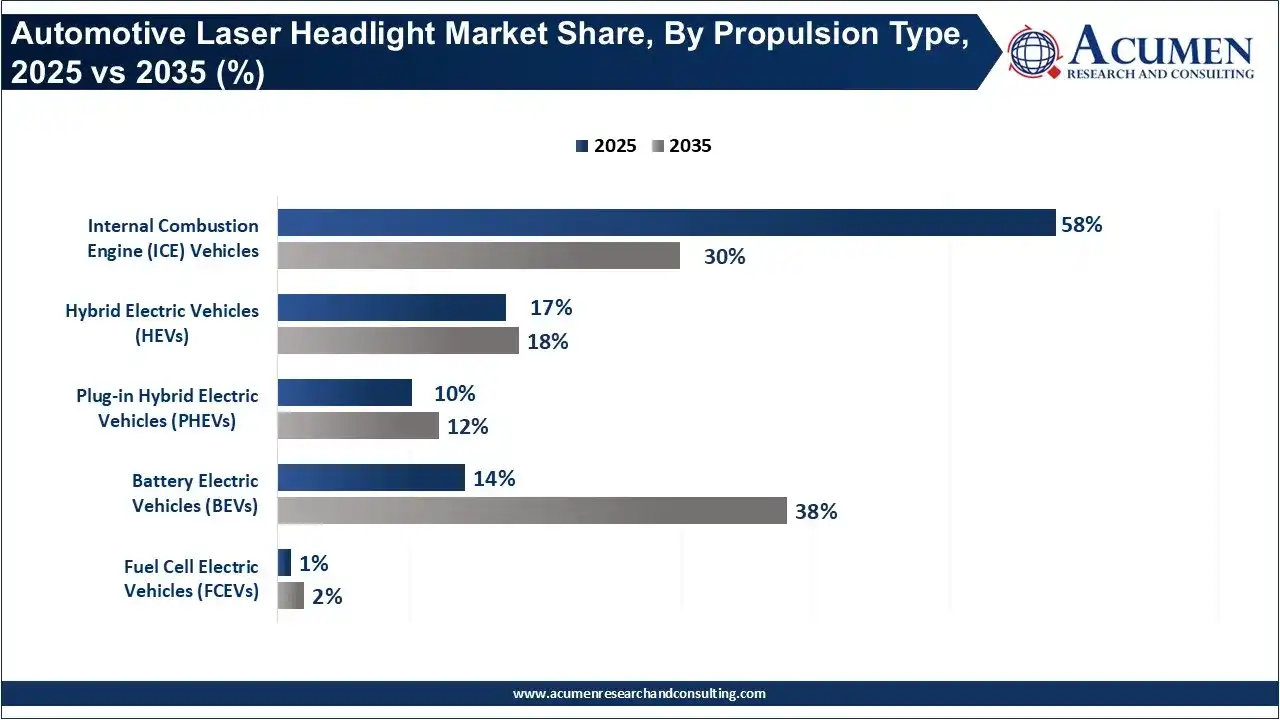
In 2025, Hybrid electric vehicles accounted for 17% share of the global automotive laser headlight market, thereby remaining second leading propulsion type. Increased adoption of efficient vehicles with less emissions and ongoing shift towards electrification has driven the sales of HEV fitted with advanced lighting technologies.
Hybrid vehicle OEMs are fitting premium HEVs with advanced laser headlights to drive efficient performance of vehicles while reducing energy consumption and optimizing lighting in night drive. Government policies and consumer's inclination towards hybrid vehicles coupled with growing production capacity of HEV across European and APAC regions is expected to lead growth in HEV segment during the projection period.
Technology Insights
Laser-LED hybrid headlights captured 60% of the global market in 2025, making them the dominant technology segment. These systems combine the long-range illumination capability of laser lighting with the efficiency and reliability of LED technology, providing enhanced visibility while maintaining lower energy consumption. Their ability to deliver adaptive lighting functions and improved road illumination has encouraged widespread adoption among premium vehicle manufacturers.
Automotive Laser Headlight Market Share, By Technology, 2025 (%)
| By Technology | Revenue Share, 2025 (%) |
|---|---|
| Laser Spot Lighting/Laser High Beam Systems | 25% |
| Laser-LED Hybrid Headlights | 60% |
| Matrix Laser Headlights | 12% |
| Digital Laser Headlights | 3% |
Laser spot lighting and laser high beam systems accounted for 25% of the market in 2025. These systems are widely used in luxury vehicles to provide high-intensity illumination over long distances, improving driver visibility during nighttime and highway driving. Continued advancements in adaptive beam control and laser optics are expected to support future market expansion.
Headlamp Module Power Insights
Headlamp modules in the 36-50 W power class held the largest market share at 45% in 2025. These units offer the perfect combination of illumination output, power efficiency and thermal output that drivers have come to expect in high-end passenger vehicles utilizing laser-LED hybrid headlamp technology.
Automotive Laser Headlight Market Share, By Headlamp Module Power, 2025 (%)
| By Headlamp Module Power | Revenue Share, 2025 (%) |
|---|---|
| Up to 35 W | 35% |
| 36–50 W | 45% |
| Above 50 W | 20% |
Above 50 W headlamp modules segment is expected to expand at the most rapid pace, registering a CAGR of 47.5% during 2026-2035. In light of increasing interest in premium and sophisticated illumination, such as high beam output for greater range and sophisticated adaptive beam patterns for autonomous applications, the deployment of higher-power laser-based units for automotive headlamps is on the rise for luxury cars and autonomous vehicles and SUVs.
Sales Channel Insights
OEM installations of automotive laser headlights led the automotive laser headlight market by 85% in 2025, owing to its increasing usage by OEMs during car manufacturing in the luxury & premium vehicle category. Automakers are working with lighting manufacturers for designing custom made laser lighting system in order to fulfil the vehicle designs. The increasing OEM use of automotive laser lighting systems during manufacturing is expected to boost growth.
Automotive Laser Headlight Market Share, By Sales Channel/Installation Type, 2025 (%)
| By Sales Channel/Installation Type | Revenue Share, 2025 (%) |
|---|---|
| Original Equipment Manufacturer (OEM) | 85% |
| Aftermarket | 15% |
The remaining 15% market is expected to be the automotive aftermarket in 2025. This segment has demand from vehicle customization, replacement of automotive lighting systems due to vehicle accident, and also due to the increasing desire of the end-users of premium segment to install high quality laser lighting systems into their vehicle.
Key Players
- ZKW Group
- OSRAM
- SLD Laser
- Marelli Holdings Co. Ltd.
- Palomar Technologies
- Hella GmbH & Co.KGaA
- LASER Component
- Valeo
- Koito Manufacturing Ltd
- Bosch
Segments Covered
By Vehicle Type
- Passenger Cars
- Commercial Vehicles
By Propulsion Type
- Internal Combustion Engine (ICE) Vehicles
- Hybrid Electric Vehicles (HEVs)
- Plug-in Hybrid Electric Vehicles (PHEVs)
- Battery Electric Vehicles (BEVs)
- Fuel Cell Electric Vehicles (FCEVs)
By Technology
- Laser Spot Lighting / Laser High Beam Systems
- Laser-LED Hybrid Headlights
- Matrix Laser Headlights
- Digital Laser Headlights
By Headlamp Module Power
- Up to 35 W
- 36–50 W
- Above 50 W
By Sales Channel / Installation Type
- Original Equipment Manufacturer (OEM)
- Aftermarket
By Region
- North America
- Europe
- Asia Pacific
- Latin America
- Middle East & Africa
Looking for discounts, bulk pricing, or custom solutions? Contact us today at sales@acumenresearchandconsulting.com
Frequently Asked Questions

Other Automotive And Transportation Reports
October 2023
August 2020
December 2024
December 2024