
Direct Drive Wind Turbine Market Size, Share, Forecast 2026 To 2035
Direct Drive Wind Turbine Market (By Technology: Permanent Magnet Synchronous Generator (PMSG), Electrically Excited Synchronous Generator (EESG); By Capacity: Less than 1 MW, 1-3 MW, More than 3 MW; By Application: Onshore, Offshore) - Global Industry Analysis, Size, Share, Analysis, Trends and Forecast 2026 - 2035
- Last Updated: 28 Jan 2026
- Report Code: ARC3901
- Category: Energy and Power
Direct Drive Wind Turbine Market Size and Forecast 2026 - 2035
The global direct drive wind turbine market size was valued at USD 21.91 billion in 2025 and is projected to reach USD 95.02 billion by 2035, expanding at a compound annual growth rate (CAGR) of 15.7% during the forecast period from 2026 to 2035.
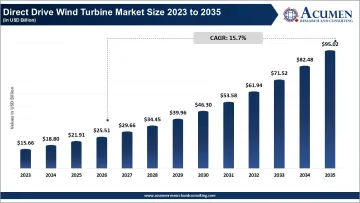
Direct Drive Wind Turbine Market Highlights
- In 2025, Asia Pacific accounted for the largest share of the direct drive wind turbine market, holding approximately 49% of total revenue.
- North America is projected to register the fastest CAGR of 20% from 2026 to 2035 for direct drive wind turbine market.
- By Technology, the permanent magnet synchronous generator (PMSG) currently holds the largest market share, representing 78% of the market.
- By Capacity, the more than 3 MW segment dominated the market, holding 58% market share, followed by Less than 1 MW segment which represented 27% market share.
- Based on application, the onshore application segment accounted for approximately 80% of the total market revenue followed by offshore application with approximately 20% market share.
Direct Drive Wind Turbine Market Overview
The direct drive wind turbine market is expected to witness strong growth due to the rising global emphasis on clean energy transition and decarbonization of power generation. Rapid expansion of wind energy projects across onshore and offshore locations, supported by government incentives, renewable energy targets, and favorable regulatory frameworks, has significantly increased the demand for advanced wind turbine technologies. Direct drive turbines, which operate without gearboxes, offer higher reliability, improved efficiency, and lower maintenance requirements, making them particularly attractive for large-scale wind projects. These advantages are critical in offshore installations, where maintenance access is difficult and costly, positioning direct drive technology as a preferred choice among the power generation companies and utilities.
Another major factors contributing to the market growth is the technological shift towards high-capacity and offshore wind turbines. The industry's move towards turbines above 3MW capacity, particularly in offshore environments has accelerated the adoption of direct drive technology due to its's ability to operate efficiently at low rotational speeds while minimizing maintenance requirements. Compared to conventional geared systems, direct drive turbines offer lower lifecycle cost, reduced downtime, and improved energy yields, which are critical for offshore and remote installations. In addition, continuous advancements in generator technology, increasing investments in offshore wind infrastructure, and growing installations across Asia Pacific and Europe are creating sustained opportunities for manufacturers and technology providers, further supporting the long-term growth of direct drive wind turbine market.
Direct Drive Wind Turbine Market Dynamics
Market Drivers
Expansion of Offshore Wind Energy Projects
- The rapid growth of offshore wind farms is a major driver for the growth of direct drive turbine market. Offshore locations offer stronger and more consistent wind resources, which significantly improve energy generation. Direct drive turbines are particularly advantageous in offshore environments due to their high reliability, fewer moving parts, and lower maintenance requirements. As governments and private investors increase funding the large-scale offshore wind projects, the demand for direct drive technology is expected to rise substantially, thus supporting the expansion of global market.
Rising Demand for Low-Maintenance and Highly Reliable Wind Turbine Systems
- The growing scale of wind farms, particularly offshore and in remote locations, has increased the need for turbine system that have minimal maintenance requirement and operational downtime. Direct dive wind turbines significantly reduced mechanical complexity by removing gearbox, leading to lower failure rates and reduced servicing requirements. This advantage is especially valuable in offshore environments, where maintenance activities focus on lifecycle cost optimization and operational reliability, as a result of which the adoption of direct drive wind turbine technology is expected to gain momentum.
Market Restraints
High Initial Capital and Installation Costs
- The significant upfront investment required for direct drive wind turbines is one of the major factors limiting the growth in this market. Direct drive wind turbines involve large generators, advanced components, and permanent magnets, all of which increases the overall manufacturing and installation cost compared to conventional geared system. Besides the initial purchases, additional cost for transportation, foundation, and specialized installation add to the total project expense. These high capital requirements can make it difficult for small-scale developers or projects in cost-sensitive regions to justify adoption, which may slow market growth in such areas.
Dependence On Rare-Earth Materials Increase Production Challenges
- Many direct drive wind turbines rely on permanent magnet generators that use rare-earth elements such as neodymium and dysprosium. Price volatility, limited supply, and geopolitical concentration of these materials create uncertainly for manufacturers. The need for rare-earth materials increases the production costs and limits the adoption in region where these materials are scarce or expensive. This is a key constraint for widespread market expansion, particularly in emerging economics or cost-sensitive projects.
Market Opportunities
Development of Rare-Earth-Free Advanced Generator Technologies
- Innovation in electrically excited synchronous generators (EESG) and other rare-earth-free solutions presents a significant growth opportunity. By reducing or eliminating the reliance on costly rare-earth elements, these technologies provide more sustainable and cost-effective alternative. With such cost-effective solutions, manufacturers can expand their market reach and appeal to region with limited access to rare-earth resources, creating avenues for direct drive wind turbine adoption.
Expansion Into Emerging Renewable Energy Markets Worldwide
- Emerging countries across Asia Pacific, Latin America, and Africa are investing heavily in renewable energy infrastructure to meet growing electricity demand and sustainability targets. Direct drive turbines, with their high reliability and lower maintenance need are particularly attractive for new wind energy projects in such regions. Government incentive, funding programs, and supportive renewable policies provide manufacturers and suppliers with opportunities to increase their presence and capture market share in these radially developing markets.
Direct Drive Wind Turbine Market Report Scope
| Attribute | Details |
|---|---|
| Direct Drive Wind Turbine Market Size 2025 | USD 21.91 Billion |
| Direct Drive Wind Turbine Market Forecast 2035 | USD 95.02 Billion |
| Direct Drive Wind Turbine Market CAGR During 2026 - 2035 | 15.7% |
| Direct Drive Wind Turbine Market Analysis Period | 2023 - 2035 |
| Direct Drive Wind Turbine Market Base Year | 2025 |
| Direct Drive Wind Turbine Market Forecast Data | 2026 - 2035 |
| Segments Covered | By Technology, By Capacity, By Application, and By Geography |
| Regional Scope | North America, Europe, Asia Pacific, Latin America, and Middle East & Africa |
| Key Companies Profiled | Siemens Gamesa Renewable Energy, GE Renewable Energy, Vestas Wind Systems, Goldwind Science & Technology, Enercon GmbH, Mingyang Smart Energy, Nordex SE, Suzlon Energy Limited, Envision Energy, Senvion S.A., Shanghai Electric Group, and ReGen Powertech Pvt. Ltd. |
| Report Coverage | Market Trends, Drivers, Restraints, Competitive Analysis, Player Profiling, Covid-19 Analysis, Regulation Analysis |
Direct Drive Wind Turbine Market Regional Insights
Asia Pacific continues to dominate the global direct drive wind turbine market due to its strong focus on large-scale renewable energy deployment and cost-effective manufacturing capabilities. Countries such as China and India are expanding wind power capacity to meet growing electricity demand and long-term energy security goals. The region benefits from well-established supply chains, the presence of leading turbine manufacturers, and consistent government support for clean energy projects. These factors allow Asia Pacific to deploy direct drive turbines at scale, making it the largest contributor to the global market.
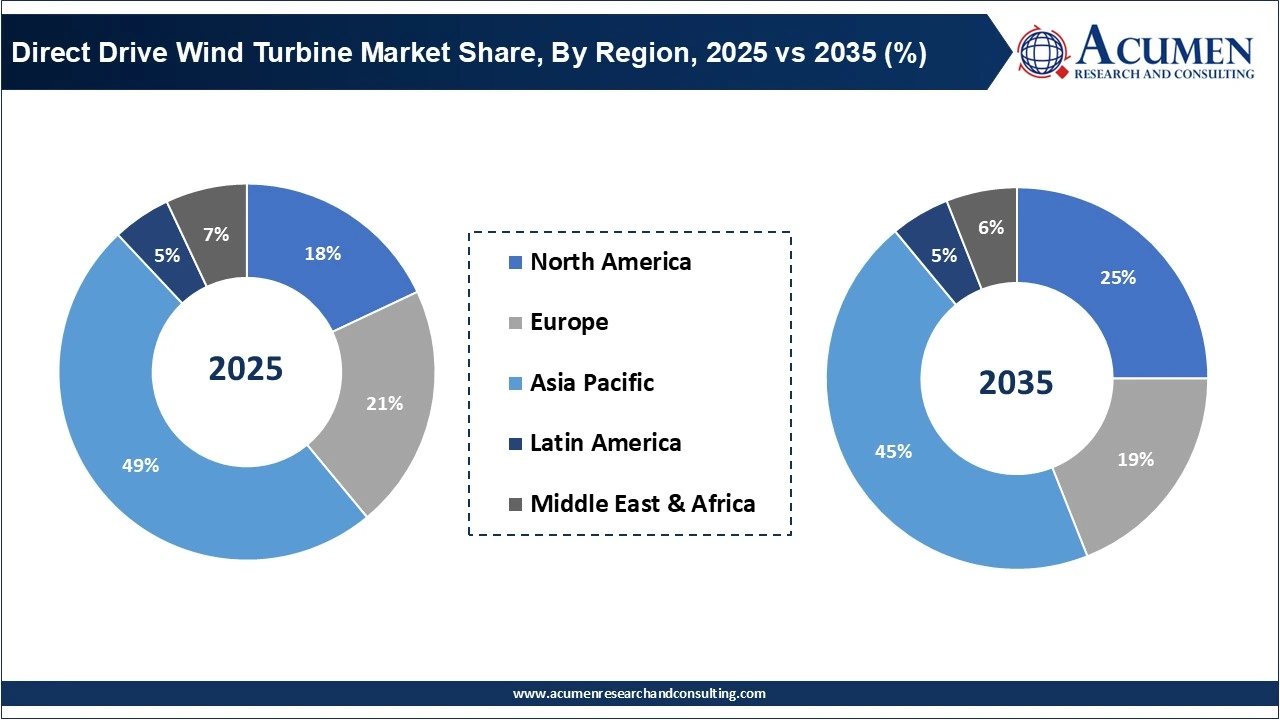
North America is emerging as the fastest-growing market, supported by rising investments in new wind farms and the repowering of older installations. The United States is increasingly adopting advanced turbine technologies to improve efficiency and reduce maintenance costs, particularly in offshore and high-capacity onshore projects. Supportive policies, tax incentives, and strong participation from utilities and corporate power buyers are encouraging increased adoption. As a result, North America is expected to record strong growth and gain market share over the coming years.
Direct Drive Wind Turbine Market Segmental Insights
The worldwide market for direct drive wind turbine is split based on technology, capacity, application, and geography.
Technology Insights
Permanent magnet synchronous generator (PMSG) dominated the market with around 78% market share in 2025, due to its high efficiency, proven ability, and wide adoption in onshore and offshore wind projects. PMSG eliminates the gearbox and uses permanent magnets to generate strong magnetic fields, reducing mechanical losses and increasing energy output. The mature supply chain, established manufacturing expertise, and long-term operational stability make PMSG the preferred choice for utility-scale installations globally. As wind energy projects expand, PMSG turbines continue to maintain their leading position in the market.
| Technology | Market Share, 2025 (%) | Key Highlights |
|---|---|---|
| Permanent Magnet Synchronous Generator (PMSG) | 78% | High efficiency, proven reliability, wide offshore and utility-scale adoption |
| Electrically Excited Synchronous Generator (EESG) | 22% | Reduced rare-earth dependency, cost stability, improved grid control |
Electrically excited synchronous generator (EESG) are gaining popularity due to lower installation cost compared to PMSG turbines. EESG turbines use electromagnets instead of rare-earth materials, reducing the dependency on neodymium and dysprosium while maintaining high efficiency. The ability to provide better field control and improved grid integration is attracting new installations, particularly in regions with limited rare-earth access. Rising awareness of cost-stable and sustainable turbine option is driving strong growth for this segment.
Capacity Insights
More than 3 MW capacity dominated the market due to the increasing deployment of high-capacity turbines in both offshore and large-scale onshore projects. Large turbines generate more power per unit, reduce the number of installations required per farm, and lower the cost of energy, making them the preferred choice for utility-scale wind turbine developers. Direct drive technology, with its high reliability and low maintenance requirements, is particularly well suited for these high-capacity installations, ensuring this segment maintains its dominant position.
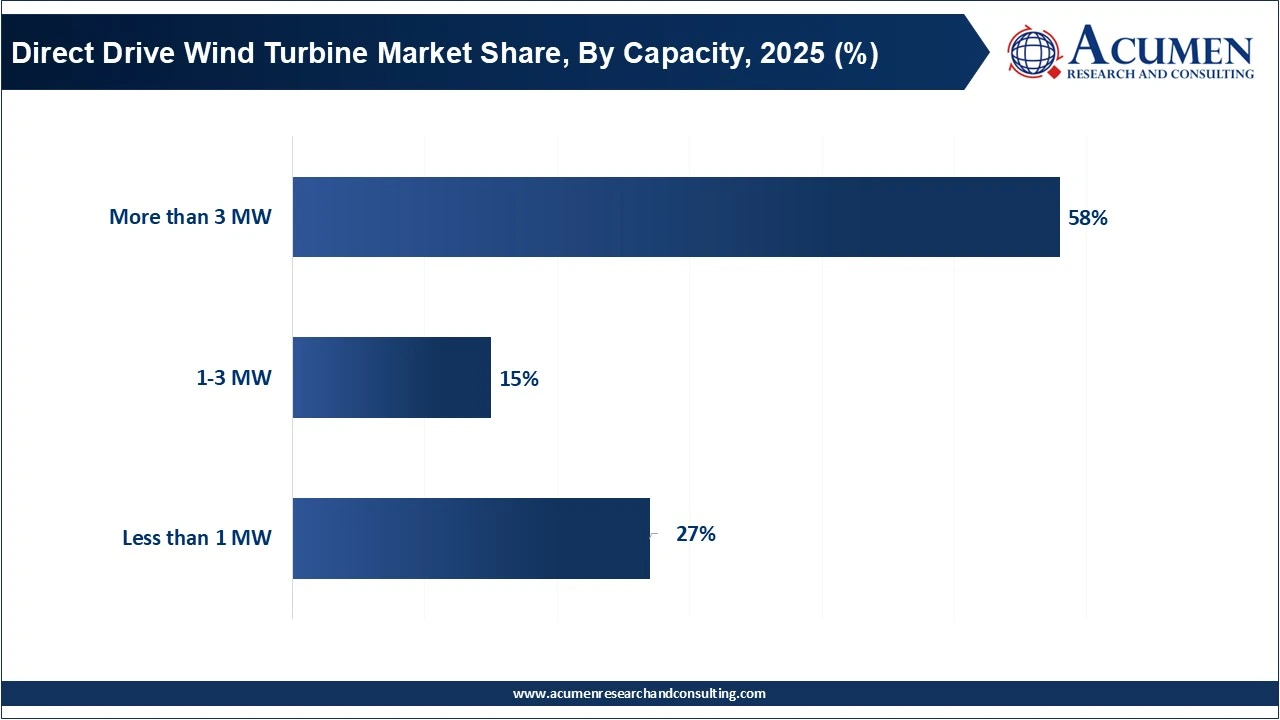
1-3 MW capacity segment is projected to grow at rapid pace due to it's balanced cost-to-power ratio and widespread applicability in onshore projects. Direct drive wind turbines with 1-3 MW capacity are ideal for regions with moderate wind potential and small-scale wind farms where developers seek manageable installation cost and predictable operational performance. Increasing investments in developing regions and growing adoption of mid-capacity turbines for both new and repowered wind projects is driving rapid growth in this segment.
| Capacity | Market Share, 2025 (%) | Key Highlights |
|---|---|---|
| More than 3 MW | 58% | Offshore expansion, higher energy output, lower levelized cost of energy |
| Less than 1 MW | 27% | Distributed generation, rural electrification, small onshore projects |
| 1–3 MW | 15% | Balanced cost-performance, suitability for mid-scale onshore wind farms |
Application Insights
The onshore segment undisputedly led the market with 80% market sharein 2025 and is expected to continue its dominance throughout the forecast period. This growth is mainly attributed by the advantages of onshore projects when compared to offshore wond power projects such as lower project cost, established infrastructure, and easy accessibility for installation and maintenance. Onshore wind farms are widely deployed across multiple regions and remain the primary point of adaption for many countries transitioning to renewable energy. Direct drive wind turbines, with fewer moving parts and reduced maintained requirement, are becoming an attractive choice for onshore projects seeking reliable long-term performance.
| Application | Market Share, 2025 (%) | Key Highlights |
|---|---|---|
| Onshore | 80% | Lower installation cost, mature infrastructure, easier maintenance access |
| Offshore | 20% | Stronger wind speeds, larger turbines, demand for high-reliability systems |
The deployment of direct drive turbines is growing in offshore projects due to stronger and more consistent wind resources, fewer land constraints, and supportive government policies in key markets. Offshore installations favor direct drive turbines because of their high reliability, reduced mechanical complexity, and lower maintenance requirement in harsh marine environment. Increasing investments in offshore wind infrastructure in Europe, Asia Pacific, and North America is driving rapid growth of this segment.
Direct Drive Wind Turbine Market Key Players
- Siemens Gamesa Renewable Energy
- GE Renewable Energy
- Vestas Wind Systems
- Goldwind Science & Technology
- Enercon GmbH
- Mingyang Smart Energy
- Nordex SE
- Suzlon Energy Limited
- Envision Energy
- Senvion S.A.
- Shanghai Electric Group
- ReGen Powertech Pvt. Ltd.
Direct Drive Wind Turbine Market Recent Developments
- In June 2025, Mingyang Smart Energy unveiled its MySE-14X turbine with modular design and AI-based adaptive control system. This reflects the company's focus on improving operational efficiency and flexibility.
- In March 2025, Goldwind launched the GD150-6.7 MW direct drive wind turbine, incorporating digital twin technology and advanced condition monitoring capabilities. The new platform is aimed at enhancing turbine reliability, optimizing lifecycle performance, and reducing unplanned downtime.
Market Segmentation
By Technology
- Permanent Magnet Synchronous Generator (PMSG)
- Electrically Excited Synchronous Generator (EESG)
By Capacity
- Less than 1 MW
- 1-3 MW
- More than 3 MW
By Application
- Onshore
- Offshore
By Region
- North America
- U.S.
- Canada
- Europe
- U.K.
- Germany
- France
- Spain
- Rest of Europe
- Asia-Pacific
- India
- Japan
- China
- Australia
- South Korea
- Rest of Asia-Pacific
- Latin America
- Brazil
- Mexico
- Rest of LATAM
- The Middle East & Africa
- South Africa
- GCC Countries
- Rest of the Middle East & Africa (ME&A)
Looking for discounts, bulk pricing, or custom solutions? Contact us today at sales@acumenresearchandconsulting.com
Frequently Asked Questions

Other Energy and Power Reports
December 2024
June 2026
November 2018
April 2026