
Neuromorphic Computing Market Size, Share, Forecast Report 2026 To 2035
Neuromorphic Computing Market (By Offering: Neuromorphic Processors, Chips and IP, Neuromorphic Systems, Software, Tools and Services; By Architecture: Digital Neuromorphic (SNN ASICs), Analog / Mixed-Signal Neuromorphic, Memristive / In-Memory Neuromorphic, Photonic and Other Emerging Architectures; By Application: Research and Scientific Simulation, Data Center AI Inference and Optimization, Robotics and Autonomous Control, Others; By Deployment: Edge / Embedded, Data Center, Cloud and HPC; By End Use: Government, Defense and Research Institutes, Automotive and Transportation, Consumer Electronics and Mobile, Industrial and Robotics, IT, Data Center and Telecom, Healthcare and Other) - Global Industry Analysis, Size, Share, Regional Analysis, Trends and Forecast 2026 - 2035
- Last Updated: 24 Nov 2026
- Report Code: ARC4015
- Category: ICT
Neuromorphic Computing Market Insights 2026 To 2035
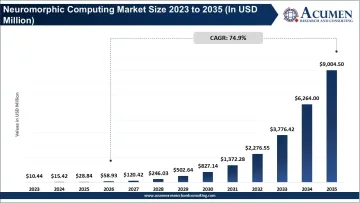
The global neuromorphic computing market size was valued at USD 28.84 million in 2025 and is expected to hit around USD 9,004.50 million by 2035; expanding at a CAGR of 74.9% during the forecast period of 2026-2035. Rising demand for energy-efficient AI processing, increasing edge computing deployments, advancements in spiking neural networks, growing investments in brain-inspired semiconductor architectures, and expanding applications in robotics, autonomous systems, defense, and industrial automation are accelerating neuromorphic computing market growth.
Neuromorphic Computing Market Size & Forecast
- Base Year Market Size (2025): $28.84 million
- Current Year Market Size (2026): $58.93 million
- Estimated Year Market Size (2035): $9,004.50 million
- Forecast Period CAGR (2026-2035): 74.9%
Key Takeaways
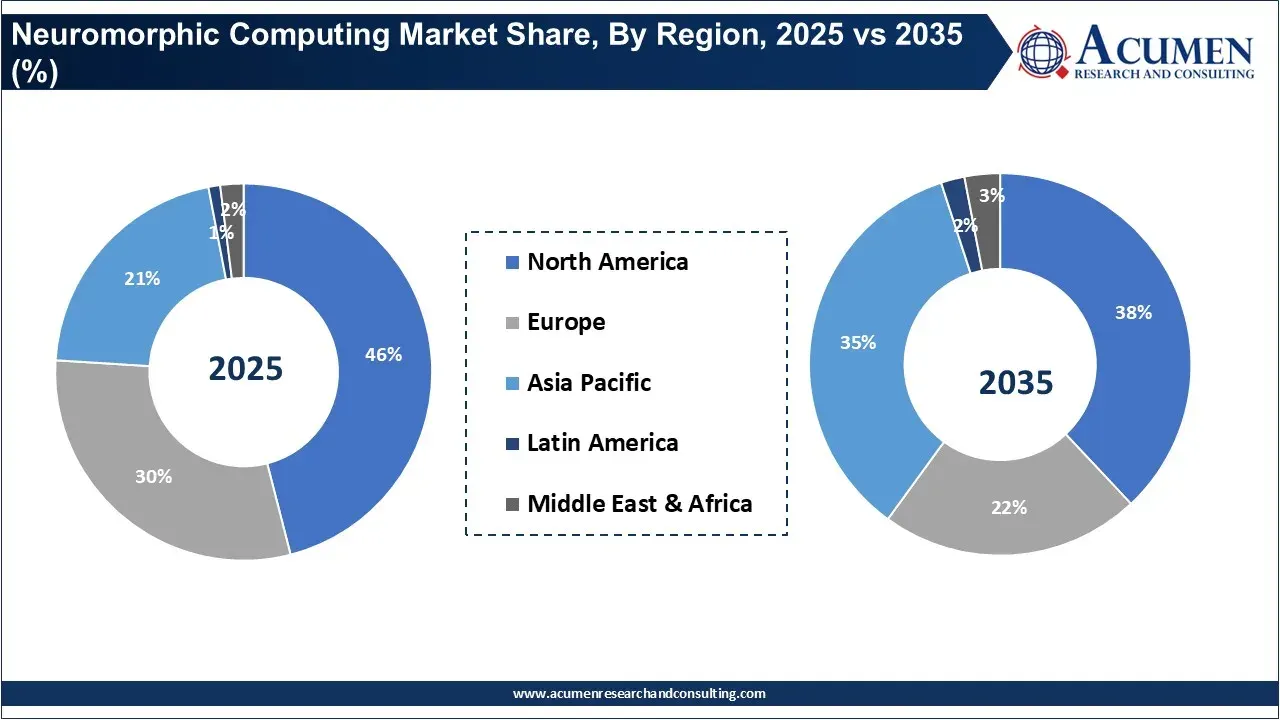
- By Region: North America dominated the regional segment with a 46.0% share in 2025, equivalent to USD 13.27 million. Its leadership is supported by an established semiconductor ecosystem, advanced AI research infrastructure, and investments in neuromorphic processor development.
- By Offering: Neuromorphic systems dominated the offering segment with a 51.9% share in 2025, equivalent to USD 14.96 million. Their demand is supported by growing investments in neuromorphic research infrastructure, high-performance computing, and integrated brain-inspired processing platforms.
- By Architecture: Digital neuromorphic architecture dominated the architecture segment with an 85.0% share in 2025, valued at USD 24.52 million. Its leadership is supported by established digital circuit design capabilities, programmable spiking neural networks, and the development of specialized neuromorphic ASICs.
- By Application: Research and scientific simulation dominated the application segment with a 40.0% share in 2025, equivalent to USD 11.54 million. Demand is supported by increasing neuroscience research, brain-inspired algorithm development, and scientific experimentation involving neural processing architectures.
- By Deployment: Data center, cloud and HPC dominated the deployment segment with a 68.0% share in 2025, generating USD 19.61 million. Its leadership reflects the concentration of neuromorphic research infrastructure and specialized computing platforms within centralized facilities.
- By End Use: Government, defense and research institutes dominated the end-use segment with a 55.0% share in 2025, valued at USD 15.86 million. Demand is supported by public-sector investments in advanced computing, defense applications, semiconductor research, and neuroscience initiatives.
Neuromorphic Computing Market Overview
The global neuromorphic computing market is transitioning from research-oriented development toward commercial applications across edge AI, robotics, autonomous systems, industrial automation, and data center computing. Neuromorphic architectures replicate selected operating principles of the human brain through artificial neurons, synapses, and event-driven processing, enabling information to be processed with potentially lower power consumption and latency than conventional computing architectures in suitable workloads.
Growth is supported by advancements in neuromorphic processors, mixed-signal and memristive architectures, spiking neural networks, and specialized software ecosystems. Increasing interest in low-power inference and real-time sensor processing is also creating opportunities for commercial deployment, particularly in automotive, consumer electronics, industrial robotics, and data center applications.
Neuromorphic Computing Market Recent Trends
- Growing adoption of spiking neural networks: Developers are increasingly exploring spiking neural networks (SNNs) to support event-driven processing, temporal data analysis, and low-power AI inference.
- Increasing focus on edge intelligence: Neuromorphic processors are gaining attention for applications requiring real-time processing, low latency, and reduced dependence on cloud connectivity.
- Expansion of mixed-signal architectures: Analog and mixed-signal designs are attracting interest because they can reproduce certain neural computing operations with potentially lower energy consumption.
- Rising interest in memristive computing: Resistive RAM (RRAM), phase-change memory (PCM), and other emerging memory technologies are being investigated to combine storage and computation more closely.
- Integration with event-based vision: Neuromorphic computing is increasingly associated with event-based cameras that capture changes in a scene rather than continuously processing conventional image frames.
- Development of neuromorphic robotics: Robotics developers are exploring brain-inspired processors for motion control, environmental perception, adaptive responses, and autonomous navigation.
Neuromorphic Computing Market Dynamics
Drivers
Increasing Demand for Energy-Efficient AI Computing
- The rapid expansion of AI workloads is increasing demand for computing architectures that reduce power consumption and processing overhead. Neuromorphic systems use event-driven computation and sparse neural activity to process selected workloads efficiently. This creates opportunities in edge devices, autonomous systems, robotics, and data centers where energy efficiency is becoming an important purchasing consideration.
Growing Adoption of Edge AI and Intelligent Sensors
- The expansion of connected devices, industrial IoT, autonomous vehicles, and smart electronics is generating demand for low-latency processing closer to data sources. Neuromorphic processors can process sensor inputs through event-based architectures, reducing reliance on continuous data transmission. This supports applications requiring real-time perception, pattern recognition, and adaptive responses.
Restraints
High Development and Manufacturing Costs
- Neuromorphic processors require specialized chip architectures, advanced semiconductor engineering, dedicated testing environments, and application-specific software development. These requirements increase initial development expenditure and create financial barriers for smaller technology companies. Limited production volumes can further increase unit costs, making large-scale commercialization challenging compared with established conventional processors.
Limited Software Standardization and Ecosystem Maturity
- The neuromorphic computing industry lacks universally adopted programming frameworks, standardized benchmarks, and interoperable development environments. Developers often need specialized tools to convert conventional neural network models into spiking neural network formats. This increases implementation complexity, limits software portability, and creates additional integration costs for enterprises evaluating neuromorphic platforms.
Opportunities
Commercialization Across Automotive and Autonomous Systems
- The increasing development of autonomous vehicles, advanced driver-assistance systems, and intelligent transportation infrastructure creates opportunities for neuromorphic processors. Their event-driven processing capabilities can support real-time object detection, motion sensing, and sensor fusion. Automotive applications are projected to register a 91.7% CAGR in this market through 2035.
Integration with Advanced Memory and In-Memory Computing
- Emerging technologies such as RRAM, PCM, and MRAM provide opportunities to develop computing architectures that integrate memory and processing functions. These approaches can reduce data movement between memory and processing units. The memristive and in-memory segment is projected to grow at a 106.9% CAGR through 2035, indicating significant potential for technology development.
Challenges
Scaling Prototypes into Commercially Viable Systems
- Many neuromorphic platforms remain concentrated in research environments, pilot projects, and specialized applications. Transitioning these systems into commercially viable products requires reliable manufacturing, competitive pricing, software compatibility, and repeatable performance benchmarks. Developers must also demonstrate measurable advantages over established AI accelerators to encourage enterprise procurement and long-term adoption.
Competition from Established Computing Architectures
- Neuromorphic processors face competition from GPUs, CPUs, FPGAs, and dedicated AI accelerators that already benefit from mature software ecosystems and established semiconductor supply chains. Enterprises may prefer conventional hardware because of existing infrastructure and developer expertise. Neuromorphic vendors must demonstrate workload-specific improvements in power efficiency, latency, and operating costs.
Neuromorphic Computing Market Regional Insights
Why Did North America Dominate the Neuromorphic Computing Market?
North America dominated the neuromorphic computing market with a 46.0% share in 2025, generating USD 13.27 million. The region's leadership is supported by its established semiconductor ecosystem, advanced artificial intelligence research infrastructure, and substantial investments in brain-inspired computing technologies.
The United States plays a significant role through the presence of semiconductor developers, research laboratories, universities, and technology companies exploring spiking neural networks and energy-efficient computing architectures. Organizations such as Intel have contributed to the commercialization and research development of neuromorphic platforms, including specialized processors designed to replicate aspects of biological neural systems.
Government-backed research initiatives and collaborations between academic institutions and technology companies are further supporting innovation. Additionally, increasing demand for advanced robotics, autonomous systems, intelligent sensing, and next-generation AI infrastructure is creating opportunities for neuromorphic computing deployment.
The region is projected to maintain its leading position, although its market share is expected to decline to 38.0% by 2035 as adoption accelerates across Asia Pacific. North America is expected to reach USD 3,421.71 million by 2035, registering a CAGR of 71.5% during 2026–2035.
Why Is Latin America Expected to Be the Fastest-Growing Regional Market?
Latin America is expected to be the fastest-growing regional market for neuromorphic computing, registering a projected CAGR of 86.9% during 2026–2035. The region accounted for 1.0% of the global market in 2025, equivalent to USD 0.29 million, and is projected to reach USD 180.09 million by 2035.
Its growth potential is associated with increasing digital infrastructure investments, expanding artificial intelligence research activities, and the gradual adoption of advanced computing technologies across industrial and academic environments. Brazil and Mexico are emerging as important markets for semiconductor-related development, industrial automation, and technology research. Universities and research institutions across the region are exploring applications involving artificial intelligence, robotics, intelligent sensing, and computational neuroscience.
Furthermore, growing interest in energy-efficient computing could create opportunities for neuromorphic architectures in edge devices, industrial monitoring, and autonomous applications. Although the regional market currently represents a relatively small portion of global neuromorphic computing revenue, increasing partnerships with international semiconductor developers and technology providers could strengthen local research and commercialization capabilities.
Top 5 Countries in Neuromorphic Computing Market
- United States: The United States represents a leading neuromorphic computing market, supported by semiconductor innovation, federal research funding, and the presence of major technology companies. Intel's Loihi processors and Hala Point system, alongside research initiatives at IBM and Sandia National Laboratories, strengthen its position. Demand is emerging across defense, robotics, autonomous systems, edge AI, and scientific computing.
- China: China is expanding its neuromorphic computing capabilities through investments in brain-inspired AI research, domestic semiconductor development, and intelligent manufacturing. Universities and research institutions are investigating neuromorphic processors, spiking neural networks, and brain-inspired computing architectures. The country's large electronics manufacturing ecosystem and growing demand for robotics, smart devices, and autonomous technologies support its long-term market potential.
- Germany: Germany is an important European market due to its established semiconductor research ecosystem, industrial automation industry, and advanced engineering capabilities. Research initiatives such as the Jülich Neuromorphic Computing Alliance and the development of SpiNNaker2 technologies in Dresden contribute to the country's position. Automotive electronics, industrial robotics, and intelligent manufacturing represent important commercialization opportunities.
- Japan: Japan's strong robotics, automotive electronics, semiconductor, and precision manufacturing industries create opportunities for neuromorphic computing adoption. Research institutions, including RIKEN, are exploring brain-inspired computing and advanced neural processing architectures. Potential applications include autonomous machines, industrial inspection, intelligent sensors, healthcare devices, and low-power computing systems.
- South Korea: South Korea benefits from its strong semiconductor and memory manufacturing ecosystem, supported by companies such as Samsung Electronics and SK hynix. Research into processing-in-memory, advanced memory architectures, and brain-inspired semiconductor technologies provides a foundation for neuromorphic innovation. Growing investments in AI hardware, consumer electronics, automotive electronics, and intelligent manufacturing are expected to support market development.
Neuromorphic Computing Market Segmental Insights
Offering Insights
Neuromorphic Systems (Research, HPC and Data Center): Neuromorphic systems dominated the offering segment with a 51.9% share in 2025, generating USD 14.96 million. Their dominance is supported by increasing investments in neuromorphic research infrastructure, high performance computing, and specialized computing platforms for brain-inspired processing. Research institutions and technology developers are adopting integrated neuromorphic systems to evaluate spiking neural networks, event-driven processing, and energy-efficient computing architectures.
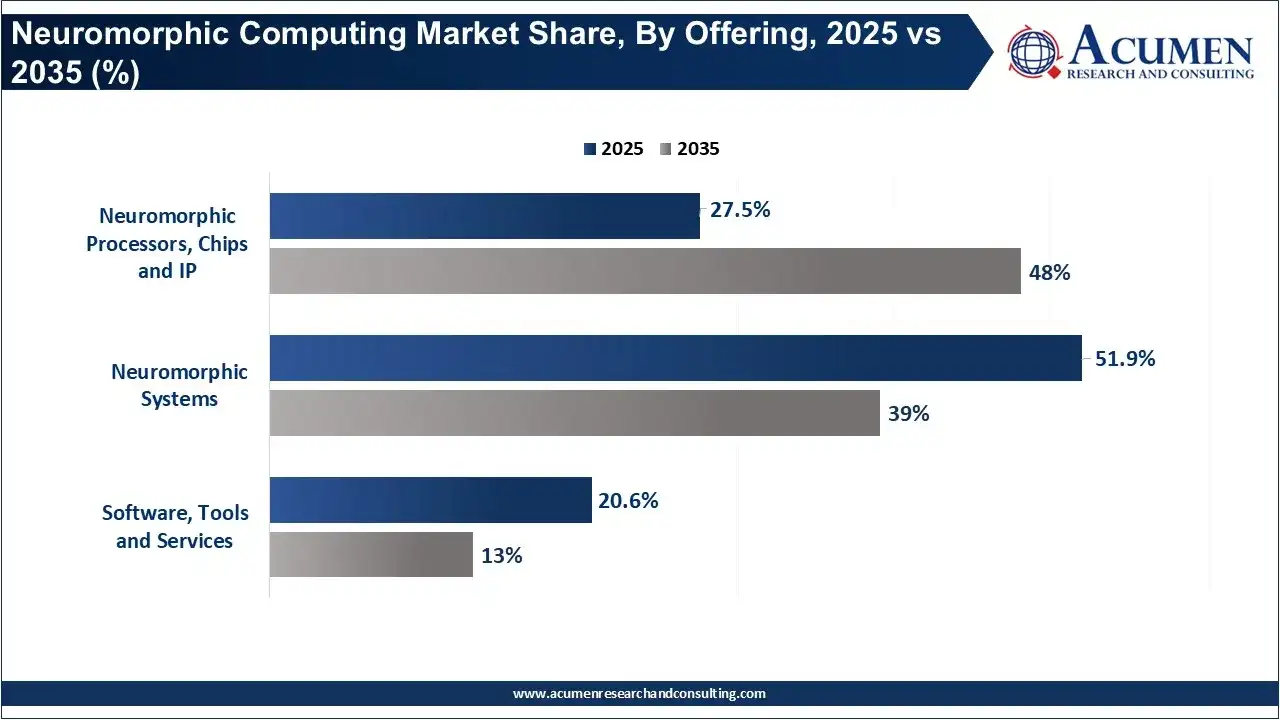
Neuromorphic Processors, Chips and IP: Neuromorphic processors, chips and IP represented the second-largest offering category, accounting for 27.5% of the market in 2025, equivalent to USD 7.93 million. Demand is supported by the development of specialized silicon architectures, low-power processing units, and intellectual property designed for event-driven computation. Their integration into edge devices, robotics, and intelligent sensing platforms is expanding commercialization opportunities.
Architecture Insights
Digital Neuromorphic (SNN ASICs): Digital neuromorphic architecture dominated the architecture segment with an 85.0% share in 2025, generating USD 24.52 million. Its leadership reflects the established development of digital spiking neural network architectures, programmable neuromorphic processors, and application-specific integrated circuits. Digital architectures provide greater compatibility with conventional semiconductor design methodologies and support scalable implementation of event-driven computing.
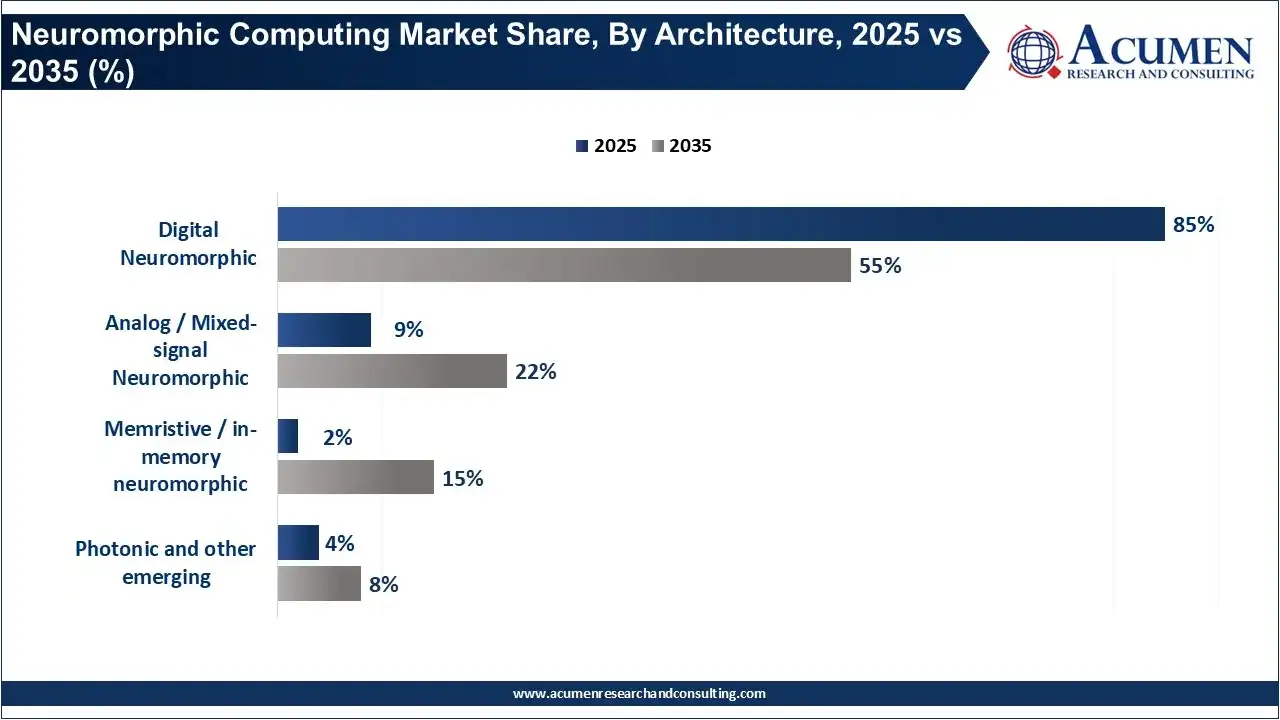
Analog / Mixed-Signal Neuromorphic: Analog and mixed-signal neuromorphic architecture represented the second-largest category, accounting for 9.0% of the market in 2025, valued at USD 2.60 million. These architectures replicate aspects of biological neural signaling through analog circuits and mixed-signal processing, enabling energy-efficient computation. Growing research into low-power neural processing and hardware-level implementation of synaptic behavior is supporting their development.
Application Insights
Research and Scientific Simulation: Research and scientific simulation dominated the application segment with a 40.0% share in 2025, generating USD 11.54 million. Its leadership is supported by the growing use of neuromorphic platforms in computational neuroscience, neural network modeling, brain-inspired algorithms, and advanced scientific experimentation. The segment is projected to reach USD 720.36 million by 2035, registering a CAGR of 47.6% during 2026–2035.
Neuromorphic Computing Market Share, By Application, 2025 & 2035 (%)
| Application | Revenue Share, 2025 (%) | Revenue Share, 2035 (%) |
|---|---|---|
| Research and scientific simulation | 40% | 8% |
| Edge AI inference - vision | 22% | 24% |
| Edge AI inference - audio, signal and sensor fusion | 16% | 20% |
| Data center AI inference and optimisation | 12% | 30% |
| Robotics and autonomous control | 10% | 18% |
Data Center AI Inference and Optimization: Data center AI inference and optimization is projected to be the fastest-growing application category, registering a CAGR of 90.6% during 2026–2035. The segment accounted for 12% of the market in 2025, equivalent to USD 3.46 million, and is projected to reach USD 2,701.35 million by 2035. Growing computational requirements associated with artificial intelligence workloads are encouraging research into alternative processing architectures that can improve energy efficiency.
Deployment Insights
Data Center, Cloud and HPC: Data center, cloud and HPC deployment dominated the deployment segment with a 68.0% share in 2025, generating USD 19.61 million. Its dominance reflects the concentration of neuromorphic research infrastructure, high-performance computing resources, and experimental computing platforms within centralized facilities. Research organizations and technology companies are evaluating neuromorphic systems for specialized AI processing, computational simulations, and large-scale neural network experimentation.
Edge / Embedded: Edge and embedded deployment represented the second-largest category, accounting for 32.0% of the market in 2025, valued at USD 9.23 million. Demand is supported by the need for low-power computing capabilities in autonomous devices, industrial sensors, robotics, and intelligent consumer electronics. Neuromorphic processors can process asynchronous sensor signals locally, reducing dependence on continuous data transmission to centralized computing infrastructure.
End Use Insights
Government, Defense and Research Institutes: Government, defense and research institutes dominated the end-use segment with a 55.0% share in 2025, generating USD 15.86 million. Their leadership is supported by public-sector investments in advanced computing research, national semiconductor initiatives, defense technology development, and neuroscience research programs. Government-funded laboratories and academic institutions are exploring neuromorphic architectures for autonomous systems, intelligent sensing, signal processing, and energy-efficient computing. The segment is projected to reach USD 1,440.72 million by 2035, registering a CAGR of 53.7% during 2026–2035.
Neuromorphic Computing Market Share, By End Use, 2025 & 2035 (%)
| End Use | Revenue Share, 2025 (%) | Revenue Share, 2035 (%) |
|---|---|---|
| Government, defense and research institutes | 55% | 16% |
| Automotive and transportation | 6% | 16% |
| Consumer electronics and mobile | 10% | 18% |
| Industrial and robotics | 9% | 14% |
| IT, data center and telecom | 12% | 26% |
| Healthcare and other | 8% | 10% |
Automotive and Transportation: Automotive and transportation is expected to be the fastest-growing end-use category, registering a projected CAGR of 91.7% during 2026–2035. Growing development of autonomous driving, advanced driver-assistance systems, intelligent vehicle sensing, and real-time decision-making technologies is creating opportunities for neuromorphic processors. Their event-driven processing capabilities can support low-latency responses and energy-efficient interpretation of information from cameras, radar, and other vehicle sensors.
Neuromorphic Computing Market Competitive Landscape
| Company | Headquarters | Neuromorphic Computing Product Portfolio | Key Applications and Target Industries |
|---|---|---|---|
| Intel Corporation | Santa Clara, California, USA | Loihi, Loihi 2, Hala Point and Lava software framework for brain-inspired computing. | Robotics, AI research, autonomous systems, scientific computing and industrial automation. |
| IBM Corporation | Armonk, New York, USA | TrueNorth and NorthPole brain-inspired computing architectures. | AI inference, computer vision, pattern recognition and scientific computing. |
| BrainChip Holdings Ltd. | Laguna Hills, California, USA | Akida neuromorphic processor, Akida 2 IP, AKD1000 and AKD1500. | Automotive, industrial IoT, healthcare, defense and edge AI. |
| SynSense AG | Zurich, Switzerland | Speck, Xylo and DYNAP neuromorphic processors and sensing platforms. | Robotics, intelligent vision, wearables, industrial monitoring and edge AI. |
| Qualcomm Incorporated | San Diego, California, USA | Snapdragon processors, Hexagon NPU and low-power on-device AI technologies. | Smartphones, automotive, connected devices, wearables and edge AI. |
| Samsung Electronics | Suwon, South Korea | Neuromorphic chip research, processing-in-memory and advanced memory technologies. | AI hardware, consumer electronics, robotics, automotive and data centers. |
| SK hynix | Icheon, South Korea | DRAM, HBM, NAND and advanced memory technologies supporting in-memory computing. | AI accelerators, data centers, HPC, automotive and intelligent computing. |
| GrAI Matter Labs | Paris, France | GrAI VIP architecture, NeuronFlow technology and neuromorphic AI processors. | Robotics, intelligent vision, automotive sensing and edge AI. |
| Innatera Nanosystems | Delft, Netherlands | Spiking Neural Processor T1, Pulsar neuromorphic microcontroller and Synfire ecosystem. | Industrial IoT, smart sensors, wearables, consumer electronics and edge computing. |
| Applied Brain Research | Waterloo, Ontario, Canada | Nengo, NengoDL, NengoFPGA and spiking neural network development technologies. | Robotics, neural modeling, autonomous systems, speech processing and AI research. |
Segments Covered
By Offering
- Neuromorphic Processors, Chips and IP
- Neuromorphic Systems (Research, HPC and Data Center)
- Software, Tools and Services
By Architecture
- Digital Neuromorphic (SNN ASICs)
- Analog / Mixed-Signal Neuromorphic
- Memristive / In-Memory Neuromorphic (RRAM, PCM, MRAM)
- Photonic and Other Emerging Architectures
By Application
- Research and Scientific Simulation
- Edge AI Inference - Vision
- Edge AI Inference - Audio, Signal and Sensor Fusion
- Data Center AI Inference and Optimization
- Robotics and Autonomous Control
By Deployment
- Edge / Embedded
- Data Center, Cloud and HPC
By End Use
- Government, Defense and Research Institutes
- Automotive and Transportation
- Consumer Electronics and Mobile
- Industrial and Robotics
- IT, Data Center and Telecom
- Healthcare and Other
By Region
- North America
- Europe
- Asia Pacific
- Latin America
- Middle East and Africa
Looking for discounts, bulk pricing, or custom solutions? Contact us today at sales@acumenresearchandconsulting.com
Frequently Asked Questions

Related Market Research Reports
September 2026
December 2025
November 2023
February 2024
May 2023
August 2024
October 2023
September 2023