
Nutraceutical Excipients Market Size, Share, Growth, Report 2026 To 2035
Nutraceutical Excipients Market (By Excipient Type: Fillers & Diluents, Binders, Disintegrants, Lubricants & Glidants, Coating Agents, Sweeteners & Flavors, Colorants, Preservatives & Stabilizers, Others; By Source: Natural, Synthetic/Semi-Synthetic, Mineral-Based, Animal-Derived; By Formulation: Tablets, Capsules, Powders, Gummies, Softgels, Liquids, Others; By Application: Vitamins & Minerals, Herbal Supplements, Sports Nutrition, Probiotics, Functional Foods & Beverages, Medical Nutrition) - Global Industry Analysis, Size, Share, Growth, Trends, Regional Analysis And Forecast 2026 To 2035
- Last Updated: 10 Jul 2026
- Report Code: ARC3949
- Category: Consumer Goods and Food and Beverages
Nutraceutical Excipients Market Size, Forecast Report 2026 To 2035
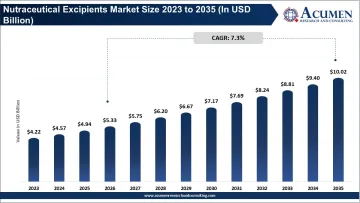
The global nutraceutical excipients market size was recorded at USD 5.33 billion in 2025 and is expected to reach around USD 10.02 billion by 2035, growing at a CAGR of 7.3% during the forecast period of 2026-2035. The rapid growth of plant-based nutrition and personalized dietary supplements is creating strong demand for specialized nutraceutical excipients. Consumers are increasingly seeking vegan, clean-label, allergen-free, and customized formulations, prompting manufacturers to develop innovative excipients that enhance product functionality and ingredient compatibility.
Report Highlights
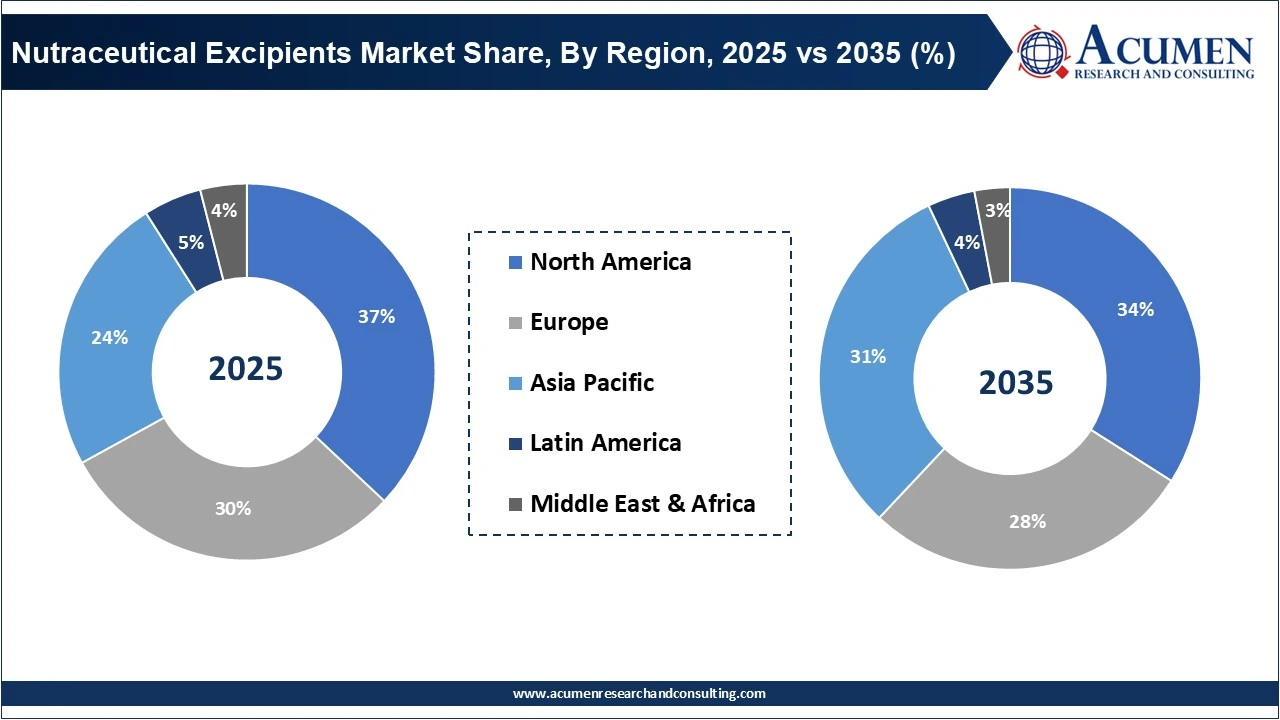
- By region, North America dominated the nutraceutical excipients market with a 37.0% share in 2025 and is projected to account for 34.0% by 2035, expanding at a CAGR of 6.3% during 2026–2035, driven by strong nutraceutical manufacturing capabilities and growing demand for clean-label dietary supplements.
- By region, Asia-Pacific emerged as the fastest-growing regional market with a 24.0% share in 2025 and is anticipated to reach 31.0% by 2035, registering the highest CAGR of 10.3%, supported by rising consumption of functional nutrition products and rapid expansion of nutraceutical production.
- By excipient type, fillers & diluents dominated the market with a 28.0% share in 2025 and are expected to hold 26.0% by 2035, owing to their widespread use in improving tablet uniformity, manufacturability, and formulation stability.
- By excipient type, binders held the second-largest share of 17.0% in 2025 and are projected to account for 16.0% by 2035, driven by increasing demand for nutraceutical tablets and multifunctional excipient systems.
- By source, natural excipients led the market with a 46.0% share in 2025 and are expected to capture 52.0% by 2035, expanding at the highest CAGR of 8.7%, supported by growing preference for clean-label, plant-based, and organic formulations.
- By source, synthetic & semi-synthetic excipients represented the band are projected to reach 28.0% by 2035, growing at a CAGR of 6.0%, owing to their superior formulation consistency and manufacturing efficiency.
- By formulation, tablets dominated the market with a 36.0% share in 2025, driven by their cost-effectiveness, dosage accuracy, and long shelf life across a wide range of nutraceutical products.
- By formulation, capsules accounted for the second-largest share of 26.0% in 2025, supported by increasing demand for vegetarian capsules and improved ingredient bioavailability.
- By application, vitamins & minerals dominated the market with a 36.0% share in 2025, owing to rising consumer focus on immunity, preventive healthcare, and daily nutritional supplementation.
- By application, herbal supplements held the second-largest share of 21.0% in 2025, driven by increasing consumer preference for botanical, traditional, and clean-label wellness products.
Nutraceutical Excipients Market Overview
The nutraceutical excipients market is segmented into various functional inactive components that serve specific purposes in formulating and producing nutraceutical products such as dietary supplements, functional foods, functional beverages, probiotics, vitamins, minerals, herbal supplements and sports nutrition products. These excipients assist in enhancing the product's quality by boosting their bioavailability, compressibility, flowability, taste, shelf life, stability and regulatory approvals.
Key segments of the nutraceutical excipients market consist of binders, fillers, disintegrants, lubricants, coating agents, flavors, sweeteners and other novel excipients in different nutraceutical dosage forms like tablets, capsules, powders, gummies, soft gels and liquids.
Current Trends in Nutraceutical Ingredients Demand, By Industries
| Industry | Current Trend | Latest Industry Statistics |
|---|---|---|
| Dietary Supplements | Consumers are increasingly purchasing vitamins, minerals, probiotics, and botanical ingredients to support immunity, healthy aging, and preventive healthcare. | 60.2% of U.S. adults reported using at least one dietary supplement in the previous 30 days during 2021–2023, highlighting sustained demand for nutraceutical ingredients. |
| Functional Foods | Food manufacturers are fortifying cereals, dairy products, snacks, and bakery products with proteins, fibers, probiotics, and vitamins to deliver additional health benefits. | Grocery stores accounted for 40.3% of functional food sales in India in 2024, reflecting strong consumer demand for fortified everyday foods. |
| Functional Beverages | Beverage companies are expanding fortified drinks containing electrolytes, collagen, probiotics, adaptogens, and botanical extracts for hydration and wellness. | Functional beverages remain one of the fastest-expanding wellness beverage categories globally as consumers increasingly replace sugary drinks with health-focused alternatives. |
| Sports & Active Nutrition | Demand is increasing for whey protein, plant proteins, BCAAs, collagen peptides, and performance nutrition ingredients among fitness-conscious consumers. | Protein and fitness supplements were cited by 41% of nutraceutical consumers in a recent industry survey in India. |
| Clinical & Medical Nutrition | Specialized nutritional ingredients are increasingly incorporated into products for diabetes management, oncology, digestive health, and elderly nutrition. | Rising incidence of chronic diseases has significantly increased demand for Foods for Special Medical Purposes (FSMP) and disease-specific nutritional formulations. |
| Personalized Nutrition | Companies are developing customized formulations using probiotics, vitamins, minerals, omega-3s, and botanical ingredients based on individual health needs and genetic profiles. | 71% of surveyed consumers expect their supplement usage to increase as they age, indicating growing acceptance of personalized wellness solutions. |
Market Dynamics
Driver
Rising Consumer Focus on Preventive Healthcare and Functional Nutrition
Preventive health and immunity care are important factors propelling growth for the nutraceutical excipients market, as consumers adopt dietary supplements, functional foods, and fortified beverages into their lifestyles for boosting immune system, improve gut health, maintain heart health, anti-aging, among others. These products necessitate high performance excipients with improved solubility, shelf life, bioavailability and taste masking properties of active ingredients.
Moreover, formulators are leveraging newer technologies and advanced excipient ingredients that can significantly boost performance, workability and consumer-appeal for the nutraceutical products presented in tablets, capsules, gummies, powders and liquid formats.
Restraint
Regulatory Complexity and Raw Material Quality Challenges
The market for nutraceutical excipients is impacted by differing regulatory environments among nations and regions. Different countries and regions have varied standards, guidelines, and regulations regarding ingredient safety, quality assurance, labeling and manufacturing of products; this requires producers of products to adjust the product development for individual markets, resulting in product development cost hikes and commercial launch delays.
Meanwhile, volatile availability and fluctuating quality of natural raw materials in markets, together with a rising demand for clean label products, contribute to inconsistency and pricing fluctuations in the sector. These issues poses a tremendous hurdle to producers, especially to smaller or medium scale enterprises engaged in the business.
Opportunity
Growing Demand for Clean-Label and Advanced Delivery Technologies
The fast-moving evolution toward clean label nutraceutical ingredients as well as creative drug formats is creating massive expansion avenues within the market for nutraceutical excipients. Modern consumers favor manufactured items from normally sourced, non-GMO, and also plant-derived ingredients, which are also free from allergens as well as contain an increasing amount of functionality and comfort.
Furthermore, the expanding trend toward the adoption of chewables, gummies, individually dissolving tablets, and stick loads is driving requirement for highly practical excipients which contribute to enhanced stability of item, regulated release, texture, and also bioavailabilty. Firms focusing on eco-friendly excipient technologies as well as customized formulatory and also novel encapsulation solutions are poised to take pleasure in an effective competitive positioning in the global market of the nutraceuticals industry.
Regional Insights
Which Region Dominated the Nutraceutical Excipients Market in 2025?
In terms of share, the North America market held the largest share of 37.0% in 2025. North America market is estimated to account for 34.0% market share in 2035, exhibiting a CAGR of 6.3% over 2026-2035. Growth is attributed to the prevalence of numerous nutraceutical manufacturers, mature regulatory environment regarding dietary supplements, and the high awareness of consumers regarding preventative health, functional food products, and a balanced nutritional diet
Consumption of dietary supplements, sports nutrition products, and fortified food products in Canada and the U.S. is on the rise, thus spurring demand for high performance excipients. The key stakeholders are inclined towards incorporating versatile excipients that can offer benefits like improved compressibility, dissolution, bioavailability and taste masking while supporting clean label requirements.
Increasing consumer preference for personalized nutrition and plant-based supplements along with rise in acceptance of varied dosage formats like gummies and chewable tablets is augmenting demand for enhanced excipient technology.
Asia Pacific Nutraceutical Excipients Market Analysis
Asia-Pacific accounted for a 24.0% share in the global market in 2025 and is projected to reach a 31.0% market share in 2035, expanding at the highest CAGR of 10.3% during the 2026-2035 forecast period. Rapid urbanization, an increase in disposable income, expanding middle-class segments and high awareness about preventive healthcare are contributing to steady growth in the Asia Pacific market comprising countries like China, India, Japan, South Korea, and the ASEAN region.
This region also witnessed a robust growth in the nutra-manufacturing industry supported by the substantial investments made in the production of functional food, supplements, herbs, and sport supplements.
Consumers’ growing preference towards plant-based ingredients, natural, and clean-label products are pushing the demand for formulation innovation. Favorable government policies along with rapid expansion of online shopping platforms further propels the growth of Asia Pacific in this market.
Segmental Insights
Excipient Type Insights
Fillers & diluents the segment, which had the highest market share of 28.0% in 2025, is predicted to have a share of 26.0% in the global nutraceutical excipients market by 2035. Fillers and diluents are one of the most frequently used nutraceutical excipients across diverse dosage forms, including tablets, capsules, powders, and chewable forms.
They help in maintaining tablet weight and also aid in the uniformity of content, thereby enabling mass production of tablets and capsules effectively. The demand for these excipients is bolstered by an increased consumption of nutraceutical dietary supplements and the mass production of high-volume nutraceutical products.
Nutraceutical Excipients Market Share, By Excipient Type, 2025 & 2035 (%)
| Excipient Type | 2025 (%) | 2035 (%) |
|---|---|---|
| Fillers & Diluents | 28% | 26% |
| Binders | 17% | 16% |
| Disintegrants | 12% | 12% |
| Lubricants & Glidants | 10% | 9% |
| Coating Agents | 11% | 11.90% |
| Sweeteners & Flavors | 9% | 11.80% |
| Colorants | 4% | 4.10% |
| Preservatives & Stabilizers | 6% | 5.90% |
| Others | 3% | 3.20% |
Binders, the second-largest segment, accounted for a market share of 17.0% in 2025 and is expected to witness a moderate decrease in its share, with an estimated market size of 16.0% by 2035. Binders are used in pharmaceutical formulations for binding active ingredients and auxiliary substances, thus providing tablets with better mechanical strength.
A rise in the production of nutraceutical tablets, capsules, and chewable forms and a growing trend toward the usage of combined and multipurpose excipients which also offer disintegration and binding functionality are expected to contribute to growth in the segment.
Source Insights
The highest contribution was reported by natural excipients with 46.0% of the market share in 2025. It is estimated to increase its share by 52.0% in 2035 and registered the highest CAGR of 8.7% in the study duration (2026–2035). In addition to this, the demand for nutraceutical products such as clean label, vegan, organic, plant-based, minimal processing is fueling up the demand for the natural origin of ingredients used for product enhancement and functioning.
Some naturally sourced ingredients such as cellulose, starch, pectin, alginates, gums and etc., being adopted by nutraceutical producers. Demand for vegan supplements, herbal formulation products, plant extracts based supplement products are some key application area driving its growth.
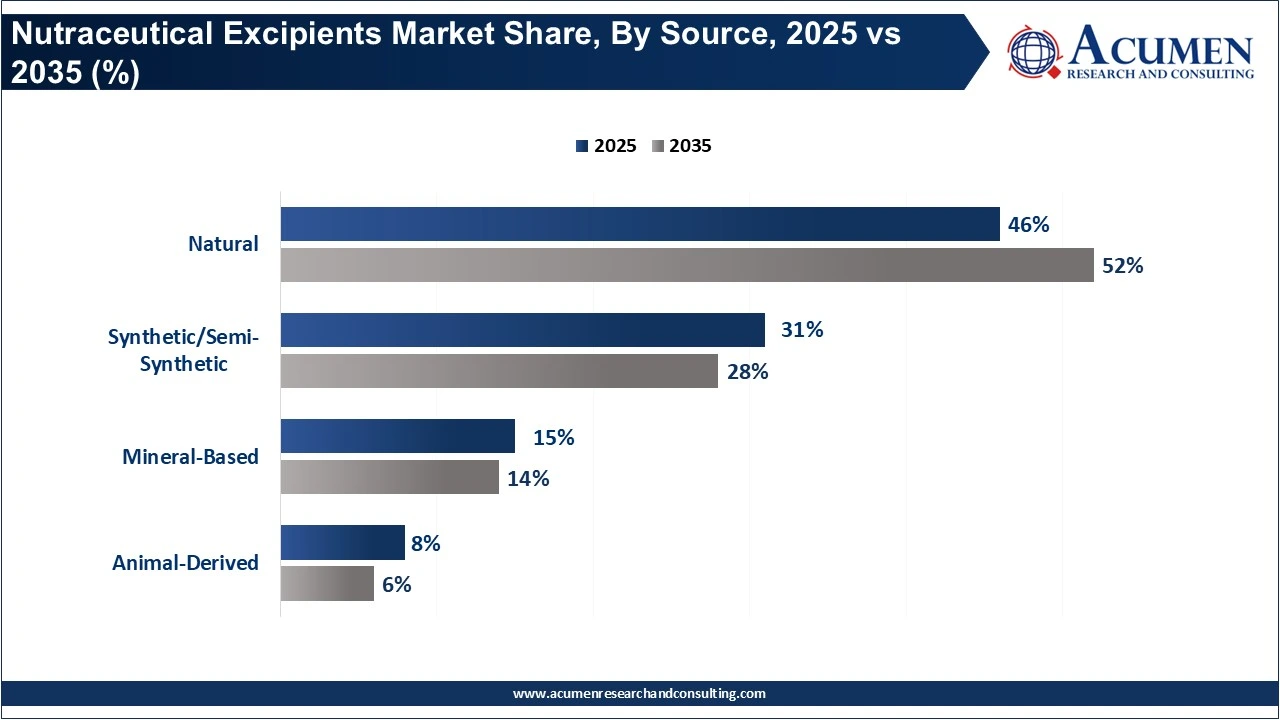
The second-largest share was achieved by synthetic & semi-synthetic excipients, contributing 31.0% in the 2025market and expected to decrease by 28.0% by 2035. The segment is expected to register a CAGR of 6.0%. Synthetic and semi-synthetic ingredients used due to functional consistency, improved product performance, consistency, higher purity and excellent compatibility with varied nutritional supplements application, which supports a repeatable and efficient production and stable formulation product.
Formulation Insights
Tablets captured 36.0% market share in 2025, with their inherent advantages in manufacturing, cost, shelf-life, dosage consistency, and ease of use. Consumers and manufacturers opt for tablets for vitamins, minerals, herbal supplements, sports nutrition products, owing to their easy-to-store and transportability, as well as cost-effective and speedy production process. Moreover, the evolving trends of coating technologies and sustained release delivery mechanisms have given an additional boost to segment expansion.
Nutraceutical Excipients Market Share, By Formulation, 2025 & 2035 (%)
| Formulation | Revenue Share, 2025 (%) |
|---|---|
| Tablets | 36% |
| Capsules | 26% |
| Powders | 14% |
| Gummies | 8% |
| Softgels | 9% |
| Liquids | 5% |
| Others | 2% |
Capsule accounted for a market share of 26.0% in the global market in 2025 Rising prevalence of vegetarian capsules, favorable compatibility with various ingredients, enhanced bioavailibity of compounds and ease of swallowing offered by this dosage form are supporting the market expansion of the segment. Moreover, the rise of vegan and clean-labeled nutraceutical products is prompting key market players to launch plant-based capsule manufacturing technology.
Application Insights
Vitamins & minerals accounted for the largest share of 36.0% in 2025. The demand for vitamin and mineral supplements across the world is driven by consumer focus on immunity, bone health, cardiovascular wellness, and preventive healthcare. With an aging population, growing number of nutritional deficiencies, and a trend of daily supplementation, manufacturers are focused on introducing improved formulations.
The demand that necessitates a wide range of high performance excipients in achieving desired stability, dissolution and bioavailability of formulations, is observed to support the segment's expansion.
Nutraceutical Excipients Market Share, By Application, 2025 & 2035 (%)
| Application | Revenue Share, 2025 (%) |
|---|---|
| Vitamins & Minerals | 36% |
| Herbal Supplements | 21% |
| Sports Nutrition | 15% |
| Probiotics | 10% |
| Functional Foods & Beverages | 12% |
| Medical Nutrition | 6% |
Herbal supplements occupied the second largest share of 21% in 2025. The demand for herbal products, especially related to traditional practices and formulations, and natural wellness supplements has surged among consumers. High focus has been given on the development of specialized excipients for stable, moisture-free, and tasty formulation of herbal supplements to increase the shelf life and aid the clean-label product development.
Recent News
- May 2025 – Roquette completed the acquisition of IFF Pharma Solutions. The acquisition significantly expanded Roquette's portfolio of pharmaceutical and nutraceutical excipients, oral dosage technologies, and formulation capabilities. By integrating IFF Pharma Solutions, Roquette strengthened its global manufacturing footprint and enhanced its ability to deliver advanced drug delivery and nutraceutical formulation solutions, positioning itself as one of the leading global excipient suppliers.
- February 2025 – Roquette launched an innovative high-performance coatings platform for pharmaceutical and nutraceutical applications. The new platform was developed to improve coating performance, manufacturing efficiency, and sustainability while addressing the growing demand for clean-label and eco-conscious formulation technologies. The launch enables nutraceutical manufacturers to develop products with improved stability, appearance, and functionality, supporting the industry's shift toward premium formulations.
Top Companies
North America
- IFF (International Flavors & Fragrances Inc.)
- Ashland Inc.
- Ingredion Incorporated
- Sensient Technologies Corporation
- Colorcon Inc.
Europe
- Roquette Frères
- DFE Pharma GmbH & Co. KG
- BASF SE
- JRS Pharma GmbH & Co. KG
- Kerry Group plc
- IMCD N.V.
Asia-Pacific
- Shin-Etsu Chemical Co., Ltd.
- Gangwal Healthcare Pvt. Ltd.
- Sigachi Industries Limited
- Fuji Chemical Industry Co., Ltd.
Segments Covered
By Excipient Type
- Fillers & Diluents
- Binders
- Disintegrants
- Lubricants & Glidants
- Coating Agents
- Sweeteners & Flavors
- Colorants
- Preservatives & Stabilizers
- Others
By Source
- Natural
- Synthetic/Semi-Synthetic
- Mineral-Based
- Animal-Derived
By Formulation
- Tablets
- Capsules
- Powders
- Gummies
- Softgels
- Liquids
- Others
By Application
- Vitamins & Minerals
- Herbal Supplements
- Sports Nutrition
- Probiotics
- Functional Foods & Beverages
- Medical Nutrition
By Region
- North America
- Europe
- Asia-Pacific
- Latin America
- Middle East & Africa
Looking for discounts, bulk pricing, or custom solutions? Contact us today at sales@acumenresearchandconsulting.com
Frequently Asked Questions

Other Consumer Goods and Food and Beverages Reports
March 2023
January 2020
August 2018
December 2025