April 2021

Pharmaceutical Filtration Market (By Product: Membrane Filters, Cartridge Filters, Capsule Filters, Syringe Filters, Accessories & Assemblies; By Technology: Microfiltration, Ultrafiltration, Nanofiltration, Reverse Osmosis, Depth Filtration; By Application: Final Product Processing, Raw Material Filtration, Cell Culture Media Filtration, Buffer Filtration, Water Purification, Air & Gas Filtration; By End User: Pharmaceutical Companies, Biopharmaceutical Companies, CDMOs, Research Institutes) - Global Industry Analysis, Size, Share, Growth, Trends, Regional Analysis And Forecast 2026 To 2035
The global pharmaceutical filtration market size was estimated at USD 14.60 billion in 2025 and is projected to surpass USD 33.71 billion by 2035; represents a remarkable CAGR of 8.7% during the forecast period from 2026 to 2035. The pharmaceutical filtration market is witnessing substantial growth due to the increasing scale of biologics production, sterile drug manufacturing, and rising regulatory emphasis on contamination control. The growing vaccine production ecosystem is another major driver, as global vaccine output exceeded 18 billion doses annually post-pandemic, increasing demand for high-efficiency filtration systems.
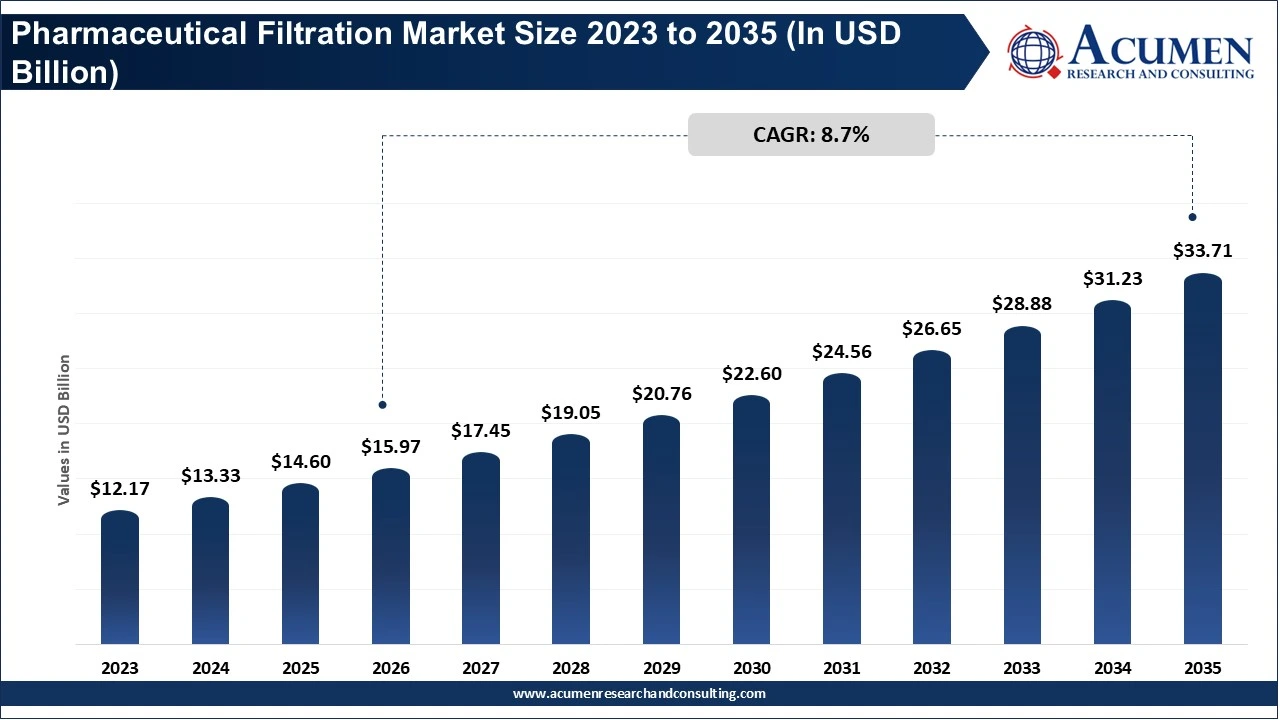
What is Pharmaceutical Filtration Market & How is the Market Growing?
A pharmaceutical filtration system consists of equipment, consumables and process technologies that help to prevent contamination and carry out effective purification for drugs throughout their development and production. Market opportunities for pharmaceutical filtration products and solutions lie in applications including raw materials and ingredients, cell media preparation, final drug processing, and process water filtration to name just a few. Such solutions are adopted across biopharmaceutical and pharmaceutical businesses to increase efficiency in their processes, reduce variability in their output and achieve high global regulatory quality standards.
Demand for pharmaceutical filtration systems is growing as manufacturers continue to transition towards single-use solutions to achieve increased flexibility, decreased cleaning validation costs, lower cross-contamination risk. The single-use trend is more prominent within biopharmaceutical development and CDMO manufacturing where efficient multiproduct manufacture is a high priority.
Regulatory Landscape for Pharmaceutical Filtration
Rising demand for biologics and sterile injectable
The overall global production of biologics that include monoclonal antibodies, biosimilars, recombinant proteins, vaccines, advanced cell and gene therapies are a prominent growth driver of the global pharmaceutical filtration market. The biological drugs are living system, and highly sensitive biological structures in contrast with the classical small molecule drugs. This means a higher chance of microbial contamination or introduction of any undesired agent during its production process and consequently requires rigorous control and removal at each and every stage of the entire manufacturing cycle, and relies heavily on microfiltration, ultrafiltration, and nanofiltration systems.
As global pipelines for new biologics continues to rise, many pharmaceutical companies are likely to ramp up investments in filtration equipment and processes for efficient and cost-effective production of their drugs, in order to meet all standards and regulatory regulations.
High operational and replacement costs of filtration systems
Even though there are several trends driving up demand, the pharmaceutical filtration market is struggling to realize faster growth because the costs for filtration systems and maintenance costs are significant. State-of-the-art filtration technology often has high capital costs, such as sterile membrane systems, tangential flow filtration systems and automated integrity test equipment. It also necessitates additional verification, validation, performance tests, and compliance documents to adhere to all pharmaceutical industry standards.
Filters, membranes and other disposable equipment will need to be replaced on a regular basis which can further strain smaller and mid-size pharma companies and their facilities as well as those in developing regions where cost is a major factor.
Expansion of single-use bioprocessing systems
The advent and proliferation of single-use bioprocessing technologies are now fueling the exponential growth in the pharmaceutical filtration market. Biopharmaceutical and pharmaceutical manufacturers are in the midst of a paradigm shift as they embrace disposable filtration solutions to enhance operating efficiency, streamline cleaning validations, and minimize the potential for cross-contamination. With growing demand for capsules filters, membrane assemblies, disposable filter cartridges and others especially for biological applications, manufacturers will likely witness sustained growth opportunities, with the personalized medicine, compact batch, CDMO and point of care market set to be key areas of growth.
North America dominated the pharmaceutical filtration market, with 38% of pharmaceutical filtration market in 2025, due to its mature ecosystem of pharmaceutical manufacturing, base for production of biologics, and sophisticated regulatory environment. North America is the key driver, and the United States has the highest share.
Its leadership is also attributed to a concentration of injectable drug, monoclonal antibody, plasma derived, and vaccine manufacturing operations, where the adoption of advanced sterile filtration systems is necessary. Strict environmental standards enforced by one of the most rigorous regulatory bodies in the world, U.S. FDA lead to higher dependence on the adoption of sterilization and decontamination measures across manufacturing.
High adoption rate for injectable, biologic products including vaccine, cell, and gene therapy, as well as stringent contamination-control protocols, are the dominant regulator for the market.
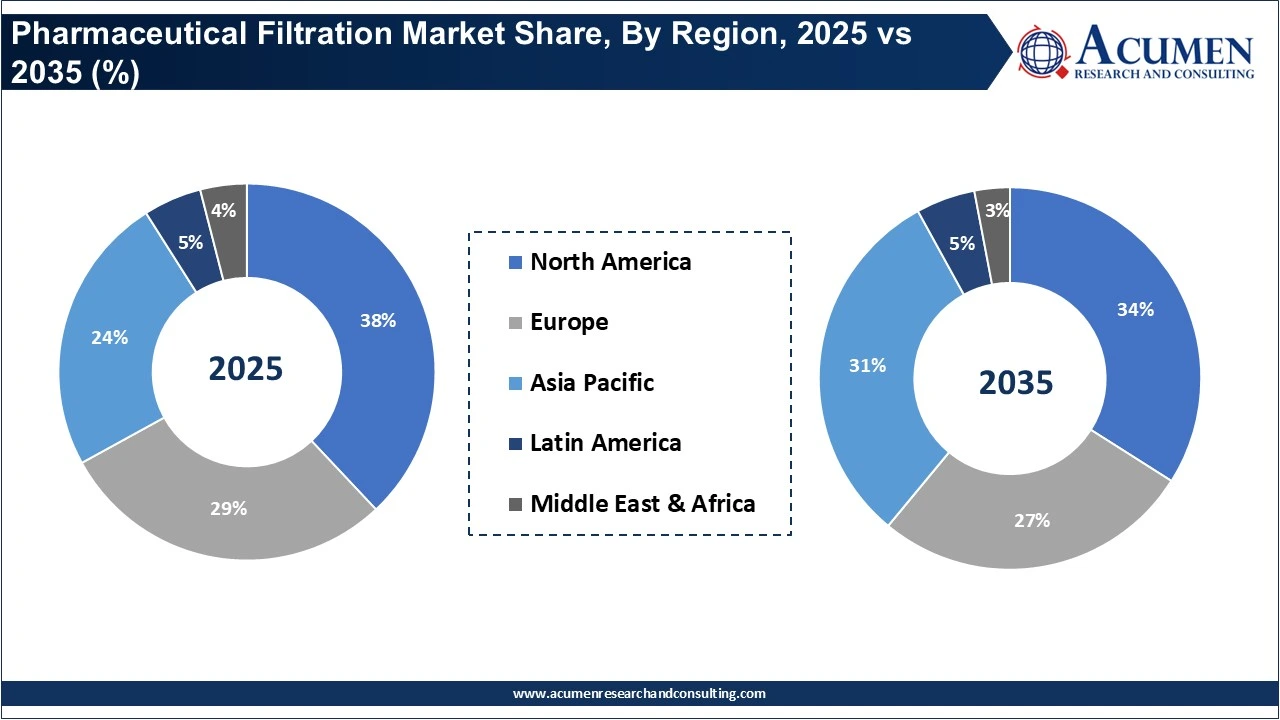
Asia Pacific captured 24% of the global pharmaceutical filtration market share in 2025 and is estimated to rise at a CAGR of 11.8% among all regions from 2026 to 2035. The increasing rate is driven by the rapid rise in pharmaceutical production capabilities, reduced cost of production, and thriving biologics industry in the region. The countries in this region including China, India, South Korea and Japan are emerging as a manufacturing destination for active pharmaceutical ingredients (API), biosimilars, and contract manufacturing organizations.
The region has been gaining an increased popularity as the favorite destination for outsourcing pharmaceutical manufacturing due to low labor costs, beneficial industrial policies and large-scale production ecosystem. This trend is resulting in a surge in demand for filters in a range of applications including raw material purification, cell culture media filtration and sterile fill finish.
Top 5 Countries in the Pharmaceutical Filtration Market
1. United States:
2. Germany:
3. China:
4. India:
5. South Korea:
Membrane filters commanded the largest share of 42% in 2025, and are expected to continue at a significant 40% share through 2035, solidifying their status as the backbone of pharmaceutical filtration systems. The strength of membrane filters comes from their fundamental importance in performing sterile filtration, achieving microbial retention, and guaranteeing the purity of drug products across biologics, injectables, vaccines, and small molecule manufacturing processes.
Membrane filters’ superior pore size consistency, ease of use with higher-value drug products, and compliance with ever-increasing contamination-free manufacturing guidelines established by agencies like the US Food and Drug Administration (FDA) and the European Medicines Agency (EMA) make these units widely popular within pharmaceutical operations.
The ongoing growth of the monoclonal antibody (MAB) and recombinant protein market, in addition to burgeoning cell-based therapies, further boost the segment’s viability, and its replacement cycle ensures continued high demand within Good Manufacturing Practice (GMP) facilities.
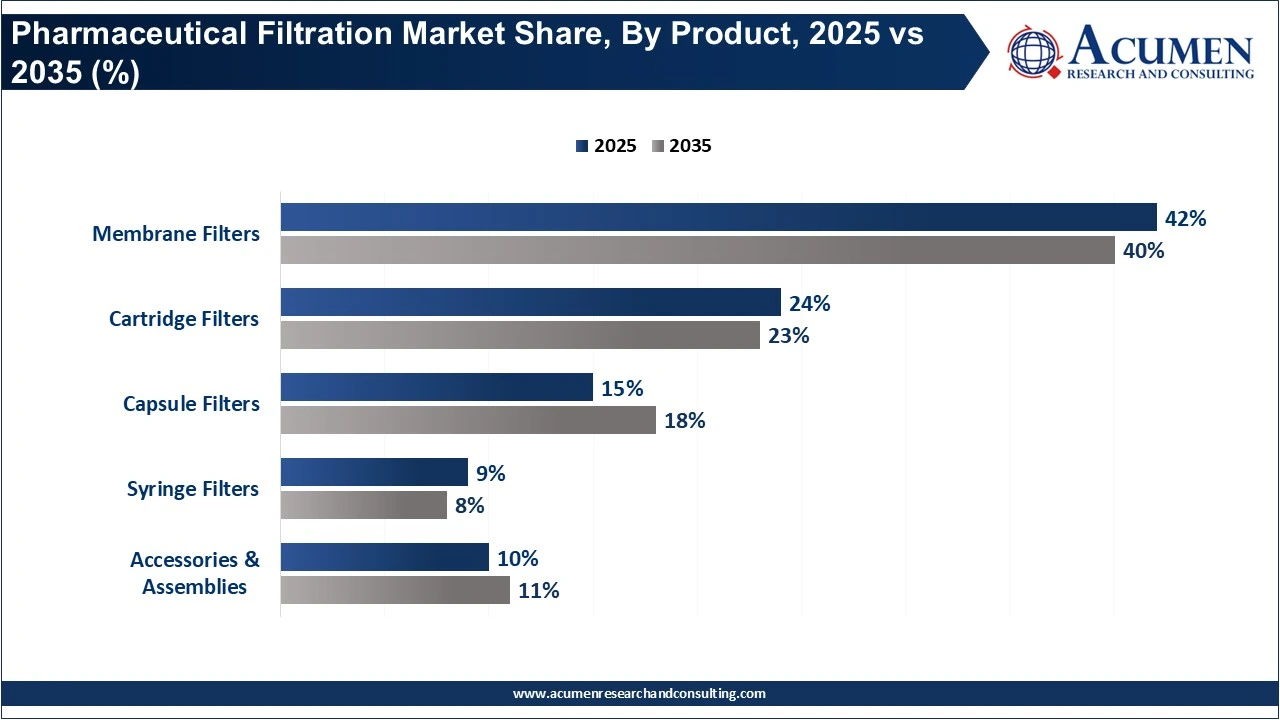
Cartridge filters comprised 24% of the market in 2025 and are the system most in demand in bulk filtration, given their durability, scalability and large volume filtration capacity. These units provide critical filtration services in both upstream and downstream bioprocessing for vaccine and plasma-derived therapies. In 2025, global commercial-scale biologics manufacturing growth in countries like the U.S., Germany, and India provided strong momentum for the demand of cartridge filtration.
Microfiltration registered the highest share at 35% in 2025 and would likely grow at a CAGR of 7.9% during 2026-2035. The dominance of microfiltration is driven by the wide applications for removing the bacteria, particles, and suspended matter from liquid and gaseous states. In the pharma manufacturing landscape, microfiltration can be called as the default choice, given the cost-effectiveness and ease of operation for both the developed and developing pharma manufacturing markets.
Ultrafiltration garnered the second largest share at 27% in 2025 and would gain up to 29% market share by 2035 at a CAGR of 9.5%. Ultra filtration plays a significant role in protein concentration, virus removal and biological products filtration. The expansion of the segment is also attributable to the increasing prevalence of biological drugs in pharmaceutical pipelines, and with increase in their complexity. The growth of biosimilaris also contributing towards the expansion of ultrafiltration segment in the market.
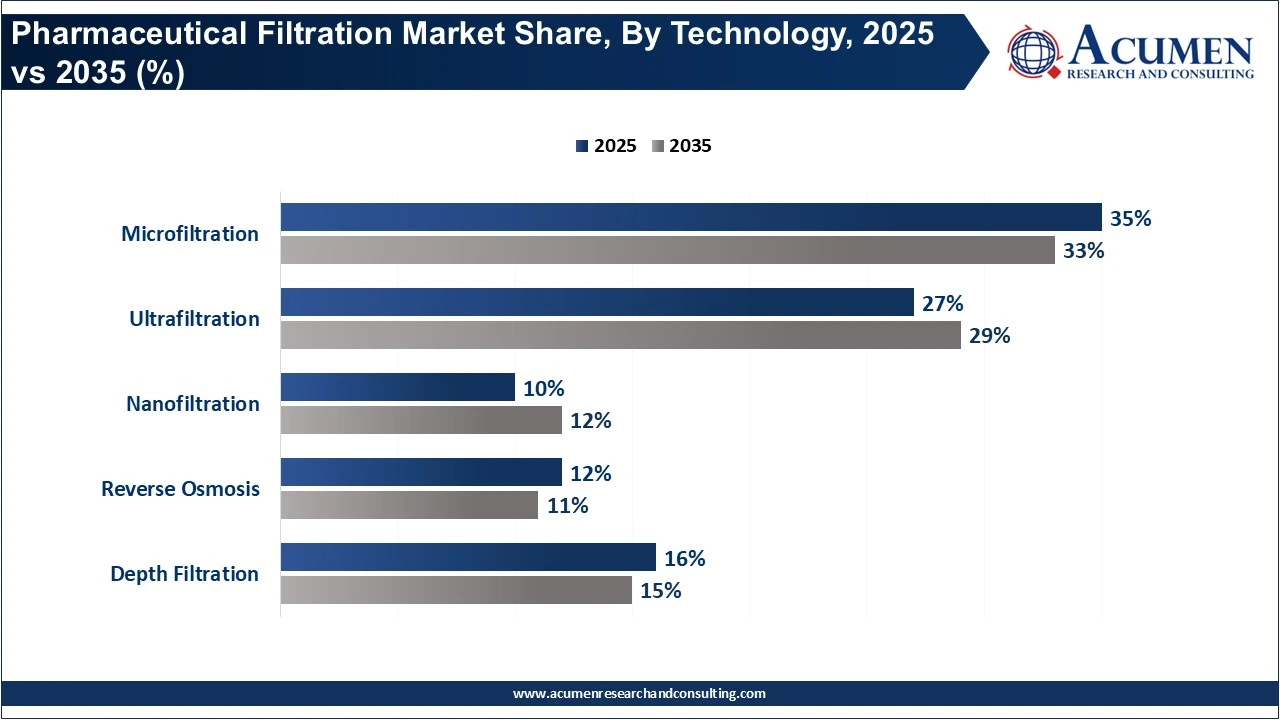
Nanofiltration represents fastest growing technology segment. Nanofiltration is expected to grow at the fastest CAGR of 10.9% in the total market during 2026-2035. The increased use of nanotechnology in the treatment of higher value biological treatments and viral vectors are contributing towards the expansion. Nanofiltration will also be important in treatment of mRNA based therapies and the newer gene therapy.
In 2025, the final product processing segment estimated to be the largest segment of the market by contributing a share of 34% and emerging as a crucial application in the pharmaceutical filtration market. This segment's expansion can be attributed to the critical need to assure product sterility at the final step before packaging and commercializing it, especially when filling. This is crucial for injectables, vaccines, ophthalmic drugs, and biological drugs to meet extreme contamination limits.
This market segment presents good potential as a revenue source and provides long-term visibility due to its inextricable connection with regulatory compliance, scheduled replacement requirements for filters, and increasingly complex drug formulations. Since companies continue to increase sterile pharmaceutical production capacity, the final product processing application segment will be a major demand driver.
Pharmaceutical Filtration Market Share, By Application, 2025 (%)
| Application | Revenue Share, 2025 (%) |
| Final Product Processing | 34% |
| Raw Material Filtration | 18% |
| Cell Culture Media Filtration | 16% |
| Buffer Filtration | 12% |
| Water Purification | 14% |
| Air & Gas Filtration | 6% |
The raw material filtration segment held 18% share of the market in 2025, making it the second-leading application area of the market, largely based on its crucial role in upstream product quality assurance. In the pharmaceutical manufacturing process, active pharmaceutical ingredients (APIs), solvents, excipients, and various chemical intermediate inputs are filtered before entering the production process. Raw materials need filtration for the removal of particulates, microorganisms, and other process residue, which may have detrimental effects on downstream processing efficiency and the quality of the final drugs produced.
This market segment has grown significantly as pharmaceutical manufacturers put emphasis on ensuring end-to-end quality control of their supply chain. As global supply chains become more intricate, especially with increased reliance on sourcing inputs from international regions, the role of filtration has expanded in ensuring the stringent quality of raw material inputs.
The pharmaceutical companies segment captured the largest market share of 41% in 2025, sustained in its top position on the back of bulk manufacturing of generic, branded, sterile injectable, and OTC (over-the-counter) drugs. The pharmaceutical companies are considered as high-volume consumers of filtration systems since it is deployed at various stages, starting from raw material purification and solvent filtration to sterilization of final products.
Production of high volumes in pharmaceutical manufacturing processes necessitates the filtration systems to preserve the integrity of batches and minimize the particulate contamination to achieve Good Manufacturing Practices (GMP). The tightening regulations have turned the filtration into a strategic tool for compliance.
Pharmaceutical Filtration Market Share, By End User, 2025 (%)
| End User | Revenue Share, 2025 (%) |
| Pharmaceutical Companies | 41% |
| Biopharmaceutical Companies | 34% |
| CDMOs | 17% |
| Research Institutes | 8% |
The biopharmaceutical companies segment contributed a 34% market share in 2025, making it the second biggest segment in the filtration systems for biopharma industry, and also one of the most critical end-user segments. High growth of biologic products such as monoclonal antibodies (mAbs), recombinant proteins, vaccines, biosimilars, and cell and gene therapy, among others is fueling the demand in this segment. Biologics are associated with living systems and have high potential for bacterial, viral and particulate contamination, therefore they are quite filtration-intensive.
By Product
By Technology
By Application
By End User
By Region
Looking for discounts, bulk pricing, or custom solutions? Contact us today at [email protected]

April 2021
March 2025
March 2023
May 2026
Trusted Market Intelligence | 2026–2035 Insights | Designed to Support Faster, Smarter Decisions
Thank you! Our team will reach out to you soon.