
Humanoid Robot Battery Market: Navigating the Next Wave of Robotics Energy Innovation
Published : 22 Sep 2026
Author : Raghuram Nair



What is the Humanoid Robot Battery Market Size?
The global humanoid robot battery market size was accounted for USD 15 million in 2025 and is projected to reach USD 3,288.09 million by 2035; growing at a strongest CAGR of 71.4% during the forecast period of 2026-2035.
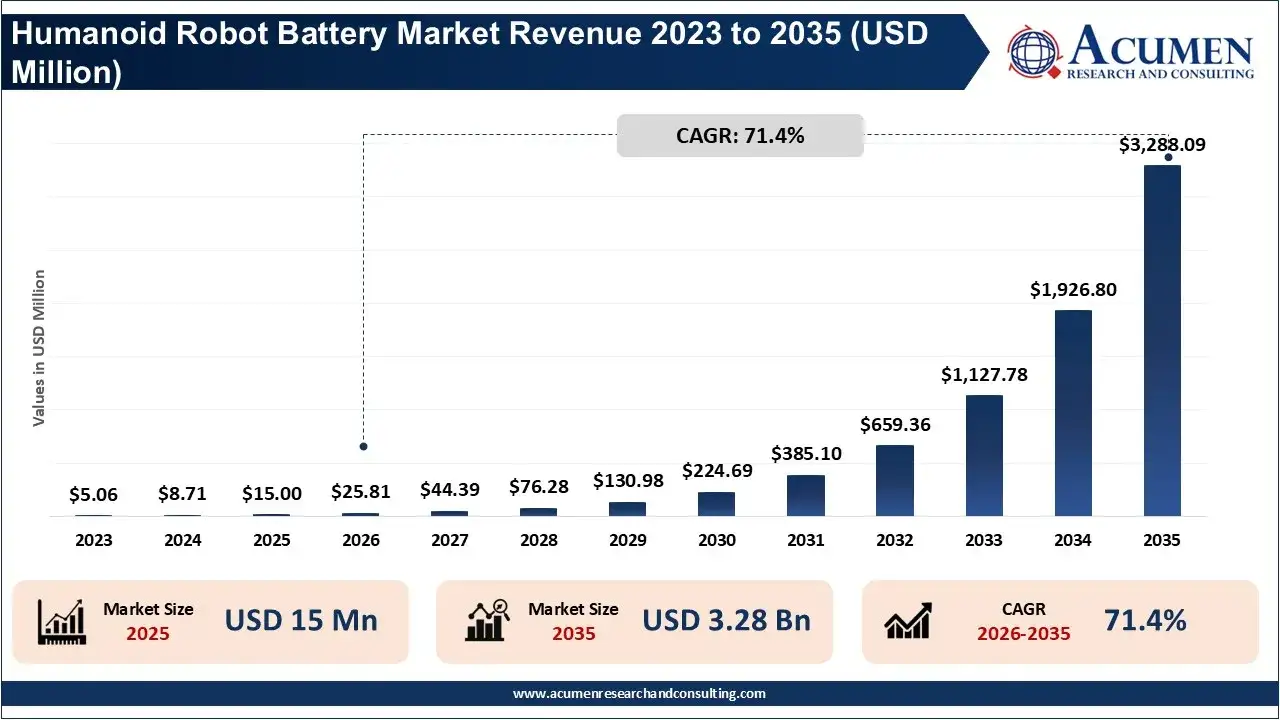
What Is Driving the Growth of the Humanoid Robot Battery Market?
The humanoid robot battery market is evolving in step with the rapid maturation of the humanoid robot industry as manufacturers demand smaller, lighter, higher powered energy sources that can sustain mobility, manipulation, sensing, and computational capabilities. Industry funding for industrial automation, artificial intelligence, advanced robotics, manufacturing, and logistics is increasing the scope of humanoid robot applications in commercial buildings.
Demand for humanoid robot batteries is also driven by the need for extended operating runtimes, higher energy densities, rapid charge capability, increased thermal stability, and the reliable provision of power to highly dynamic systems. Simultaneously, breakthroughs in lithium-ion chemistries, battery management systems, manufacturing methods, and the emergence of solid-state and semi-solid-state technologies offer the potential to enhance the performance and value proposition of next-generation humanoid robots.
Investment Opportunities Across Cells, Packs, BMS, and Thermal Management
- Humanoid robot-ready batteries: High-energy-density cell manufacturing: Additional energy-dense cell manufacturing capacity at the component level (for NMC/NCA cells for the most part, but next-generation chemistries as well) can help overcome the weight constraints humanoid platforms face today.
- Solid-state and semi-solid-state batteries: Pilot projects in solid-state and semi-solid-state cell development and manufacturing can help enable higher energy density, safer cells, and longer use cycles.
- Compact battery pack design: Cell pack designers can engineer lightweight, space-efficient cells designed specifically to fit within the limited internal layout of a humanoid robot.
- Battery management systems: BMS designers can further develop high-performance control and diagnostic electronics that can help monitor cell voltage, current, temperature, state of charge and battery health in humanoid robots under dynamic load conditions.
- Thermal management: As cells are increasingly paired with high-performance other system components, specialized cooling and heat dissipation systems can help.
- Fast-charging systems: Optimized fast-charging systems that can help minimize downtime in warehouse, manufacturing, logistics and other high-utilization settings can create new end-market opportunities.
- Battery swapping systems: Automated, standardized removable battery packs, charging pads and swapping infrastructure, as well as rental or subscription business models, can help grow additional opportunities for high-end-utilization, short-lived robot fleets.
- Additional support infrastructure: Cell, pack and system-level testing solutions for cycle life, thermal and safety testing, charging and high-frequency load variation, as well as second-life applications, can help support scaled commercial adoption of humanoid robot batteries.
Key Restraints and Industry Challenges
There are technical and commercial challenges that could affect the rate of deployment of the humanoid robot battery market. To meet the challenges of mounting weight on space and commercial applications, a battery must balance capacity with weight, energy, runtime, and power all at the same time. A higher-capacity battery can pack on weight as well as more power, thus requiring the robot to burn more energy.
Furthermore, if researchers design exotic new battery chemistries and adapt pack architectures, this can be expensive in development and manufacturing costs. Perhaps of more concern, battery production could be complicated by low levels of standardisation between emerging humanoid platforms.
Exposure to supply chain bottlenecks of essential battery materials and issues such as charging downtime, battery degradation, safety considerations and nascent commercial economics for humanoids could also hinder scaling-up.
Humanoid Robot Battery Market Segmental Outlook
| Segmentation | Dominant Segment | 2025 Share | Key Reason for Dominance |
|---|---|---|---|
| By battery chemistry | High-Nickel NMC/NCA | 72% | High energy density and strong power-to-weight characteristics make high-nickel chemistries suitable for weight-sensitive humanoid robot platforms. |
| By cell form factor | Cylindrical cells | 42% | Mature manufacturing infrastructure, established supply chains, and proven performance across automotive and consumer electronics applications support widespread adoption. |
| By battery capacity | 1–2.5 kWh | 58% | This capacity range provides a practical balance between energy availability, battery weight, physical footprint, and the power requirements of emerging humanoid platforms. |
| By battery component | Battery cells | 68% | Cells are the primary energy-storage element and have a direct influence on battery capacity, weight, cost, and overall operating performance. |
| By application | Industrial/manufacturing | 42% | Humanoid robots are well suited to repetitive assembly, material handling, machine tending, inspection, and intralogistics tasks, supporting battery demand in manufacturing environments. |
How Are Regional Markets Shaping the Humanoid Robot Battery Industry?
Asia-Pacific had the dominant share in the humanoid robot battery market in 2025 with 50% share owing to extensive presence of robotics manufacturing, old supply chains of batteries, electronics ecosystem, and industrial automation. Countries like China, Japan, and South Korea have expanded their capabilities in robotics, lithium-ion battery manufacturing, semiconductor technologies, and intelligent manufacturing resulting in a growth environment for development of humanoid robots.
- China: China's large-scale robotics manufacturing ecosystem and extensive lithium-ion battery supply chain support the development of battery systems for humanoid robots. Growing investment in industrial automation and humanoid robotics is also encouraging domestic demand for compact, high-energy-density battery technologies.
- Japan and South Korea: Japan's established robotics industry and South Korea's strengths in batteries, electronics, and advanced manufacturing provide complementary capabilities for humanoid robot battery development. Battery manufacturers and robotics companies in these countries are increasingly positioned around higher energy density, safety, charging performance, and compact form factors.
The North American region experienced second-largest regional share in 2025 of 37.0% owing to investment and focus in artificial intelligence, robotics, advanced manufacturing, and autonomous systems. The technology players, research institutes, and automation builders are impacting demand for batteries with high-performance functions such as supporting longer cycle times, fast charging times, and more complex functions in humanoid robots.
- United States: The U.S. market is supported by investment in AI, humanoid robotics, autonomous systems, and advanced manufacturing. The expansion of robotics development by technology and automation companies is creating demand for batteries that can support continuous movement, onboard computing, and increasingly complex robotic workloads.
- Canada: Canada's investments in AI research, robotics, and advanced manufacturing are supporting the broader humanoid robotics ecosystem. Its research and technology capabilities create opportunities for battery suppliers and robotics developers focused on improving energy efficiency, operating duration, and system-level performance.
What Factors Are Influencing Battery Adoption Among Humanoid Robot Manufacturers?
- Energy density: Higher energy density enables humanoid robots to operate for longer periods without substantially increasing battery weight, which is important for mobile and weight-sensitive platforms.
- Battery weight: Manufacturers need to balance energy capacity with overall robot weight because heavier battery packs can increase the energy required for movement and potentially reduce payload capacity.
- Operating runtime: Longer battery runtime is increasingly important for industrial, manufacturing, logistics, and warehouse deployments where frequent charging can interrupt workflows.
- Power delivery: Humanoid robots require batteries capable of handling rapidly changing power loads generated by motors, actuators, sensors, onboard computing, and AI workloads.
- Safety and thermal stability: Battery manufacturers are prioritizing thermal management, cell monitoring, and safety mechanisms to address heat generation and variable loads during continuous robotic operation.
- Charging performance: Faster charging can reduce operational downtime and support higher utilization rates, particularly for robots deployed across multiple shifts.
- Battery lifecycle: Longer cycle life can improve the economics of humanoid robots by reducing the frequency of battery replacement and supporting extended fleet operation.
Who Are the Key Companies Shaping the Humanoid Robot Battery Market?
The humanoid robot battery ecosystem includes battery-cell manufacturers Panasonic Energy, LG Energy Solution, Samsung SDI, and SK On, and battery-pack manufacturers CATL, BYD, EVE Energy, CALB, Gotion High-Tech, and Farasis Energy, in addition to advanced-battery and advanced-robot technology companies that develop batteries, battery packs, and energy-management systems and software for advanced robotics and other applications.
CATL, BYD, EVE Energy, CALB, and Gotion High-Tech are all large-scale Asian lithium-ion (Li-ion) cell manufacturers with the capacity for large-volume production, while Panasonic Energy, LG Energy Solution, Samsung SDI, and SK On are all well-established experts in high-performance, high-energy-density battery cells, while Farasis Energy offers additional patent expertise in pouch-cell technology and high-energy-density battery-pack design and manufacturing.
As humanoid robot commercialization and widespread deployment continue to evolve, these companies are well-positioned to participate through cell chemistry development, high-density battery systems, small form factors, thermal management expertise, and manufacturing scale.
Segments Covered in the Report
By Battery Chemistry
- High-Nickel NMC/NCA
- LFP
- Lithium Polymer
- Solid-State/Semi-Solid-State
- Other Chemistries
By Cell Form Factor
- Cylindrical
- Pouch
- Prismatic
By Battery Capacity
- <1 kWh
- 1–2.5 kWh
- 2.5–5 kWh
- 5 kW
By Battery Component
- Battery Cells
- Battery Management System
- Thermal Management System
- Battery Pack Housing & Structural Components
- Other Components
By Application
- Industrial/Manufacturing
- Logistics & Warehousing
- Healthcare & Caregiving
- Retail & Hospitality
- Domestic/Personal
- Research & Education
- Other Applications
By Region
- North America
- Europe
- Asia-Pacific
- Latin America
- Middle East & Africa
Contact Us:
Mr. Richard Johnson
Acumen Research and Consulting
India: +91 8983225533