
India Battery Energy Storage System Market Projected to Reach USD 19,445.2 Million by 2035, Garnering a CAGR of 24.3%
Published : 13 Jan 2026
Author :



What is the India Battery Energy Storage System Market Size?
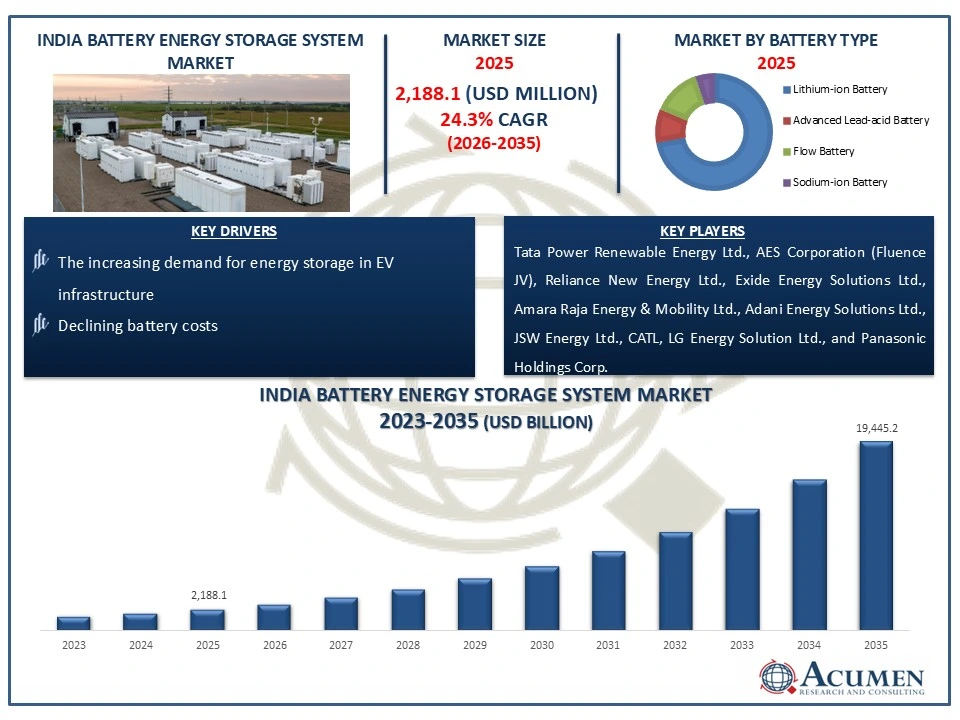
The India battery energy storage system market is projected to grow at a CAGR of 24.3% during the forecast period from 2026 to 2035 and reach the market size of USD 19,445.2 million by 2035, growing from a base value of USD 2,188.1 million in 2025.
The government policies play an important part in helping BESS develop in India. These include: legal status related to energy storage system energy storage obligations, and waiver of inter-state transmission charges. Viability Gap Funding will facilitate the implementation of 4,000 MWh BESS projects during 2030-31, in which support will be worth a maximum of 40% for capital cost in BESS installation projects. Each of these not only carries its own distinctive features in form of specifications, including National Solar Mission and National Mission for Enhanced Energy Efficiency, wherein previous ones have been performing appreciably large work in the form of propagation of non-fossil fuel-based energy resources. One such target, added further in support to the efforts put in BESS in meeting those targets, is extraction of resources from non-fossil fuel energy such that 50% of cumulative installed energy capacity by 2030 consists of non-fossil fuel-based energy. The aforementioned factors along with other incentives such as support in form of economic budgeting and support in form of proper regulations will act as a stimulator for BESS projects in India.
In addition, the market is experiencing substantial growth pertaining to the fall of battery prices. Battery prices have fallen significantly during the previous decade. This has made BESS a viable option from the economic standpoint. In 2023, the price of batteries had reached a record low owing to moderation in the price of raw materials along with the rise in the production of batteries. For example, the tariff rates of BESS schemes in the ongoing Gujarat utilities tender were USD 5,448/MW/month. This is a substantial decrease from the price of the first SECI tender in 2022 at USD 13,164/MW/month. In the coming future, the fall in prices will further drive the growth of the market.
Moreover, the stability in the grid is also another significant aspect that is currently driving the growth of the market. The BESS technology is playing a vital role in the regulation of the supply and demand for electricity in the market with the objective of ensuring a stable power grid system. For example, the first commercial BESS with a capacity of 20MW/40 MWh was established in Delhi to offer energy support for four hours per day to the grid.
India Battery Energy Storage System Market Statistics
- The India battery energy storage system market accrued a revenue of USD 2,741.1 million in 2026 and is anticipated to grow at a strong CAGR of over 24.3% from 2026 to 2035.
- In terms of battery type, the lithium-ion battery segment dominates the market, registering 72% of the total market share in 2025.
- A lucrative trend in the battery energy storage system market is the increasing demand for energy storage in EV infrastructure.
What are the India Battery Energy Storage System Market Dynamics?
Increasing Demand for Energy Storage in EV Infrastructure Fuels the Battery Energy Storage System Market Value
The India electric vehicle (EV) ecosystem is resulting in high demand for battery energy storage solutions, especially within EV charging stations and vehicle-to-grid (V2G) solutions. With the rise in EV charging stations, there is a requirement for energy storage solutions that can stabilize power supply during peak hours of demand. This is stimulating demand for battery energy storage solutions. Commercial fast charging stations are including battery energy storage solutions to reduce dependence on power supplied through the electricity network. Battery swapping stations, which are getting popular within two and three-wheelers, are incorporating energy storage solutions for better operational management and minimizing the waiting times associated with charging. V2G technology, which is currently a budding technology, is expected to provide positive solutions for demand management within the energy space and will help EVs supply excess power back to energy providers. To meet its renewable energy and energy efficiency goals, India is reportedly planning to achieve 30% EV penetration within the power ecosystem by 2030. Resultantly, energy storage solutions within the EV ecosystem will continue to advance.
Declining Battery Costs is Augmenting the Battery Energy Storage System Market Revenue
Decreasing lithium-ion battery prices are making BESS solutions viable for large-scale deployment in the country. Economies of scale, improved manufacturing efficiencies, and supply chain optimizations result in lower battery costs. Industry reports estimate that the manufacturing capacity of lithium-ion batteries in India stands at 18 GWh as of 2023. It is projected to increase significantly to 145 GWh by 2030. Domestic battery manufacturing under the PLI scheme and investments in lithium refining- Artikel Jammu and Kashmir's lithium reserve, for instance, will further bring down the cost. Alternative battery chemistries, such as sodium-ion and solid-state batteries, are fast gaining traction as potential solutions to overcome resource constraints and enhance safety. Indigenously developed BMS and artificial intelligence-based energy optimization software will also ensure better efficiency, life, and real-time monitoring. In addition, new innovations in thermal management, second-life battery applications, and innovative energy storage designs are further enhancing system performance and improving India battery energy storage systems market dynamics. As production volumes pick up, India battery energy storage systems market is expected to see a decrease in CAPEX, making energy storage a viable economic option for utilities, businesses, and domestic segments.
Shift Toward Low-carbon Energy Generation is Expected to Drive the Battery Energy Storage System Market Growth
This provides immense opportunities to the BESS sector in the Indian market. For achieving a net-zero emission target by 2070, it is noticed that the country is going to accentuate its focus on low-carbon options like solar and wind energy. Currently, low-carbon-based electricity contributes to almost 23% of overall power produced in India, and as per the goal of non-fossil fuel power capacity by 2030, it is expressing a serious need for improved storage systems. The BESS is crucial in maintaining a stable network of energy by addressing the intermittency of energy produced by low-carbon sources. Development of an integrated transmission system is anticipated by the government of India by 2030, in which 51.5 GW battery energy storage is integrated, requiring an investment of approximately USD 29 Billion. This shift to low-carbon energy is a boon to low-carbon targets in India, which is providing a potential opportunity to induce advancements in technology as well as development in the energy sector.
India Battery Energy Storage System Market Segmentation
The Indian market for battery energy storage system has been segmented into battery type, connection type, ownership, and application.
- Battery type is classified into lithium-ion battery, advanced lead-acid battery, flow battery, and sodium-ion battery.
- Connection type is divided into on-grid, and off-grid.
- Ownership is split into customer owned, third-party owned, and utility owned.
- Application is classified into residential, commercial & industrial, and utility.
Which are the India Battery Energy Storage System Market Top Players?
The top players operating in the India battery energy storage system market report include Tata Power Renewable Energy Ltd., AES Corporation (Fluence JV), Reliance New Energy Ltd., Exide Energy Solutions Ltd., Amara Raja Energy & Mobility Ltd., Adani Energy Solutions Ltd., JSW Energy Ltd., CATL, LG Energy Solution Ltd., and Panasonic Holdings Corp. and others.
India Battery Energy Storage System Market Key Insights
| Parameter | Details |
|---|---|
| Size in 2025 | USD 2,188.1 Million |
| Forecast by 2035 | USD 19,445.2 Million |
| CAGR During 2026 – 2035 | 24.3% |
| Largest Battery Type Segment (% Share 2025) | Lithium-ion |
| Key Players Covered | Tata Power Renewable Energy Ltd., AES Corporation (Fluence JV), Reliance New Energy Ltd., Exide Energy Solutions Ltd., Amara Raja Energy & Mobility Ltd., Adani Energy Solutions Ltd., JSW Energy Ltd., CATL, LG Energy Solution Ltd., and Panasonic Holdings Corp. |
Contact:
Mr. Richard Johnson
Acumen Research and Consulting
India: +91 8983225533