
India Green Hydrogen Market Size, Share, Trends, Report 2026 To 2035
India Green Hydrogen Market (By Technology: Alkaline Electrolyzer, PEM Electrolyzer, SOEC Electrolyzer, By Distribution Channel, Pipeline, Cargo; By Application: Refining, Fertilizers & Ammonia, Steel & Iron, Chemicals & Methanol, Mobility & Shipping, Transport, Others; By Market Destination: Domestic Consumption, Export) - Industry Analysis, Size, Share, Growth, Trends Analysis, and Forecast 2026 - 2035
- Last Updated: 26 Aug 2026
- Report Code: ARC3970
- Category: Energy and Power
India Green Hydrogen Market Size, Forecast Report 2026 To 2035
The India green hydrogen market size was valued at USD 23.72 million in 2025 and is projected to reach USD 11,248.92 million by 2035, expanding at a compound annual growth rate (CAGR) of 92.7% during the forecast period from 2026 to 2035.
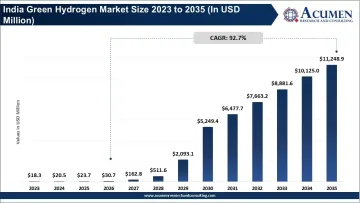
Report Highlights
- By region, Western India dominated the India green hydrogen market with a 40% share in 2025, supported by strong renewable energy potential, major refining and petrochemical industries, industrial clusters, and strategic ports in Gujarat and Maharashtra.
- By region, South India held the second-largest share of 30% in 2025, supported by its expanding renewable energy capacity, industrial base, and increasing investments in green hydrogen and green ammonia projects.
- By technology, alkaline electrolyzers dominated the India green hydrogen market with an 80% share in 2025, driven by their established commercial use, lower capital costs, and suitability for large-scale continuous hydrogen production.
- By technology, PEM electrolyzers accounted for an 18% share in 2025 and are expected to grow rapidly due to their high operational flexibility and ability to respond quickly to fluctuations in renewable power generation.
- By distribution channel, pipelines dominated the India green hydrogen market with a 70% share in 2025, supported by their cost-efficient and reliable transportation of large hydrogen volumes across industrial clusters.
- By distribution channel, cargo accounted for a 30% share in 2025, supported by its ability to transport hydrogen and hydrogen derivatives over long distances and facilitate future international exports.
- By application, the refining segment dominated with a 45% share in 2025, driven by the extensive use of hydrogen in hydrocracking and hydrodesulfurization and the growing need to decarbonize refinery operations.
- By application, the fertilizers and ammonia segment accounted for a 40% share in 2025, supported by the increasing adoption of green hydrogen as a low-carbon feedstock for ammonia and fertilizer production.
- By market destination, domestic consumption dominated with a 95% share in 2025, driven by strong demand from refining, fertilizers, ammonia, chemicals, and other energy-intensive industries across India.
- By market destination, the export segment held a 5% share in 2025, reflecting the emerging role of India as a potential supplier of green hydrogen and green ammonia to international markets.
How is India’s Green Hydrogen Industry Growing?
The Indian green hydrogen market is witnessing significant growth, primarily driven by the country's ambitious decarbonization objective and expanding renewable energy capacity. India aims to achieve net-zero carbon emissions by 2070, which has created strong government support through policy framework, financial incentives, and favorable renewable energy tariffs. Initiatives such as the National Hydrogen Mission focus on promoting hydrogen-based transportation, power generation, and industrial applications.
Additionally, increasing investments from both public and private sectors in renewable projects, including solar and wind farms, are providing the necessary infrastructure for large-scale hydrogen production. The increasing demand for sustainable and low-carbon alternatives in industries such as steel, cement, refining, and chemicals is further pushing the adoption of green hydrogen as a key energy source.
Technological advancement and decreasing cost of electrolyzes are seen as another major growth enablers for the market. Improvements in electrolysis efficiency, as well as innovation in hydrogen storage, and transportation, are making green hydrogen increasingly commercial viable and scalable. Partnership between energy companies, technology providers, and industrial consumers is accelerating project developments, and enabling integrated hydrogen ecosystems. The growing global focus on clean energy and decarbonization is also encouraging Indian companies to explore export opportunities, In particularly for green ammonia and hydrogen derivatives. In addition, these factors establish strong foundation of sustained growth, positioning India as a potential India as a leader in the global green hydrogen economy.
India Green Hydrogen Investments (2026)
| Investor / Company | Investment / Financial Commitment | Project / Focus |
|---|---|---|
| Government of India | ₹19,744 crore | National Green Hydrogen Mission, including production, electrolyzer manufacturing, pilots, and R&D |
| Adani New Industries | Large-scale investment planned | Green hydrogen and derivatives ecosystem, including electrolyzers and renewable energy |
| L&T | Project investment announced | Green hydrogen and green ammonia production and associated infrastructure |
| Sembcorp Industries | ₹36,238 cror | Green hydrogen and green ammonia production facility |
| ACME Group | ₹52,474 crore | Integrated green hydrogen/ammonia project with 5 GW solar and 1.5 GW electrolyzer capacity |
| Welspun New Energy | ₹40,000 crore | Green hydrogen and green ammonia ecosystem |
| ACME Group | More than ₹52,000 crore | Green hydrogen and ammonia project with associated renewable energy capacity |
| Uttar Pradesh government / private investors | ₹1.15 trillion proposed | Green hydrogen and green ammonia projects across the state |
India Green Hydrogen Market Dynamics
Market Drivers
1. Governments' policies and Strategic Initiatives
The Indian government has launched service policies and programs such as the National Hydrogen Mission, aimed at promoting green hydrogen production, utilization, and infrastructure developments. These initiatives encompass incentives for electric vehicle manufacturing, support for renewable energy integration, and measures to encourage large-scale adoption. This acts as a major driver by providing regulatory, boosting confidence to investors, accelerating project development, and aligns with India's decarbonization goals, thereby creating a structured and supportive environment for market growth.
2. Increasing Emissions Pressures and Decarbonization Needs
Under current policies, India's total greenhouse gas emissions are projected to grow at around 4.4-4.6 GtCO2 by 2030, about 8-11% higher than prior assessments by the Climate Action Tracker. This highlights the urgent need for accelerated decarbonization across heavy industries and energy systems. Green hydrogen offers a low-carbon alternative for application that is difficult to electrify directly including, high-temperature heat, industrial feedstock, and fuel uses. This projected rise in emission and the desire to avoid a lack of future fossil emissions are growth drivers for adopting green hydrogen solutions that support long-term climate commitments.
Market Restraints
1. High Production Costs of Green Hydrogen
Despite the steady decline in renewable energy prices, green hydrogen production remains to be cost-intensive, mainly due to the capital cost of electrolyzers and the substantial amount of renewable electricity required for commercial cost operations. The high costs of green hydrogen currently limit its ecosystem competitiveness against conventional energy alternative, especially in price sensitive industrial sectors. This regulation slows down adoption because industries and investors may be hesitant to switch without strong economic incentives, supportive subsidies, or technological that lower production and reduce procurement costs.
2. Infrastructure and Supply Chain Challenges
The India green hydrogen market growth is limited by insufficient hydrogen storage, transportation, and distribution infrastructure. Green hydrogen requires specialized pipelines, high-pressure storage tanks, and an efficient transport mechanism. The lack of nationwide infrastructure and standardized regulation poses significant logistics challenges, restricting the smooth integration of green hydrogen into industrial or mobility applications. This acts as a restraint because even if production capacity increases, the absence of supporting infrastructure can delay commercialization and limit market scalability.
Market Opportunities
1. Technological Advancements and Electrolysis Innovation
Eelectrolyzer, which split water into hydrogen and oxygen using electricity, are the core of green hydrogen production. Technology advancements and innovations in electrolysis are driving the growth of the green hydrogen market by making production more efficient, cost-effective, and reliable. Modern electrolyzers now convert electricity into hydrogen with higher efficiency, reducing energy consumption per kilogram. This technological progress creates a major opportunity, as lower production costs will make green hydrogen more competitive with conventional fuels, driving its adoption within India and enabling export to international markets.
2. Export Potential and International Collaboration
India's has abundant renewable energy, which gives it the opportunitiy to become major exporter of green hydrogen and green ammonia. Partnerships with international companies and governments can help India develop large-scale hydrogen production hubs for export markets. This opportunity is significant because it not only strengthens India's energy security and industrial growth but also allows the country to capitalize on the global energy transition, attracting foreign investment and fostering strategic international collaborations.
Regional Insights
Western India Dominated the Market with 40% in 2025: Expected to Witness Significant Growth
- Gujarat and Maharashtra stand strong support to its dominant position due to a well-suited combination of high potential for renewable energy capacity and established refining and petrochemical, chemical, fertilizer plants to ensure enormous hydrogen consumption by various end-use sectors.
- Gujarat is also strong due to presence of largest clusters of industries and access to strategic ports such as Kandla, Mundra ports. Besides having ample renewable energy resources to produce cost competitive green hydrogen.
- There will be high growth for Western India in the forecast period owing to sustained investment on scale into large-scale green hydrogen and green ammonia projects, electrolyzer manufacturing capacities, renewable energy capacity and port based green hydrogen infrastructure.
- Its leadership role will be cemented by identification of Deendayal port in Gujarat as Green Hydrogen Hub, pushing its production, distribution and export capacity to new highs.
South India to Expand Rapidly: Held the Second Largest Share of 30%
- It benefits from widespread established wind power renewable energy, and existing infrastructure in sectors such as refinery, fertilizers, steel, and chemical industries. In case of South India it consists of strong green hydrogen and hydrogen adoption potential in state of Tamil Nadu, Karnataka, Andhra Pradesh, and Kerala.
- The rapid pace in growth is backed by Andhra Pradesh expected to become green hydrogen hub, backed by Tamil Nadu and Karnataka with their wide wind power capacities and Karnataka.
- Both have supported government backed initiative in green hydrogen, including announcement of Green Hydrogen Hub at Pudimadaka for Andhra Pradesh, which has identified VOC Port in Tamil Nadu also as a Green Hydrogen Hub strengthening production and export prospects in South India.
India Green Hydrogen Market Share, By Region, 2025 (%)
| By Region | Revenue Share, 2025 (%) |
|---|---|
| North India | 15% |
| West India | 40% |
| South India | 30% |
| East India | 13% |
| Northeast India | 2% |
India Green Hydrogen Market Segmentation Insights
Technology Insights
Alkaline electrolyzers dominated the Indian green hydrogen market with 80% share in 2025 because it represents the most established and commercially proven technology available in today. Their long operational history, lower capital cost, and suitability for large-scale, continuous hydrogen production make them the preferred choice for easy and industrial-scale projects. Indian companies and public sector organization prefer alkaline systems because they reduce upfront investment risk and offer stable performance, particularly for applications where hydrogen demand is predictable and constant. This combination of cost efficiency and reliability shows that alkaline electrolyzers currently hold the largest revenue growth.
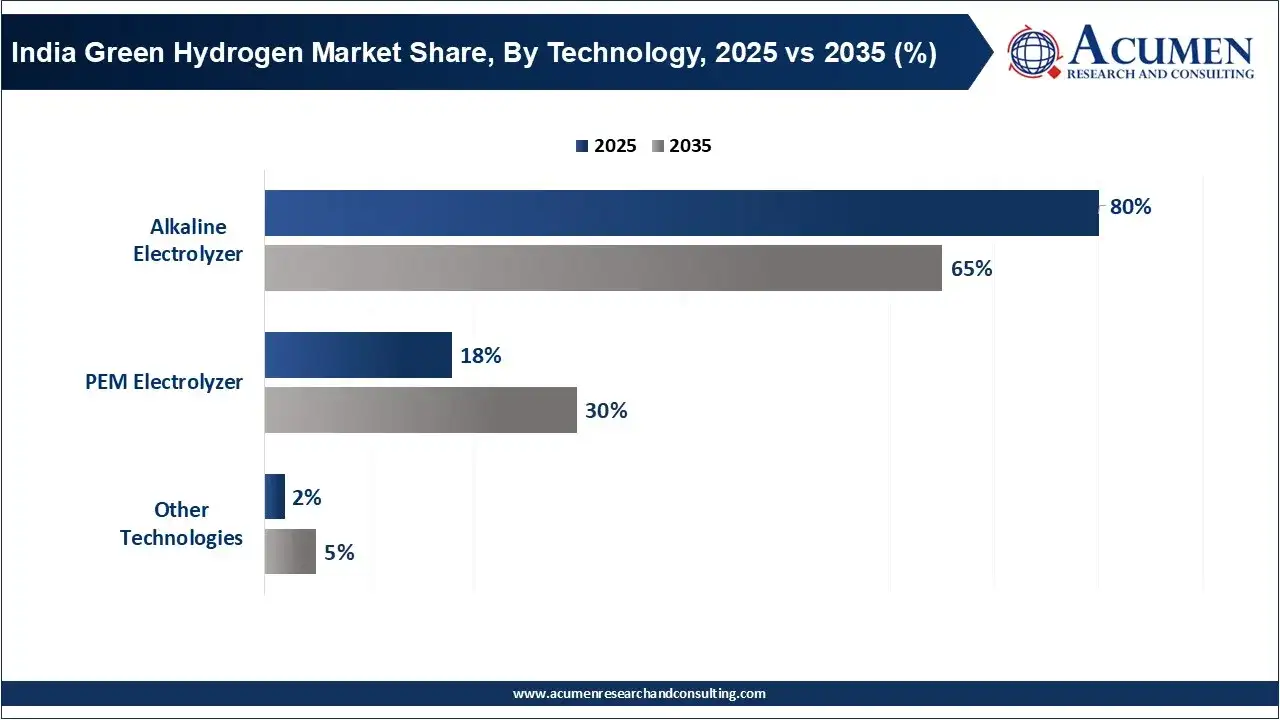
PEM electrolyzers are the fastest-growing segment in Indian green hydrogen market, which also held 18% market share in 2025, due to their superior efficiency and operational flexibility. Unlike alkaline systems, PEM electrolyzers respond quickly to fluctuations in renewable energy supply, making them highly compatible with solar and wind power. As India quickly increase its renewable energy capacity and shifts towards decentralized and flexible hydrogen production models, the demand for PEM electrolyzers is expected to grow, driven by increasing deployment in emerging projects
Distribution Channel Insights
Pipeline segment dominated the Indian green hydrogen market with 70% share in 2025; because it offers the most economical and efficient solution for transporting large volumes of hydrogen over short to medium distances. Industrial clusters such as refineries, fertilizer plants, and steel plants benefit from a continuous and stable hydrogen supply through pipelines. Since most hydrogen consumption in India currently occurs near production sites, the pipelines' infrastructure minimizes transportation losses and operational costs. This efficiency and alignment with existing industrial layout make pipelines the leading distribution channel in the current market.
India Green Hydrogen Market Share, By Distribution Channel, 2025 (%)
| By Distribution Channel | Revenue Share, 2025 (%) |
|---|---|
| Pipeline | 70% |
| Cargo | 30% |
Cargo held second largest share of 30% in 2025 in the Indian green hydrogen market as it enables long-distance transportation and export of hydrogen in compressed, liquefied, or derivative forms, such as ammonia. India has positioned itself increasingly as a future exporter of green hydrogen, and cargo-based transportation is emerging as a critical enabler of the market. This mode of distribution offers the flexibility require to supply hydrogen to decentralized regions where pipeline infrastructure is not available, while simultaneously enabling efficient accesses to international markets.
Application Insights
The refining segment held the largest share of 45% in 2025, supported by the extensive use of hydrogen in refining operations such as hydrocracking and hydrodesulfurization. Refineries traditionally rely on hydrogen produced from fossil fuels, particularly natural gas, which contributes significantly to carbon emissions. The growing emphasis on reducing the carbon intensity of refinery operations is encouraging refiners to adopt green hydrogen produced using renewable energy. In India, the expansion of renewable power capacity, government initiatives under the National Green Hydrogen Mission, and increasing pressure to decarbonize energy-intensive industries are supporting the integration of green hydrogen into refinery processes.
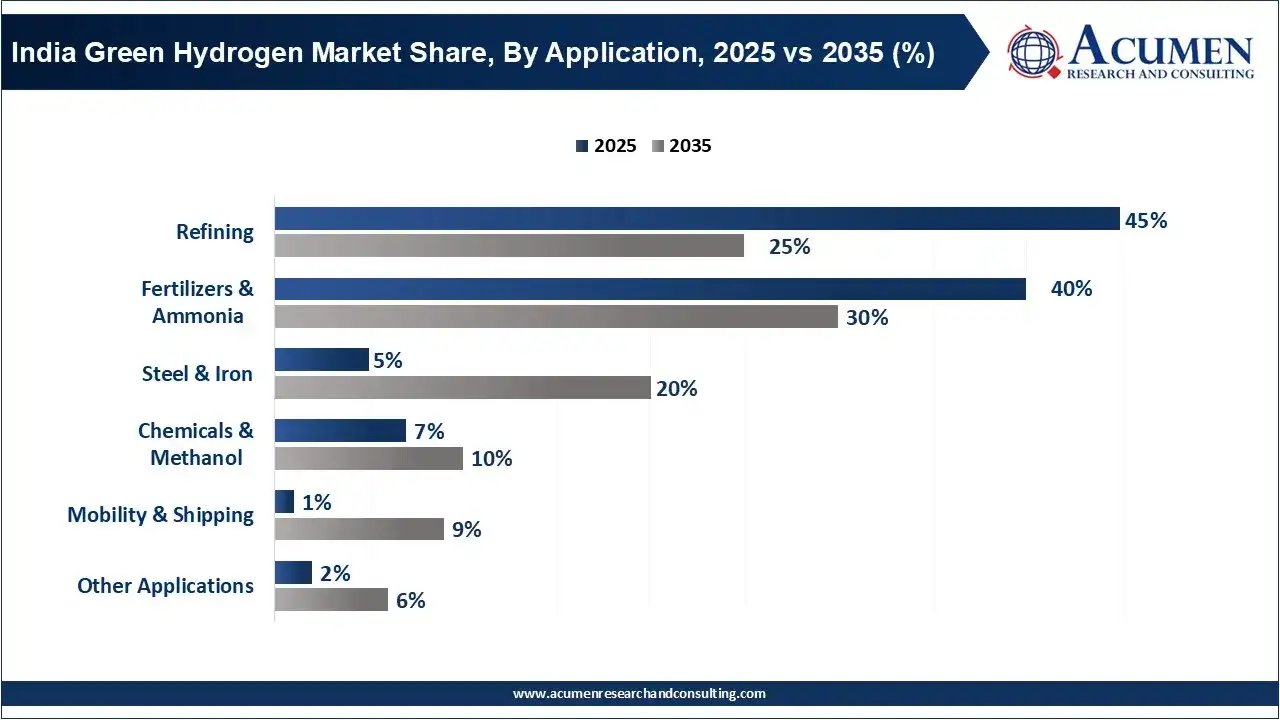
The fertilizers and ammonia segment held 40% share in 2025, making it another major application area for green hydrogen in India. Hydrogen is a critical feedstock for ammonia production, which is subsequently used in the manufacturing of nitrogen-based fertilizers. Conventional ammonia production relies heavily on hydrogen derived from natural gas, resulting in substantial carbon emissions. The transition toward green hydrogen provides an opportunity to produce low-carbon or green ammonia using renewable electricity and electrolyzers.
Destination Insights
The domestic consumption segment dominated the market with 95% in 2025. The segment’s strong position is primarily attributed to the increasing demand for low-carbon hydrogen across India’s refining, fertilizer, ammonia, chemicals, and emerging mobility sectors. Government initiatives under the National Green Hydrogen Mission are encouraging domestic production and utilization of green hydrogen by supporting electrolyzer manufacturing, renewable energy integration, and large-scale hydrogen projects. Major Indian energy and industrial companies are also developing captive green hydrogen and green ammonia facilities to reduce their dependence on fossil-fuel-based hydrogen and meet long-term decarbonization targets.
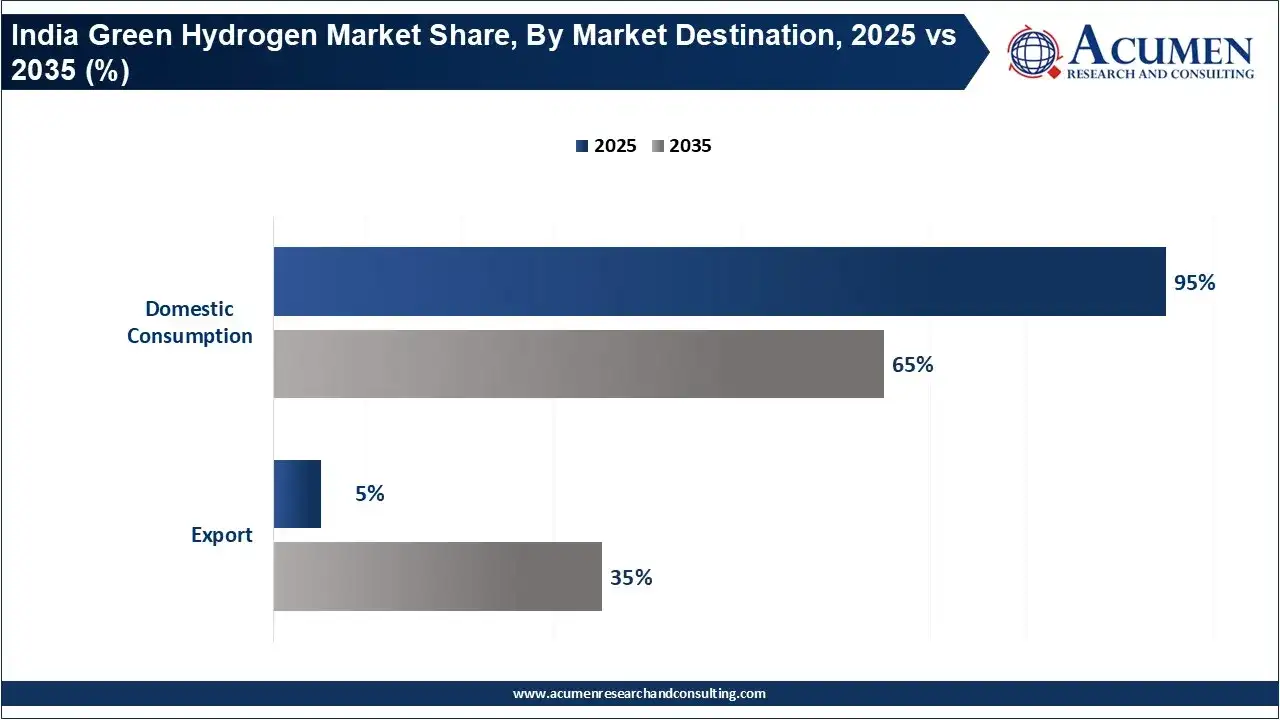
The export segments held the second largest share of 5% in 2025, reflecting the early-stage development of India’s green hydrogen export ecosystem. India is positioning itself as a potential global supplier of green hydrogen and green hydrogen-derived products, particularly green ammonia, to markets seeking low-carbon energy alternatives. The government is promoting export-oriented projects through the National Green Hydrogen Mission and related incentives aimed at reducing production costs and establishing a competitive domestic hydrogen industry.
India Green Hydrogen Market Competitive Landscape
- Reliance Industries Limited – Reliance is developing an integrated green energy ecosystem spanning renewable power, electrolyzer manufacturing, green hydrogen, and green chemicals.
- Adani New Industries Limited – Adani New Industries is building large-scale green hydrogen and electrolyzer capabilities, supported by the Adani Group’s renewable energy and port infrastructure.
- NTPC Limited – NTPC is expanding into green hydrogen through renewable energy projects, hydrogen hubs, and large-scale production initiatives.
- Indian Oil Corporation Limited – Indian Oil is developing green hydrogen projects to support decarbonization across its refining and fuel operations.
- Larsen & Toubro Limited – L&T is building capabilities across the green hydrogen value chain, including electrolyzer manufacturing, engineering, and hydrogen infrastructure.
- ACME Cleantech Solutions Private Limited – ACME is a major green hydrogen and green ammonia developer with large-scale production projects under India’s Green Hydrogen Mission.
- Greenko Group – Greenko is developing green hydrogen and green ammonia projects supported by its renewable energy and energy-storage capabilities.
- GAIL (India) Limited – GAIL is pursuing green hydrogen production and hydrogen-blending initiatives while leveraging its extensive natural gas infrastructure.
Recent News
- August 2026: A new Centre of Excellence for hydrogen was inaugurated in Pune on August 20, 2026, aimed at advancing R&D, innovation, and collaboration across India’s hydrogen ecosystem.
- July 2026: The Ministry of New and Renewable Energy announced plans for an “electrolyzer on lease” initiative, allowing companies to access renewable hydrogen without bearing the upfront cost of owning an electrolyzer.
Segments Covered
By Technology
- Alkaline Electrolyzer
- PEM Electrolyzer
- SOEC Electrolyzer
- By Distribution Channel
- Pipeline
- Cargo
By Application
- Refining
- Fertilizers & Ammonia
- Steel & Iron
- Chemicals & Methanol
- Mobility & Shipping
- Transport
- Others
By Market Destination
- Domestic Consumption
- Export
By Region (Within the country)
- North India
- West India
- South India
- East India
- Northeast India
Looking for discounts, bulk pricing, or custom solutions? Contact us today at sales@acumenresearchandconsulting.com
Frequently Asked Questions

Other Energy and Power Reports
February 2025
January 2018
June 2026
February 2024