
Automated Cell Therapy Manufacturing Market Size to Surge USD 10.48 Billion by 2035 with a CAGR of 17%
Published : 27 Nov 2026
Author : Lucas Hoffmann



What is the Automated Cell Therapy Manufacturing Market Size?
The global automated cell therapy manufacturing market size was estimated at $2.15 billion in 2026 and is projected to surge $10.48 billion by 2035 with a CAGR of 17% during the forecast period of 2026-2035. The market is driven by increasing clinical development of cell-based therapies, rising demand for standardized manufacturing, growing adoption of closed-system technologies, and investments in scalable production infrastructure. Automation improves process consistency, reduces manual handling, and strengthens quality control.
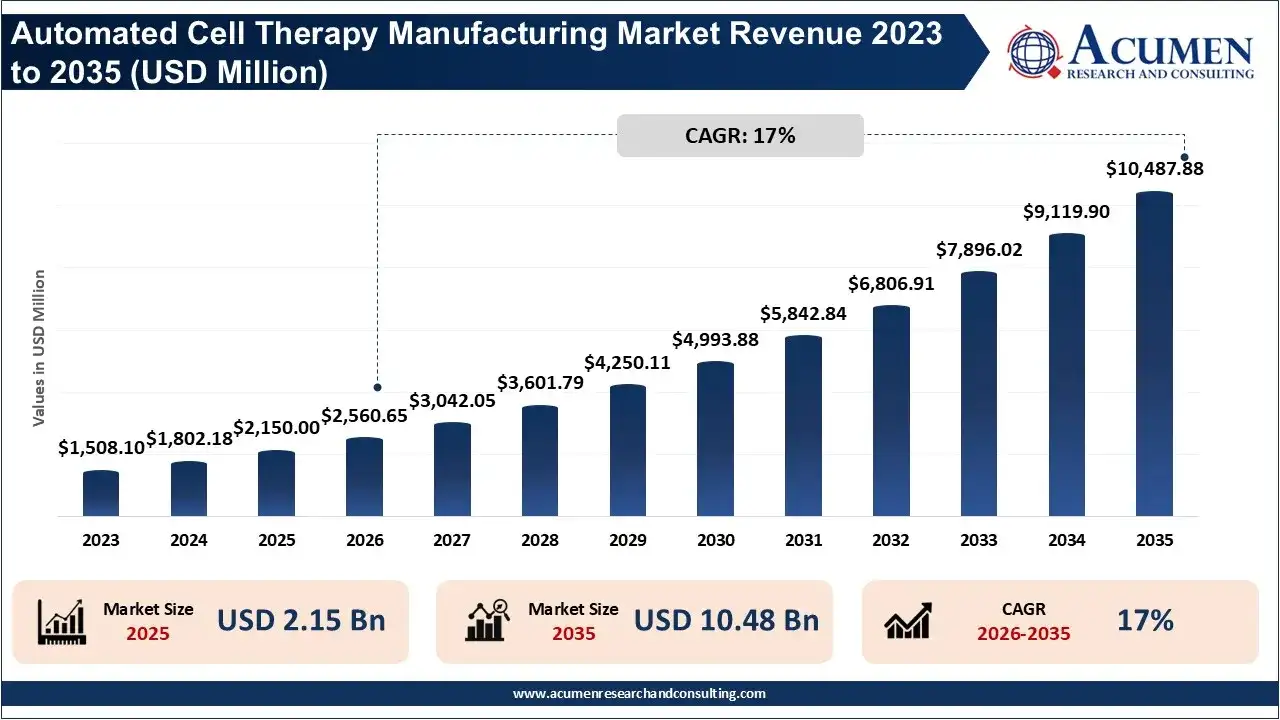
Global Market Snapshot
The automated cell therapy manufacturing market is evolving through the convergence of advanced cell processing technologies, robotics, digital manufacturing, and regulatory advancements. The increasing complexity of CAR-T, T-cell receptor (TCR), natural killer (NK), and stem cell therapies is creating demand for automated platforms capable of integrating cell selection, activation, genetic modification, expansion, harvesting, and formulation. Manufacturers are increasingly transitioning from manual and semi-automated workflows toward closed, modular, and end-to-end production systems to improve process reproducibility, reduce contamination risks, and strengthen manufacturing scalability.
- According to the FDA's December 2025 Report to Congress, the agency had received 18 AMT designation requests and granted 3 designations as of October 16, 2025, with 9 applications under active review. The designated technologies included automated manufacturing methods for cell-based therapies, demonstrating increasing regulatory recognition of advanced manufacturing platforms.
- A global clinical research analysis identified 10,373 cumulative cell therapy clinical trials through October 2025, including 3,563 in the United States, 3,365 in China, and 1,584 in Europe. CAR-T therapies accounted for 2,409 trials, highlighting the growing requirement for reliable and scalable manufacturing infrastructure to support clinical development.
- On January 11, 2026, the FDA outlined a more flexible approach to chemistry, manufacturing, and controls requirements for cell and gene therapies. The agency clarified that manufacturers are not universally required to provide three process performance qualification (PPQ) batches for process validation, allowing validation approaches to reflect product and process characteristics.
Automated Cell Therapy Manufacturing Market Segmental Analysis
| Segment | Dominant category | 2025 share | Driving factor |
|---|---|---|---|
| Component | Consumables & Single-Use Kits | 42% | Recurring consumption, contamination control, and closed-system adoption |
| Automation Type | Modular Unit-Operation Systems | 50% | Flexible integration and lower initial implementation complexity |
| Workflow Step | Cell Expansion | 30% | Consistent cell growth, therapeutic yields, and scalable production |
| Cell Therapy Type | CAR-T Cell Therapies | 52% | Established clinical and commercial applications and personalized cancer treatment demand |
| Therapy Model | Autologous Therapies | 72% | Patient-specific manufacturing and individual cell identity preservation |
| Scale of Operation | Clinical Manufacturing | 50% | Expanding clinical pipelines and compliant trial manufacturing requirements |
| End User | Pharmaceutical & Biotechnology Companies | 50% | Internal development pipelines and manufacturing capability investments |
Regional Outlook
North America Automated Cell Therapy Manufacturing Market: Largest Regional Market
North America dominated the automated cell therapy manufacturing market with a 46.0% share in 2025, generating USD 989.00 million in revenue. The region's leadership is supported by its well-established biotechnology ecosystem, advanced biopharmaceutical manufacturing infrastructure, strong clinical research capabilities, and early commercialization of cell-based therapies.
The presence of major pharmaceutical companies, biotechnology developers, contract development and manufacturing organizations (CDMOs), and specialized cell processing technology providers strengthens the regional manufacturing landscape. Increasing investments in automated production platforms, closed-system processing technologies, and digital manufacturing solutions are further supporting market expansion.
- The United States represents the primary contributor to regional demand due to its extensive CAR-T therapy development and commercialization activities, expanding clinical trial pipeline, and established advanced therapy manufacturing infrastructure. The growing need to improve manufacturing throughput, reduce manual intervention, and maintain batch-to-batch consistency is encouraging pharmaceutical and biotechnology companies to adopt automated cell processing systems.
Asia-Pacific Automated Cell Therapy Manufacturing Market: Fastest-Growing Regional Market
Asia-Pacific generated USD 451.50 million in 2025, representing a 21.0% share of the global automated cell therapy manufacturing market. The regional market is projected to register a CAGR of 20.2% during 2026–2035 and reach USD 2,915.63 million by 2035.
The region's rapid expansion is supported by increasing investments in biotechnology research, growing clinical trial activity, expanding cell therapy development pipelines, and the gradual establishment of advanced biopharmaceutical manufacturing facilities. Rising interest in regenerative medicine, personalized cancer treatments, and next-generation cell therapies is also creating demand for scalable and standardized manufacturing technologies.
- China represents a major growth contributor due to its expanding cell therapy research ecosystem, increasing clinical development activity, and investments in domestic biopharmaceutical manufacturing capabilities.
- Japan is strengthening its position through regenerative medicine research, advanced therapy development, and initiatives supporting the commercialization of innovative cell-based treatments.
Europe Automated Cell Therapy Manufacturing Market: Established Biopharmaceutical and Advanced Therapy Ecosystem
Europe represents an important market for automated cell therapy manufacturing, supported by its established biotechnology industry, advanced therapy research capabilities, and regulatory framework for advanced therapy medicinal products. The region benefits from a strong network of pharmaceutical companies, biotechnology developers, academic research institutions, and specialized manufacturing organizations involved in cell and gene therapy development. Increasing emphasis on manufacturing standardization, product traceability, quality assurance, and regulatory compliance is encouraging the adoption of automated cell processing technologies.
- Germany represents a significant contributor through its biopharmaceutical manufacturing base, biotechnology research infrastructure, and established pharmaceutical industry.
- The United Kingdom maintains an important position through its advanced therapy research ecosystem, clinical trial infrastructure, and development of cell and gene therapy technologies.
Key Growth Opportunities and Future Outlook
“According to a 2026 global clinical research analysis, a cumulative 10,373 cell therapy clinical trials had been identified worldwide through October 2025, including 3,563 trials in the United States, 3,365 in China, and 1,584 in Europe.”
One of the major growth opportunities lies in the transition from manually operated manufacturing processes toward integrated, closed, and automated production platforms. Companies are increasingly focusing on technologies that combine cell isolation, activation, genetic modification, expansion, harvesting, and formulation within standardized manufacturing workflows. For instance, Cellares received FDA Advanced Manufacturing Technology (AMT) designation for its Cell Shuttle platform in April 2025, recognizing its automated cell therapy manufacturing capabilities.
In April 2026, the company also entered a 10-year commercial supply agreement with Cabaletta Bio to manufacture its investigational CAR-T therapy, with the manufacturing platform designed to support production for thousands of patients annually, subject to regulatory approval. These developments demonstrate the growing commercial importance of automated manufacturing infrastructure.
Leading Companies and Competitive Positioning
- Miltenyi Biotec: The company offers the CliniMACS Prodigy platform, which integrates multiple cell processing operations, including cell selection, activation, engineering, and expansion, within a closed and automated manufacturing system.
- Terumo BCT: The company provides automated cell processing and expansion technologies, including the Quantum Cell Expansion System and Sepax C-Pro, supporting scalable cell therapy manufacturing workflows.
- Cellares: The company develops integrated automated manufacturing platforms, including Cell Shuttle and Cell Q, designed to support high-throughput cell therapy production and scalable commercial manufacturing.
- Ori Biotech: The company develops the IRO automated manufacturing platform, which integrates multiple cell therapy processing operations to improve production standardization, scalability, and manufacturing efficiency.
- Lonza: The company provides cell and gene therapy development and manufacturing services, alongside its Cocoon Platform, which supports automated and functionally closed manufacturing of personalized cell therapies.
- Thermo Fisher Scientific: The company offers cell therapy manufacturing solutions through its Gibco and Cell Therapy Systems portfolios, including specialized media, reagents, processing equipment, and manufacturing technologies.
- Cytiva: The company supplies cell processing and biomanufacturing technologies, including Sefia systems and single-use solutions, supporting cell separation, concentration, and downstream manufacturing operations.
- Sartorius: The company provides bioreactors, single-use processing systems, and process monitoring technologies that support controlled cell expansion and scalable biopharmaceutical manufacturing.
- Fresenius Kabi: The company participates in automated cell processing through its LOVO Cell Processing System, which supports automated washing, volume reduction, and processing of cellular products.
- Multiply Labs: The company develops robotic manufacturing systems designed to automate complex cell therapy production workflows, improve process reproducibility, and support scalable manufacturing operations.
Segments Covered in the Report
By Component
- Automated Platforms & Instruments
- Consumables & Single-Use Kits
- Software (MES, Process Control, Data Analytics)
- Services (Installation, Validation, Maintenance)
By Automation Type
- End-to-End Integrated Platforms
- Modular Unit-Operation Systems
- Robotic Workcells & Automated Factories
By Workflow Step
- Cell Collection Processing, Separation & Isolation
- Activation, Genetic Modification & Transduction
- Cell Expansion
- Formulation, Fill-Finish & Cryopreservation
- Quality Control & Release Testing
- Others (Harvest, Sampling, Logistics)
By Cell Therapy Type
- CAR-T Cell Therapies
- TCR-T & TIL Therapies
- NK & CAR-NK Cell Therapies
- Stem Cell Therapies (HSC, MSC, iPSC-Derived)
- Others (Dendritic Cells, Tregs, Other Immune Cells)
By Therapy Model
- Autologous
- Allogeneic
By Scale of Operation
- Preclinical & Process Development
- Clinical
- Commercial
By End User
- Pharmaceutical & Biotechnology Companies
- CDMOs
- Academic Medical Centres & Hospitals (Point-of-Care)
- Research Institutes
By Region
- North America
- Europe
- Asia-Pacific
- Latin America
- Middle East & Africa
Contact Us:
Mr. Richard Johnson
Acumen Research and Consulting
India: +91 8983225533