
Electric Truck Charging Station Market Size to Surge USD 35.32 Billion by 2035, CAGR of 24%
Published : 23 Jul 2026
Author : Lucas Hoffmann



What is the Electric Truck Charging Station Market Size?
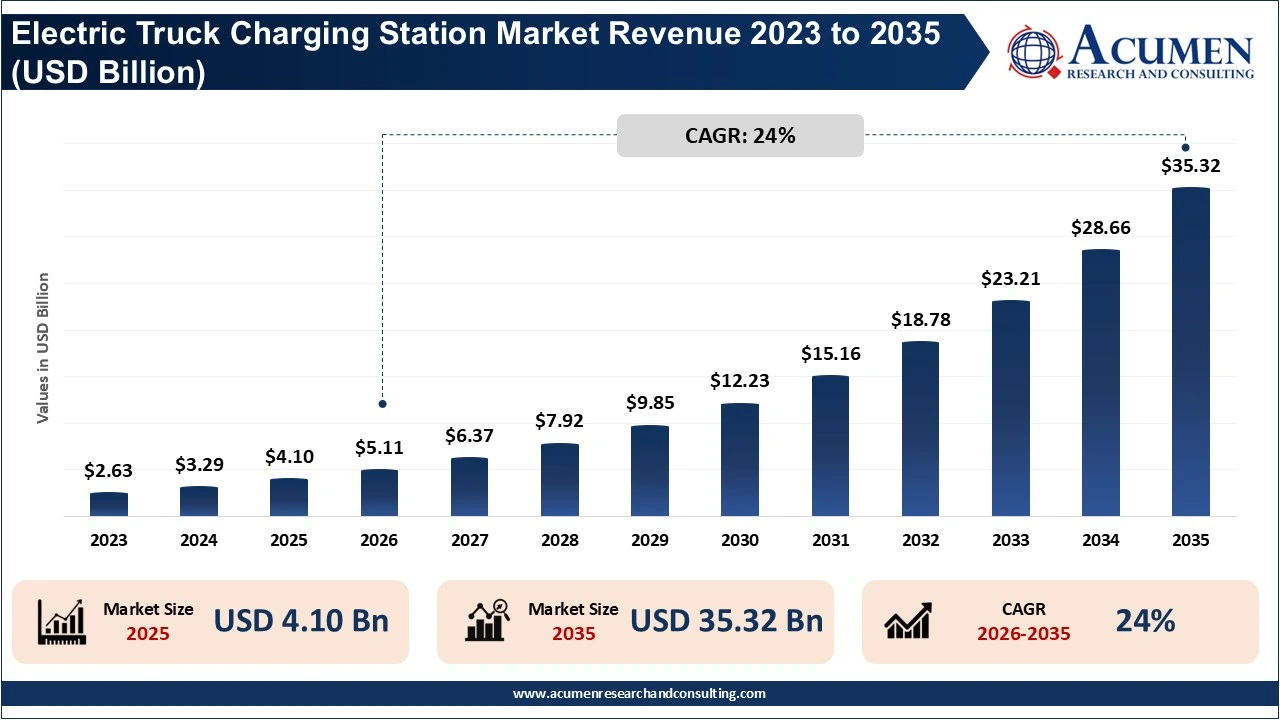
The global electric truck charging station market size was estimated at USD 4.10 billion in 2025 and is expected to surge USD 35.32 billion by 2035, growing at a CAGR of 24% during the forecast period of 2026-2035. The increasing adoption of medium- and heavy-duty electric trucks by logistics, retail, and transportation companies is driving demand for dedicated high-power charging infrastructure. Fleet operators are investing in depot and corridor charging solutions to reduce emissions, comply with sustainability goals, and lower operating costs.
What is Electric Truck Charging Station Market?
The electric truck charging station market plays a crucial role in the entire commercial electric vehicle market as it provides the charging infrastructure necessary to supply a sufficient amount of power reliably and on-demand for cargo transport. The market caters to a broad spectrum of end-users, including logistics service providers, fleet operators, warehousing companies, port authorities, mine sites, and operators of public charging networks. The growth of the market is fueled by increased battery capacities and the expanding of commercial fleet sizes, with a growing emphasis on scalability, optimizing fleet utilization, efficient energy consumption, and enabling the decarbonization of freight transportation.
Market Outlook for Electric Truck Charging Stations Through 2035
- Charging-related demand to grow sharply: The increasing deployment of electric medium- and heavy-duty (MDHT) trucks will result in significant growth in the need for high-power charging through 2035.
- Fleet operators and charge providers to expand: Deployment of MCS charging stations for long-haul freight will further reduce operational downtime with significantly higher speeds for trucks.
- Fleet operators to drive private depot charging growth: Logistics companies continue investment in private charging depot to optimize the fleet performance.
- Government support for public corridor charging to expand: Public and private providers will continue expanding highway charging corridors for long-haul commercial transportation.
- Grid modernization accelerates: Utility providers will invest in upgrading the power grid and building out the substations for high-power requirements by the truck charging stations.
- Dedicated charging hub facilities will proliferate: Private charging solutions are added to the logistics park, ports, warehouse facilities, and freight corridor. Charging providers will install
- Renewable energy charging infrastructure: Charging infrastructure providers will start integrate Solar, Wind, and BESS into charging stations to lower operating costs and emissions.
- Commercial operators and vehicle OEM will move to a standard charging approach: Common charging specifications increase interoperability and ease cross-network charging experiences.
- Technological Advancements: Artificial Intelligence solutions will enhance charging scheduling, energy management and prediction maintenance of charging equipment.
Can Smart Charging and Vehicle-to-Grid (V2G) Technologies Transform Fleet Energy Management?
Rise of smart charging, AI and V2G services The incorporation of smart charging, AI and V2G into electric truck charging solutions will be another significant growth opportunity for the market. These capabilities can facilitate more intelligent scheduling for vehicle charging (e.g. Taking into account utility prices, network load and fleet operations), allowing businesses to save costs and improve energy efficiencies.
V2G services could also provide opportunities to generate revenues from selling back excess stored power on the electric truck during periods of peak grid demand and reduce overall electricity costs. Smart grid deployment by utilities to facilitate renewable energy integration will drive smart charging/V2G services in the charging ecosystem for electric trucks.
Regional Outlook
Why has Asia Pacific region commanded a major share of the global electric truck charging station market?
Asia Pacific region commanded a major share of the global electric truck charging station market in 2025. This dominance is primarily attributed to China's leadership in manufacturing electric commercial vehicles, vast electric truck charging station networks, a robust domestic battery manufacturing industry, and government incentives and policies for electric commercial vehicles.
Extensive deployment of high capacity charging stations is witnessed across major freight corridors in the Asia Pacific region on the back of increasing urbanization, a growing logistics network, and substantial investment from utilities and charging network operators.
Continuous increase in the number of electric trucks in countries like China, Japan, and South Korea is further strengthening the dominance of the Asia Pacific region.
Why is North America projected to record the fastest growth?
North America is projected to record the fastest growth rate in terms of CAGR 2026-2035. This growth is driven by considerable public and private investments in heavy-duty charging infrastructure, an expanded national freight charging corridor network, and public funding policies to support the commercial vehicle sector.
The growing demand for high power DC chargers and megawatt charging solutions is led by the adoption of long haul battery electric trucks by logistics service providers, retailers and truck operators. Collaboration between trucking manufacturers, charging infrastructure developers, utilities and governmental organizations is anticipated to speed up commercial charging networks' expansion throughout the US and Canada.
Competitive Landscape
North America
- The North American market is characterized by leading charging network operators and technology companies based in the U.S.
- The U.S.-based Tesla (Texas, United States) is steadily increasing its supercharger network coverage while working on Megawatt Charging System (MCS) technology development through the Tesla Semi program, which will enable fast charging for heavy-duty electric trucks.
- U.S.-based ChargePoint (California, United States) offers comprehensive fleet charging solutions, including cloud-based energy management software and depot charging hardware, for commercial fleets.
- The U.S.-based EVgo (California, United States) is expanding its DC fast charging network and commercial fleet charging segment.
- The U.S.-based Electrify America (Virginia, United States) is focused on building ultra-fast charging corridors and commercial vehicle infrastructure in an effort to support freight electrification across the U.S.
Europe
- Europe is leading in terms of electric truck charging infrastructure development, with regulatory incentives and a growing focus on cross-border freight electrification. Europe's leading companies include; Switzerland-based ABB (Zurich, Switzerland) a provider of high-power DC fast charging technology and commercial vehicle charging solutions.
- Germany-based Siemens AG (Munich, Germany) offers smart charging systems, grid integration solutions and energy management platforms for commercial transport.
- Finland-based Kempower (Lahti, Finland) specializes in scalable DC fast charging solutions for electric truck depots and logistics centers.
- The Netherlands-based Milence (Amsterdam, Netherlands), a joint venture by Daimler Truck, the TRATON GROUP and Volvo Group, is building the largest dedicated public charging network in Europe for heavy-duty electric trucks along freight routes.
- In the UK, Shell Recharge (London, United Kingdom) and BP Pulse (London, United Kingdom) are investing in high-power charging solutions for both public and fleet segments.
Asia Pacific
- The Asia Pacific market is dominant in the electric truck charging station landscape owing to its massive electric commercial vehicle population, high manufacturing capacity, and supportive government initiatives.
- The key market participants are from China including TELD New Energy (Qingdao, China), one of the world's largest EV charging networks, is steadily deploying high-power charging infrastructure in the commercial segment; Star Charge (Jiangsu, China) is a prominent player in the design, manufacturing, and operation of EV charging equipment in both domestic and international markets; XJ Electric Co., Ltd. (Henan, China) develops smart charging systems and grid-connected infrastructure for commercial vehicles.
- Japan's Toshiba Infrastructure Systems & Solutions Corporation (Kawasaki, Japan) offers advanced power electronics and charging technologies, and Taiwan's Delta Electronics (Taipei, Taiwan) is a leading manufacturer of highly efficient DC fast chargers with a presence in both the Asia Pacific and global markets.
Segments Covered
By Vehicle Category
- Light-Duty Electric Trucks
- Medium-Duty Electric Trucks
- Heavy-Duty Electric Trucks
By Charger Technology
- AC Charging
- DC Fast Charging
- High-Power DC Charging
- Megawatt Charging System (MCS)
By Deployment Type
- Fleet Depot Charging
- Public Truck Charging Hubs
- Highway Corridor Charging
- Distribution Center Charging
- Opportunity Charging
By End User
- Logistics & Freight
- Retail & E-commerce
- Municipal Fleets
- Industrial
- Fleet Operators
By Region
- North America
- Europe
- Asia Pacific
- Latin America
- Middle East & Africa
Contact Us:
Mr. Richard Johnson
Acumen Research and Consulting
India: +91 8983225533