
Hydrogen Aircraft Market Size to Surge USD 8,072 Million by 2035, CAGR of 27.4%
Published : 20 Jul 2026
Author : Simone Lamb



What is the Hydrogen Aircraft Market Size?
The global hydrogen aircraft market size was calculated at USD 715 million in 2025, expected to reach at USD 8,072 million by 2035. The market is expected to grow at CAGR of 27.4% during the forecast period of 2026-2035. The hydrogen aircraft market is experiencing significant growth due to increasing global commitments to decarbonize the aviation industry and achieve net-zero carbon emissions. Continuous advancements in hydrogen propulsion technologies, fuel cell systems, cryogenic hydrogen storage, and government investments in sustainable aviation infrastructure are further accelerating market expansion.
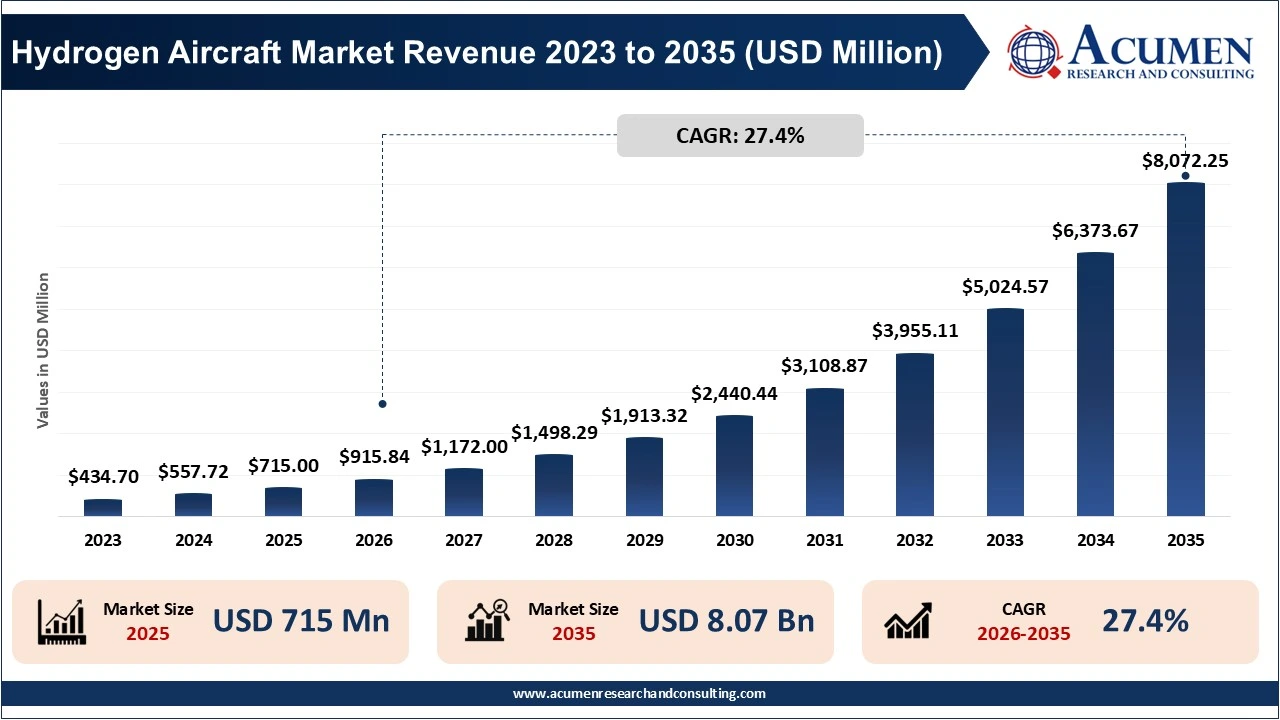
The global hydrogen aircraft market covers the production, design, and marketing of aircraft that use hydrogen propulsion technology, such as hydrogen fuel cells or hydrogen combustion engines. These aircraft are driven by a clean hydrogen energy source to produce environmentally friendly, eco-sustainable, low carbon aircraft emissions and provide assistance to aircraft industry transitions towards air transport industry sustainability.
Commercial, defense, cargo and general aviation is included with its range such as short range, medium range, and long range segments. Increased investment on zero- emission aviation initiatives, hydrogen production and storage solutions, latest propulsion systems technologies and aerospace research is enhancing global adoption of hydrogen-fueled aircraft as a sustainable solution in line with governments and key players around the globe are seeking a climate neutral target in future.
Hydrogen Aircraft Market Statistics
- By region, North America accounted for the largest revenue share of 41% in 2025. The region enjoys an established aerospace manufacturing ecosystem, significant investment in hydrogen aviation research, and strong government support for sustainable aviation technology. Its market dominance continues to be bolstered by the presence of leading aircraft manufacturers, propulsion developers, and hydrogen infrastructure initiatives.
- By region, Asia Pacific is projected to experience the fastest CAGR of 33.0% from 2026 to 2035. The demand in the region is being fueled by rapid growth in air passenger traffic, increasing aerospace manufacturing capacity, and growing public investment in clean aviation technologies. Government initiatives focused on the promotion of hydrogen-powered transport and carbon neutrality are expected to spur market growth in China, Japan, South Korea, and India.
- By propulsion technology, the hydrogen combustion engine dominated the market with the largest revenue share of 45% in 2025. This segment benefits from compatibility with existing aircraft engine architecture, simplifying integration into current aviation systems, and providing a viable transition path for manufacturers to reduce emissions while leveraging existing technologies.
- By propulsion technology, the hydrogen fuel cell is anticipated to capture the second-largest market share, reaching 50% by 2035. Hydrogen fuel cell systems are gaining traction for their increased energy efficiency, quiet operation, and zero direct carbon emissions during flight. Advances in fuel cell technology and Lightweight power systems are expected to accelerate their adoption in next-generation aircraft.
- By range, short-haul aircraft accounted for the largest share of the market, representing 60% in 2025. This segment's current dominance is attributable to hydrogen propulsion technology's more immediate suitability for short-haul flights, given current constraints on hydrogen storage and aircraft weight. Growing demand for regional air mobility and sustainable domestic aviation supports the segment's market leadership.
- By range, long-haul aircraft is expected to demonstrate the fastest CAGR of 33.2% from 2026 to 2035. Improvements in cryogenic liquid hydrogen storage, lightweight materials, and aircraft design are making long-range hydrogen flights more feasible. Significant investment in zero-emission aviation initiatives is anticipated to create substantial opportunities in the development of long-haul hydrogen aircraft.
- By end-use, commercial aviation held the largest share of the hydrogen aircraft market at 55% in 2025. Airlines are increasingly investing in hydrogen-powered aircraft to meet long-term carbon neutrality goals and comply with stringent environmental regulations. The growth of this segment is further driven by increasing passenger demand for sustainable travel options and the aviation industry's overarching decarbonization efforts.
- By end-use, defence held the second-largest share, at 20% in 2025. Defense entities are investing in hydrogen-powered aircraft to enhance operational efficiency, reduce dependence on conventional fuels, and support environmentally friendly military operations. Research into advanced propulsion systems and the development of next-generation tactical aircraft continue to contribute to the expansion of this market segment.
Will Green Hydrogen Infrastructure Become the Key Enabler for Commercial Hydrogen Aviation?
One of the biggest opportunities in the hydrogen aircraft market comes from large scale production of green hydrogen, its storage, and airport refueling infrastructure. Although aircraft propulsion systems are quickly being developed, the commercial widespread deployment relies on a robust and available hydrogen supply chain, as well as airport infrastructure which allows for safe and effective aircraft refueling processes.
Capital injection into renewable green hydrogen, cryogenic storage systems, airport fuel networks and international hydrogen standards will reduce operational costs of the aircraft and speed up its commercialization. The investment in hydrogen ecosystems around the world from governmental bodies and private stakeholders will see infrastructure become the key catalyst for sustainable aviation long term.
Hydrogen Aircraft Regional Outlook
North America remained the largest hydrogen aircraft market in 2025, owing to its well-established aerospace sector, well-developed research and development base, and early investments in hydrogen aviation technology. Multiple major aircraft manufacturers, propulsion system developers, and aerospace research institutes in the region are involved in the development of hydrogen-powered aircraft. The regional market is further bolstered by government funding initiatives, partnerships between aerospace companies and hydrogen technology companies, and a rising awareness of the need for sustainable aviation.
Europe is another major market for hydrogen aircraft, thanks to the region’s ambitious targets for carbon emission reduction, the supportive regulatory framework for sustainable aviation, and a number of hydrogen aviation partnerships initiated by leading aircraft and research organizations.
Asia Pacific is projected to record the highest growth in the forecast period, fueled by the increasing number of air passengers, development of air travel infrastructure, and growing government expenditure on new energy technologies. Countries such as China, Japan, South Korea, and India are currently making strides in hydrogen technologies and next-generation aerospace in an effort to curtail aviation emissions.
In addition, Latin America is beginning to explore alternative, cleaner aviation technologies via its ongoing research and demonstration projects and renewable hydrogen initiatives. Similarly, Middle East & Africa are anticipated to grow at a moderate rate owing to growing investments in the production of green hydrogen, aviation sector modernization programs, and long-term diversification initiatives aiming for the adoption of clean transport.
Who are the Top Companies operating in the Hydrogen Aircraft Market?
The hydrogen aircraft market includes significant collaboration among aerospace manufacturers, propulsion technology firms, and hydrogen fuel solution providers for the development of zero-emission aviation technology. Some of the key players in the market are Airbus SE, ZeroAvia Inc., Universal Hydrogen Co., H2Fly GmbH, GKN Aerospace, Rolls-Royce Holdings plc, Honeywell International Inc., Safran S.A., MTU Aero Engines AG, and AeroDelft.
They invest in hydrogen combustion engines, fuel cell propulsion systems, cryogenic hydrogen storage technology, light-weight aircraft structures, and integrated hydrogen fueling infrastructure. Numerous strategic collaborations, demonstration flight, validation of flight technology programs and governments’ research and development funding are leading toward a faster commercialization of hydrogen-fueled aircraft and toward a robust aerospace industry for sustainable aviation.
Segments Covered
By Propulsion Technology
- Hydrogen Combustion Engines
- Hydrogen Fuel Cell Systems
- Hybrid Hydrogen-Electric Systems
By Range
- Short-Haul (≤1,000 km)
- Medium-Haul (1,000–3,000 km)
- Long-Haul (≥3,000 km)
By End Use
- Commercial Aviation
- Defense
- Cargo
- Private Aviation
- Others
By Region
- North America
- Europe
- Asia Pacific
- Latin America
- Middle East & Africa
Contact Us:
Mr. Richard Johnson
Acumen Research and Consulting
India: +91 8983225533