
Autonomous Vehicle Damage Detection Market Size to Surge USD 13,470.41 Million by 2035, Reflecting a CAGR of 19.8%
Published : 26 Aug 2026
Author : Lucas Hoffmann



What is the Autonomous Vehicle Damage Detection Market Size?
The autonomous vehicle damage detection market, valued at USD 2,211.52 Million in 2025, is expected to reach USD 13,470.41 Million by 2035, reflecting a strong CAGR of 19.8% over the forecast period.
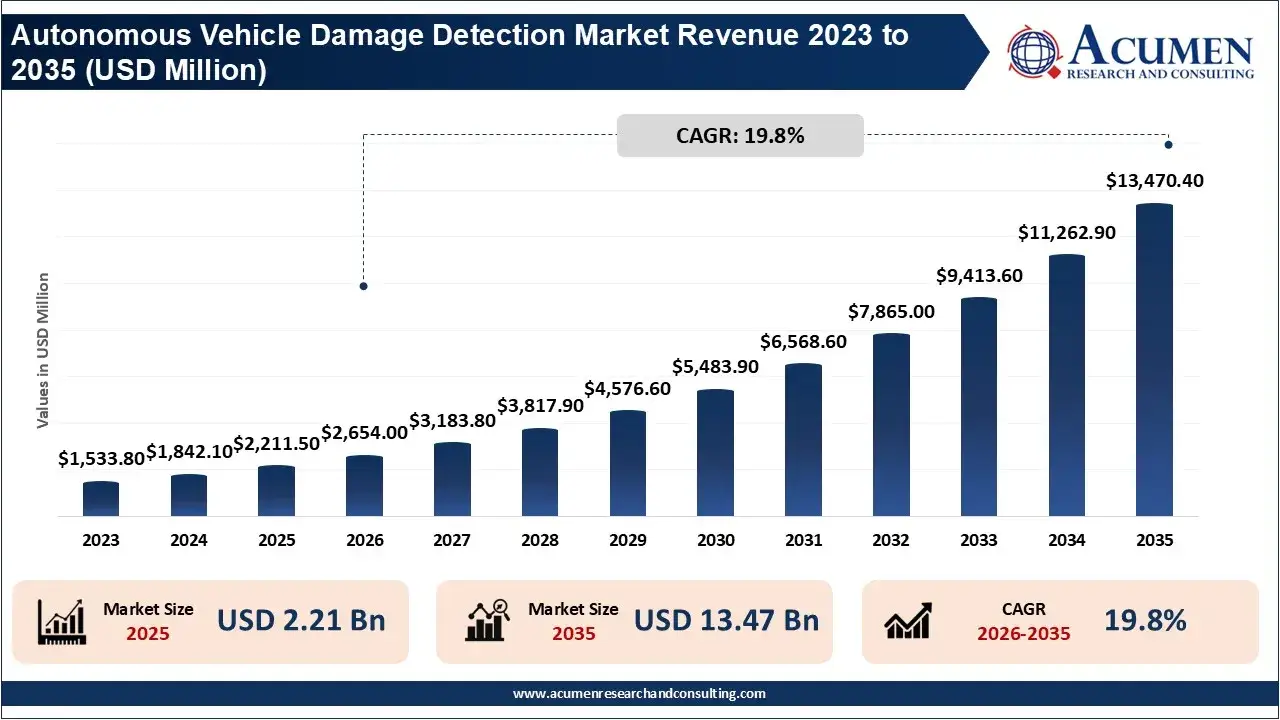
The global autonomous vehicle damage detection market is primarily driven by the growing demand for faster, more accurate, and digitally enables vehicle inspection processes across the automotive ad insurance ecosystems. As vehicle ownership increases and mobility models such as shared mobility, rental services, and fleet operations expand, traditional manual inspection methods are becoming inefficient, and expansive. To address these challenges, origination are increasingly adapting AI-powered damage detection systems that use computer vision and deep learning to automate inspection, reduce human error and provide real-time damage assessments.
At the same time, insurance companies are accelerating digital transformation efforts to speed up claims processing, improve customer experience, and minimize fraud, which significant driving the adoption of automated damage detection technologies.
- In October 2025, Tractable strengthened its AI-driven damage detection capabilities by extending its platforms to support multi-angle vehicle inspection through both mobile imaging and fixed inspection systems. This development enables insurance providers and fleet operators to carry out more consistent and through damage assessment across different inspection setting, leading to higher accuracy and faster inspection processes.
Autonomous Vehicle Damage Detection Market Statistics
- By July 2025, Waymo had surpassed 100 million fully autonomous miles after doubling its autonomous mileage in six months and exceeded 10 million autonomous trips by May 2025, showcasing the sheer scale of vehicle exposure requiring ongoing condition monitoring and post-accident inspection.
- Mid-2025, Waymo operated approximately 1,500 autonomous vehicles in five US cities, creating the substantial recurring need for condition checks, collision evaluation, fleet maintenance and damage documentation.
- By August 2026, WeRide operated approximately 3,400 Level 4 autonomous vehicles globally with over 1,800 robotaxis, while projecting 5,000 Level 4 vehicles by year end 2026, indicating significant growth in the scale of vehicles requiring automated condition assessment and damage assessment.
- By December 2025, Mobileye's ADAS technology had been incorporated into over 230 million vehicles across approximately 1,400 vehicles and >50 OEM relationships. While ADAS has broader scope than autonomous damage assessment, the installed base clearly signals the massive vehicle population that currently possess camera and AI driven perception capabilities which could support adjacent assessment tasks.
- Shipments of Mobileye's EyeQ SoCs and SuperVision Systems were 35.7 million units and 29.0 million units in 2025 and 2024 respectively, showcasing the exploding computer-vision hardware market that is rapidly increasing capacity for automated condition assessment.
What Creates the Major Challenge for Autonomous Vehicle Damage Detection Market?
A significant challenge for the market is the high investment and technical complexity required to deploy automated damage detection systems. These solutions rely on advanced hardware such as high-resolution cameras, LiDAR, and sensors, align with sophisticated software capable of professing large volumes of image ad sensor data. Smaller organizations may struggle with high initial costs, and adding these systems to existing workflows often require redesigning processes, training employees, and customizing the software, all of which increase the time and overall cost of implementations.
Expansions of Electric Vehicles and Commercial Fleets: Market’s Largest Opportunity
The significant growth opportunity the market comes from the rapid expansion of electric vehicles, shared mobility service, and commercial fleets. These sectors need quick, reliable, and standardized inspection to reduce vehicle downtime and ensure smooth efficient operations. Fleet operators, ride hailing companies and logistics providers are increasingly investing in automated damage detecting system to monitor vehicle health, ensure safety compliance, and optimize maintenance schedules, which creating significant potential for technology provide to expand market in globally.
Autonomous Vehicle Damage Detection Market Regional Outlook
North America currently held the largest share of the global autonomous vehicle damage detection market, driven by the region’s early adoption of advanced automotive technologies, mature insurance ecosystem, and significant investment in Ai and connected vehicle platforms. The United States is at the forefront of deploying automated damage detection across insurance claims processing, fleet management, and dealership inspections. The high costs of labor, along with the need for quicker and more accurate vehicle inspection, have driven many companies to adopt AI-powered damage detection solution. In addition, strong government regulation and advanced digital infrastructure make it easier for companies to implement and expand these technologies, further strengthen North America's leading position in the market.
U.S. Autonomous Vehicle Damage Detection Market Trends
- The U.S. market is one of the most mature markets for autonomous vehicle damage detection given widespread commercial deployment of robotaxis and the close connection of the autonomous fleets, insurers, auto repair shops and their supporting AI-claims technology platforms.
- More than 100 million total fully autonomous miles have been put on by Waymo to date, totaling more than 10 million rides taken, as of May 2025 with Waymo’s database of 100M fully autonomous miles also resulting in the need for ongoing and consistent vehicle monitoring.
- Recently, Waymo published findings that in a 25.3 million mile assessment, fully autonomous vehicles had 88% fewer total dollar property-damage claims than the auto claims baseline and 86%, making a clear case for high-quality autonomous vehicle crash and repair data for AV fleets as they continue to evolve.
- Together, these forces create significant opportunity in automated collision analysis, providing AV-specific damage capture solutions; automated damage severity rating; intelligent estimation workflows; and connections between AV accidents and the broader insurance ecosystem.
On the other hand, Asia-Pacific is emerging as the faster growing region fueled by rapid urbanization, increasing vehicle ownership, and the expansion of smart motility initiatives. Countries such as China, India, Japan, and South Korea are witnessing rising demand for automated vehicle inspection due to the growth of electric vehicles, transportation services, and large commercial fleets. Government initiative promoting digital transformation and autonomous vehicle adoption, further support the deployment of AI-driven damage detection system.
China Autonomous Vehicle Damage Detection Market Trends
- China represents one of the highest growth areas for autonomous-vehicle damage detection based upon widespread adoption of level-4 robotaxi fleets, enormous vehicular production volumes and a robust auto/AI ecosystem.
- Chinese automated vehicle company efforts are graduating from pilots into commercial-level fleets: As one recent example of progress for WeRide, for instance, its level-4 vehicles on roads globally reached approximately 3,400 by 2026, inclusive of more than 1,800 robotaxis on roads today, and the company anticipates a level-4 fleet of 5,000 units by year-end 2026.
- Automated-damage-detection-systems can streamline damage diagnosis and repair workflows, enabling automated-vehicle-fleet operators as these companies progressively deploy robotaxi services across cities in China.
Key Players
The autonomous vehicle damage detection market is gaining intensity, as established players in the claims and auto repair software space face new competition from companies specializing in AI and computer vision technology. Profiles of key competitors continue to be with, Tractable, Click-Ins, UVEye, Mitchell International, CCC Intelligent Solutions, Solera Holdings, ProovStation, Claim Genius, ControlExpert, AudaExplore (Audatex), ClickMotive, and Deepomatic.
Increasingly, these competitors are vying in terms of accuracy of the AI's damage recognition, the automation speeds achieved from inspection to claim estimates, integration within the claim-estimation and repair workflow, and the scale at which the company can handle vehicle images or multi-angle scans.
Segments Covered
By Offering
- Software / AI platform
- Hardware / inspection equipment
- Service
By Technology
- Computer vision / image-based AI
- LiDAR-based
- Radar-based
- Ultrasonic / proximity sensor-based
- Multimodal / sensor fusion
- Others
By Deployment Mode
- Cloud
- On-premises
- Hybrid
By Application
- Insurance claims & underwriting
- Fleet & mobility operations
- Vehicle inspection & condition assessment
- Collision repair & repair estimation
- Rental, leasing & remarketing
- Accident / incident investigation
- Other
By Vehicle Type
- Passenger vehicles
- Commercial vehicles
By End User
- Insurance companies
- Automotive OEMs
- Fleet operators
- Rental & leasing companies
- Others
By Region
- North America
- Europe
- Asia Pacific
- Latin America
- Middle East & Africa (MEA)
Contact Us:
Mr. Richard Johnson
Acumen Research and Consulting
India: +91 8983225533