
Single-stage Onboard Charger Market Size to Reach USD 3,876.59 million by 2035; Expanding at a CAGR of 24%
Published : 09 Oct 2026
Author : Raghuram Nair



What is the Single-stage Onboard Charger Market Size?
The single-stage onboard charger market size was accounted for USD 450 million in 2025 and is expected to reach USD 3,876.59 million by 2035; expanding at a CAGR of 24% during the forecast period from 2026 to 2035. The single-stage onboard charger market is being driven by growing EV adoption, demand for compact charging systems, improvements in automotive power electronics, and the need to reduce charging-system complexity, cost, and conversion losses.
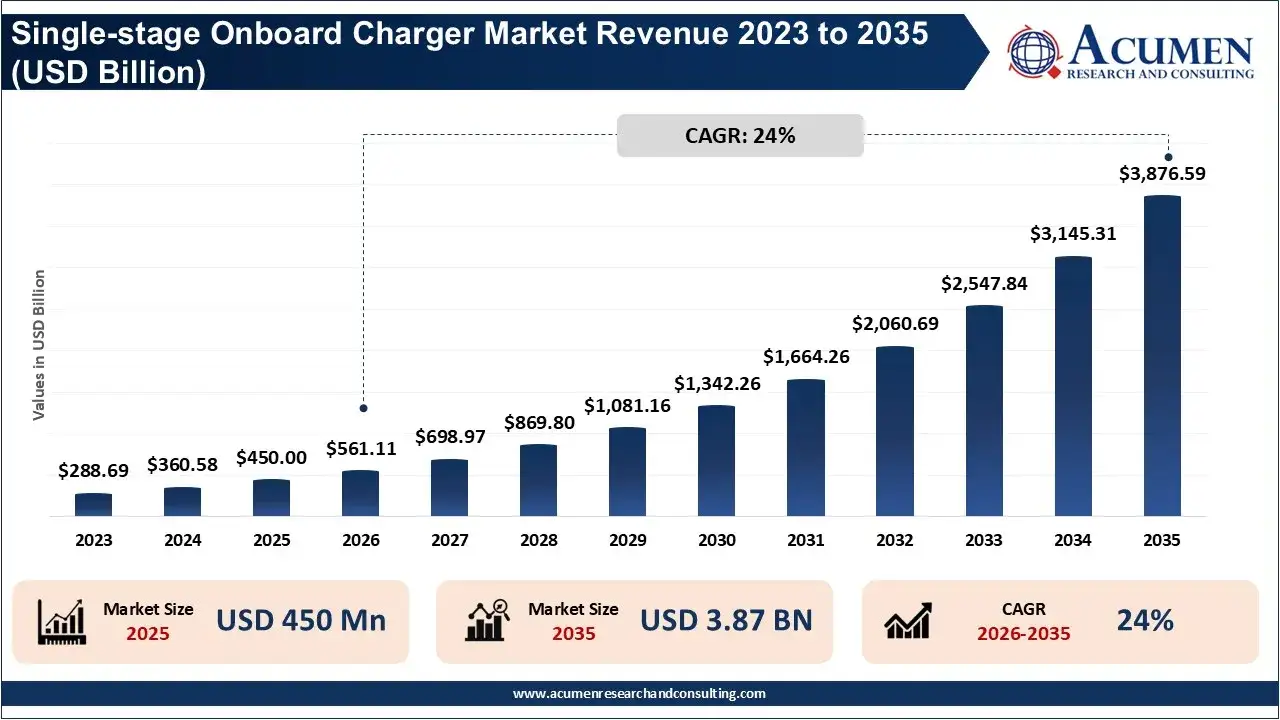
Why Is OBC Architecture Becoming a Key EV Design Decision?
The onboard charger has become an important part of EV electrical architecture because it determines how efficiently grid electricity is converted and delivered to the vehicle battery. Single-stage designs can simplify power-conversion architecture by reducing the number of conversion stages between the AC input and battery system. This can support lower component counts, compact packaging, and potentially reduced system costs. As automakers seek to balance charging performance with vehicle price, weight, thermal management, and available packaging space, single-stage OBC architectures are attracting attention across mainstream electric vehicles.
Where Are Single-stage OBCs Creating Value in Electric Vehicles?
- Simplified Power Conversion: Single-stage architectures can reduce the number of power-conversion steps required within the onboard charger. Fewer conversion stages can simplify system architecture, potentially reduce component requirements, and create opportunities for smaller and lighter charging systems in electric vehicles.
- Compact Vehicle Packaging: Space inside modern EVs is increasingly allocated across batteries, thermal systems, electronics, motors, and passenger features. Compact OBC designs can help automakers manage these competing requirements by reducing charger size and supporting more efficient integration within the vehicle's electrical architecture.
- Lower System Complexity: A simpler conversion architecture can reduce the number of components and interconnections within the onboard charging system. This can support easier system integration and potentially improve reliability, manufacturing efficiency, and serviceability when appropriately designed for the vehicle's operating requirements.
- Mainstream EV Charging: Single-stage OBCs are particularly relevant to passenger EVs where charging requirements need to be balanced against vehicle cost. Moderate-power charging systems can provide practical AC charging capabilities for daily driving while avoiding unnecessary increases in hardware complexity and vehicle cost.
- Power Electronics Efficiency: Advances in switching devices, control algorithms, thermal management, and power-module design are helping manufacturers improve OBC efficiency. Better conversion performance can reduce energy losses during charging and limit heat generation, creating benefits for vehicle efficiency and charging-system thermal management.
Single-stage Onboard Charger Market Segmental Outlook
| Segment | Leading Segment | 2025 Share | Key Driver |
|---|---|---|---|
| By Integration Type | Standalone Single-stage OBCs | 68% | Established standalone architectures and relatively straightforward integration within conventional EV electrical systems. |
| By Power Flow | Unidirectional OBCs | 64% | Widespread adoption in conventional EV charging applications where power primarily flows from the electrical grid to the vehicle battery. |
| By Charging Power | >3.3 kW to 6.6 kW | 32% | Suitability for mainstream passenger EV charging, offering a practical balance between charging speed, system cost, thermal requirements, and vehicle electrical architecture. |
| By Semiconductor Material | Silicon | 45% | Established automotive power-electronics ecosystem, broad supplier availability, mature manufacturing processes, and cost advantages. |
| By Propulsion Type | Battery Electric Vehicles (BEVs) | 72% | Increasing BEV adoption and the requirement for integrated AC charging capability across battery-electric vehicle platforms. |
| By Vehicle Type | Passenger Cars | 69% | Larger EV deployment base and widespread use of onboard AC charging across consumer electric vehicles. |
What Will Change by 2030?
- Higher-Power Charging Will Expand: As EV owners increasingly expect shorter charging times, OBC power levels will gradually increase across vehicle segments. Manufacturers will need to balance faster AC charging with thermal performance, component cost, battery requirements, grid compatibility, and available vehicle packaging.
- Power Density Will Become More Important: OBC developers will increasingly focus on delivering greater electrical power within smaller and lighter packages. Higher-frequency switching, improved semiconductor materials, advanced cooling, and integrated power modules can help reduce charger size while maintaining performance.
- Silicon Carbide Will Gain Greater Attention: Although silicon remains widely established, silicon carbide can provide advantages in switching efficiency, high-temperature operation, and power density. As costs decline and automotive-grade SiC supply expands, manufacturers are likely to evaluate the material more extensively for next-generation charging systems.
Single-stage Onboard Charger Market Regional Outlook
Asia-Pacific dominated the single-stage onboard charger market in 2025, accounting for 48.0% of the market. The region's leadership is supported by high EV production volumes, rapid electric-mobility adoption across China, Japan, South Korea, and India, and the presence of major automotive OEMs and power-electronics manufacturers.
China's extensive EV manufacturing ecosystem generates substantial demand for onboard charging systems across passenger and commercial vehicles, while increasing EV adoption in India and other Asian markets is expanding demand for cost-efficient and compact OBC architectures. The region's established semiconductor, electronics, battery, and automotive supply chains also support localized production and technology development.
Europe was the second-largest regional market, accounting for 25% of the global single-stage onboard charger market in 2025. The region's automotive industry is undergoing continued electrification, creating demand for efficient and compact power-conversion systems.
European automakers and Tier 1 suppliers are increasingly focused on reducing vehicle weight, improving charging performance, and optimizing high-voltage electrical architectures. Demand for advanced OBCs is also supported by the expansion of EV platforms across passenger vehicles and growing investments in automotive power electronics.
What Are Companies Investing in?
- January 2025: Infineon Technologies expanded its automotive power semiconductor portfolio with new CoolSiC MOSFET technologies targeting electric vehicle power-conversion applications. The development reflects continued industry investment in silicon carbide solutions that can improve efficiency and power density across EV electrical systems.
- March 2025: STMicroelectronics expanded its automotive silicon carbide capabilities with continued investment in SiC manufacturing and technology development. The company's strategy targets growing demand for high-efficiency power electronics across electric vehicle traction inverters, onboard chargers, and other high-voltage applications.
Key Companies
The single-stage onboard charger market includes Infineon Technologies, STMicroelectronics, onsemi, Wolfspeed, ROHM Semiconductor, Mitsubishi Electric, Renesas Electronics, Texas Instruments, NXP Semiconductors, Delta Electronics, BorgWarner, Valeo, DENSO, Panasonic Automotive Systems, and Ficosa. Infineon, STMicroelectronics, onsemi, Wolfspeed, ROHM, Mitsubishi Electric, and Renesas contribute power semiconductor and automotive power-electronics technologies, while Delta Electronics, BorgWarner, Valeo, DENSO, Panasonic Automotive Systems, and Ficosa focus on automotive charging, power-conversion, thermal, and electrical systems.
Segments Covered
By Integration Type
- Standalone Single-Stage OBC
- Integrated Single-Stage OBC
By Power Flow
- Unidirectional
- Bidirectional
By Charging Power
- Up to 3.3 kW
- 3.3 kW to 6.6 kW
- 6.6 kW to 11 kW
- 11 kW to 22 kW
- Above 22 kW
By Semiconductor Material
- Silicon (Si)
- Silicon Carbide (SiC)
- Gallium Nitride (GaN)
- Others
By Propulsion Type
- Battery Electric Vehicles (BEVs)
- Plug-in Hybrid Electric Vehicles (PHEVs)
By Vehicle Type
- Passenger Cars
- Light Commercial Vehicles
- Heavy Commercial Vehicles
- Electric Buses
- Electric Two- & Three-Wheelers
By Region
- North America
- Europe
- Asia-Pacific
- Latin America
- Middle East & Africa
Contact Us:
Mr. Richard Johnson
Acumen Research and Consulting
India: +91 8983225533