
Single-stage Onboard Charger Market Size, Share, Growth, Report 2026 To 2035
Single-stage Onboard Charger Market (By Integration Type: Standalone Single-Stage OBC, Integrated Single-Stage OBC; By Power Flow: Unidirectional, Bidirectional; By Charging Power: Up to 3.3 kW, 3.3 kW to 6.6 kW, 6.6 kW to 11 kW, 11 kW to 22 kW, Above 22 kW; By Semiconductor Material: Silicon (Si), Silicon Carbide (SiC), Gallium Nitride (GaN), Others; By Propulsion Type: Battery Electric Vehicles (BEVs), Plug-in Hybrid Electric Vehicles (PHEVs); By Vehicle Type: Passenger Cars, Light Commercial Vehicles, Heavy Commercial Vehicles, Electric Buses, Electric Two- & Three-Wheelers) - Global Industry Analysis, Size, Share, Regional Analysis, Trends and Forecast 2026 - 2035
- Last Updated: 30 Sep 2026
- Report Code: ARC3991
- Category: Energy and Power
Single-stage Onboard Charger Market Overview
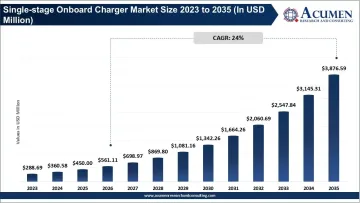
The single-stage onboard charger market size was valued at USD 450 million in 2025. The market is seen to reach at USD 3,876.59 million by 2035; expanding at a CAGR of 24% during the forecast period of 2026-2035. The growth of the single-stage on-board charger market is being supported by the expansion of battery electric vehicle production, rising demand for higher-power AC charging, increasing adoption of high-voltage vehicle architectures, and the transition toward more compact and efficient power-electronics systems.
The increasing integration of on-board chargers with DC-DC converters and other vehicle power-electronics systems is being reinforced by the rapid expansion of the global electric vehicle ecosystem. Global electric car sales exceeded 17 million units in 2024, with sales increasing by more than 20% year over year, according to the International Energy Agency (IEA). At the same time, the global public charging network expanded by more than 25% in 2024, increasing the need for efficient and higher-power vehicle charging systems. The continued deployment of high-voltage EV platforms, including 800-V architectures, is also encouraging manufacturers to develop more compact, efficient, and higher-power-density OBC designs. These developments, together with growing interest in bidirectional charging and integrated power-electronics architectures, are expected to support demand for advanced single-stage on-board chargers over the forecast period.
Key Takeaways
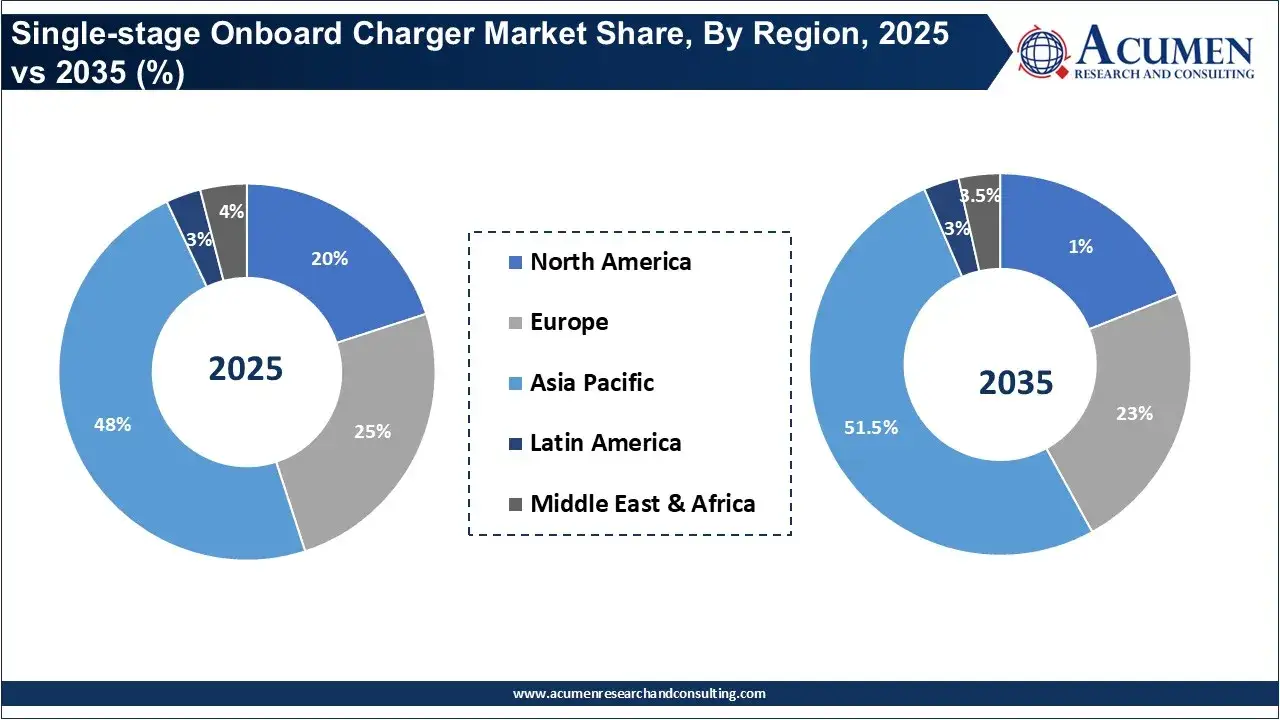
- By region: Asia-Pacific dominated the market with a 48% share in 2025, driven by rapid EV production and charging infrastructure expansion.
- By integration type: Standalone single-stage OBCs dominated with a 68% share in 2025, supported by established standalone architectures.
- By power flow: Unidirectional OBCs dominated with a 64% share in 2025, reflecting their widespread adoption in conventional EV charging.
- By charging power: >3.3 kW to 6.6 kW dominated with a 32% share in 2025, supported by its suitability for mainstream passenger EV charging.
- By semiconductor material: Silicon dominated with a 45% share in 2025, supported by its established automotive power-electronics ecosystem.
- By propulsion type: Battery Electric Vehicles (BEVs) dominated with a 72% share in 2025, driven by increasing BEV adoption.
- By vehicle type: passenger cars dominated with a 69% share in 2025, reflecting their larger EV deployment base.
Market Size & Forecast
- Base Year Market Size (2025): $450 million
- Current Year Market Size (2026): $561.11 million
- Estimated Year Market Size (2035): $3,876.59 million
- Forecast Period CAGR (2026-2035): 24%
Single-Stage vs. Two-Stage OBC
| Parameter | Single-Stage OBC | Two-Stage OBC | Market Implication |
|---|---|---|---|
| Power conversion architecture | AC-to-DC conversion is performed through an integrated conversion stage | AC power is typically processed through separate PFC and DC/DC conversion stages | Single-stage architectures can reduce system complexity, while two-stage designs offer greater control flexibility |
| Component count | Generally lower due to greater functional integration | Generally higher because multiple conversion stages are used | Lower component count can support packaging and weight reduction |
| Power density | Potentially higher because of fewer conversion stages and reduced passive components | Typically requires more space for additional conversion components | Important for compact EV platforms with limited packaging space |
| Conversion efficiency | Can achieve high efficiency by reducing conversion stages and associated losses | Additional conversion stages can introduce cumulative losses | Efficiency depends strongly on topology, semiconductor technology, operating point, and control strategy |
| Power factor correction | PFC functionality is integrated into the overall conversion architecture | PFC is generally implemented as a dedicated stage | Two-stage designs provide greater flexibility in independently optimizing PFC performance |
| Development complexity | Requires sophisticated topology and control optimization | Mature multi-stage architectures can offer established design approaches | Choice depends on OEM development priorities, target performance, and platform requirements |
| Bidirectional charging | Can be designed for bidirectional power flow depending on topology | Bidirectional operation can be implemented through appropriately designed conversion stages | Both architectures can support advanced charging functions, but topology selection is critical |
| Typical strategic value | Focuses on integration, compactness, efficiency, and reduced system complexity | Focuses on flexibility, controllability, isolation, and established power-conversion architectures | OEMs and suppliers select architectures according to vehicle platform and charging requirements |
Single-stage Onboard Charger Market Technology Landscape
- Advanced PFC Technologies: Development of bridgeless, totem-pole, interleaved, and other advanced PFC topologies to improve power factor, reduce losses, and increase conversion efficiency.
- High-Frequency Switching: Increasing switching frequencies are enabling manufacturers to reduce the size of magnetic components and other passive components, contributing to more compact OBC designs.
- 400-V and 800-V OBC Architectures: Expansion of high-voltage EV platforms is driving development of OBCs capable of operating across broader voltage ranges while maintaining efficiency, insulation, thermal performance, and reliability.
- High-Power-Density OBCs: Automakers and suppliers are prioritizing smaller and lighter charging modules that deliver higher power within constrained vehicle packaging spaces.
- Bidirectional OBC Technology: Development of bidirectional power-conversion architectures is supporting emerging V2G, V2H, and V2L applications by enabling electricity to flow between the vehicle battery and external electrical systems.
- Integrated OBC and DC-DC Converter Platforms: Integration of the OBC with auxiliary DC-DC conversion functions can reduce component duplication, wiring, weight, and overall power-electronics packaging requirements.
- OBC and Inverter Integration: Emerging integrated powertrain architectures combine multiple power-conversion functions within a common platform, creating opportunities for further reductions in size, weight, and system complexity.
Single-stage Onboard Charger Market Dynamics
Driver: Rapid Expansion of the Global Electric Vehicle Fleet
The growing EV adoption is translating into a larger installed base of vehicles that need efficient AC-to-DC charging solutions, driving demand for on-board chargers. EV sales globally surpassed 20 million units in 2025 (up 20% year-on-year) and accounted for some 25% of new-car sales globally in 2025, according to the IEA.
Meanwhile, the EV charging infrastructure is also growing exponentially, with over 1.3 million public charging points added worldwide in 2024, a 30%+ YoY growth. The growing EV and charging ecosystem is motivating OEMs to commercialize more performance-optimized, and space-efficient high-power OBC architectures that can support bigger battery packs, higher-voltage platforms and much higher AC charging speeds.
Driver Impact on the Market:
| Statistical Indicator | Latest Data | Impact on the Market |
|---|---|---|
| Global electric car sales, 2025 | >20 million units | Expands the installed base requiring onboard charging systems |
| EV sales growth, 2025 | 20% YoY | Supports new OBC installations across vehicle platforms |
| EV share of global new-car sales, 2025 | ~25% | Increases OBC addressable demand within the automotive market |
| Global electric car production, 2024 | 17.3 million units | Expands OEM and Tier-1 procurement opportunities |
| Public charging points added in 2024 | >1.3 million | Strengthens the broader EV charging ecosystem |
| Growth in global public chargers, 2024 | >30% YoY | Supports continued EV adoption and charging-system deployment |
Restraint: High System-Level Cost and Design Complexity of Advanced OBCs
The increasing technical requirements of OBCs can constrain adoption of advanced architectures, particularly in cost-sensitive EV segments. High-power and high-voltage OBCs require sophisticated power semiconductors, thermal-management systems, EMI/EMC protection, high-frequency magnetics, capacitors, sensors, gate drivers, and digital control systems. The transition toward 800-V platforms further increases requirements for high-voltage components and system qualification. However, improvements in semiconductor technology can partly offset these costs at the system level.
Opportunity: Shift Toward 800-V, High-Power and High-Power-Density OBC Architectures
The move to higher-voltage EV platforms provides a key opportunity for next-gen single-stage OBC solutions. Automakers are pursuing increased battery pack capacity and reduced charge time, and OBC suppliers are designing architectures that operate at higher voltages and power while managing thermal dissipation and packaging volume. Experts from the industry illustrate this evolution, with 11-kW and 22-kW OBC architectures increasingly integrating three-phase operation and using three-phase operation for higher-power OBCs.
Opportunity Impact on the Market:
| Statistical / Technical Indicator | Value | Market Opportunity |
|---|---|---|
| High-power OBC reference power levels | 11 kW and 22 kW | Expands demand for high-power charging architectures |
| 22-kW bidirectional OBC output range | 200–800 V | Supports higher-voltage EV platforms |
| 22-kW reference OBC peak efficiency | >96% | Supports efficiency-focused vehicle architectures |
| 22-kW DC-DC peak efficiency in reference design | >98.5% | Demonstrates potential for high-efficiency power conversion |
| SiC 22-kW reference power density | 3 kW/L | Creates opportunity for compact OBC packaging |
| Global ultra-fast public chargers, 2024 | +50% YoY | Reinforces broader consumer demand for faster EV charging |
Challenge: Managing Thermal Performance, EMI/EMC and Reliability at Higher Power Density
Raising OBC power density presents a primary design challenge, as additional switching frequencies and power levels tend to raise thermal loads, EMI issues, insulation requirements, and stress on components. This is especially critical where OBCs are being integrated with other power-electronics functions such as DC-DC conversion, within a limited vehicle package.
The trade-off can be enhanced by more advanced semiconductor technologies, which, however, need gate-drive design, thermal paths, magnetic design, and electromagnetic compatibility (EMC) design. A Wolfspeed 6.6-kW bidirectional OBC reference design showed a power density of 54 W/in2 and over 96.5% peak efficiency, meaning advanced design can still achieve this level of performance with dedicated thermal design.
Single-stage Onboard Charger Market Segmentation Insights
Integration Type Insights
Standalone single-stage OBC remained the dominant segment in 2025 with 68.0% of the total market. Despite some efficiencies gained by fully integrated archictecture, standalone architectures will still benefit from minimal design additions for functional system expansion in the higher power ranges, and are easy to incorporate into current EV platforms. Automakers and Tier-1 suppliers can implement dedicated OBC modules when needed for specific customer charging needs, which can still be fairly flexible in power rating, packaging, thermal management and charging services while maintaining competitiveness in high volume price-sensitive vehicle platforms.
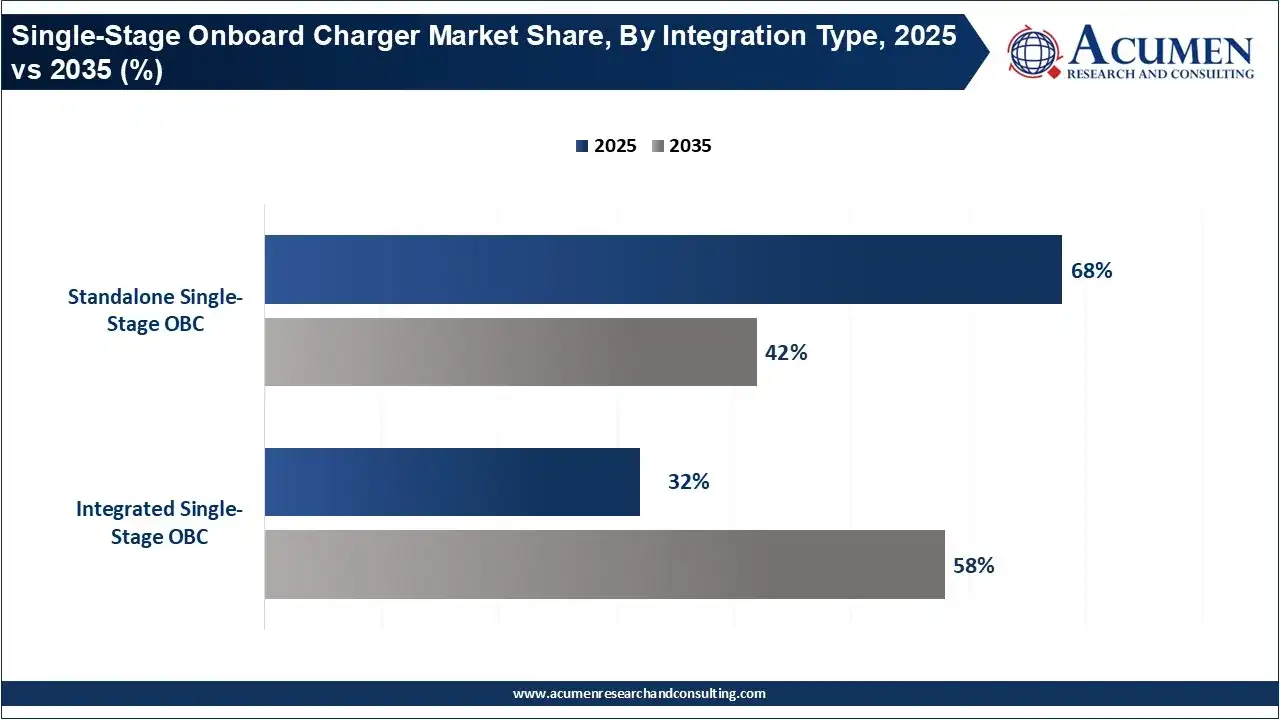
The integrated single-stage OBC market share is estimated to grow 26.0% during the forecast period, from 32.0% in 2025 to 58.0% in 2035. Integrated architectures are gaining traction in an effort to eliminate duplication of hardware, lightening vehicle weight, decreasing wiring and packaging volume, and limiting power-electronics complexity.
Integrating OBCs with DC-DC converters and other vehicle power-electronics functions is becoming an even more compelling solution for OEMs as they seek high power density and highly integrated electrical architectures.
Power Flow Insights
Unidirectional OBCs dominated the market in 2025, representing 64.0% of the market. Their leading position reflects their established deployment across conventional AC charging applications, where electricity flows from the charging infrastructure to the vehicle battery. Unidirectional systems generally have simpler power-conversion architectures and control requirements than bidirectional systems, making them suitable for mainstream passenger EVs and cost-sensitive vehicle platforms.
Bidirectional OBCs are expected to be the faster-expanding segment, increasing from 36.0% of the market in 2025 to 62.0% by 2035. Growing interest in Vehicle-to-Grid (V2G), Vehicle-to-Home (V2H), Vehicle-to-Load (V2L), and broader vehicle-to-everything applications is increasing demand for OBCs capable of managing two-way power flows.
Charging Power Insights
The >3.3 kW to 6.6 kW was the largest single-stage OBC market with a 32.0% share in 2025. These OBCs have a relatively high degree of commonality in passenger EVs and plug-in hybrids (PHEVs) that utilize residential and workplace AC charging as their primary charging opportunity.
These modules also strike a natural compromise between overall system cost, thermal and vehicle packaging constraints, and charging performance that suits mass market deployment for many applications.
The above 22 kW segment is estimated to be the fastest growing charging-power segment, with a CAGR of 30.3% from 2026 to 2035. Growing penetrations of high-voltage architectures in EVs, coupled with the need for shorter AC charging times, are driving the move towards higher power OBCs. These are especially applicable for commercial EVs and highperformance passenger vehicle applications, fleets and platforms with larger packs.
Semiconductor Material Insights
Silicon (Si) held the largest single-stage onboard charger market share in 2025, with 45.0%. Silicon-based power devices have a high installed base as a result of a mature supply chain, an automotive-qualified silicon base, widespread availability, and relatively cost-effective component economics.
They are especially important for low- and medium-power OBCs where the purchase price of the system is an important criterion and the performance requirement may not merit the added expense or design complexity of a wide band gap material.
Silicon Carbide (SiC) is predicted to be the largest market segment for semiconductor materials in 2035 at 42.0%, up from 35.0% in 2025. SiC devices are increasingly being adopted in high-voltage/high-power OBCs due to their high-temperature operability, lower switching losses, high-frequency efficiency and higher power density.
Demand for the material will be bolstered as more GaN-based solutions are introduced to 800-V EV architectures and high-power charging systems. Increased adoption of GaN in compact and high-frequency applications is also set to contribute to increased demand, especially where switching frequency and size are a design consideration.
Propulsion Type Insights
Battery Electric Vehicles (BEVs) dominated the market in 2025, accounting for 72.0% of the Single-stage Onboard Charger Market. BEVs generally require larger battery packs and rely extensively on onboard charging for AC charging applications, creating substantial demand for efficient and increasingly higher-power OBC systems. The expansion of BEV production across passenger and commercial vehicle platforms is increasing demand for 400-V and 800-V OBC architectures, while the growing adoption of bidirectional charging is creating additional opportunities for advanced power-conversion systems.
BEVs are also projected to be the fastest-growing propulsion segment, registering a CAGR of 26.1% from 2026 to 2035. Increasing EV adoption, expanding model availability, declining battery costs, government electrification initiatives, and growing charging infrastructure are supporting the transition from internal combustion vehicles toward battery-electric platforms. This trend is expected to directly expand the installed base of vehicles requiring onboard charging systems.
Vehicle Type Insights
Passenger cars held the largest single-stage onboard charger market share in 2025, with 69.0%. The high market share is supported by the fast-growing penetration of passenger EVs and growing choice of battery-electric as well as plug-in hybrid passenger vehicles in nearly all regions.
Passenger cars constitute a vast installed base for AC charging, especially for residential, workplace, and destination charging. As a result, OBC vendors are preparing compact, lightweight, and low-cost architectures that can be used on many different passenger-vehicle platforms, accommodating both various battery voltages and charging powers.
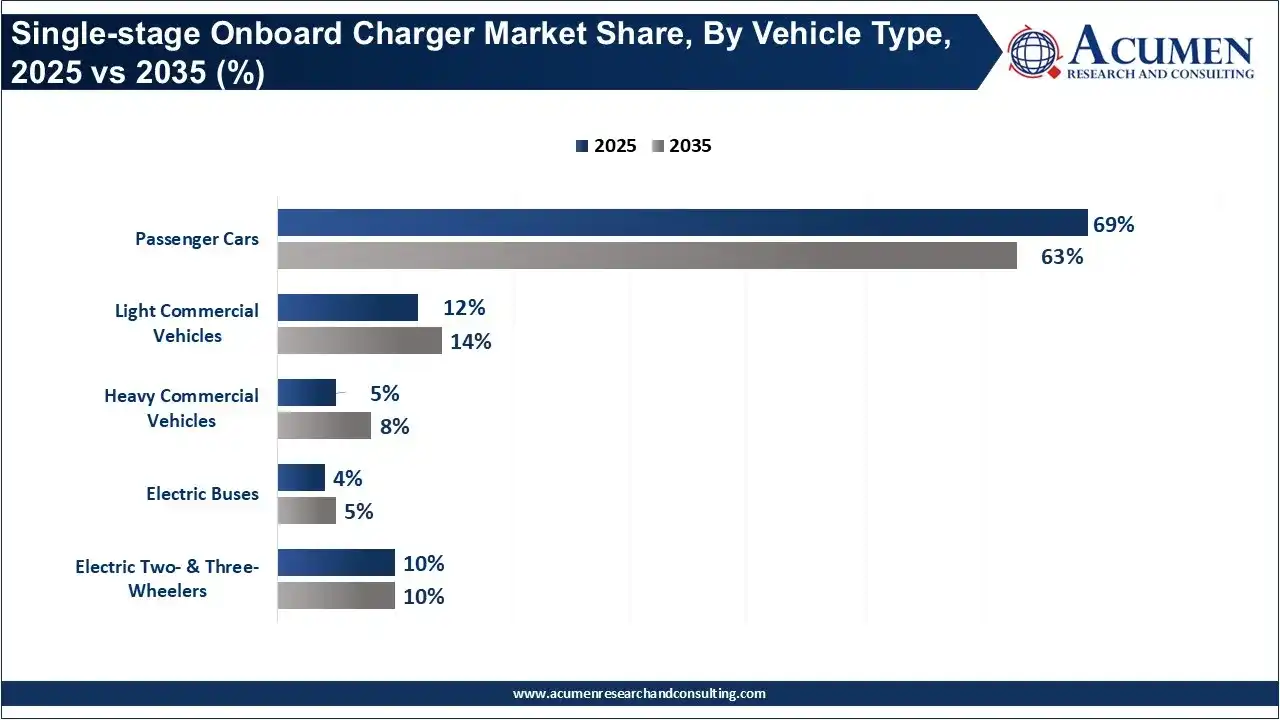
Light commercial vehicles represented the second largest vehicle-type segment in 2025, with 12.0%. As more and more vans used for logistics and commercial services are becoming electrified, as well as delivery vans, more demand is emerging for highly reliable OBC systems that can consistently accommodate frequent charging.
This vehicle-type segment is also aided by the rise of fleet charging stations, which can rely on AC to bolster high-power DC charging for overnight and scheduled fleet use.
Single-stage Onboard Charger Market Use Cases
| Industry / Use Case | Application | OBC Requirement | Relevant Technology |
|---|---|---|---|
| Passenger Electric Vehicles | Battery charging for electric cars and plug-in hybrid vehicles | Compact, efficient AC charging with low weight and high reliability | Single-stage conversion, SiC/GaN, high-frequency switching, 400-V/800-V architectures |
| Electric Commercial Vehicles | Charging electric vans, delivery vehicles, and utility vehicles | Higher charging power, durability, high efficiency, and extended operating cycles | 11-kW/22-kW OBCs, SiC, liquid cooling, three-phase charging |
| Electric Delivery & Logistics Fleets | Overnight and workplace charging of delivery fleets | High utilization, reliability, fleet energy management, and predictable charging | Smart charging, scalable OBCs, integrated OBC + DC-DC systems |
| Vehicle-to-Home (V2H) | Using EV batteries as backup or household energy storage | Bidirectional conversion, islanding protection, home-energy integration | Bidirectional OBC, smart energy management, digital controls |
| Vehicle-to-Vehicle (V2V) | Transferring electrical energy between EVs | Controlled bidirectional energy transfer and electrical protection | Bidirectional OBC, isolation monitoring, power-control systems |
| Agricultural Electric Vehicles | Electric tractors and agricultural machinery | Robust operation, high-voltage charging, environmental durability | SiC, high-power OBCs, liquid cooling, wide-input-voltage architectures |
| Off-Grid & Renewable Energy Integration | EV battery integration with solar or localized energy systems | Bidirectional power conversion and energy-management capabilities | Bidirectional OBC, V2H/V2G, digital energy management |
Single-stage Onboard Charger Market Regional Insights
Asia-Pacific Single-stage Onboard Charger Market Analysis
Asia-Pacific dominated the Single-stage Onboard Charger Market in 2025, accounting for 48.0% of the market. The region's leading position is supported by high EV production volumes, rapid expansion of electric mobility in China, Japan, South Korea, and India, and the presence of major automotive OEMs and power-electronics manufacturers.
China's large electric vehicle manufacturing ecosystem provides significant demand for onboard charging systems across passenger and commercial vehicles, while growing EV adoption in India and other Asian markets is expanding the addressable market for cost-efficient and compact OBC architectures. The region's established semiconductor, electronics, and automotive supply chains also support localized manufacturing and technology development.
Europe Single-stage Onboard Charger Market Analysis
Europe was the second-largest regional market, accounting for 25% of the global single-stage onboard charger market in 2025. The region's strong position is supported by expanding EV adoption, stringent vehicle-emission regulations, continued investment in charging infrastructure, and increasing demand for efficient power-conversion technologies.
The transition toward higher-power and bidirectional charging systems is also creating opportunities for advanced OBC architectures across passenger and commercial EV platforms. Germany represents a key country market in Europe, supported by its established automotive manufacturing base, growing EV production, and strong presence of automotive power-electronics and component suppliers.
Regulations & Government Programs
India: PM E-DRIVE and Charging Infrastructure Development
India is developing its EV ecosystem through a combination of vehicle incentives and charging-infrastructure programs. The PM E-DRIVE Scheme has a total outlay of ₹10,900 crore, with ₹2,000 crore specifically allocated to public EV charging infrastructure, including EV charging stations and battery-related charging infrastructure. The program covers categories including electric two-wheelers, three-wheelers, e-ambulances, and e-trucks.
Europe: AFIR and the Shift Toward Smart Charging
The European Union's Alternative Fuels Infrastructure Regulation (AFIR) establishes minimum requirements for EV charging deployment across the region. Along the TEN-T core network, charging pools for light-duty EVs were required from the end of 2025 to provide at least 400 kW of total power, including at least one charging point capable of 150 kW. The regulation also requires publicly accessible charging points to be digitally connected and charging points built or renovated after specified dates to support smart charging.
United States: NEVI Charging Infrastructure Standards
The U.S. National Electric Vehicle Infrastructure (NEVI) Formula Program provides federal support for strategically deploying EV charging infrastructure. Federal standards cover areas including installation, operation and maintenance, interoperability, data, network connectivity, and information regarding charging-station pricing, availability and accessibility.
Competitive Landscape
- BorgWarner Inc. – Develops high-voltage onboard charging and power-electronics solutions for electric vehicles, including scalable architectures designed for integration with broader electrified powertrains.
- Valeo SE – Supplies high-voltage onboard chargers and integrated power-electronics systems, including solutions combining OBC and DC-DC conversion functions.
- Hyundai Mobis Co., Ltd. – Develops automotive electrification systems including onboard chargers and integrated charging solutions for EV and hybrid vehicle platforms.
- LG Electronics / LG Magna e-Powertrain – Provides OBCs ranging from 3.6 kW to 11 kW, including 400-V/800-V and bidirectional charging solutions supporting V2G and V2L applications.
- Delta Electronics, Inc. – Offers OBC modules from 3.3 kW to 22 kW, along with bidirectional charging and integrated EV power-electronics solutions for BEVs and PHEVs.
- Toyota Industries Corporation – Develops onboard charging and vehicle power-supply systems, with integrated architectures combining charging and DC-DC conversion functions.
- BRUSA HyPower AG – Specializes in high-power-density onboard charging and power-conversion systems for electric and hybrid vehicles, including high-voltage and bidirectional architectures.
- DENSO Corporation – Develops automotive power-electronics systems and onboard charging technologies as part of its broader EV electrification portfolio.
- STMicroelectronics N.V. – Supplies power semiconductors and automotive power-management technologies used in OBC architectures, including silicon carbide and other devices supporting high-efficiency power conversion.
- Infineon Technologies AG – Provides automotive power-semiconductor technologies, including SiC MOSFETs, gate drivers, controllers, and power-management components used in advanced OBC systems.
Pricing & Cost Factors
| Cost Factor | Cost Influence | Higher-Cost Configuration | Cost-Optimization Approach | Impact on Single-stage OBC Pricing |
|---|---|---|---|---|
| Power Rating | Higher charging power generally requires higher-current components, larger thermal systems, and more robust power electronics | 11-kW and 22-kW OBCs | Optimize topology and component utilization | High |
| PFC Topology | Topology affects semiconductor count, control complexity, efficiency, magnetics, and EMI filtering | Totem-pole or advanced interleaved PFC | Conventional boost PFC where appropriate | Medium to High |
| DC/DC Converter Topology | Converter topology determines switching components, magnetics, control electronics, and isolation requirements | Advanced bidirectional resonant architectures | Simplified unidirectional architectures | High |
| Thermal Management | Higher power density increases heat-generation and cooling requirements | Liquid cooling and advanced thermal interfaces | Optimized air cooling or passive thermal solutions where feasible | Medium to High |
| Magnetics | Transformers and inductors influence OBC size, weight, efficiency, and material costs | High-frequency, high-power magnetic components | High-frequency optimized designs | Medium to High |
| Control Electronics | Digital controllers, gate drivers, sensors, communication interfaces, and software add system cost | Advanced digital control and diagnostics | Integrated controllers and standardized platforms | Medium |
| Enclosure & Packaging | Smaller and lighter packaging requires greater thermal and mechanical optimization | High-power-density automotive packaging | Modular and standardized packaging | Medium |
| Automotive Qualification | Automotive-grade components and validation increase development and qualification costs | High-reliability automotive-grade systems | Platform reuse and standardized designs | Medium to High |
| Production Volume | Higher volumes generally improve purchasing leverage, manufacturing efficiency, and tooling amortization | Low-volume specialized OBCs | High-volume standardized platforms | High |
Partnerships, Product Launches & Investments:
- September 2025: FORVIA HELLA and Tau Motors entered a strategic development cooperation to develop a virtually isolated onboard charger (viOBC) for electric vehicles, with HELLA Ventures also investing in Tau Motors. The technology targets higher power density, reduced weight, and bidirectional charging capabilities.
- September 2025: Sterling Tools' subsidiary Sterling Gtake E-Mobility partnered with China's Landworld Technology through technology-license and supply agreements to manufacture onboard chargers, DC-DC converters, and multifunction power-electronics units in India. The collaboration is expected to generate approximately ₹450 crore in business by FY2030.
Segments Covered
By Integration Type
- Standalone Single-Stage OBC
- Integrated Single-Stage OBC
By Power Flow
- Unidirectional
- Bidirectional
By Charging Power
- Up to 3.3 kW
- 3.3 kW to 6.6 kW
- 6.6 kW to 11 kW
- 11 kW to 22 kW
- Above 22 kW
By Semiconductor Material
- Silicon (Si)
- Silicon Carbide (SiC)
- Gallium Nitride (GaN)
- Others
By Propulsion Type
- Battery Electric Vehicles (BEVs)
- Plug-in Hybrid Electric Vehicles (PHEVs)
By Vehicle Type
- Passenger Cars
- Light Commercial Vehicles
- Heavy Commercial Vehicles
- Electric Buses
- Electric Two- & Three-Wheelers
By Region
- North America
- Europe
- Asia-Pacific
- Latin America
- Middle East & Africa
Looking for discounts, bulk pricing, or custom solutions? Contact us today at sales@acumenresearchandconsulting.com
Frequently Asked Questions

Other Energy and Power Reports
September 2023
July 2026
February 2020
November 2018