
Liquid-cooled EV Charger Modules Market Size, Share, Trends, Report 2026 To 2035
Liquid-cooled EV Charger Modules Market (By Module Type: AC–DC Modules, DC–DC Modules, Integrated AC–DC/DC–DC Modules; By Power Rating: ≤20 kW, 21–40 kW, 41–60 kW, 61–100 kW, 101–200 kW, 200 kW; By Charger Architecture: Standalone Architecture, Distributed Charging Architecture; By Charging Application: Public Fast Charging, Commercial Fleet Charging, Heavy-Duty / Megawatt Charging, Workplace & Destination Charging, Other Specialized Charging; By Vehicle Type: Passenger EVs, Commercial EVs, Specialty / Off-Highway EVs; By End User: Charger OEMs, Charging Infrastructure System Integrators, Charging Network Operators, Fleet Operators, Utilities / Energy Companies, Aftermarket / Service Providers, Other Buyers; By Deployment Stage: OEM / New Charger Installation, Charger Upgrade / Retrofit, Replacement / Aftermarket) - Global Industry Analysis, Size, Share, Growth, Regional Analysis, Trends and Forecast 2026 - 2035
- Last Updated: 23 Aug 2026
- Report Code: ARC3968
- Category: Automotive And Transportation
Liquid-cooled EV Charger Modules Market Size, Forecast 2026 To 2035
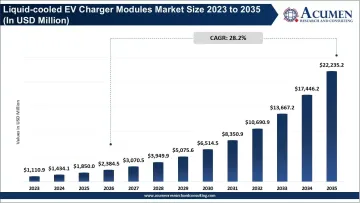
The global liquid-cooled EV charger modules market size was calculated at USD 1,850 million in 2025 and is expected to reach USD 22,235.2 million by 2035; growing at a promising CAGR of 28.2% during the forecast period of 2026-2035. Rising deployment of high-power and ultra-fast EV charging infrastructure is driving demand for liquid-cooled charger modules by increasing the need for efficient thermal management at higher power levels.
Report Highlights
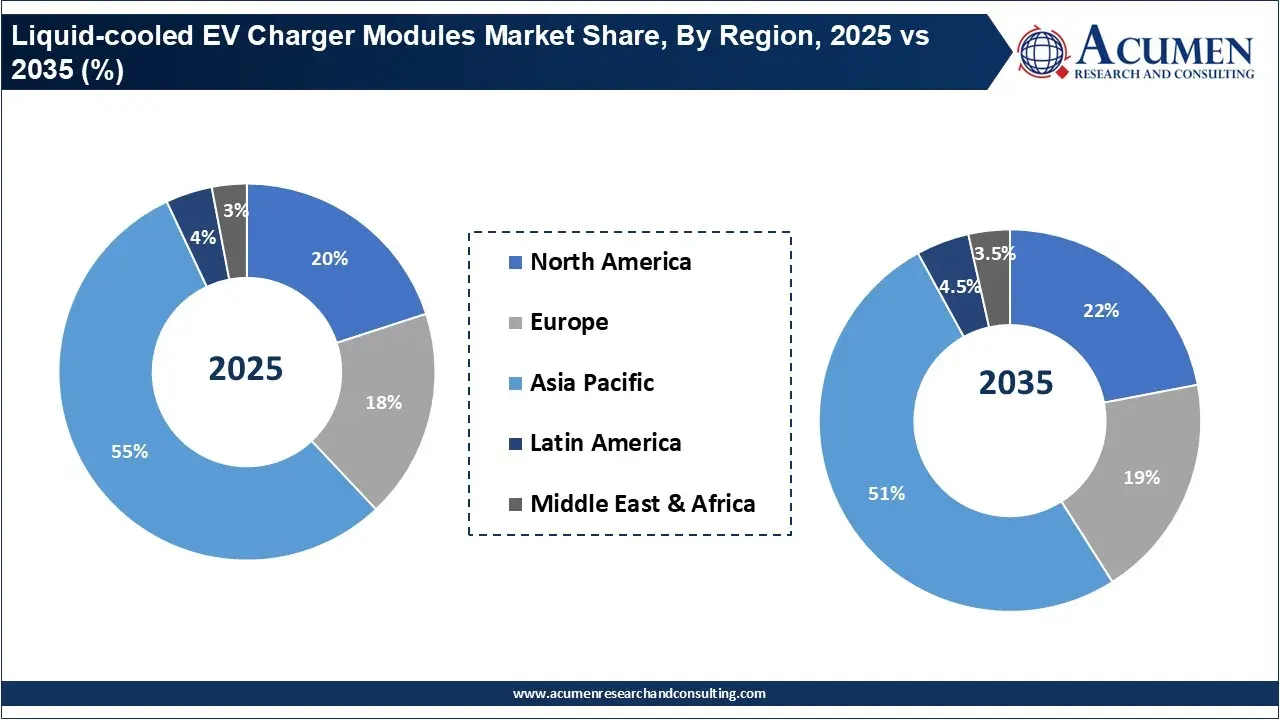
- By region, Asia-Pacific dominated the market with a 55.0% share in 2025, supported by its large EV manufacturing base, expanding charging infrastructure, and strong presence of power-electronics manufacturers.
- By region, North America held the second-largest share of 20.0% in 2025, driven by the expansion of high-power DC charging infrastructure, charging networks, and commercial fleet electrification.
- By region, Middle East & Africa accounted for a 3.0% share in 2025 and is expected to register the fastest regional growth, supported by increasing investment in EV infrastructure and the development of emerging charging networks.
- By module type, the AC–DC segment dominated the market with a 64.0% share in 2025, as AC–DC modules perform the primary conversion of grid-supplied AC electricity into DC power required for EV charging.
- By module type, the integrated AC–DC/DC–DC segment is expected to register the fastest growth during the forecast period, supported by increasing demand for compact and integrated power-conversion architectures in high-power EV charging systems.
- By power rating, the 41–60 kW segment dominated the market with a 42.0% share in 2025, reflecting strong demand for mid-to-high-power charging modules that balance charging performance, thermal management, and system cost.
- By power rating, the 21–40 kW segment held the second-largest share of 27.0% in 2025, supported by its suitability for charging applications requiring higher output than conventional low-power systems.
- By charger architecture, the standalone architecture segment dominated the market with a 62.0% share in 2025, as dedicated power-conversion units remain widely used in EV charging systems requiring independent and scalable power delivery.
- By charger architecture, the distributed charging architecture segment accounted for 38.0% of the market in 2025, supported by the growing deployment of centralized power systems capable of supplying multiple charging dispensers.
- By charging application, the public fast charging segment dominated the market with a 48.0% share in 2025, driven by the increasing deployment of high-power charging stations requiring efficient thermal management during frequent charging cycles.
- By charging application, the commercial fleet charging segment held the second-largest share of 22.0% in 2025, supported by the growing electrification of commercial fleets and their requirement for reliable high-power charging infrastructure.
- By vehicle type, the passenger EVs segment dominated the market with a 68.0% share in 2025, supported by the expanding global passenger electric vehicle fleet and increasing availability of fast-charging infrastructure.
- By vehicle type, the commercial EVs segment held the second-largest share of 27.0% in 2025, driven by increasing fleet electrification and the need for high-power charging solutions that minimize vehicle downtime.
- By end user, the charger OEMs segment dominated the market with a 54.0% share in 2025, as charger manufacturers are the primary buyers and integrators of liquid-cooled power modules in complete EV charging systems.
- By end user, the charging infrastructure system integrators segment held the second-largest share of 16.0% in 2025, supported by their role in deploying and integrating charging equipment across commercial and public charging projects.
- By deployment stage, the OEM/new charger installation segment dominated the market with an 82.0% share in 2025, reflecting the strong contribution of new charging infrastructure installations to demand for liquid-cooled charger modules.
- By deployment stage, the charger upgrade/retrofit segment accounted for 13.0% of the market in 2025, supported by efforts to enhance the power capacity and performance of existing charging infrastructure.
What Is a Liquid-cooled EV Charger Module and How Does the Market Work?
A liquid-cooled EV charger module is a power electronics unit employed within an EV charging architecture which converts and manages electric energy in terms of control and then operates with a liquid-cooling design as a system to manage internally produced thermal energy. A liquid-cooling system passes liquid through or by all internally generated heat sources rather than airflow associated with an air-cooled system, enabling significantly higher thermal outputs within a comparatively smaller design footprint.
The liquid-cooled EV charger modules market operates primarily as a B2B power-electronics market, supplying specialized power-conversion modules to EV charger OEMs, charging infrastructure integrators, and other charging-equipment manufacturers. Demand begins with the growing need for higher-power and faster EV charging, which increases heat generation within power-conversion components and creates a stronger requirement for advanced thermal management.
Liquid Cooling vs Air Cooling for EV Charger Modules
| Comparison Parameter | Liquid Cooling | Air Cooling |
|---|---|---|
| Cooling mechanism | Uses a circulating coolant through cold plates/channels to transfer heat away from power semiconductors and other heat-generating components. | Uses natural or forced airflow, typically through fans and heatsinks, to dissipate heat. |
| Heat dissipation capability | High; better suited to removing substantial heat from high-power, compact power-electronics assemblies. | Moderate; becomes increasingly challenging as power density and continuous thermal loads increase. |
| High-power charging suitability | Excellent for high-power DC fast charging, ultra-fast charging, fleet charging, and emerging megawatt-level systems. | More suitable for low-to-moderate power applications and systems where thermal loads are relatively manageable. |
| Power density | Supports higher power density because heat can be removed efficiently from a relatively compact area. | Generally requires larger heatsinks and greater airflow to handle increasing heat loads. |
| Thermal uniformity | Typically provides better temperature control across heat-generating components because coolant can be directed close to the heat source. | Temperature distribution can be less uniform, particularly as airflow paths become more complex. |
| Charger footprint | Can enable more compact high-power charger designs by reducing dependence on large heatsinks and airflow paths. | Higher-power systems may require larger heatsinks, ventilation paths, and fans. |
| Performance under sustained load | Strong advantage where chargers operate at high output for extended or repeated periods. | Thermal performance can become constrained during sustained high-load operation, potentially requiring output management or derating depending on design and conditions. |
Market Dynamics
Driver
Rising Demand for High-Power EV Charging Infrastructure
One of the largest drivers of the liquid-cooled EV charger modules market, in this case, would be the quick build out of high-power DC fast chargers. Power-conversion components would have to withstand high amounts of thermal stress in operation as EV charger stations are designed to be ever-increasing in power output, for instance in ultra-fast or heavy-duty charging. With the aid of high-power elements in liquid-cooled modules removing heat more effectively, more high power density charger units can be developed and operated more reliably and thermally.
Restraint
Higher System Cost and Complexity of Liquid Cooling
The higher cost and engineering complexity associated with liquid-cooled systems can restrain market adoption, particularly in cost-sensitive charging applications. Unlike air-cooled modules, liquid-cooled architectures require additional components such as pumps, coolant circuits, cold plates, heat exchangers, sensors, hoses, and fittings.
These components increase the initial equipment cost as well as installation, maintenance, and servicing requirements. Liquid-cooled systems also introduce potential concerns related to coolant leakage, pump failure, and thermal-loop maintenance. Consequently, charger manufacturers may continue using air cooling in lower-power applications where thermal requirements can be managed without the additional complexity of liquid cooling.
Opportunity
Expansion of Ultra-fast and Megawatt EV Charging
The increasing drift towards EV charging up to ultra-fast speeds and in multi-megawatt range is a major market opportunity for manufacturers of EV liquid-cooled charger modules. DC charging solutions for the future must provide significantly more power to handle charging requirements in the field of heavy-duty, bus, commercial fleet, and charging hub high-throughput applications compared to existing EV charging.
This development raises the technical demand for high cooling efficiency to remove heat produced by the power-conversion stages of these higher voltage and higher-power chargers, thereby making the liquid-cooled modules potentially more valuable. With EV charger designs progressing to an ever-higher level of power density, the use of liquid cooling will help manufacturers to produce high power density compact chargers, while enabling high output charge rates to sustain the most intensive driving patterns.
Segmental Insights
Module Type Insights
The AC-DC modules segment dominated market share of 64% globally in 2025, which makes it the leading module category. The market data reveals a 2026 market size of $1.526 billion, and forecast market size of $12.674 billion by 2035. The leading position of the AC-DC module segment has to be based on the fundamental issue that the modules are required to change the incoming AC power from grid supply into the suitable DC power to charge EV batteries.
Since the conversion section is a major part in the charging station, when the power output of chargers keeps increasing, the underlying power conversion modules will naturally become more and more significant. The higher power density of the AC-DC conversion systems will further enhance the relevance of liquid cooling. Since the increase of power per unit volume will result in enormous thermal burden, and while high efficiency and reliability are necessary for the operator.
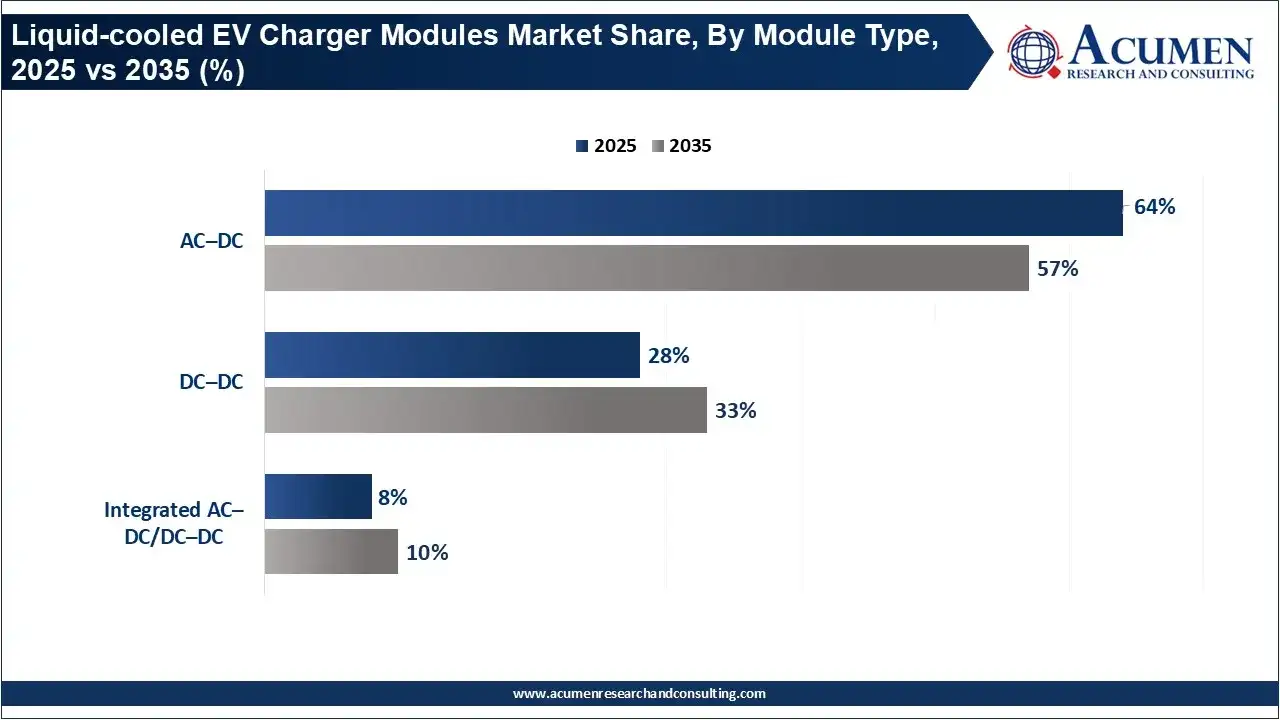
On the other hand, the integrated AC-DC/DC-DC modules segment is seen to grow at the rapid pace. The segment's share is projected to increase from 8.0% to 10.0% by 2035, while revenue rises to approximately USD 2.22 billion. Its implied 31.12% CAGR makes it the fastest-growing module-type segment in the supplied forecast. As charging equipment design moves toward high power density through element count reductions, component count, system integration, integrated power management and thermal benefits become more critical, making the architecture more appealing. Integration can complement liquid cooling as it means thermal management design can be focused around a consolidated system of power conversion.
Power Rating Insights
This 41–60 kW power-rating segment was the dominant market segment in 2025, and held 42.0% market share. This market dominance shows that a good portion of demand for liquid-cooled module performance lies in the mid to high power segments, rather than at the far high end of the spectrum. This segment represents a practical module building block to the charger system designers needing a module with higher output power than those at lower power ratings, while still keeping performance within a reasonable thermal profile.
The significance of this segment also comes from its potential use as a building block within higher-power charging systems. Rather than designing a single enormous power-conversion unit, charger manufacturers can use multiple modules in parallel to increase system output.
Liquid-Cooled EV Charger Modules Market Share, By Power Rating, 2025 (%)
| Power Rating | Revenue Share, 2025 (%) |
|---|---|
| ≤20 kW | 4% |
| 21–40 kW | 27% |
| 41–60 kW | 42% |
| 61–100 kW | 12% |
| 101–200 kW | 8% |
| >200 kW | 7% |
The 21–40 kW category represented 27.0% of the market, making it the second-largest power-rating segment. Together, the 21–40 kW and 41–60 kW categories represented 69.0% of the market in 2025. This concentration demonstrates the importance of modular power blocks in the current industry structure.
At the same time, the presence of 101–200 kW and >200 kW modules, representing 8.0% and 7.0%, respectively, indicates that the market is already moving toward higher-power applications. As charging systems transition toward ultra-fast and heavy-duty applications, these higher-power categories could become increasingly strategically important.
Charger Architecture Insights
Standalone architectures stood for 62.0% compared with 38.0% for distributed charging architecture in 2025. Standalone charging system architecture would continue to play crucial role, owing to the availability of a dedicated power-conversion and charging setup at the charging point.
This architecture is optimal for charging at a site where power-electronics components are to be housed within every individual charging dispensing unit. Distributed architecture would become very popular for increased number of charging dispensing units in larger sites, with an enabling for utilization of the existing electrical infrastructure capacity amongst multiple charging units.
Liquid-Cooled EV Charger Modules Market Share, By Charger Architecture, 2025 (%)
| Charger Architecture | Revenue Share, 2025 (%) |
|---|---|
| Standalone Architecture | 62% |
| Distributed Charging Architecture | 38% |
Charger Applications Insights
Public fast charging held the leading share in the charging application markets with 48.0% in 2025. This dominant position is therefore associated with the applications in liquid cooling modules, as chargers are required for delivering high power over a very short period in a fast charging station.
As high power conversion usually brings additional thermal loads and this utilization of public charging station can be very high over the day, reliability and performance are becoming linked to the technology to manage temperature.
Liquid-Cooled EV Charger Modules Market Share, By Charging Application, 2025 (%)
| Charging Application | Revenue Share, 2025 (%) |
|---|---|
| Public Fast Charging | 48% |
| Commercial Fleet Charging | 22% |
| Heavy-Duty / Megawatt Charging | 12% |
| Workplace & Destination Charging | 10% |
| Other Specialized Charging | 8% |
Commercial fleet charging held the second leading share of the charging application market with 22.0% to become the second highest consumer in 2025. The application of the fast charging service to commercial fleets offer a very interesting solution in relation with liquid cooling modules, because fleet operators place relatively larger emphasis in the charger availability to insure their uptime, the charge availability windows and the speed of replenishment.
Vehicle Type Insights
Passenger EVs represent 68.0% of 2025 market. Passenger EVs represent the single largest application space due to both an extensive passenger EV charging ecosystem, which includes high volume on-property vehicle charging, along with private vehicle on-property charging which continues to be a significant driver of demand for HP modules on top of growing P-EV public network high and ultra-fast charging.
Liquid-Cooled EV Charger Modules Market Share, By Vehicle Type, 2025 (%)
| Vehicle Type | Revenue Share, 2025 (%) |
|---|---|
| Passenger EVs | 68% |
| Commercial EVs | 27% |
| Specialty / Off-Highway EVs | 5% |
Commercial EVs represent 27.0% of 2025 market. Although the commercial vehicle installation base is smaller, these applications can place high demand on charging due to the need for intensive utilization with limited downtime for charging, and consequently remain an attractive market for high-power and liquid-cooled systems.
End User Insights
Charger OEMs made up 54.0% of the market’s demand in 2025 – more than three times the share of the next largest end-user segment. This means OEMs are arguably a major purchasing consideration as module suppliers, for which the key differentiators are OEM qualification, technical integration, reliability testing, efficiency, thermal management, as well as the ability to guarantee reliable, long-term supply.
Liquid-Cooled EV Charger Modules Market Share, By End User, 2025 (%)
| End User | Revenue Share, 2025 (%) |
|---|---|
| Charger OEMs | 54% |
| Charging Infrastructure System Integrators | 16% |
| Charging Network Operators | 10% |
| Fleet Operators | 9% |
| Utilities / Energy Companies | 6% |
| Aftermarket / Service Providers | 3% |
| Other Buyers | 2% |
Charging infrastructure system integrators make up 16.0% of the market's demand. Companies can influence module demand through large-scale charging projects where power electronics, chargers, grid connections, energy management, and site infrastructure must operate as an integrated system.
Deployment Stage Insights
OEM/new charger installations accounted for an overwhelming 82% of the market in 2025. This is one of the most important structural characteristics of the market because it shows that liquid-cooled modules are currently driven primarily by new charging-infrastructure deployment rather than replacement demand.
The dominance of new installations indicates that the industry is still in a strong infrastructure-expansion phase. As charger manufacturers introduce new generations of higher-power equipment, liquid-cooled modules can be incorporated directly into new designs rather than being limited to retrofit applications.
Liquid-Cooled EV Charger Modules Market Share, By Deployment Stage, 2025 (%)
| Deployment Stage | Revenue Share, 2025 (%) |
|---|---|
| OEM / New Charger Installation | 82% |
| Charger Upgrade / Retrofit | 13% |
| Replacement / Aftermarket | 5% |
Charger upgrades and retrofits accounted for 13% of the market. This segment is important because charging operators may seek to increase charger output or improve thermal performance without completely rebuilding an existing site. Module-level upgrades can potentially provide a pathway for increasing system capability while retaining portions of the existing infrastructure.
Replacement/aftermarket applications represented the remaining 5%. The relatively small share indicates that the market's current revenue base remains heavily linked to new charger deployments, although aftermarket demand should become more relevant as the installed base of liquid-cooled charging equipment grows.
Regulatory Framework for Liquid-cooled EV Charger Modules
| Region / Market | Regulation / Standard / Framework | Primary Regulatory Focus |
|---|---|---|
| Global / International | IEC 61851 series – Electric Vehicle Conductive Charging System | Safety, functionality and requirements for EV supply equipment |
| Global / International | ISO 15118 series | EV–EVSE communication and advanced charging functions |
| European Union | Alternative Fuels Infrastructure Regulation (AFIR), Regulation (EU) 2023/1804 | Deployment, power-output targets, accessibility, interoperability and digital requirements for public charging infrastructure |
| United States | NEVI / U.S. federal EV charging requirements | Deployment of federally supported EV charging infrastructure |
| India | Electricity Act / charging-station regulatory framework | Electricity supply and licensing |
| China | Chinese GB/T EV charging standards | EV connectors, charging interfaces, communication and charging equipment |
| Japan | Japanese EV charging standards / JIS-based requirements | Charging interfaces, electrical safety and interoperability |
Regional Insights
What Made Asian Countries Dominate the Liquid-cooled EV Charger Modules Market in 2025?
The market in Asia-Pacific accounted for largest share in 2025 as it represented 55.0% in the global market or approximately $1.02 billion. The large market opportunity for the region is linked to the concentration of EV production, charger installation & power-electronics and high-volume manufacturing processes for EV chargers. The biggest contributor to the regional opportunity is China due to its large EV ecosystem and widespread high-power EV charger installation network. Japan, South Korea and lately India complement the regional market due to rising EV penetration and evolving toward higher power EV charger technologies.
Which Region is Notably Growing in the Market?
In 2025 North America generated 20.0% of the total liquid-cooled EV charger modules market. As a whole region it sat in second place for value behind Asia-Pacific and nearly provided one fifth of all market value. The region benefits greatly from the growing rollout of high-power DC charging stations through public charging corridors and along highway networks and large public parking lots and commercial stations.
As charging infrastructure providers adopt higher capacity charging equipment more and more, a stable temperature in the modules, especially at high continuous loads, becomes a significant competitive advantage of liquid cooled power modules, versus traditionally used thermal management systems.
Middle East & Africa Liquid-cooled EV Charger Modules Market Analysis:
Middle East & Africa 3.0 % of global liquid-cooled EV charger modules market in 2025, to exhibit fastest growth rates across all regional segments during the forecast period. This represents an expansion of approximately 14.0 times compared with the 2025 market and corresponds to an estimated 30.22% CAGR, the highest among the five geographic segments analyzed.
The region also has a potentially important advantage for high-power charging deployment: newly developed charging infrastructure can incorporate advanced technologies without necessarily having to replace extensive legacy charging equipment. This creates opportunities for charging operators to adopt higher-power and more thermally advanced systems as new infrastructure is commissioned.
Top Countries to Lead the Liquid-cooled EV Charger Modules Market by 2035
| Country | Market position by 2035 | Key reason for expected leadership |
|---|---|---|
| China | Leading market | China combines the world's largest EV ecosystem with extensive fast-charging deployment and a strong domestic power-electronics manufacturing base. |
| United States | Major high-value market | Expansion of high-power charging networks, commercial fleet electrification, and demand for ultra-fast charging are expected to support strong adoption of liquid-cooled modules. |
| Germany | Leading European market | Germany's large automotive industry, expanding public charging infrastructure, and transition toward higher-power charging support demand for advanced thermal-management technologies. |
| India | High-growth market | Rapid EV adoption, charging-infrastructure expansion, and increasing domestic production of EV power electronics are expected to strengthen India's position. |
| Japan | Established technology market | Japan's advanced automotive and power-electronics industries and continued investment in EV charging technologies provide a strong base for liquid-cooled module adoption. |
Competitive Landscape
- Infypower - Infypower is a major power-electronics supplier offering high-power EV charging modules and liquid-cooled charging solutions, positioning it strongly in high-power charging applications.
- UUGreenPower - UUGreenPower focuses on high-power charging power modules and related power-conversion technologies, with liquid-cooled architectures supporting demanding charging applications.
- Tonhe Electronics Technologies - Tonhe develops power-electronics products for EV charging and has established capabilities in charging modules designed for high-power applications.
- Winline Technology - Winline Technology participates in the EV charging power-module market, supplying power-conversion solutions for charging infrastructure.
- Huawei - Huawei brings its broader digital-power and EV-charging capabilities into high-power charging infrastructure, including advanced power-conversion and thermal-management technologies.
- Shenzhen Sinexcel Electric - Sinexcel develops power-conversion and EV-charging technologies and competes in high-power charging equipment and module applications.
- Shenzhen Increase Tech - Increase Tech focuses on EV charging power electronics and charging modules, including solutions designed for higher-power charging requirements.
- Kstar Science & Technology - Kstar's power-electronics expertise spans EV charging and energy infrastructure, supporting its participation in high-power charging applications.
- TELD - TELD operates across EV charging infrastructure and charging equipment, giving it an important position in the development and deployment of advanced charging technologies.
- XYPower - XYPower participates in the EV charging power-module ecosystem, with its technology portfolio addressing the power-conversion requirements of charging infrastructure.
Recent News
- In August 2026, Exicom Tele-Systems announced the start of manufacturing liquid-cooled AC and DC power modules for EV chargers at its Hyderabad Smart Manufacturing Facility. The company stated that it is the first Indian manufacturer to produce this class of liquid-cooled power electronics for global markets, with initial production supporting North American and European markets and Tritium's DC charging portfolio, including the TRI-FLEX ultra-fast DC charger and DC-FLEX charging systems.
- In September 2025, Autel Energy Europe launched a next-generation EV charging platform built around in-house designed liquid-cooled power modules, combined with scalable charging cabinets, high-performance terminals, and upgraded all-in-one chargers. The launch targeted ultra-fast and scalable charging applications and demonstrated the growing integration of liquid-cooled power modules directly into complete charging-platform architectures.
Segments Covered
By Module Type
- AC–DC Modules
- DC–DC Modules
- Integrated AC–DC/DC–DC Modules
By Power Rating
- ≤20 kW
- 21–40 kW
- 41–60 kW
- 61–100 kW
- 101–200 kW
- 200 kW
By Charger Architecture
- Standalone Architecture
- Distributed Charging Architecture
By Charging Application
- Public Fast Charging
- Commercial Fleet Charging
- Heavy-Duty / Megawatt Charging
- Workplace & Destination Charging
- Other Specialized Charging
By Vehicle Type
- Passenger EVs
- Commercial EVs
- Specialty / Off-Highway EVs
By End User
- Charger OEMs
- Charging Infrastructure System Integrators
- Charging Network Operators
- Fleet Operators
- Utilities / Energy Companies
- Aftermarket / Service Providers
- Other Buyers
By Deployment Stage
- OEM / New Charger Installation
- Charger Upgrade / Retrofit
- Replacement / Aftermarket
By Region
- North America
- Europe
- Asia-Pacific
- Latin America
- Middle East & Africa
Looking for discounts, bulk pricing, or custom solutions? Contact us today at sales@acumenresearchandconsulting.com
Frequently Asked Questions

Other Automotive And Transportation Reports
March 2025
May 2025
January 2025
June 2024