
Automated EV Battery Swapping Market: Driving Efficiency, Scalability & the Future of Electric Mobility
Published : 23 Sep 2026
Author : Lucas Hoffmann



What is the Automated EV Battery Swapping Market Size?
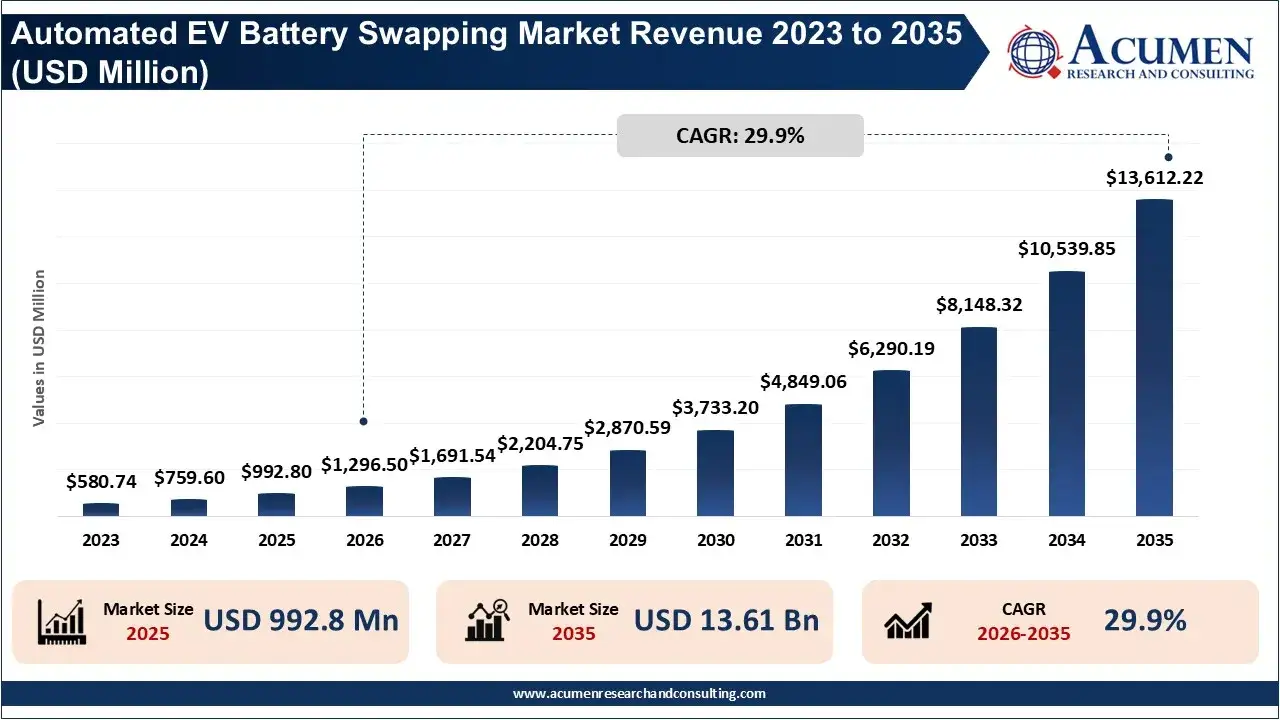
The global automated EV battery swapping market is an estimated USD 992.80 million in 2025, it is anticipated to cross USD 13,612.22 million by 2035, climbing at a compound annual growth rate (CAGR) of 29.9% during the forecast period of 2026-2035. Rising demand for rapid electric vehicle energy replenishment and reduced vehicle downtime is a major growth factor for the automated EV battery swapping market, as automated stations can replace depleted batteries within minutes, making the model particularly attractive for high-utilization passenger and commercial EVs, delivery fleets, and other applications where conventional charging can reduce vehicle availability.
What Is Automated EV Battery Swapping Market and How Does It Work?
The automated EV battery swapping market includes the technology, equipment, services and solutions that enables automatic extraction and replacement of an EV battery with an exchanged with a charged EV battery at an EV automated battery swapping station. Automated battery swapping is a technology that helps replace the battery of an electric vehicle when compared to traditional charging which requires one to attach the EV to a charger that re-energizes the batteries.
What Business Opportunities Are Emerging Around Battery Swapping Networks?
- Battery-as-a-Service platforms: Battery swapping operators can develop recurring-revenue models in which customers pay for battery access rather than purchasing the battery outright. This creates opportunities for subscription plans, pay-per-use services, and fleet-specific contracts while allowing operators to generate recurring revenue from battery utilization.
- Automated swapping station deployment: Companies can generate revenue by designing, manufacturing, installing, and operating automated swapping stations. Opportunities extend across passenger EVs, delivery vehicles, taxis, two-wheelers, three-wheelers, and commercial fleets, with station configurations adapted to different battery sizes and vehicle architectures.
- Fleet-focused swapping networks: Dedicated networks for logistics, e-commerce, food delivery, ride-hailing, and other high-utilization fleets can provide predictable demand and higher station utilization. Operators can establish stations at fleet depots, warehouses, distribution centers, and frequently used routes.
- Battery leasing and financing: Battery ownership can be separated from vehicle ownership through leasing and financing models. Financial companies and energy-service providers can participate by funding battery inventories and receiving recurring payments from EV users or fleet operators.
Automated EV Battery Swapping Market Segmental Outlook
| Segmentation | Dominant Segment | 2025 Market Share | Key Growth Factors |
|---|---|---|---|
| By Service Type | Subscription-based battery swapping | 42% | Recurring usage patterns, bundled battery access, charging, software, maintenance, and battery-health monitoring |
| By Vehicle Type | Passenger cars | 48% | Rising demand for faster energy replenishment and automated swapping with minimal driver intervention |
| By Automation Level | Fully automated battery swapping | 65% | Integration of automated vehicle positioning, battery identification, extraction, replacement, reconnection, and battery-health validation |
| By Network Model | Closed/fleet-dedicated networks | 45% | Predictable vehicle routes, centralized battery inventories, controlled demand, and improved fleet economics |
Automated EV Battery Swapping Market Regional Outlook
By Region, Asia Pacific Dominated the Automated EV Battery Swapping Market in 2025
Asia Pacific accounted for a 63% share of the automated EV battery swapping market in 2025, owing to the region's solid existing battery swapping infrastructure and EV ecosystem and its unique position as a battery and EV manufacturing hub. Rapid growth in EV adoption and the development of automated swapping infrastructure are also contributing to the APAC market.
The emerging battery-as-a-service (BaaS) model, which involves charging EV owners a subscription fee or pay-per-swap fee for batteries and lowering the upfront cost of EVs, is gaining traction in the region, supported by growing investments by automakers, battery manufacturers, and swapping-network operators. This is enabling standardized and automated battery exchange solutions to be implemented on a larger scale.
- China: China remains a major hub for automated EV battery swapping due to its large EV fleet, extensive battery-swapping infrastructure, strong domestic battery manufacturing ecosystem, and growing adoption of battery-as-a-service models. Increasing deployment by EV manufacturers and swapping-network operators is supporting broader commercialization.
By Region, North America Is Expected to Register the Fastest Growth Through 2035
North America is forecast to lead the automated EV battery swapping market through 2035, with a CAGR of 36.2% and its share rising from 13% to 20% over the forecast period. Rapid EV adoption, increasing demand for alternative fast-charging solutions, and growing interest in battery swapping among commercial fleets and high-utilization passenger EVs are among the factors propelling the North America market.
The faster charging of automated swapping can decrease the time a vehicle is out of service relative to traditional charging, making this technology especially attractive for commercial vehicles such as taxis and fleet vehicles. Ongoing investments in EV infrastructure and the adoption of BaaS business models are also expected to drive demand in the North America market.
- United States: The U.S. automated EV battery swapping market is gaining attention as fleet operators and EV infrastructure companies explore alternatives that can minimize charging downtime. The technology has potential across commercial fleets, ride-hailing vehicles, delivery vehicles, and other high-utilization applications where rapid battery replacement can improve vehicle availability.
Why High-Utilization EVs Are Becoming a Core Application for Battery Swapping?
- Less Vehicle Downtime: Swapping can give an empty battery in considerably less time than a standard charge, getting a driver back in the road. For logistics, taxi and other vehicle owners who operate for many hours per day, this is a necessity.
- Increased vehicle utilization: Drivers do not have to wait for long charging times, allowing fleet operators to extend vehicle operation time and increase operational hours, boosting vehicle utilization and profitability.
- Fits well with known flows: Commercial fleet routes tend to be predictable or repeatable. As a result, operators can more easily locate swapping stations at depots, logistics hubs, retail locations, and other high-demand locations.
- Reduced operational disruption: Some businesses face issues of scheduling vehicle downtime if vehicles that are scheduled to operate at a certain time and date will run out of juice. Swapping facilitates the exchange of discharged batteries while still on the road.
- Battery-as-a-Service can minimize capex: By unlocking battery access through BaaS, fleet owners can lower the capital expenditure and make a transition to operating expenditure by turning costs into a function of use.
- Increasing last-mile delivery volume: E-commerce, food delivery, and urban logistics need to keep their vehicles running all the time and turn around quickly. To do so, Gogoro has teamed with Zypp Electric in India on last-mile delivery fleet battery swapping.
- Improved battery management: Swapping stations could charge batteries during times the vehicle is not in use, which is often away from the vehicle, and may even be able to check their state of health through a battery-management system.
What Strategies Are Battery Swapping Operators Using to Expand Their Networks?
Swapping operators are rapidly combining the advantages of partnerships, open-network models, fleet deployment, existing energy infrastructure, and expanding on development near to existing markets to accelerate the growth of their networks. NIO is expanding its passenger-car swapping network via partnerships with automakers and battery makers, including in its 2025 partnership with CATL in which both parties will collaborate on specifications for battery swaps and maintenance, develop the Swappable Battery Network, and share costs and revenue, while NIO has 3,172 Power Swap Stations as of its July 2022 announcement.
Gogoro is similarly pursuing partnerships with vehicle manufacturers, fleet operators, oil companies, and governments to build network density, with agreements with HPCL to deploy swapping stations across HPCL's retail network and with Hero Moto Corp to combine its own swapping platform with locally designed vehicles.
Segments Covered in the Report
By Service Type
- Pay-Per-Swap
- Subscription-Based
- Battery Leasing/Battery-as-a-Service
- Hybrid / Bundled Models
By Vehicle Type
- Two-Wheelers
- Three-Wheelers
- Passenger Cars
- Light Commercial Vehicles
- Medium & Heavy Commercial Vehicles
- Buses
By Automation Level
- Fully Automated Battery Swapping
- Semi-Automated Battery Swapping
By Network Model
- Open/Public Network
- Closed/Fleet-Dedicated Network
- Semi-Open Network
By Region
- North America
- Europe
- Asia-Pacific
- Latin America
- Middle East & Africa
Contact Us:
Mr. Richard Johnson
Acumen Research and Consulting
India: +91 8983225533