
Liquid-cooled EV Charger Modules Market Size to Surge USD 22,235.2 Million by 2035, Expanding at CAGR of 28.2%
Published : 03 Sep 2026
Author : Simone Lamb



What is the Liquid-cooled EV Charger Modules Market Size?
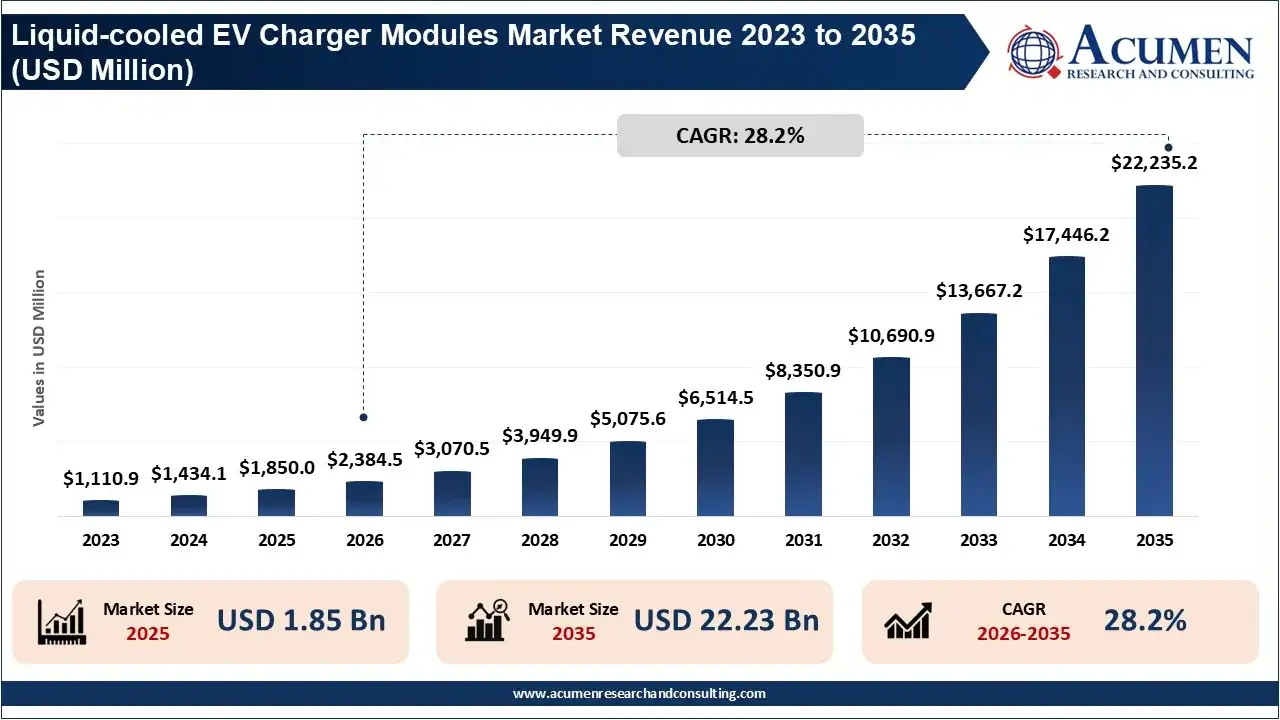
The global liquid-cooled EV charger modules market size was recorded at USD 1,850 million in 2025 and is observed to surge at USD 22,235.2 million by 2035; growing at a CAGR of 28.2% over the forecast period from 2026 to 2035.
Future Outlook for the Liquid-cooled EV Charger Modules Market
It is predicted that market growth in liquid-cooled EV charger modules will be led by increased deployment of high-power, ultra-fast and megawatt charger infrastructure. Increasing the performance, reliability and compactness of the chargers, an efficient management system for thermally dissipating high-power chargers and charging capabilities will be critical, as the systems move towards a greater system power density and faster charging speeds.
High-power charging capacity grows continues to build momentum, the proliferation of 1000 V systems, silicon carbide power electronics and megawatt-scale chargers increase thermal demands further fueling a need for liquid-cooled module manufacturers in applications ranging from passenger EVs, commercial fleets, to bus and truck charging hubs
What Are the Key Trends Reshaping Liquid-cooled EV Charging Technology?
- Evolution towards ultra-fast and high-power chargers: Increasing deployment of chargers from 150-kW and above results in demand for improved thermal management and high-power power modules.
- Transition to 800V and higher voltage power systems: Higher-voltage vehicle power systems and faster chargers bring higher levels of importance in efficiently performing thermal management in power-conversion stages.
- Introduction of megawatt charging systems: Development of 1-MW charging stations for cars, electric trucks, buses, and fleets bring lucrative market and possibilities for liquid cooled power modules.
- Silicon carbide semiconductor deployment: SiC power devices enable high-performance higher-voltage charging systems and compact sizes; high-power systems take advantage of liquid cooled designs.
- Higher power-density and more compact power systems: increased utilization of liquid cooling in highly compact power systems that must handle and dissipate substantial power in small spaces.
- Full liquid cooling architectures for electric vehicle charging: New vehicle charging architectures not only liquid cool individual power modules, but entire power modules cabinets, power delivery cables and other components.
What Challenges Could Limit the Adoption of Liquid-cooled EV Charger Modules?
Despite potential advantages, mass-market adoption of liquid-cooled EV charger modules will likely face significant challenges related to elevated initial capital expense, complex system integration, and higher ongoing maintenance responsibilities relative to air-cooled equivalents. Such architectures will require system elements including pumps, coolant-circuits, cold plates, heat-exchangers, sensors, tubing, and connectors, adding to the hardware and integration costs, and increasing system failure complexity with a larger set of components.
The operational reliability that an operator can expect on a long-term, sustained basis may be influenced by concerns involving coolant leakage, pump reliability, maintaining thermal loop integrity, and mechanic experience. Differences in charging standards, safety norms, and certification processes between locales will also compound development costs and international standardization complexity for global deployment.
Government Investments and EV Charging Initiatives Support Market Expansion
| Country/Region | Government initiative | Relevance to liquid-cooled EV charger modules |
|---|---|---|
| India | PM E-DRIVE | Increasing deployment of high-power charging infrastructure is expected to create demand for advanced thermal-management and liquid-cooled charging modules. |
| United States | NEVI Program | Expansion of high-power DC charging networks supports demand for efficient, high-performance charger modules. |
| European Union | Alternative Fuels Infrastructure Regulation (AFIR) | Deployment of high-power charging infrastructure across European corridors is expected to support advanced charging technologies and thermal-management solutions. |
| China | National EV charging infrastructure programs | China's large EV ecosystem and continued charging-infrastructure investment create significant opportunities for high-power and liquid-cooled charger modules. |
| Japan | National charging infrastructure targets | Increasing fast-charging deployment supports the adoption of higher-power charging equipment and associated thermal-management technologies. |
Liquid-cooled EV Charger Modules Market Regional Outlook
Asia Pacific’s Dominance to Continue in the Market
Asia-Pacific dominated the liquid-cooled EV charger modules market with a 55.0% share in 2025, supported by its large EV manufacturing base, expanding charging infrastructure, and strong presence of power electronics manufacturers. The rapid deployment of high-power and ultra-fast charging stations is increasing the need for advanced thermal management, as higher power conversion generates greater heat within charging equipment. In addition, the presence of established EV and power-electronics supply chains in countries such as China, Japan, South Korea, and India supports the local development and integration of liquid-cooled charger modules.
- China: China remains a major hub for EV production and charging infrastructure, with continued deployment of high-power charging systems supporting demand for advanced thermal-management technologies. The country's large-scale charging ecosystem and strong power-electronics manufacturing base create favorable opportunities for liquid-cooled charger modules.
- India: India is expanding its EV charging ecosystem through public infrastructure investments and growing adoption of electric mobility. The increasing deployment of fast-charging stations is expected to create opportunities for liquid-cooled modules capable of supporting higher power loads and sustained charging performance.
North America holds the second-largest market share
North America held the second-largest regional share of 20.0% in 2025, driven by the expansion of high-power DC charging infrastructure, charging networks, and commercial fleet electrification. As charging operators increasingly deploy higher-capacity systems across public charging corridors, commercial locations, and fleet facilities, effective thermal management is becoming increasingly important for maintaining reliable performance under continuous high-power loads. This growing shift toward high-output charging systems is creating favorable opportunities for liquid-cooled charger modules, particularly where charging utilization and power requirements are high.
- United States: The United States is expanding its public charging infrastructure, with fast chargers expected to account for an increasing share of the charging network. The IEA projects the country's public charging capacity to more than double by 2035, creating opportunities for high-power charging and liquid-cooled technologies.
- Canada: Canada is accelerating EV charging deployment through government-backed infrastructure programs, with more than 39,000 public chargers recorded by March 2026. Continued investment in Level 3 and fast-charging infrastructure is expected to support demand for advanced charger modules and thermal-management systems.
Middle East and Africa expected to register the fastest growth
Middle East and Africa accounted for a 3.0% share in 2025 and is expected to register the fastest regional growth in the liquid-cooled EV charger modules market. Increasing investment in EV charging infrastructure, the development of emerging charging networks, and growing interest in electric mobility are creating a stronger foundation for high-power charging deployment. As charging infrastructure expands from established urban markets into new corridors and commercial applications, the need for reliable thermal management solutions is expected to increase, supporting the adoption of liquid-cooled charger modules across the region.
- United Arab Emirates: The UAE is rapidly developing high-speed EV charging infrastructure, including large charging hubs and highway electrification projects. ADNOC Distribution's 2026 launch of a 60-point superfast EV charging hub and plans for additional highway hubs highlight the growing opportunity for high-power charging technologies.
- Saudi Arabia: Saudi Arabia is emerging as an important EV infrastructure market as investments in electric mobility and charging networks increase. The development of high-power charging infrastructure is expected to strengthen demand for efficient thermal-management solutions, including liquid-cooled charger modules.
Competitive Landscape of the Liquid-cooled EV Charger Modules Market
Players in the liquid-cooled EV charger modules market include Infypower, UUGreenPower, TELD, Tonhe Electronics Technologies, Winline Technology, Huawei, Shenzhen Sinexcel Electric, Shenzhen Increase Tech, Kstar Science & Technology, and XYPower. These market players are differentiating their products based on high-power charging modules, power-conversion technologies, thermal-management technology, efficiency, reliability, and scalable charging architecture.
Segments Covered
By Module Type
- AC–DC Modules
- DC–DC Modules
- Integrated AC–DC/DC–DC Modules
By Power Rating
- ≤20 kW
- 21–40 kW
- 41–60 kW
- 61–100 kW
- 101–200 kW
- 200 kW
By Charger Architecture
- Standalone Architecture
- Distributed Charging Architecture
By Charging Application
- Public Fast Charging
- Commercial Fleet Charging
- Heavy-Duty / Megawatt Charging
- Workplace & Destination Charging
- Other Specialized Charging
By Vehicle Type
- Passenger EVs
- Commercial EVs
- Specialty / Off-Highway EVs
By End User
- Charger OEMs
- Charging Infrastructure System Integrators
- Charging Network Operators
- Fleet Operators
- Utilities / Energy Companies
- Aftermarket / Service Providers
- Other Buyers
By Deployment Stage
- OEM / New Charger Installation
- Charger Upgrade / Retrofit
- Replacement / Aftermarket
By Region
- North America
- Europe
- Asia-Pacific
- Latin America
- Middle East & Africa
Contact Us:
Mr. Richard Johnson
Acumen Research and Consulting
India: +91 8983225533