
Humanoid Robot Battery Management Systems Market Size to Hit USD 513.48 Million by 2035; Expanding at a CAGR of 73.2%
Published : 30 Oct 2026
Author : Lucas Hoffmann



Humanoid Robot Battery Management Systems Market Size, Growth and Forecast 2026–2035
The global humanoid robot battery management systems market size was estimated at $2.11 million in 2025 and is projected to hit at $513.48 million in 2035 from $3.67 in 2026; while expanding at a CAGR of 73.2% during the forecast period 2026 to 2035. Increasing commercialization of humanoid robots, rising demand for high-energy-density batteries, and the need for reliable power management are driving market growth. Advancements in battery monitoring, thermal protection, and AI-enabled energy optimization are further supporting demand for specialized battery management systems.
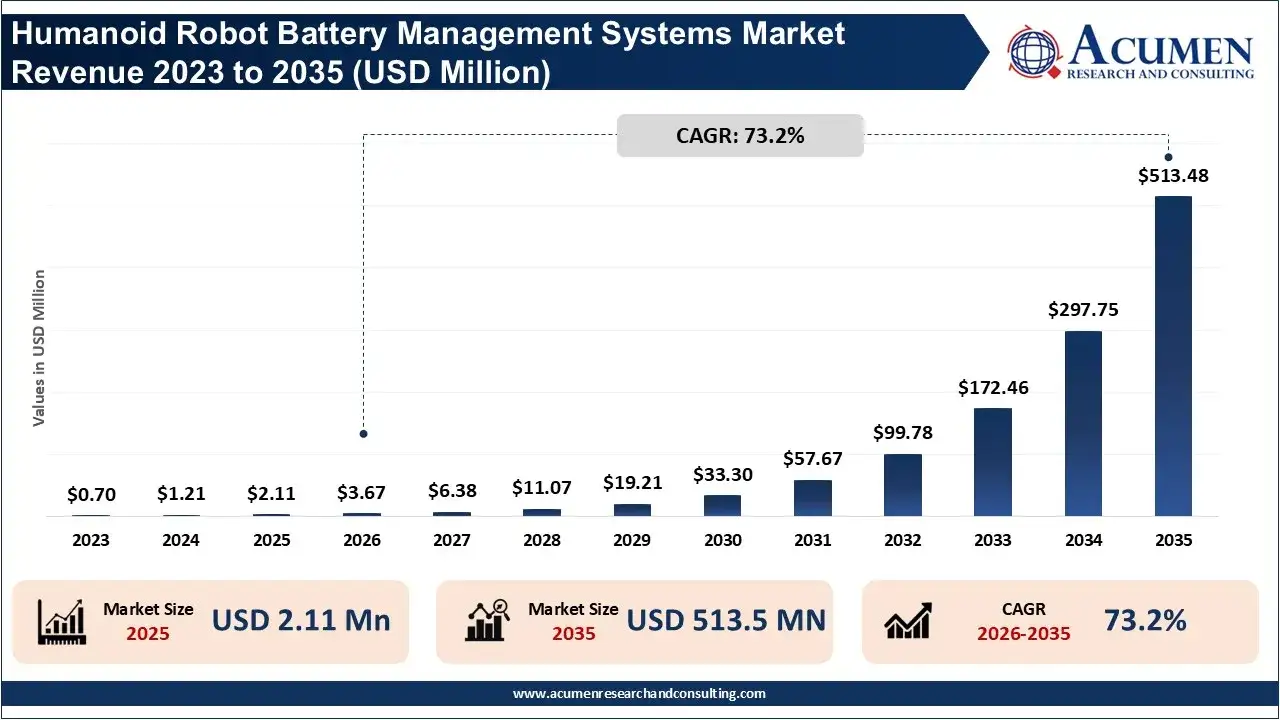
Humanoid Robot Battery Management Systems Market Overview
The humaniod robot battery management systems market is witnessing adoption due to the robotics manufacturers' efforts to increase battery efficiency and power, as well as operational reliability for humanoid robots of the next generation. Humanoids with smart battery management systems are designed to monitor the voltage, current, temperature, state of charge, and state of health of a battery pack.
The expanding use of humanoid robots in industrial manufacturing, logistics, warehousing and commercial operations is likely to result in the need for compact, lightweight and high-performance BMS solutions. In addition, the evolution of the latest lithium-ion battery technology, smart battery management, modular battery architectures and predictive diagnostics will drive the availability of advanced BMS solutions to meet these requirements.
Humanoid Robot Battery Management Systems Market Future Outlook (2027-2035)
- Increasing humanoid robot commercialization: Growing investments in humanoid robot manufacturing and commercial deployment are expected to increase demand for specialized battery management systems that support continuous operation and reliable power delivery.
- Rising demand for high-energy-density batteries: Battery technologies offering higher energy density are expected to gain importance as manufacturers seek to extend robot operating time without significantly increasing battery weight or size.
- Integration of intelligent battery monitoring: AI-enabled battery management systems are expected to gain adoption through predictive diagnostics, battery health estimation, adaptive charging, and real-time energy optimization.
- Expansion of industrial humanoid robot applications: Increasing use of humanoid robots in manufacturing, material handling, and warehouse operations is expected to create demand for durable battery management solutions.
- Advancements in thermal management: Improved temperature monitoring, thermal protection, and battery cooling technologies are expected to become increasingly important as humanoid robots perform energy-intensive movements and tasks.
- Development of modular battery architectures: Modular battery packs and distributed BMS architectures could improve battery maintenance, scalability, and integration across different humanoid robot platforms.
Humanoid Robot Battery Management Systems Market Segmental Outlook
| Market Segmentation | Leading Segment | Market Share (2025) | Growth Outlook |
|---|---|---|---|
| By Component | Hardware | 78% | Demand supported by battery monitoring circuits, sensors, controllers, and protection components |
| By BMS Architecture | Centralized BMS | 57% | Supported by consolidated control, simplified monitoring, and integrated battery pack designs |
| By Battery Chemistry | High-Nickel NMC/NCA | 72% | Driven by high energy density, lower battery weight, and power delivery requirements |
| By Battery Configuration | Fixed or Integrated Battery BMS | 63% | Supported by integration with purpose-built humanoid robot power systems |
| By System Voltage | 48 V to Below 72 V | 56% | Balances power delivery, electrical design requirements, and component integration |
| By Battery Capacity | 1–2.5 kWh | 58% | Balances battery weight with energy requirements for mobility and manipulation |
| By Intelligence Level | Conventional BMS | 84% | Intelligent and AI-enabled BMS solutions are expected to gain adoption through predictive diagnostics and adaptive energy management |
| By Application | Industrial and Manufacturing | 42% | Driven by factory automation, repetitive operations, material handling, and production assistance |
Investment Trends
- Humanoid robotics investment growth: Investment in humanoids and robotic foundation models across the Americas, Europe, and Israel reached approximately USD 6.1 billion in 2025, compared with USD 2.0 billion in 2024, reflecting a substantial increase in capital allocation toward humanoid development.
- Global humanoid robot shipment expansion: Global humanoid robot shipments reached approximately 19,100 units in the first half of 2026, representing 272% year-over-year growth compared with approximately 5,100 units in the first half of 2025.
- Humanoid robot shipment forecasts: Global humanoid robot shipments are projected to reach more than 50,000 units in 2026, indicating increasing commercialization and production capacity across major manufacturers.
- Industrial and commercial adoption: Industrial and commercial applications accounted for more than 70% of humanoid robot shipments in the first half of 2026, compared with approximately 50% in the corresponding period of 2025.
- Expansion of humanoid robotics companies: More than 50 companies were developing humanoid robots as of January 2026, highlighting increasing competition and investment in robotic hardware, power systems, and supporting technologies.
- Long-term production projections: Annual humanoid robot shipments are forecast to reach 1.2 million units by 2030 and 10 million units by 2035 under Bank of America's research scenario.
- Major funding rounds in 2025: Figure AI raised USD 1.5 billion, 1X Technologies raised USD 1.0 billion, Apptronik secured USD 734 million, and Agility Robotics raised USD 400 million, highlighting significant private investment in humanoid robotics development.
Humanoid Robot Battery Management Systems Market Regional Analysis
Asia-Pacific Humanoid Robot Battery Management Systems Market: Largest Regional Market
Asia-Pacific was the dominant market for humanoid robot battery management systems and held a 50.0% revenue share of USD 1.06 million in 2025. The strong presence of an indigenous battery manufacturing industry coupled with robust development of the humanoid robot industry, strong semiconductor manufacturing industry, and large industrial automation adoption drive the demand for battery management systems.
China is the leading contributor to the regional market owing to the presence of multiple endogenous robot and battery manufacturing companies and also the regional government support for the growth of advanced robotics. Japan, South Korea also adds to the strong presence of technologies such as batteries, electronics, and robotics industries.
Middle East and Africa Humanoid Robot Battery Management Systems Market: Region with the Highest CAGR
Middle East and Africa humanoid robot battery management systems market is expected to grow at a CAGR of 79.2% during 2026-2035. The growth can be attributed to the rising investment in artificial intelligence (AI), smart manufacturing, industrial automation, and advanced technology infrastructure in the regional countries.
Increasing economic diversification plans by the government and investment in robotics research is attracting humanoid robots adoption in manufacturing, logistics, healthcare, hospitality, and service industries of the regional countries. The UAE and Saudi Arabia are the significant markets growing on account of the investment in smart city development, AI infrastructure, and advanced industrial technologies.
Impact of Humanoid Robot Commercialization on Battery Management Demand
| Commercialization Factor | Impact on Humanoid Robot Deployment | Resulting Battery Management Demand |
|---|---|---|
| Mass production of humanoid robots | Increasing production volumes and commercial availability of humanoid platforms | Higher demand for integrated BMS hardware, controllers, and battery monitoring components |
| Industrial automation adoption | Deployment in manufacturing, assembly, and repetitive production operations | Demand for reliable battery monitoring, power management, and continuous-operation capabilities |
| Warehouse and logistics expansion | Growing use of humanoids for material handling, sorting, and transportation | Increased need for battery health monitoring, efficient charging, and energy optimization |
| Longer operating requirements | Demand for extended operating hours and reduced charging downtime | Adoption of high-performance BMS, advanced cell balancing, and battery state estimation |
| AI-powered robotic systems | Integration of advanced computing, sensors, and autonomous decision-making | Demand for intelligent BMS solutions and predictive battery diagnostics |
| High-mobility robotic applications | Frequent walking, balancing, lifting, and dynamic movements | Greater emphasis on real-time power monitoring and thermal management |
| Battery swapping and modular designs | Development of replaceable battery packs and modular power architectures | Demand for battery identification, communication, protection, and charging coordination |
Humanoid Robot Battery Management Systems Market Competitive Landscape
Key companies across the broader market ecosystem include Analog Devices, Inc., Texas Instruments Incorporated, NXP Semiconductors N.V., Infineon Technologies AG, Renesas Electronics Corporation, STMicroelectronics N.V., onsemi, Sensata Technologies Holding plc, CATL (Contemporary Amperex Technology Co., Limited), BYD Company Limited, LG Energy Solution Ltd., Samsung SDI Co., Ltd., Panasonic Holdings Corporation, Tesla, Inc., Figure AI, Inc., Agility Robotics, Apptronik, Inc., Unitree Robotics, AGIBOT, UBTECH Robotics Corp. Ltd., Boston Dynamics, Inc., Sanctuary AI, and 1X Technologies. These companies participate in different parts of the humanoid robotics and battery technology value chain, ranging from battery monitoring semiconductors and battery cells to integrated robotic platforms.
Segments Covered
By Component
- Hardware
- Software
By BMS Architecture
- Centralized BMS
- Modular BMS
- Distributed BMS
By Battery Chemistry
- High-Nickel NMC/NCA
- Lithium Iron Phosphate (LFP)
- Lithium Polymer (Li-Po)
- Solid-State & Semi-Solid-State
- Other Battery Chemistries
By Battery Configuration
- Fixed / Integrated Battery BMS
- Swappable / Removable Battery BMS
By System Voltage
- Below 48 V
- 48 V to Below 72 V
- 72 V to Below 100 V
- 100 V and Above
By Battery Capacity
- Below 1 kWh
- 1–2.5 kWh
- Above 2.5–5 kWh
- Above 5 kWh
By Intelligence Level
- Conventional BMS
- Intelligent / AI-Enabled BMS
By Application
- Industrial & Manufacturing
- Logistics & Warehousing
- Healthcare & Caregiving
- Retail & Hospitality
- Domestic & Personal
- Research & Education
- Other Applications
By Region
- North America
- Europe
- Asia-Pacific
- Latin America
- Middle East & Africa
Contact Us:
Mr. Richard Johnson
Acumen Research and Consulting
India: +91 8983225533