
Silicon Anode Battery Market Size to Hit USD 29,021.75 Million by 2035, Reflecting a CAGR of 49.4%
Published : 31 Aug 2026
Author : Lucas Hoffmann



What is the Silicon Anode Battery Market Size?
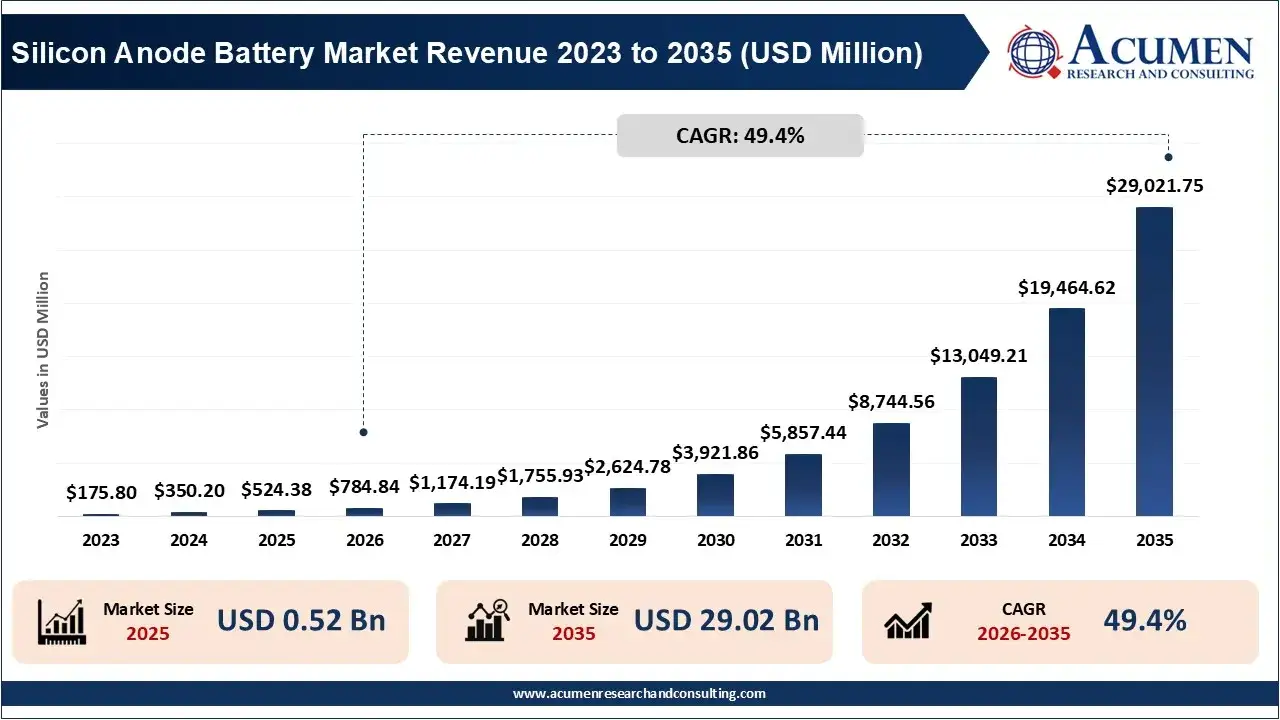
The silicon anode battery is continuously growing due to the increasing demand for high-energy-storage batteries across electric vehicles, consumer electronics, and energy capacity applications. Silicon offers a much higher lithium-storage capacity than traditional graphite, which enables longer battery life, faster charging, and improved performance without increasing battery size or weight. As industries push for compact designs with higher efficiency manufacture are increasingly shift toward silicon anode technologies. In addition, growing investment support for clean mobility and carbon emission reduction is accelerating the adoption of advanced battery solutions.
A significant development underscoring the accelerating maturity of the silicon anode battery market occurred in July 2025, when Enovix Corporation introduced its AI-1 silicon anode battery platform. The platforms delivered more than 7,350 mAH of capacity with high energy density, positioning it well for next-generation consumer electronics applications. This launch reflects meaningful progress in addressing key technological innovations of silicon and aids, particularly issues related to volume expansion and cycle life.
How Will Renewable Energy Expansion Shape the Silicon-Anode Battery Market?
How Is AI Increasing Demand for High-Energy-Density Silicon Batteries?
- The explosive growth in AI generates an emerging demand stream for higher energy-density batteries such as in data centers, AI-enabled device and appliance designs, robotics and drone technology, and edge-computing platforms.
- In 2024 electricity consumption in the U.S. for data centers came in at about 415 TWh and the IEA said that in 2025 demand for energy for all data centers jumped another 17%, with AI only data center use accelerating at an even faster pace.
- AI-equipped data centers have become much more energy dense and, according to IEA, the power density of an AI server increased by 11x from 2020 to 2025 and should go up a 4x more from then until 2027, pushing the usage of compact, high-power battery packs to cover uninterruptible power, backup power and short period of buffering at an increased rate.
- That same July IEA forecast said that AI could drive up to 300GWH of demand for energy storage by 2030 with Reuters suggesting that data centers may grow from 4% of power consumed in the US to 17% of total 2030 demand from the country.
Silicon Anode Battery Market Regional Outlook
- China is set to become the global hub of silicon-anode battery manufacturing, leveraging the world's largest li-ion battery manufacturing ecosystem, established anode producers, and significantly expanding silicon-carbon production. China's capacity is forecast to grow from 370,000 tonnes per year in 2024 to 410,000 tonnes per year in 2025, a rise of 10.81% y-o-y.
- Leading manufacturers are progressing from trial manufacturing in China-Putailai began trials at Wuhu in June 2025, the site contributing 10,000tpa to the company's silicon-carbon anode capacity (and 2,100tpa to silicon-oxide anode capacity).
- The company plans a total capacity from its various anode materials facilities of 250,000 tonnes per year and 350,000 tonnes per year in 2025 and 2026 respectively.
- China's market is also already being served due to early end use in smartphones, where silicon-carbon enables higher capacities in the same form factors.
- It is this synergy of materials manufacturing, battery cell production expertise, consumer-electronics demand, EV production, and the supply chain, which is enabling China to be the center of commercialization of silicon anode technology.
- Rather than a manufacturing powerhouse for silicon-anode batteries, Germany offers an emerging demand market. Opportunity in the country is closely related to electric vehicles (EVs), renewable energy storage, and the growth of Germany’s domestic battery industry.
- Present analysis of the industry suggests that the country currently faces extremely high dependence on silicon-anode materials imports.
- Within the country's domestic market activity, more action is located on research, prototype electrodes and battery pack assembly than on commercial-level silicon-anode material manufacturing.
- With these trends, Germany stands as a promising downstream market for silicon-anode material suppliers where increased energy density, greater driving range and smaller battery pack sizes might translate to increased adoption as EV and energy storage production takes on a greater hold within the country.
Silicon-Anode Battery Pilot Production and Gigafactory Projects
| Company | Location | Project / Facility | Production Scale / Capacity |
|---|---|---|---|
| Sila Nanotechnologies | Moses Lake, U.S. | Sila Moses Lake automotive-scale silicon-anode plant | 2 GWh initially; up to 250 GWh planned |
| Group14 Technologies | Moses Lake, U.S. | BAM-2 silicon battery-materials factory | 2,000 tonnes/year per module ≈ 10 GWh; 6 modules planned |
| Group14 Technologies / SK Inc. | Sangju, South Korea | EV-scale SCC55 silicon-battery-materials facility | 2,000 tonnes/year ≈ 10 GWh |
| Enovix | Penang, Malaysia | Fab2 high-volume manufacturing facility | High-volume production line; capacity ramp underway |
| Enovix | South Korea | Routejade / Korean battery manufacturing facilities | Manufacturing and electrode/pack capabilities |
Silicon Anode Battery Market Competitive Landscape
Silicon Anode Battery Market Segmentation
- Silicon-Carbon
- Silicon Oxide / SiOx
- Nanostructured Silicon
- Silicon-Dominant
- Other
- <1,500 mAh
- 1,500–2,500 mAh
- 2,500–5,000 mAh
- 5,000–10,000 mAh
- 10,000 mAh
- Cylindrical
- Pouch
- Prismatic
- Other
- Automotive
- Consumer Electronics
- Energy Storage Systems (ESS)
- Industrial
- Aerospace & Defense
- Medical
- Other
- North America
- Europe
- Asia Pacific
- Latin America
- Middle East & Africa (MEA)