
xEV Power Chip Market Size, Share, Growth, Report 2026 To 2035
xEV Power Chip Market (By Device Type: Power MOSFETs, IGBTs, Power Diodes & Rectifiers, Power Management ICs, Integrated Power Modules, Others; By Semiconductor Material: Silicon (Si), Silicon Carbide (SiC), Gallium Nitride (GaN), Others; By xEV Type: BEV, PHEV, HEV, FCEV; By Application: Traction Inverter, On-Board Charger (OBC), DC-DC Converter, Battery Management & Power Distribution, Electric Motor Control, Thermal Management & HVAC, Auxiliary Power Systems, Others; By Vehicle Class: Passenger Cars, LCV, HCV, Electric Buses, Two-Wheelers & Three-Wheelers; By Voltage Architecture: Below 400 V, 400 V to <600 V, 600 V to <800 V) - Global Industry Analysis, Size, Share, Regional Analysis, Trends and Forecast 2026 - 2035
- Last Updated: 24 Sep 2026
- Report Code: ARC3987
- Category: Automotive And Transportation
xEV Power Chip Market Size, Share, Growth
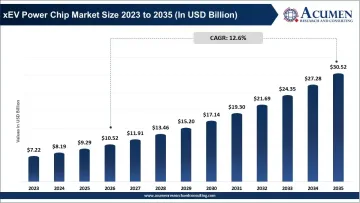
The global xEV power chip market size was valued at USD 9.29 billion in 2025 and is observed to reach USD 30.52 billion by 2035; growing at a CAGR of 12.6% during the forecast period of 2026-2035. The shift toward higher-voltage EV platforms, particularly 800 V and 1,000 V architectures, is increasing demand for high-efficiency SiC power devices, while GaN is emerging in selected high-frequency power-conversion applications.
Report Highlights
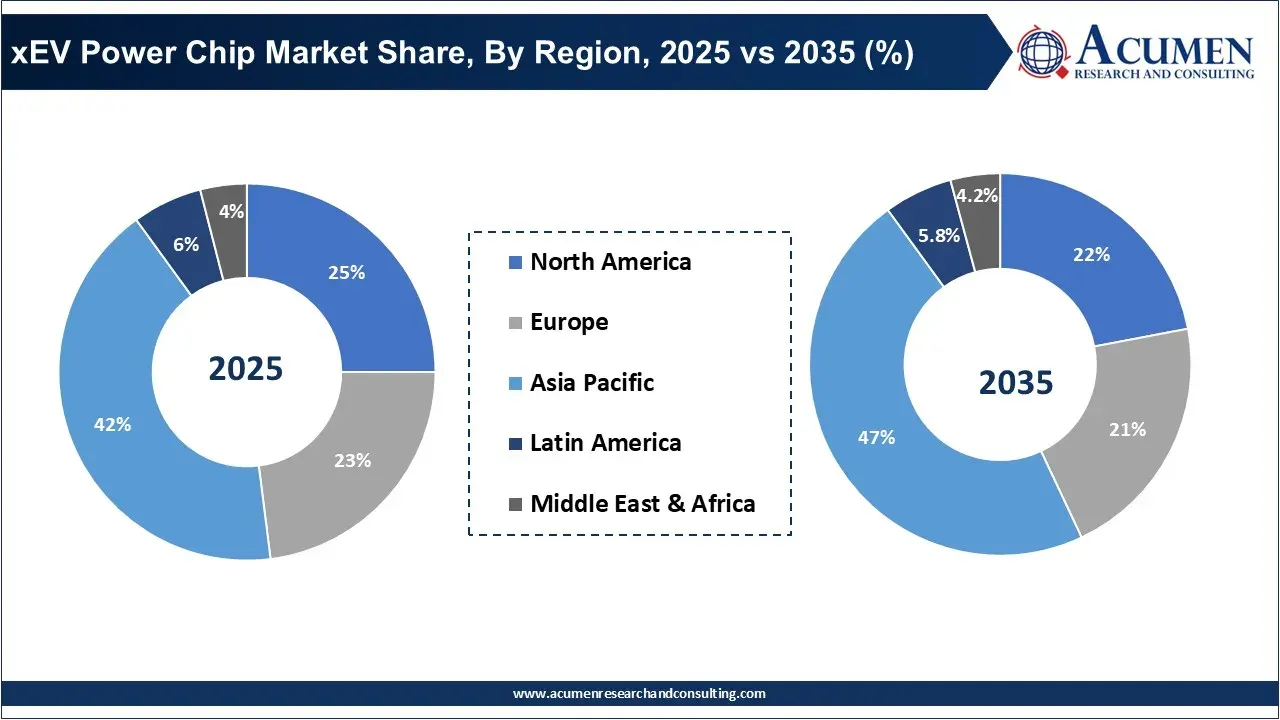
- By region, Asia-Pacific dominated with 42% of the xEV power chip market in 2025, supported by its combination of large-scale EV production, battery manufacturing, powertrain manufacturing, semiconductor packaging, and growing SiC capabilities.
- By region, North America accounted for 25% in 2025, supported by its established automotive electronics ecosystem and increasing requirements for advanced power semiconductors in electrified vehicles.
- By device type, IGBTs dominated with 28% of the market in 2025, supported by their established use in high-voltage and high-current switching applications and mature automotive manufacturing ecosystem.
- By device type, power MOSFETs accounted for 25% in 2025, supported by their suitability for high-frequency switching across DC-DC converters, auxiliary power systems, and other xEV electronics.
- By semiconductor material, silicon dominated with 56% in 2025, reflecting its mature manufacturing infrastructure, broad supplier base, and cost advantages across diverse xEV power-electronic applications.
- By semiconductor material, silicon carbide accounted for 32% in 2025 and is projected to reach 46% by 2035, driven by increasing requirements for high-voltage, high-efficiency power conversion in advanced EV architectures.
- By xEV type, BEVs dominated with 52% of the market in 2025 and are expected to reach 59% by 2035, as their battery-electric propulsion systems require power chips across inverters, charging, DC-DC conversion, thermal management, and electrical distribution.
- By xEV type, FCEVs are projected to register the fastest CAGR of 14.9% during 2026-2035, supported by semiconductor requirements across fuel-cell power conversion, high-voltage battery systems, DC-DC converters, and electric-motor control.
- By application, traction inverters dominated with 32% in 2025, reflecting their central role in converting battery power into controlled electrical output for vehicle propulsion.
- By application, onboard chargers accounted for 15% in 2025, with demand supported by increasing charging-power requirements and the need for compact, efficient power-conversion systems.
- By vehicle class, passenger cars dominated with 55% of xEV power chip demand in 2025, supported by high vehicle volumes and growing semiconductor content across propulsion, charging, battery management, and auxiliary systems.
- By vehicle class, light commercial vehicles represented 15% in 2025, with electrification of delivery vans, urban logistics fleets, and commercial vehicles increasing demand for durable and efficient power electronics.
- By voltage architecture, 400 V to <600 V systems represented the leading category in 2025, supported by their established deployment across existing EV platforms and balance between power capability, component availability, safety, and cost.
- By voltage architecture, 800 V and above systems accounted for 15% in 2025, with adoption supported by fast-charging requirements, lower current at equivalent power levels, and increasing deployment of high-efficiency SiC power devices.
xEV Power Chip Market Overview and Industry Context
The xEV power chip landscape is shifting from a largely silicon-based power-electronics ecosystem into a multi-material playing field featuring silicon IGBTs, SiC MOSFETs and GaN HEMTs. Although silicon will maintain a foothold in cost-effective, commercial-vehicle families, SiC power devices are increasingly becoming the choice for traction inverters, onboard chargers and high-voltage power-conversion systems to accommodate 800 V and 1,000 V architectures. The shift toward 800 V and 1,000 V architectures is visible in the increased availability and adoption of silicon carbide power devices.
In 2025, approximately 0.4 six-inch-equivalent SiC epitaxial wafers were forecasted to be used per average electric vehicle, and the penetration of SiC power devices in xEV applications is projected to grow from 19.2% in 2024 to 24.4% in 2026 to 47.7% by 2029.
xEV Power Chip Cost Structure: From Wafer Manufacturing to Automotive Power Modules
| Cost-chain stage | Key Cost Components | Typical Cost Considerations / Recent Benchmarks |
|---|---|---|
| SiC substrate / wafer manufacturing | SiC crystal growth, boule processing, wafer slicing, polishing, defect reduction | Apprx. $800–$1,200 per wafer in 2026; 200 mm wafers can carry a 30–50% premium because of limited supply and lower yields. |
| SiC epitaxy | Epitaxial deposition, doping control, thickness uniformity and inspection | Adds approximately $200–$400 per wafer, depending on drift-layer thickness and doping requirements. |
| Front-end device fabrication | MOSFET/IGBT/HEMT fabrication, lithography, implantation, deposition, etching and metallization | Cost is influenced by wafer diameter, process complexity, yield and automotive-grade reliability requirements. |
| Power module packaging | Ceramic substrate, baseplate, terminals, housing, cooling structure and thermal interface materials | Packaging becomes a major cost layer for high-current automotive modules because thermal management and mechanical reliability are critical. |
Production Capacity
xEV Power Chip Manufacturing Landscape: Silicon, SiC and GaN Production Capacity
- Infineon began releasing its first customer products based on 200 mm SiC wafer technology in Q1 2025, with manufacturing in Villach, Austria, while its Kulim, Malaysia facility is transitioning from 150 mm to 200 mm wafers.
- In 2025, industry-wide SiC utilization was estimated at approximately 50% for upstream processing and 70% for device manufacturing, reflecting the capacity expansion wave of 2019–2024 and subsequent demand normalization.
- Onsemi is expanding vertically integrated SiC production in the Czech Republic. The company's planned investment is up to $2 billion, while its existing Czech operations can produce more than 3 million wafers annually, including more than 1 billion power devices.
- Infineon reported in 2025 that its 300 mm GaN manufacturing roadmap was on track, with first customer samples targeted for Q4 2025. A 300 mm wafer can produce approximately 2.3 times more chips per wafer than a 200 mm wafer.
- Navitas and PSMC announced in 2025 plans for 200 mm GaN-on-silicon production using PSMC's Fab 8B and a 180 nm process.
- Yole's 2026 assessment identifies GaN HEMTs as the fastest-growing xEV power-device technology, but notes that their absolute contribution remains small compared with silicon and SiC through 2031.
- xEV platforms are moving from 400 V toward 800 V and 1,000 V, increasing the requirement for higher-voltage power devices and accelerating SiC adoption in traction inverters.
Market Dynamics
Driver
Rising 800 V and High-Power EV Architectures
High-voltage power semiconductors will play an important role in 400 V to 800 V and 1,000 V vehicle electrical architectures. SiC MOSFETs offer benefits for high-voltage switching efficiency and will be integrated into traction inverters, onboard chargers and high-power charging systems. As SiC is integrated into more new EV platforms, VPEC semiconductor manufacturers will scale up 200 mm SiC MOSFET production and lower-cost, vertically integrated substrate-to-module manufacturing; building a strong driver for the xEV power chip market.
Restraint
SiC Capacity Utilization and Manufacturing Overcapacity
The rapid investment cycle in SiC manufacturing has created a mismatch between installed production capability and near-term demand. In 2025, upstream SiC utilization was around 50% and device-line utilization around 70%, according to Yole estimates, creating pressure on manufacturers to improve yields, reduce costs and delay or optimize additional capacity investments. This environment can also intensify pricing pressure and make it more difficult for newer facilities to achieve attractive utilization during their initial ramp-up periods.
Opportunity
Larger Wafers and Integrated Wide-Bandgap Production
A significant manufacturing opportunity is to shift SiC and GaN to a bigger wafer format and more integrated value chains. Infineon's 200 mm SiC roadmap and 300 mm GaN plans show how providers aim to ramp up chip counts per wafer and reduce costs. Its 300 mm GaN tech yields 2.3 times more chips per wafer than 200 mm processing. And ATC's STMicroelectronics Catania fab and onsemi's Czech dollar sign highlight the potential of bringing substrates, wafer fab, packaging and testing closer together within regional ecosystems.
xEV Power Chip Market Regional Insights
Asia-Pacific: Manufacturing Scale and Electrification Momentum Establish the Region as the Core Growth Engine
Asia-Pacific is the leading regional market for xEV power chip and is expected to expand its lead through 2035. In terms of global value share, the Asia-Pacific regional market comprised 42% in 2025. Regional market value increases from $3.90 billion in 2025 to $4.42 billion in 2026 and $14.34 billion in 2035, a 14.0% CAGR in the region from 2026 to 2035, the leading CAGR among the three established major markets of Asia-Pacific, Europe and North America.
Asia-Pacific's leadership position is enabled in part by the single-geo-aggregation of the full xEV value chain. It blends large-volume EV production, battery-cell and battery-pack manufacturing, electric-motor manufacturing, inverter manufacturing, semiconductor packaging, power-module assembly, and a growing silicon-carbide and other power-seminconductor ecosystem for xEV power chips. Asia-Pacific is therefore not only an important consumption market for xEVs but also a manufacturing and technology development center for xEV power chips.
China Anchors Asia-Pacific's xEV Power Chip Opportunity
- China represents a strategically important country-level market within Asia-Pacific because of the region's dominant position in the global xEV power chip market. China's importance stems from the combination of large-scale EV manufacturing, battery production, electric powertrain deployment, and domestic automotive electronics capabilities.
- The country's extensive EV ecosystem creates demand across the complete xEV power-chip stack, from MOSFETs and IGBTs to integrated power modules and advanced SiC devices.
- The country's increasing adoption of high-voltage platforms also creates a pathway for greater use of wide-bandgap semiconductors, particularly SiC, in traction inverters and charging systems.
North America: Established Automotive Electronics Ecosystem Supports High-Value Power Chip Demand
North America accounted for 25% of the xEV power chip market in 2025, making it the second-largest regional market. The regional market increases from $2.32 billion in 2025 to $2.63 billion in 2026 and $6.71 billion by 2035, corresponding to an 11.0% CAGR during 2026-2035.
The region's xEV power-chip opportunity is closely tied to the evolution of electric passenger vehicles and commercial transportation. Passenger EVs require high-power traction inverters, battery-management systems, onboard chargers, DC-DC converters, and thermal-management electronics. At the same time, electrification of delivery vehicles, commercial fleets, buses, and other transportation applications broadens the addressable market for high-current and high-voltage semiconductor devices.
A particularly important regional development is the push toward domestic power-semiconductor production. North American semiconductor investment has increasingly focused on strengthening domestic manufacturing and reducing supply-chain exposure. Industry analysis points to significant U.S. investment in SiC manufacturing and packaging, including support for domestic capacity expansion.
xEV Power Chip Country-level Investment Landscape: SiC, Power Modules, Inverters and High-Voltage Platforms
| Country | Investment focus | Key xEV power-chip opportunities |
|---|---|---|
| China | SiC power modules, IGBTs, traction inverters, integrated e-drive systems | Large-scale EV production is supporting domestic demand for SiC modules, IGBTs and inverter technologies. Domestic semiconductor suppliers are also increasing their role in automotive power electronics. |
| United States | SiC manufacturing, power modules, high-voltage EV platforms and advanced packaging | Investments are concentrated around SiC capacity, automotive-grade power devices and high-efficiency traction-inverter platforms. |
| Germany | Power semiconductors, SiC, power modules and automotive inverter systems | Germany combines major automotive demand with semiconductor manufacturing and engineering capabilities, creating investment opportunities across chips, modules and vehicle power electronics. |
| Japan | SiC devices, power modules, hybrid/EV power electronics and automotive semiconductor technology | Automotive semiconductor expertise and established power-device manufacturing support investment in SiC MOSFETs, modules and high-efficiency drivetrain components. |
| South Korea | SiC power devices, EV inverters, power modules and automotive semiconductors | Investment is linked to the country's large EV, battery and automotive-electronics ecosystem, creating demand for advanced power devices and integrated modules. |
| India | SiC devices, EV power electronics, traction inverters, OBCs and two-/three-wheeler applications | Electrification of passenger vehicles and especially two-/three-wheelers creates opportunities for cost-efficient power chips, modules and inverter systems. |
xEV Power Chip Market Segmental Insights
Device Type Insights
Power MOSFETs Gain Structural Importance as IGBTs Give Way to More Efficient Switching Technologies
IGBTs represented the largest device-type segment in the xEV power chip market in 2025, accounting for 28% of the market, followed by power MOSFETs at 25%. IGBTs remain relevant where high-voltage and high-current switching requirements are significant and where established manufacturing ecosystems, automotive qualification experience, and cost considerations remain important. Their extensive deployment history also provides automakers and Tier 1 suppliers with a mature technology base.
Nevertheless, increasing demand for higher efficiency and reduced switching losses is changing the competitive position of conventional silicon IGBT technology. As xEV platforms increasingly adopt advanced power architectures, particularly higher-voltage systems, alternative semiconductor technologies can capture applications that historically relied on IGBTs.
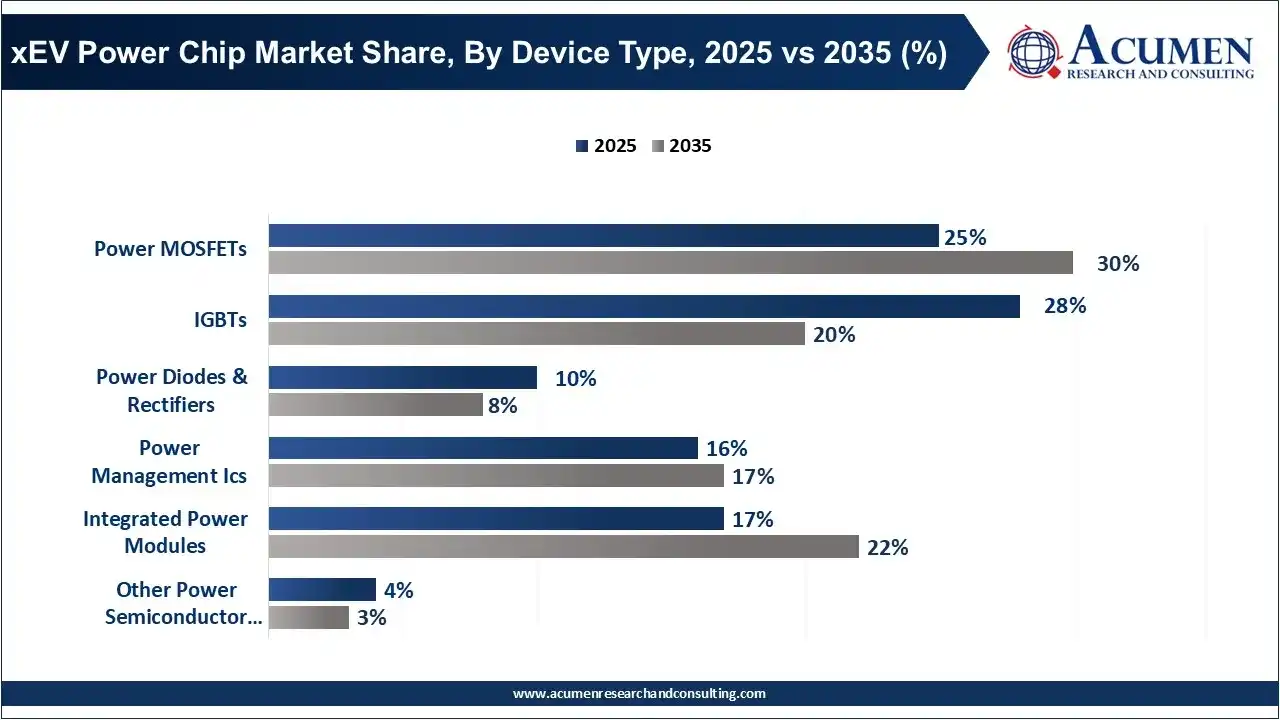
Power MOSFETs are being targeted as a key growth area because xEV architectures are increasingly demanding semiconductor devices that are designed for high-frequency switching, small-form packaging, and controlled power conversion. The technology can be used in DC-DC converters, auxiliary power supplies, battery-management-related power stage components, and lower- to mid-voltage automotive electronics.
As automakers add more electronically controlled functions, requirements for high-performance switching devices will not only impact propulsion, but will include charging, thermal management, infotainment, lighting, sensing, and other auxiliary loads.
Semiconductor Material Insights
Silicon Remains the Largest Base, While SiC Captures the Long-Term Technology Shift
Silicon represented the largest semiconductor material category in 2025 at 56%, followed by silicon carbide at 32%. Silicon remains the largest material category in 2025, holding 56% of the market. Its established manufacturing infrastructure, relatively mature technology base, broad supplier ecosystem, and comparatively favorable economics continue to support extensive use across xEV power electronics.
Silicon devices remain important across a broad range of vehicle voltage levels and applications. Not every xEV power-electronic application requires the performance characteristics of wide-bandgap semiconductors. Consequently, silicon continues to have substantial addressable demand in cost-sensitive vehicle architectures and applications where its performance remains adequate.
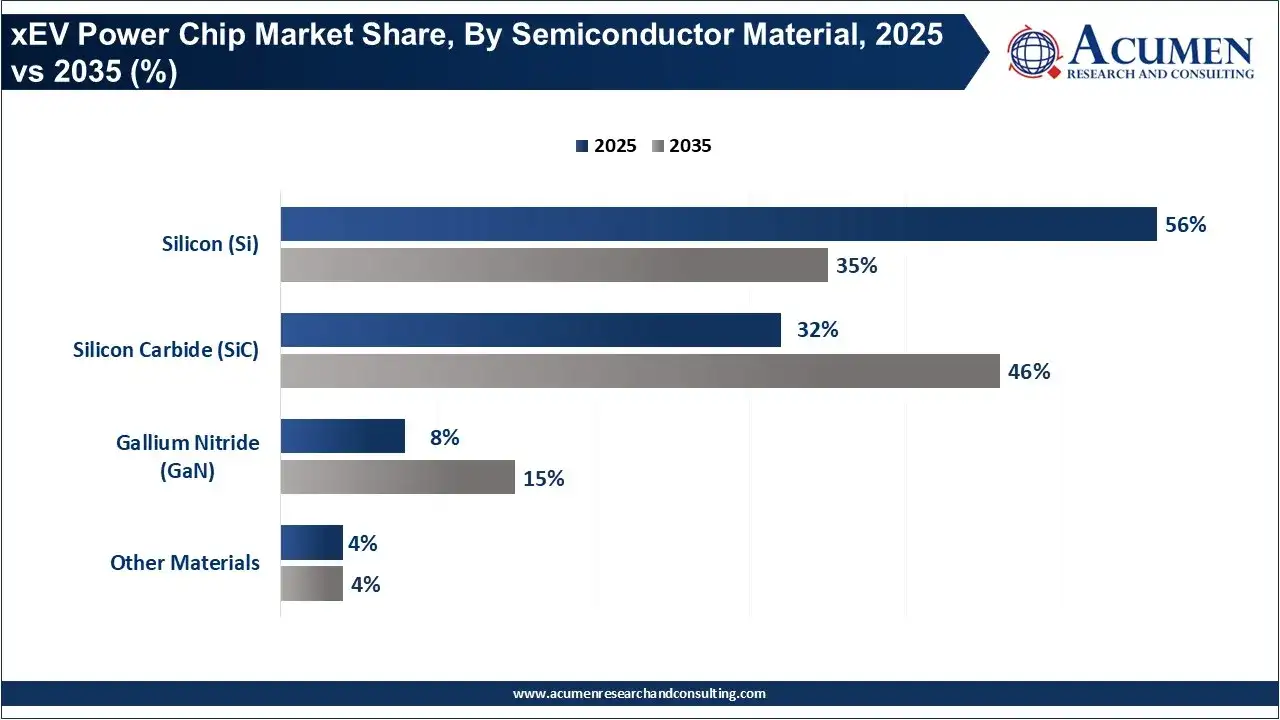
Silicon carbide represents the most significant material-level transition in the market. Its share rises from 32% in 2025 to 46% in 2035, overtaking conventional silicon and becoming the largest semiconductor material category by the end of the forecast period.
The expansion of SiC is closely associated with the requirements of modern EV powertrains. SiC devices can operate at higher voltages and temperatures while offering lower switching losses compared with conventional silicon devices in suitable applications. These characteristics become particularly valuable as automakers move toward higher-voltage electrical architectures.
xEV Type Insights
BEVs Establish the Largest Demand Pool While FCEVs Record the Fastest CAGR
Battery electric vehicles (BEVs) represented 52% of the xEV power chip market in 2025 and are estimated to capture 59% of the market in 2035. BEVs dominate the xEV market as their propulsion architecture is heavily dependent on high-power electrical conversion. Unlike a traditional vehicle, BEVs need the battery, inverter, electric motor, charging system, DC-DC conversion, thermal management, and numerous other electronic subsystems to all work together as one electrical ecosystem.
The traction inverter is one of the largest semiconductor demand sites as it converts the battery's direct current power into alternating current that drives the electric motor. BEVs also require power semiconductors for onboard charging, battery management, auxiliary power conversion, thermal management and electrical distribution.
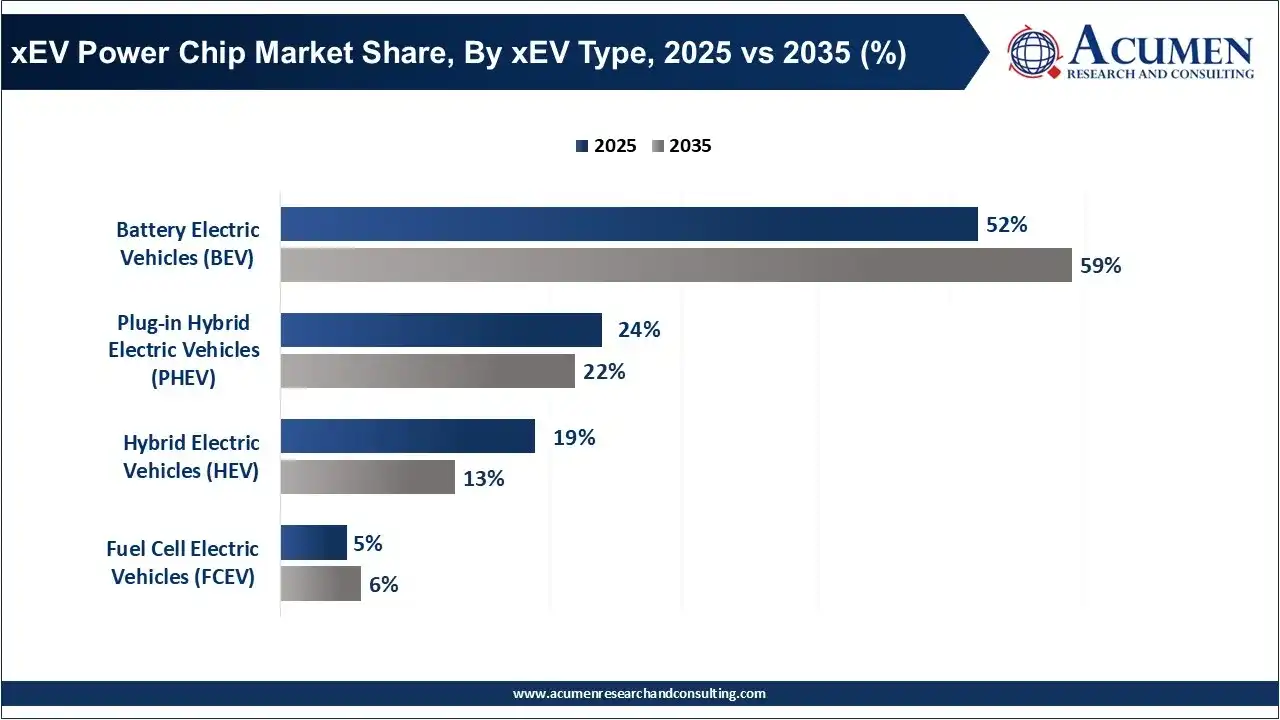
Fuel cell electric vehicles (FCEVs) are set to record the fastest CAGR among the xEV types at 14.9% during 2026-2035. Their market share rises modestly from 5% in 2025 to 6% in 2035, while market value increases from $0.53 billion in 2026 to $1.83 billion in 2035. The high growth rate reflects the power-electronic intensity of fuel-cell propulsion architectures. FCEVs require sophisticated electrical conversion between the fuel-cell stack, high-voltage battery, DC-DC systems, inverter, and electric motor. This creates semiconductor requirements across multiple power-conversion stages.
Application Insights
Traction Inverters Anchor Power Chip Demand Across xEV Platforms
Traction inverters was the largest application segment in 2025 at 32%. Traction inverter is the core power-electronics application of xEV power chips, as it directly controls the flow of electrical energy from the battery to the electric motor. Inverters are required to operate at high currents and switching frequencies while maintaining efficiency at various vehicle operating points.
This relative market share of 32% clearly shows how that SEMI company is very much concentrated by semiconductor demand to Propulsion. Semiconductor demand concentrated by inverter efficiency at how vehicle manufacturers demand longer driving range, better acceleration, higher power density, and lower thermal loss.
xEV Power Chip Market Share, By Application, 2025 (%)
| By Application | Revenue Share, 2025 (%) |
|---|---|
| Traction Inverter | 32% |
| On-Board Charger (OBC) | 15% |
| DC-DC Converter | 13% |
| Battery Management & Power Distribution | 14% |
| Electric Motor Control | 10% |
| Thermal Management & HVAC | 6% |
| Auxiliary Power Systems | 5.8% |
| Other xEV Applications | 4.2% |
On-board chargers (OBCs) 15% of application demand in 2025. OBCs convert electrical energy from the charging grid from AC to DC to be supplied to the battery. OBCs have specific semiconductor needs that depend on charging power, efficiency, vehicle voltage, thermal limits, and packaging. Higher charging power demands higher power densities and thermal design considerations and may push for the use of advanced switching components. The wide-bandgap (WBG) semiconductors are entering the picture and could become more instrumental in OBC designs, as their high switching performance allows for minimizing the passive components and the power-conversion system.
Vehicle Class Insights
Passenger Cars Dominate xEV Power Chip Consumption
Passenger cars accounted for 55% of xEV power chip demand in 2025. Passenger cars dominate because global electrification has been concentrated heavily in the consumer automotive segment, while passenger vehicles also contain increasingly sophisticated electrical and electronic architectures.
Modern electric passenger cars require semiconductor devices across traction inverters, onboard chargers, DC-DC converters, battery management, thermal systems, electric motor control, and auxiliary functions. The combination of high vehicle volumes and increasing semiconductor content per vehicle supports the segment's leading position.
xEV Power Chip Market Share, By Vehicle Class, 2025 (%)
| By Vehicle Class | Revenue Share, 2025 (%) |
|---|---|
| Passenger Cars | 55% |
| Light Commercial Vehicles (LCV) | 15% |
| Heavy Commercial Vehicles (HCV) | 12% |
| Electric Buses | 10% |
| Two-Wheelers & Three-Wheelers | 8% |
Light Commercial Vehicles (LCVs) are the second-largest vehicle class in the xEV power chip market, accounting for 15% of the market in 2025. This segment includes electric vans, delivery vehicles, and light-duty commercial transport platforms that require power semiconductors for traction inverters, onboard chargers, DC-DC converters, battery management systems, and electric motor control.
The electrification of last-mile delivery fleets, urban logistics, commercial vans, and service vehicles supports demand for xEV power chips in this category. Compared with passenger cars, LCVs often operate under more intensive daily utilization, making energy efficiency, charging reliability, thermal management, and powertrain durability important considerations in vehicle design.
Voltage Architecture Insights
400 V to <600 V Systems Lead the Current Market
In 2025, the architecture ranging from 400 V to <600 V was the most significant segment. The dominance of the 400 V to <600 V category remains mostly as a result of existing EV electrical architectures. This voltage range offers an optimum compromise of system power, charging ability, part availability, safety, and cost.
Much of existing EV platforms have been designed for electrical architectures within and above this voltage range, accommodating substantial semiconductor requirements for inverters, chargers, converters, and batteries.
xEV Power Chip Market Share, By Voltage Architecture, 2025 (%)
| By Voltage Architecture | Revenue Share, 2025 (%) |
|---|---|
| Below 400 V | 28% |
| 400 V to <600 V | 49% |
| 600 V to <800 V | 8% |
| 800 V and Above | 15% |
Within the 800 V and above category was 15% in 2025. The segment is smaller than 400 V to <600 V, but of much greater strategic significance as higher-voltage architectures are more profoundly associated with fast charging, lower current at comparable power levels, and high-power electric powertrains.
The transition toward higher voltage directly supports demand for SiC-based power devices because the material is particularly suited to high-voltage and high-efficiency power conversion. Consequently, growth in high-voltage architectures can reinforce the material transition from silicon toward SiC.
Key Companies
- Infineon Technologies AG (Neubiberg, Germany)
- STMicroelectronics N.V. (Plan-les-Ouates, Switzerland)
- onsemi (Scottsdale, Arizona, U.S.)
- Wolfspeed, Inc. (Durham, North Carolina, U.S.)
- ROHM Co., Ltd. (Kyoto, Japan)
- Mitsubishi Electric Corporation (Tokyo, Japan)
- Fuji Electric Co., Ltd. (Tokyo, Japan)
- Renesas Electronics Corporation (Tokyo, Japan)
- BYD Semiconductor Co., Ltd. (Shenzhen, China)
- Toshiba Electronic Devices & Storage Corporation (Kawasaki, Japan)
M&A, Partnerships, Capacity Expansions and Product Launches
- In May 2025, Infineon announced that it would supply power modules for Rivian's R2 platform traction inverters, with supply expected to begin in 2026. The platform will use both silicon and SiC modules from Infineon's HybridPACK Drive G2 family, alongside additional automotive semiconductor products.
- In April 2026, onsemi announced an expanded strategic collaboration with NIO to support the automaker's transition from 400V to 900V EV architectures using EliteSiC technology. The collaboration covers NIO's next-generation vehicle platforms and is aimed at improving drivetrain efficiency, high-voltage performance and charging capabilities.
Segments Covered
By Device Type
- Power MOSFETs
- IGBTs
- Power Diodes & Rectifiers
- Power Management ICs
- Integrated Power Modules
- Other Power Semiconductor Devices
By Semiconductor Material
- Silicon (Si)
- Silicon Carbide (SiC)
- Gallium Nitride (GaN)
- Other Materials
By xEV Type
- Battery Electric Vehicles (BEV)
- Plug-in Hybrid Electric Vehicles (PHEV)
- Hybrid Electric Vehicles (HEV)
- Fuel Cell Electric Vehicles (FCEV)
By Application
- Traction Inverter
- On-Board Charger (OBC)
- DC-DC Converter
- Battery Management & Power Distribution
- Electric Motor Control
- Thermal Management & HVAC
- Auxiliary Power Systems
- Other xEV Applications
By Vehicle Class
- Passenger Cars
- Light Commercial Vehicles (LCV)
- Heavy Commercial Vehicles (HCV)
- Electric Buses
- Two-Wheelers & Three-Wheelers
By Voltage Architecture
- Below 400 V
- 400 V to <600 V
- 600 V to <800 V
- 800 V and Above
By Region
- North America
- Europe
- Asia-Pacific
- Latin America
- Middle East & Africa
Looking for discounts, bulk pricing, or custom solutions? Contact us today at sales@acumenresearchandconsulting.com
Frequently Asked Questions

Other Automotive And Transportation Reports
December 2025
July 2020
August 2023
August 2020