
Electric Vehicle Market Size to Hit USD 4,199.24 Billion by 2035, CAGR of 18.1%
Published : 29 Jul 2026
Author : Lucas Hoffmann



What is the Electric Vehicle Market Size?
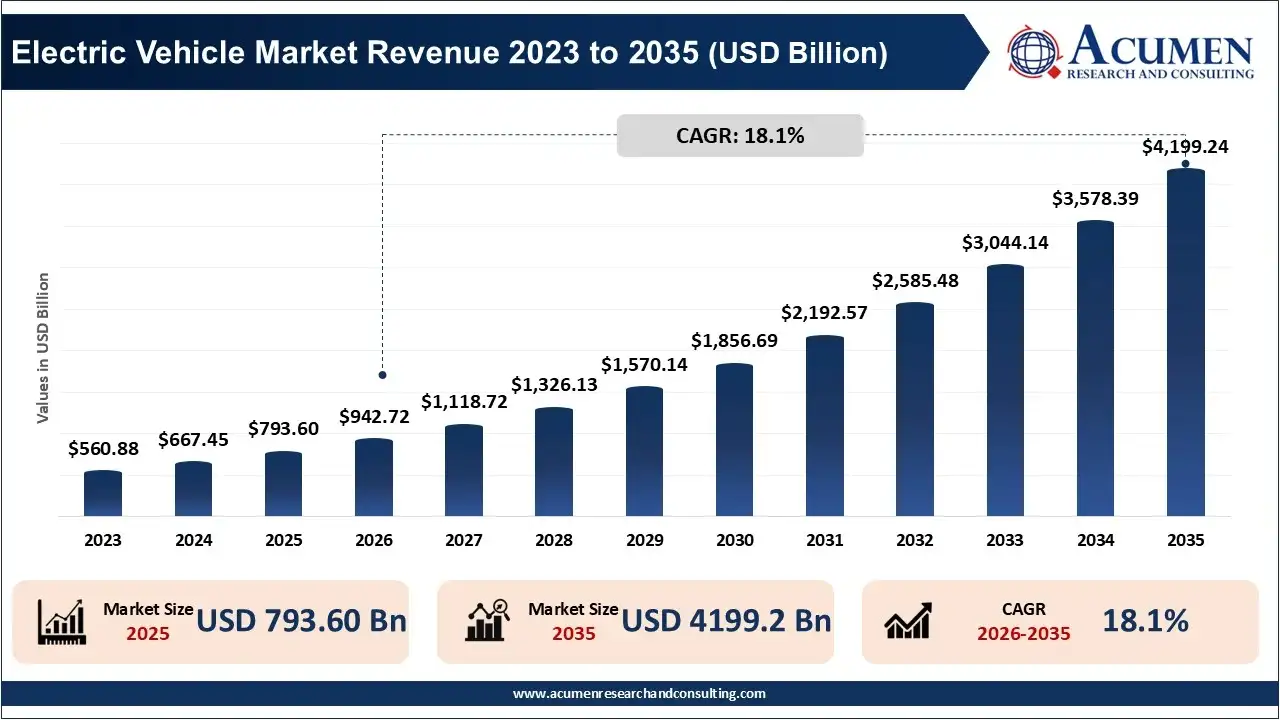
The global electric vehicle market size was estimated at USD 793.60 billion in 2025 and is projected to hit USD 4,199.24 billion by 2035, growing at a compound annual growth rate (CAGR) of 18.1% over the forecast period from 2026 to 2035. Government incentives and subsidies, majorly seen in India, European countries and Middle Eastern areas have supported the market’s expansion in last few years.
Key Takeaways
- By region, the Asia Pacific region registered the highest market share of 46.0% in 2025, driven by a strong EV supply chain, rapidly growing urbanization, and robust investment in electric mobility by leading automotive players.
- By region, North America is poised to grow at the fastest CAGR of 19.5% during the forecast period, owing to increasing adoption of next-generation EV technologies, development of domestic battery manufacturing, and rise in public-private investment in sustainable mobility.
- By propulsion type, Battery Electric Vehicles (BEV) held the largest market share of 62.0% in 2025, due to the increasing adoption of enhanced battery technologies, an expanding charging infrastructure, and a widening array of cost-effective EV options.
- By propulsion type, Plug-in Hybrid Electric Vehicles (PHEV) held the second-largest market share of 18.0% in 2025, owing to their superior driving range, thus easing consumer anxieties regarding charging.
- By vehicle category, passenger cars held the most dominant share in the global Electric Vehicles market with a market share of 57.0% in 2025, owing to the increasing demand for personal mobility, continuous vehicle launches and growing popularity among individual vehicle owners.
- By vehicle category, medium & heavy commercial vehicles are estimated to witness the fastest growth with a CAGR of 23.5% during the forecast period, owing to the growing focus towards electrification of logistics and freight transportation industry, and the commitments by large corporates toward the use of greener vehicles.
- By battery type, NMC batteries led the market with a market share of 42.0% in 2025, owing to its high energy density, longer driving range and widespread usage in high-performance EVs.
- By battery type, LFP batteries secured the second largest share of the global market with a market share of 34.0% in 2025, attributed to their longer cycle life, better thermal stability, and increasing preferences among OEMs for cost optimization.
- By driving range, 301-500 km segment estimated to garner the highest market share in 2025, owing to their effectiveness in addressing day-to-day commute and long-distance driving needs without a steep hike in the vehicle price.
- Vehicles above 500 km segment expected to witness the fastest CAGR of 23.5% during the forecast period, owing to continuing innovations in high-capacity battery technology and rising demand for top-end long-distance EVs.
- By drive type, front-wheel drive (FWD) held the highest market share of 44.0% in 2025, due to compact design, better energy efficiency, and prevalence in entry-level and mid-segment EVs.
- By drive type, the rear-wheel drive (RWD) captured the second largest share of the market in 2025, with a share of 30.0%, owing to growing consumer interest in high performance EVs and premium EVs.
- By price range, mid-range electric vehicles hold the largest share of the global electric vehicles market with 38.0% market share in 2025,owing to the blend of affordability, key features, and extensive demand across developed and emerging economies.
- By price range, premium segment of electric vehicles hold 28.0% of market share in 2025 owing to demand for autonomous, luxury interiors, and enhanced battery performance vehicles.
- By end user, individual consumers segment hold the largest share in the global electric vehicles market with 48.0% in 2025, due to increased vehicle availability and growing consumer confidence.
- By end user, fleet operators segment hold a share of 22.0% in 2025,owing to increase in electrification of ride-sharing applications, taxi services, and logistics vehicles.
Electric Vehicle Market Regional Outlook
Asia Pacific Held the Largest Share in 2025
Asia Pacific contributed over 46.0% to the global electric vehicle market in terms of revenue in 2025. The significant growth is attributed to integrated supply chains, substantial manufacturing capacity, an array of processing facilities for raw materials, and consistent government policy backing for electrification initiatives. With a plethora of established and emerging manufacturers and the highest capacity of battery production in the globe, Asia Pacific leverages considerable scale economies, which drive lower manufacturing costs and faster commercial viability for novel technologies.
Expanding charging networks, advancements in battery performance, and regulatory frameworks aimed at incentivizing the adoption of zero-emission transport have also aided expansion within the region.
World’s EV production and consumption hub China was the most significant contributor to the regional market in terms of value during the said year. It holds considerable sway owing to massive investment in battery production infrastructure, significant government support, a comprehensive ecosystem and the strong market presence of established automakers.
Automakers such as Geely, BYD, NIO, and XPeng are based in China. China's leadership in the manufacturing and usage of electric vehicles has a remarkable impact on EV supply chains and the adoption of the next generation of batteries.
Focus on High-Tech and Sustainable Solutions Japan remained a strong contender by focusing on hybrid and battery electric vehicle technologies and innovative solutions in battery manufacturing. Leading companies like Toyota, Nissan, and Honda are heavily investing in developing next-generation batteries and high-performance EVs to expand their offerings.
North America to Grow Rapidly During the Forecast Period
North America to register the highest CAGR of 19.5% over the forecast period attributed to the ramp-up of investment in electric vehicle (EV) production, domestic battery manufacturing, EV charging infrastructure, and clean energy initiatives. Governments in the region are putting in place supportive policies to boost local EV supply chain development, minimize dependency on imported battery components, and promote the uptake of zero-emission vehicles.
Furthermore, expansion in the number of battery gigafactories, rise in R&D investments, and increasing collaborations between automakers and technology providers are playing a pivotal role in enhancing the electric mobility environment in the region.
The U.S. is expected to remain the largest market in the region driven by enormous investment by leading auto companies including Tesla, General Motors (GM), Ford Motor Company, and Rivian Automotive Inc., into electric vehicle production, battery manufacturing and lithium mining.
Availability of federal incentives, tax credits and infrastructure grants that expedite the development of a widespread network of EV charging infrastructure and adoption of EVs are significant contributors to the growing electric vehicle market in the U.S.
Several manufacturers, including General Motors, Ford and battery producer SK On, plan to invest tens of billions in establishing battery plants in the U.S. over the next decade, making the country one of the key centers for battery production and recycling.
Canada, the largest producer of nickel, a crucial component of most current lithium-ion batteries, holds considerable sway over battery manufacturing supply chain due to the presence of enormous quantities of critical battery minerals including lithium, cobalt and graphite.
Latest Trends Supporting the Expansion of Electric Vehicle Market
- Increased use of solid-state and next generation lithium-ion battery technologies, contributing to improved range and faster charge times
- Expanding network of ultra-fast charging stations along major highways, in city centers, and at various commercial venues.
- Higher investment in domestic EV battery manufacturing facilities, local supply chains, and component suppliers to bring down costs.
- Higher use of Artificial Intelligence (AI) and connected car technologies to manage energy more intelligently and perform predictive maintenance.
- Rapid introduction of more low-cost electric vehicles, fueling a broader consumer acceptance.
- Accelerating shift towards electric power for commercial fleet, transit bus, and last-mile delivery applications.
- Expanded V2G and bidirectional charging technology usage in electric vehicles to bolster power grid resilience.
- Growing prevalence of Software Defined Vehicles (SDVs), updated via over-the-air (OTA) software updates.
Which are the Top Companies operating in the Electric Vehicle Market?
The global EV market is very competitive with the largest automakers increasing their investment in electrification, battery R&D, software-defined vehicles, and sophisticated manufacturing facilities to build out their market share. The major global automakers currently investing in and expanding within EV include the following: Tesla, Inc.
Remains a leader through its vertically integrated business model, integrated charging infrastructure, and continued development in battery and autonomous technologies. BYD Company Ltd. Has grown into one of the largest EV producers in the world, utilizing its battery technology and vertically integrated supply chain to fuel its expansion into new global markets.
Traditional Automakers; Toyota Motor Corporation, Volkswagen Group, Mercedes-Benz Group AG, General Motors, Ford Motor Company, Honda Motor Co., Ltd., Nissan Motor Co., Ltd., Renault Group, Mitsubishi Motors Corporation are all rapidly transitioning their product lineups to EVs by adding new models, building out their battery production capabilities, and investing significantly in new platform and software technology.
Segments Covered
By Propulsion Type
- Battery Electric Vehicles (BEV)
- Plug-in Hybrid Electric Vehicles (PHEV)
- Hybrid Electric Vehicles (HEV)
- Fuel Cell Electric Vehicles (FCEV)
By Vehicle Category
- Passenger Cars
- Two-Wheelers
- Light Commercial Vehicles
- Medium & Heavy Commercial Vehicles
- Buses & Coaches
- Three-Wheelers
By Battery Type
- Nickel Manganese Cobalt (NMC) Batteries
- Lithium Iron Phosphate (LFP) Batteries
- Lithium-Ion Batteries
- Solid-State Batteries
- Other Battery Chemistries
By Driving Range
- 301–500 km
- 150–300 km
- Less than 150 km
- Above 500 km
By Drive Type
- Front-Wheel Drive (FWD)
- Rear-Wheel Drive (RWD)
- All-Wheel Drive (AWD)
By Price Range
- Mid-Range ($18,000–$35,000)
- Premium ($35,000–$70,000)
- Economy (Under $18,000)
- Luxury (Above $70,000)
By End User
- Individual Consumers
- Fleet Operators
- Corporate Users
- Mobility-as-a-Service Providers
- Government & Public Sector
By Region
- North America
- Europe
- Asia-Pacific
- Latin America
- Middle East & Africa
Contact Us:
Mr. Richard Johnson
Acumen Research and Consulting
India: +91 8983225533