
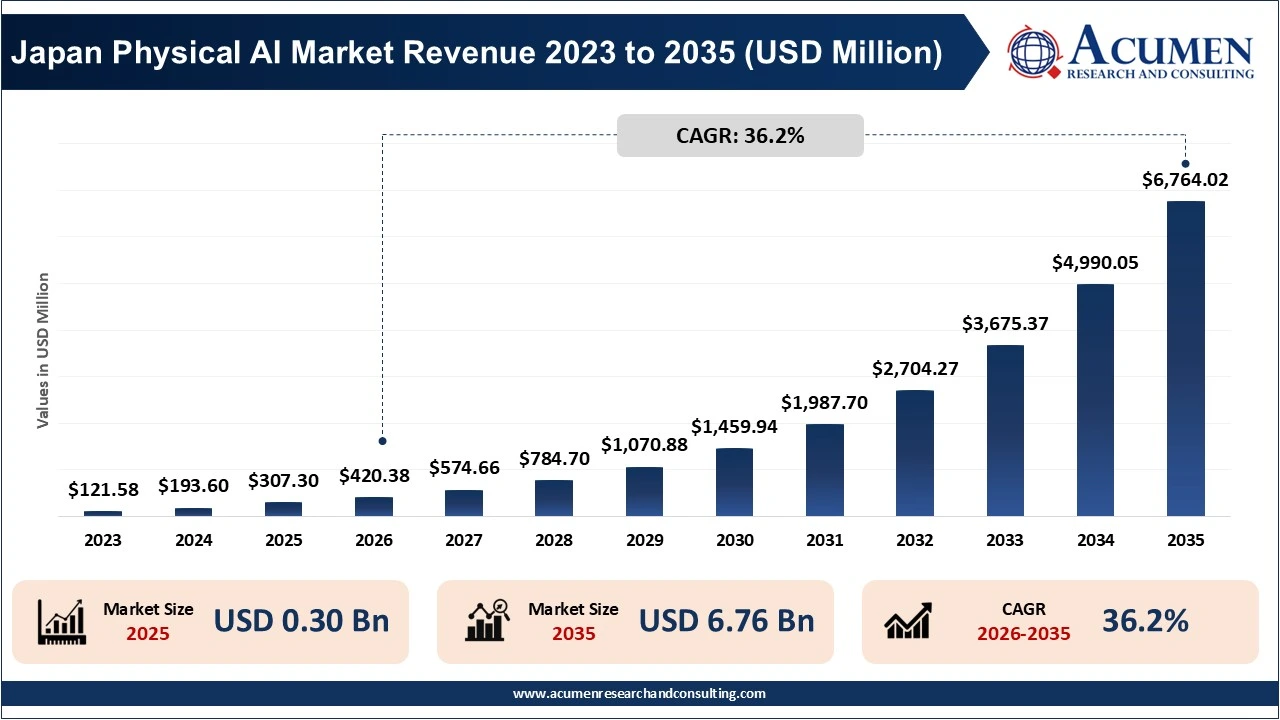
Japan Physical AI Market Size to Reach USD 6.76 Billion by 2035, CAGR of 36.2%
Published : 15 Jul 2026
Author : Raghuram Nair



What is the Japan Physical AI Market Size?
The Japan physical AI market size was valued at USD 307.30 million in 2025 and is expected to reach around USD 6764.02 million by 2035, expanding at a compound annual growth rate (CAGR) of 36.2% during the forecast period from 2026 to 2035.
The Japan physical AI market involves the implementation of AI technologies within physical systems ( robots used in manufacturing facilities, independent mobile machines and vehicles used in the industry of transportation and autonomous vehicles, devices used in hospitals, unmanned aircraft used in public spaces and private infrastructure projects), allowing them to perceive, acquire, process information, learn, decide and act within their surroundings and the real world, as well as related AI hardware, software and services for a wide array of uses in manufacturing, healthcare, the transportation sector and the automotive industry, logistics, commerce, public works and rural cultivation industries.
Japan Physical AI Market Statistics
- By component, the hardware sector accounted for the largest market share of 57% in 2025, due to the prevalent use of sensors, actuators, processors, and robotics in the manufacturing, logistics and healthcare sectors.
- By component, the software sector held the second-largest market share of 30% in 2025, due to the growing use of AI models, computer vision, perception algorithms, and autonomous decision-making platforms in physical AI systems.
- By deployment, the on-device AI sector dominated the market with 53% share in 2025 due to its ability to process data in real-time, offering low latency and enhanced data privacy for robots and other autonomous machines.
- By deployment, the cloud-based AI sector commanded a second-largest share of 47% in 2025, driven by increasing demand for centralized AI model training, fleet management and scalable analytics in interconnected robotics systems.
- By technology, the computer vision technology segment represented the largest market share of 40% in 2025 due to its extensively use in object detection, navigation, quality inspection, and environmental mapping by AI-powered robots.
- By technology, the speech/NLP technology segment represented the second largest market share of 22% in 2025 due to an increasing demand for voice-activated interfaces, natural language processing and sophisticated human-robot communication.
- By robot type, industrial robots garnered the largest market share of 38% in 2025 due to their adoption in automotive, electronics and manufacturing facilities focused on intelligent automation.
- By robot type, service robots held the second largest share of 18% in 2025, driven by its growing implementation in sectors like healthcare, hospitality, retail, and elderly care for addressing labor shortages and enhancing service delivery.
- By application, manufacturing & automotive segment represented the largest share of 24% in 2025, driven by expanding investments in smart factories, AI-driven manufacturing processes, and precision manufacturing techniques.
- By application, the healthcare segment occupied the second largest share of 17% in 2025 due to the rapid proliferation of AI-enabled surgical and rehabilitation robots, monitoring systems, and solutions for elder care.
How Is Japan's Aging Population Creating New Opportunities for the Physical AI Market?
Japan’s aging population and shrinking labor pool will significantly accelerate the demand for intelligent robotics and autonomous solutions, resulting in considerable growth for the physical AI market. Japan is now one of the most aged societies in the world with significant and ongoing shortages of labor in manufacturing, agriculture, eldercare, and other fields, driving the need for smart solutions.
Robots with the power of AI will see demand for their use in manufacturing and repetitive tasks, caregiving, logistics and supply chains, assisted-living care facilities, hospitality industries, and beyond. Government-backed digital transformations like Society 5.0, digital government, the “Robotic Technology-based society,” and initiatives such as the next generation robotics investment are fueling growth.
Major Cities Playing Role in Japan Physical AI Market
Major Japanese cities acting as a core platform to facilitate R&D and commercialization of physical AI technologies, leverage with solid manufacturing prowess, robust research centers and advanced industrial base. Tokyo ranks as Japan's foremost hub for artificial intelligence research, robotic innovations, corporate headquarters for firms like SoftBank Robotics, Mitsubishi Electric and various AI startups.
Nagoya is critically important because it houses the world's largest hub of automobile manufacturers, like Toyota, Denso and other leading companies pushing the frontiers of AI enabled robots and smart manufacturing solutions.
Osaka is central to innovation for healthcare robotics, medical device developments, and high end manufacturing processes; this has led to expanded investments in the area of AI assisted medical technology.
Kitakyushu as the home for Yaskawa Electric, the city is globally recognized for intelligent robotics solutions, motion control and industrial automation applied in the workplace. Hamamatsu Companies such as Yamaha Motor are pioneers in this space with their advanced research on service robots and automated mobility systems.
Tsukuba with research institutes and Universities working on various initiatives that bring artificial intelligence, robots, and new forms of automation technologies to market. These cities work to improve their position in global Physical AI rankings.
Top Companies & Their Significance
A number of internationally recognized companies in Japan are accelerating innovation in the realm of physical AI through superior robotics, intelligent automation, and AI-driven manufacturing innovations. From the city of Oshino comes the FANUC Corporation, a leading industrial robot and factory automation manufacturer that provides AI-infused robotics systems for automotive, electronics and manufacturing companies across the globe.
Based in Kitakyushu, Yaskawa Electric Corporation also provides industrial automation by creating advanced Motoman robotic systems, motion control, and AI solutions to the manufacturing world.
Mitsubishi Electric Corporation, located in Tokyo, injects AI into the workplace by embedding artificial intelligence in factory automation, machine vision and industrial control solutions to increase manufacturing performance.
Japan’s existing infrastructure of physical AI can be supplemented further by other leading corporations including Omron Corporation and Denso Corporation, who focus on AI-enabled sensing technologies, collaborative robots and autonomous inspections and intelligence solutions.
Segment Covered
By Component
- Hardware
- Software
- Services
By Deployment
- Cloud-based AI
- On-device
By Technology
- Computer Vision
- Speech / NLP
- Gesture / Movement Recognition
- Reinforcement Learning & Control Systems
- Others (multi-modal AI, biomimetic robotics)
By Robot Type
- Industrial Robots
- Service Robots
- Humanoids/Social Robots
- Cobots
- Exoskeletons/Prosthetics
- Mobile Robots/Drones
By Application
- Healthcare
- Manufacturing & Automotive
- Logistics & Warehousing
- Retail & Hospitality
- Defense & Security
- Agriculture
- Education & Research
- Others
Contact Us:
Mr. Richard Johnson
Acumen Research and Consulting
India: +91 8983225533