
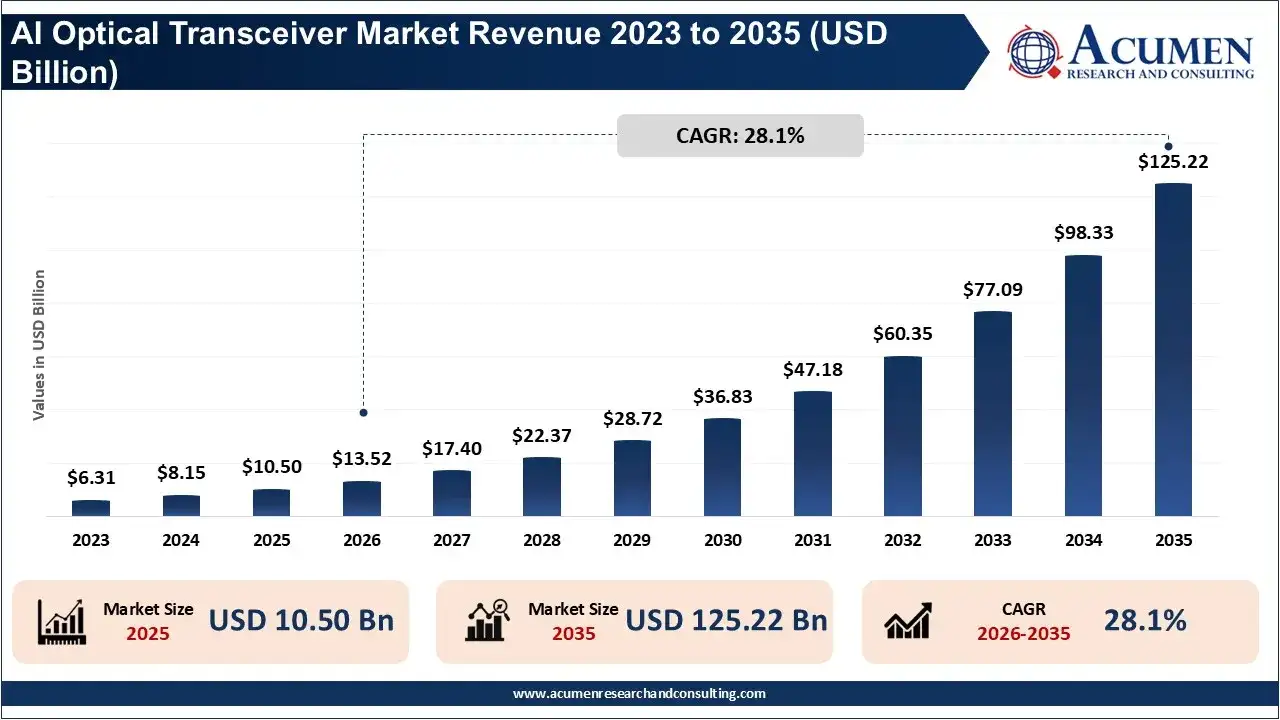
AI Optical Transceiver Market Size to Surge USD 125.22 Billion by 2035, Growing at a Significant CAGR of 28.1%
Published : 07 Sep 2026
Author : Lucas Hoffmann



What is the AI Optical Transceiver Market Size?
The global AI optical transceiver market size is expanding from USD 13.52 billion in 2025 to over USD 125.22 billion by 2035, growing at a significant CAGR of 28.1% during the forecast period 2026 to 2035.
What Role Do Optical Transceivers Play in GPU and AI Accelerator Clusters?
Optical transceivers are the glue that links GPUs and AI accelerators to the network fabric needed for thousands of processors to work together as an integrated computer. For AI training and inference, accelerators need to constantly exchange model parameters, gradients, intermediate data and other information, which results in tremendous east-west traffic back-and-forth between servers, switches, storage systems, and server racks.
Optical transceivers encode electrical signals into light for travel over fiber and re-encode them into electrical signals on the other end, providing both bandwidth increases and connectivity much farther than copper. But as AI clusters grow from dozens of accelerators to thousands or tens of thousands, optical is becoming a major bottleneck to how efficiently compute can work together.
What are the Emerging Trends of AI Optical Transceiver Market?
- Migration from 800G to 1.6T optical transceivers — 800G is increasingly becoming the baseline for high-performance AI clusters, while 1.6T is moving from technology roadmaps toward volume deployment as hyperscalers seek greater bandwidth per optical link.
- Emergence of 3.2T optical connectivity — Even as 1.6T enters mainstream deployment, manufacturers are developing and validating 3.2T solutions based on 400G-per-lane technologies, creating the next major bandwidth upgrade cycle for AI networking.
- Growing adoption of silicon photonics — Silicon photonics is gaining importance because higher optical bandwidth requires greater integration, lower power consumption, and improved scalability, making photonic integration increasingly important for next-generation AI networks.
- Shift toward linear pluggable optics (LPO) — LPO is emerging as an alternative architecture that reduces or eliminates DSP processing within the optical module, potentially lowering power consumption and latency while retaining the flexibility of pluggable optics.
- Growing interest in co-packaged optics (CPO) — CPO places optical engines closer to switch ASICs or accelerators, reducing high-speed electrical distances and addressing power, signal-integrity, and bandwidth-density constraints that become more severe at 1.6T and beyond.
Segmental Landscape of AI Optical Transceiver Market
| Segmentation | Dominated Segment & Key Factor | Fastest-Growing / Second-Largest Segment |
|---|---|---|
| By Data Transfer Rate | 800G: Dominated due to its widespread adoption across high-speed Ethernet switching and GPU clusters, supported by its balance of bandwidth, maturity, ecosystem availability, and power efficiency. | Second-largest: 400G — 25% share in 2025 |
| By Application / Network Function | Compute / AI Fabric : Dominated because AI training and inference generate massive east-west data flows between GPUs, accelerators, switches, and storage systems. | Fastest-growing: Data Center Interconnect (DCI) — 32.4% CAGR (2026–2035) |
| By End User | Hyperscale Cloud Service Providers : Dominated due to the massive scale of AI infrastructure deployed across hyperscaler data centers, GPU clusters, storage networks, and inter-data-center connections. | Second-largest: AI Infrastructure / Neocloud Providers — 12% share in 2025 |
| By Form Factor | OSFP-family : Dominated because its larger physical design provides thermal-management advantages and supports high-power 800G and emerging 1.6T optical modules. | Second-largest: QSFP-family — 30% share in 2025 |
| By Optical Technology | EML-based : Dominated due to its high-speed transmission capabilities, established ecosystem, and suitability for the performance and reach requirements of advanced data-center networks. | Second-largest: Silicon Photonics-based — 27% share in 2025 |
| By Transmission Reach | Short Reach (>100 m–2 km) : Dominated because AI data centers require large volumes of optical links connecting GPU servers, accelerators, switches, and storage infrastructure across relatively short distances. | Second-largest: Medium Reach (>2–10 km) — 17% share in 2025 |
AI Optical Transceiver Market Regional Outlook
- North America - 55% share by 2025: The North America region accounted for the majority share of the market in 2025, owing to its concentration of hyperscale cloud provider, AI infrastructure providers, and large-scale data centers. The region is a major hub for AI optical infrastructure and development.
- Asia-Pacific - 35% share by 2025: Asia-Pacific secured second-largest shares in the AI optical transceiver market in 2025 driven by rapid development in data centers, the expansion of AI infrastructure, rise in cloud investment and semiconductor fabrication in the region.
- Europe - 7% share by 2025: The Europe region contributed the third-largest shares in the global AI optical transceiver market in 2025, due to growth in hyperscale & colocation datacenters and increased acceptance of enterprise AI, coupled with investments in digital infrastructure and sovereign AI capabilities.
- Middle East & Africa - 2% share by 2025: Middle East & Africa holds2 % shares in the AI optical transceiver market in 2025, facilitated by growing investment in AI infrastructure- centric data centers and the deployment of digital infrastructure in various countries.
- Latin America - 1% share by 2025: The Latin America region holds the minor share in global AI optical transceiver market in 2025, due to increased modernization of data centers, expanded usage of cloud infrastructure, and growing deployment of digital infrastructure in the region.
Strategic Partnerships Reshaping the AI Optical Transceiver Market
- NVIDIA announced a $2 billion investment in Lumentum as part of a multiyear strategic partnership focused on advanced optics technology, manufacturing capacity, and R&D for next-generation AI data centers. The agreement also includes multibillion-dollar purchase commitments and is intended to expand U.S.-based production of advanced optical components.
- Major AI and semiconductor companies collaborated through the OCI Multi-Source Agreement initiative to develop an open optical scale-up interconnect approach for AI clusters. The initiative targets a common physical-layer architecture that can eventually scale to 3.2 Tb/s per fiber, potentially supporting pluggable, onboard, and co-packaged optical implementations.
Segments Covered in the Report
By Data Transfer Rate
- ≤200G
- 400G
- 800G
- 1.6T
- >1.6T
By Application / Network Function
- Compute / AI Fabric
- Storage Networking
- Data Center Interconnect (DCI)
- Other AI Networking
By End User
- Hyperscale Cloud Service Providers
- AI Infrastructure / Neocloud Providers
- Colocation / Data Center Operators
- Enterprise
- Government / Research
- Telecom / Network Operators
By Form Factor
- SFP-family
- QSFP-family
- OSFP-family
- Other Pluggable
- Embedded / Non-pluggable
By Optical Technology
- VCSEL-based
- EML-based
- DML-based
- Silicon Photonics-based
- Coherent
- Other / Emerging
By Transmission Reach
- Very Short Reach (≤100 m)
- Short Reach (>100 m–2 km)
- Medium Reach (>2–10 km)
- Long Reach (>10–80 km)
- Extended Reach (>80 km)
By Region
- North America
- Europe
- Asia-Pacific
- Latin America
- Middle East & Africa
Contact Us:
Mr. Richard Johnson
Acumen Research and Consulting
India: +91 8983225533