
xEV Power Chip Market Size to Surpass USD 30.52 Billion by 2035, Growing at CAGR of 12.6%
Published : 06 Oct 2026
Author : Raghuram Nair



What is the xEV Power Chip Market Size?
The global xEV power chip market was valued at USD 9.29 billion in 2025 and is projected to rise to USD 30.52 billion by 2035, reflecting a CAGR of 12.6% during the forecast period of 2026-2035. The xEV power chip market is being driven by rising electric vehicle production, increasing power-electronics content per vehicle, demand for higher inverter efficiency, faster charging, and the transition toward higher-voltage vehicle architectures.
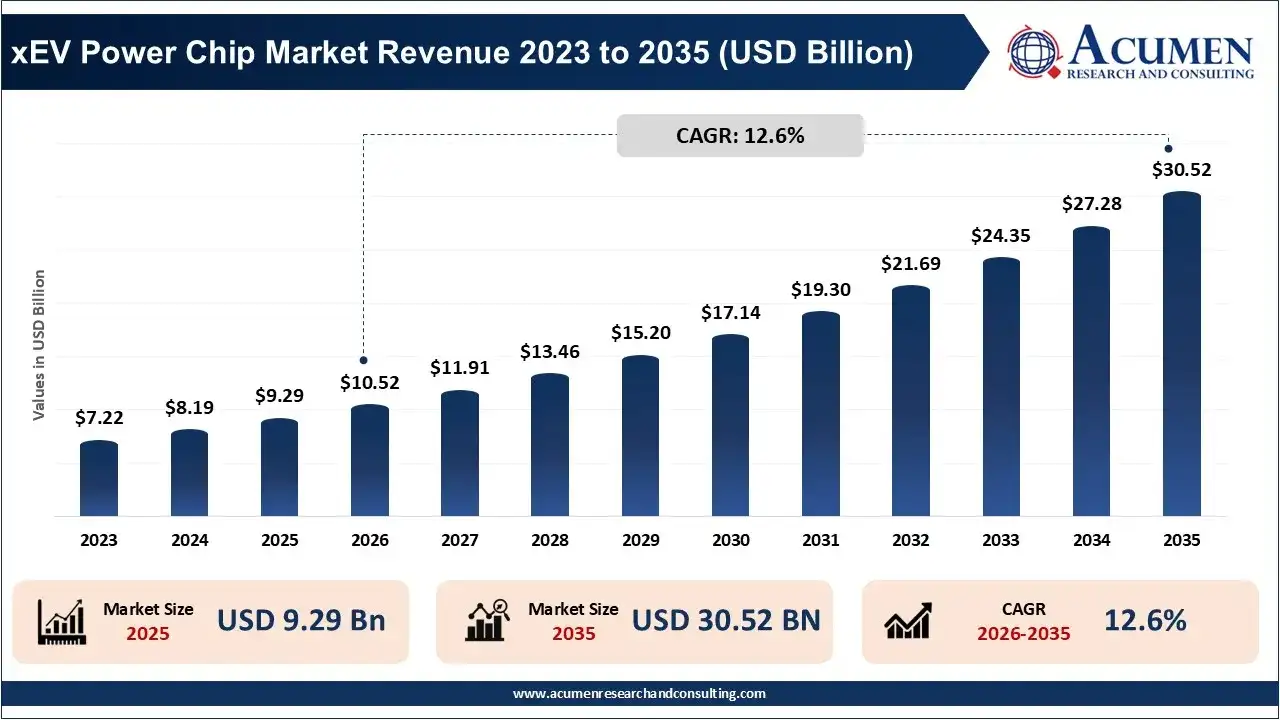
xEV Power Chip Market: Why Are Power Chips Becoming More Important in Electric Vehicles?
Power chips sit at the heart of an electrified vehicle's energy system, controlling how electricity moves between the battery, inverter, motor, charger, and other electrical components. As automakers push for longer driving ranges, faster charging, smaller power-electronics packages, and better thermal performance, semiconductor requirements are becoming more demanding.
The transition from conventional silicon devices toward silicon carbide and other advanced materials is also changing the competitive landscape. At the same time, higher-voltage platforms are encouraging automakers and suppliers to rethink inverter, charging, and power-conversion architectures. As a result, power chips are becoming an increasingly important part of vehicle efficiency, performance, and cost.
Where Are xEV Power Chips Creating the Most Value?
- Traction Inverters: Traction inverters rely on power semiconductors to convert battery-generated DC electricity into the controlled AC power required by electric motors. Improvements in switching efficiency, thermal performance, and power density can directly influence vehicle range, acceleration, packaging, and overall drivetrain efficiency.
- Onboard Charging: Power chips manage the conversion of electricity as energy moves from the charging source into the vehicle battery. More efficient semiconductor devices can support faster charging, reduce energy losses, and enable smaller charging systems while meeting increasingly demanding thermal and power-density requirements.
- DC-DC Conversion: DC-DC converters regulate electrical power between different voltage levels within electrified vehicles. Power chips used in these systems support auxiliary loads, battery-related functions, and low-voltage vehicle electronics, making efficiency and compact packaging increasingly important as electrical architectures become more sophisticated.
- Battery Management: Power semiconductors contribute to the control and distribution of electrical energy within battery systems. Their role is becoming more important as battery packs increase in size and voltage, requiring efficient switching, protection, monitoring, and power-management functions across increasingly complex energy architectures.
xEV Power Chip Market Segmental Outlook
| Segment | Leading Segment | 2025 Share | Key Driver |
|---|---|---|---|
| By Device Type | IGBTs | 28% | Established use in high-voltage and high-current switching applications, supported by mature automotive manufacturing and power-electronics infrastructure. |
| By Semiconductor Material | Silicon | 56% | Mature manufacturing infrastructure, broad supplier base, established device technologies, and cost advantages across diverse xEV power-electronic applications. |
| By xEV Type | BEVs | 52% | Extensive power-chip requirements across traction inverters, charging, DC-DC conversion, thermal management, and electrical distribution systems. |
| By Application | Traction Inverters | 32% | Central role in converting battery power into controlled electrical output for vehicle propulsion and determining drivetrain efficiency. |
| By Vehicle Class | Passenger Cars | 55% | High vehicle production volumes and increasing semiconductor content across propulsion, charging, battery management, and auxiliary systems. |
| By Voltage Architecture | 400 V to <600 V | Leading Category | Established deployment across existing EV platforms and a balance between power capability, component availability, safety, and system cost. |
xEV Power Chip Market: What Will Change by 2030?
- Higher-Voltage Architectures Will Gain Ground: More automakers will evaluate 800 V and other higher-voltage architectures to improve charging speed, reduce current-related losses, and support high-power vehicle systems. This shift will create new requirements for semiconductor voltage ratings, thermal management, packaging, and inverter design.
- Silicon Carbide Will Expand Beyond Premium EVs: Silicon carbide power devices are expected to move into a broader range of electric vehicle applications as manufacturers seek higher efficiency and improved thermal performance. Falling production costs and expanding manufacturing capacity could gradually increase adoption beyond premium vehicle platforms.
- Power Density Will Become a Design Priority: Automakers and Tier 1 suppliers will increasingly seek power modules capable of handling greater electrical loads within smaller packages. Higher power density can free up vehicle space, reduce system weight, and improve the packaging of inverters, chargers, and other power-electronic components.
- Inverters Will Become More Integrated: Future electric powertrains will increasingly combine semiconductor devices, power modules, cooling systems, control electronics, and software into more integrated architectures. This approach can reduce system size, improve thermal management, and simplify the connection between power conversion and motor-control functions.
xEV Power Chip Market Regional Outlook
Asia-Pacific dominated the xEV power chip market with a 42% share in 2025. The region benefits from the combination of large-scale electric vehicle production, battery manufacturing, powertrain production, semiconductor packaging, and expanding silicon carbide capabilities. China remains particularly important because of its extensive EV manufacturing ecosystem, while Japan and South Korea contribute automotive electronics, semiconductor, battery, and materials expertise. The concentration of multiple stages of the EV value chain within the region gives semiconductor manufacturers close access to vehicle OEMs, battery companies, and power-electronics suppliers.
- China: China is the region's largest opportunity, supported by high EV production volumes, a strong battery supply chain, expanding domestic semiconductor capabilities, and rapid adoption of electrified powertrain technologies.
North America accounted for 25% of the xEV power chip market in 2025, supported by its established automotive electronics ecosystem and increasing demand for advanced power semiconductors in electrified vehicles. The region is also seeing greater attention toward domestic semiconductor production and supply-chain resilience as automakers and technology suppliers seek more secure access to critical components. Demand is expected to remain concentrated around traction inverters, onboard chargers, battery systems, and increasingly sophisticated vehicle electrical architectures.
xEV Power Chip Market: What Are Companies Investing In?
- January 2026: Infineon announced the expansion of its silicon carbide manufacturing capacity in Malaysia, strengthening its position in high-power semiconductor production. The investment supports growing demand for SiC devices across electric vehicles, renewable energy, and other high-efficiency power applications.
- February 2026: onsemi announced expanded silicon carbide production capabilities as it continued scaling its vertically integrated SiC supply chain. The company has been increasing manufacturing capacity and technology development to address growing demand for high-efficiency power devices used in electric vehicles and energy infrastructure.
Key Companies
The xEV power chip market includes Infineon Technologies, Wolfspeed, onsemi, STMicroelectronics, Mitsubishi Electric, ROHM Semiconductor, Renesas Electronics, Texas Instruments, NXP Semiconductors, Toshiba, Fuji Electric, Microchip Technology, Vishay Intertechnology, Semiconductor Manufacturing International Corporation (SMIC), and BYD Semiconductor.
Infineon, onsemi, STMicroelectronics, Wolfspeed, ROHM, Mitsubishi Electric, and Fuji Electric are particularly active across automotive power semiconductors, IGBTs, MOSFETs, SiC devices, and power modules. Renesas, NXP, Texas Instruments, Toshiba, and Microchip contribute automotive semiconductor and power-management technologies, while BYD Semiconductor supports China's expanding EV ecosystem.
Segments Covered
By Device Type
- Power MOSFETs
- IGBTs
- Power Diodes & Rectifiers
- Power Management ICs
- Integrated Power Modules
- Other Power Semiconductor Devices
By Semiconductor Material
- Silicon (Si)
- Silicon Carbide (SiC)
- Gallium Nitride (GaN)
- Other Materials
By xEV Type
- Battery Electric Vehicles (BEV)
- Plug-in Hybrid Electric Vehicles (PHEV)
- Hybrid Electric Vehicles (HEV)
- Fuel Cell Electric Vehicles (FCEV)
By Application
- Traction Inverter
- On-Board Charger (OBC)
- DC-DC Converter
- Battery Management & Power Distribution
- Electric Motor Control
- Thermal Management & HVAC
- Auxiliary Power Systems
- Other xEV Applications
By Vehicle Class
- Passenger Cars
- Light Commercial Vehicles (LCV)
- Heavy Commercial Vehicles (HCV)
- Electric Buses
- Two-Wheelers & Three-Wheelers
By Voltage Architecture
- Below 400 V
- 400 V to <600 V
- 600 V to <800 V
- 800 V and Above
By Region
- North America
- Europe
- Asia-Pacific
- Latin America
- Middle East & Africa
Contact Us:
Mr. Richard Johnson
Acumen Research and Consulting
India: +91 8983225533