
AI Optical Transceiver Market Size, Share, Trends, Report 2026 To 2035
AI Optical Transceiver Market (By Data Transfer Rate: ≤200G, 400G, 800G, 1.6T, >1.6T; By Application: Compute / AI Fabric, Storage Networking, Data Center Interconnect (DCI), Other AI Networking; By End User: Hyperscale Cloud Service Providers, AI Infrastructure / Neocloud Providers, Colocation / Data Center Operators, Enterprise, Government / Research, Telecom / Network Operators; By Form Factor: SFP-family, QSFP-family, OSFP-family, Other Pluggable, Embedded / Non-pluggable; By Optical Technology: VCSEL-based, EML-based, DML-based, Silicon Photonics-based, Coherent, Others; By Transmission Reach: Very Short Reach (≤100 m), Short Reach (>100 m–2 km), Medium Reach (>2–10 km), Long Reach (>10–80 km), Extended Reach (>80 km)) - Global Industry Analysis, Size, Share, Growth, Regional Analysis, Trends and Forecast 2026 - 2035
- Last Updated: 01 Sep 2026
- Report Code: ARC3973
- Category: Semiconductor and Electronics
AI Optical Transceiver Market Size, Forecast Report 2026 To 2035
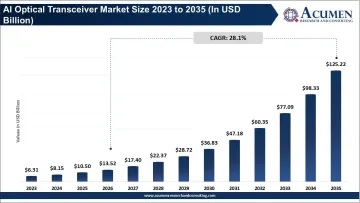
The global AI optical transceiver market size was valued at USD 13.52 billion in 2025. The market is seen to reach at USD 125.22 billion by 2035 while promising a growth at significant CAGR of 28.1% during the forecast period 2026 to 2035. Rising AI data center deployments are accelerating demand for high-speed optical connectivity as increasingly dense GPU clusters generate massive east-west data traffic between compute, switching, and storage infrastructure.
Report Highlights
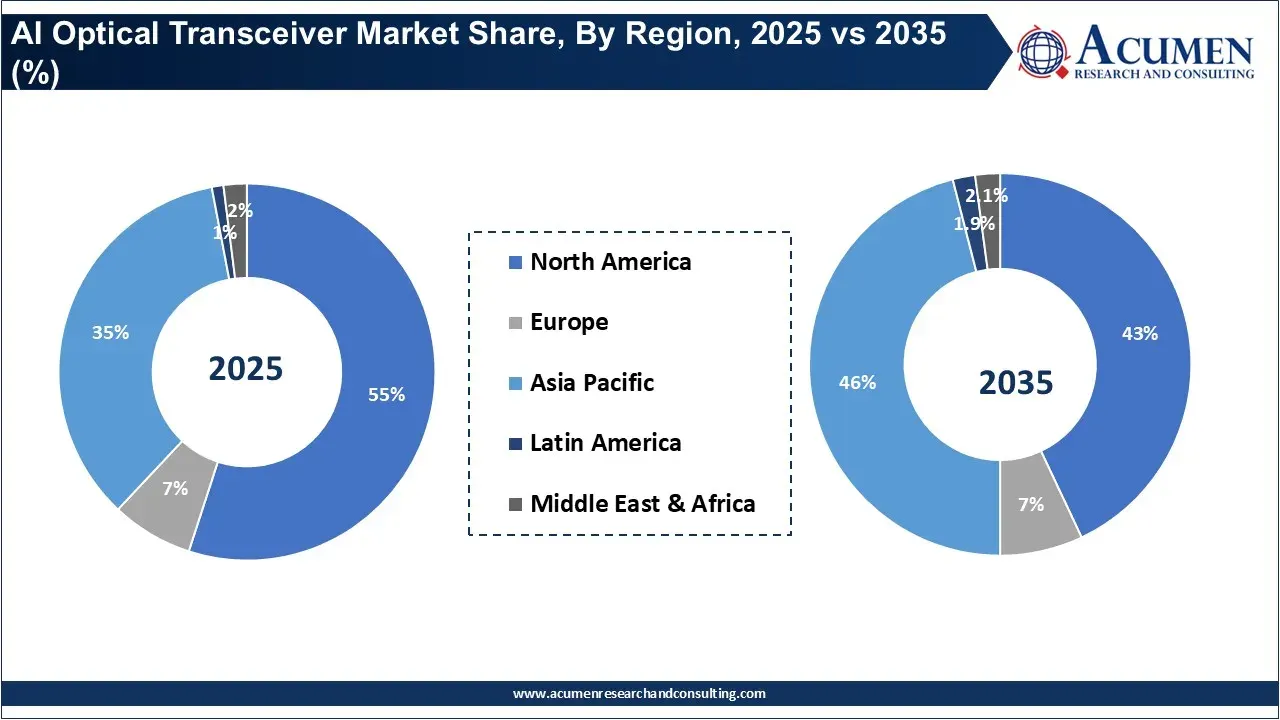
- By region, North America dominated the market with a 55% share in 2025, supported by its concentration of hyperscale cloud providers, AI infrastructure companies, large-scale data centers, and advanced networking ecosystems.
- By region, Asia Pacific is projected to become the largest regional market by 2035 with a 46% share, driven by rapid data-center construction, expanding cloud infrastructure, AI investments, semiconductor capabilities, and digitalization.
- By region, Latin America is projected to record the fastest regional growth with a 37.5% CAGR through 2035, supported by data-center modernization, cloud adoption, hyperscale expansion, colocation capacity, and rising AI infrastructure investment.
- By data transfer rate, 800g dominated the market in 2025 with a 57% share, supported by its strong adoption across high-speed Ethernet switching and GPU-intensive AI clusters.
- By data transfer rate, 400g held the second-largest share of 25% in 2025, supported by its established deployment base across enterprise, cloud, telecom, and lower-bandwidth data-center applications.
- By application/network function, compute / AI fabric dominated the market with a 70% share in 2025, driven by the growing need for high-bandwidth optical connectivity between gpu servers, accelerators, switches, and storage systems.
- By application/network function, data center interconnect is projected to be the fastest-growing segment with a 32.4% CAGR from 2026 to 2035, supported by the increasing geographic distribution of ai infrastructure and demand for high-speed connectivity between data centers.
- By end user, hyperscale cloud service providers dominated the market in 2025, driven by their large-scale deployment of AI clusters, cloud data centers, storage infrastructure, and high-speed backbone networks.
- By end user, AI infrastructure and neocloud providers accounted for 12% of the market in 2025, supported by rising demand for outsourced high-density GPU infrastructure among organizations unable to build large AI systems independently.
- By form factor, OSFP-family modules dominated the market with a 65% share in 2025, supported by their thermal-management advantages and suitability for high-bandwidth 800g and emerging 1.6t applications.
- By form factor, QSFP-family modules accounted for 30% of the market in 2025, benefiting from a mature ecosystem and extensive deployment across existing data-center and networking infrastructure.
- By optical technology, EML-based technology dominated with a 48% share in 2025, supported by its high-speed transmission capabilities, established ecosystem, and suitability for demanding data-center connectivity.
- By optical technology, silicon photonics accounted for 27% of the market in 2025, driven by its potential to improve integration, scalability, and cost efficiency as optical networking requirements increase.
- By transmission reach, short reach (>100 m–2 km) dominated the market with a 61% share in 2025, reflecting the large number of high-speed optical connections required between servers, accelerators, switches, and storage systems.
- By transmission reach, medium reach (>2–10 km) accounted for 17% of the market in 2025 and is expected to reach 19% by 2035, supported by the expansion of data-center campuses, metropolitan computing networks, and distributed AI infrastructure.
What is the AI Optical Transceiver Market and Why Is It Becoming Critical to AI Infrastructure?
The AI optical transceiver market includes optical networking modules and technologies that enable the transmission and receiving of high-speed data over AI-powered computing infrastructure. The optical transceiver takes an electrical signal, transforms it into an optical signal to be transmitted down an optical fiber, and, upon receipt of the optical signal, transforms it back into an electrical signal. Optical transceivers facilitate high-bandwidth communication between GPUs, AI accelerators, network switches, storage devices, and data centers.
The demand is increasing, since AI workloads generate significantly more network traffic than traditional computing workloads, and network bandwidth represents an increasingly significant portion of the overall system performance of an AI cluster. As the size of AI clusters increases, optical interconnects present the best alternative for delivering the required bandwidth, reach and signal integrity necessary to transport data, while also mitigating power and reach limitations existing in traditional copper technologies.
Which AI Optical Transceiver Technologies Are Most Attractive for Investors?
| Technology / Investment Theme | Key Companies | Why It Is Attractive |
|---|---|---|
| Silicon Photonics | Intel, Broadcom, NVIDIA | Silicon photonics enables higher integration and scalable manufacturing for high-speed optical connectivity, making it increasingly important as 800G and 1.6T architectures scale. |
| High-Speed EML / Laser Technology | Lumentum, Applied Optoelectronics | Higher-speed AI transceivers require advanced lasers capable of supporting 200G-per-lane and future 400G-per-lane architectures, creating opportunities for suppliers positioned upstream in the optical component chain. |
| Optical DSPs | Marvell, Broadcom, Credo, MaxLinear | DSPs are fundamental to high-speed PAM4 optical modules and become increasingly valuable as signaling moves toward 200G-per-lane and future 400G-per-lane architectures. |
| Advanced Optical Components | Lumentum, MACOM | Lasers, TIAs, optical engines and related components represent critical upstream bottlenecks where technology qualification and manufacturing capabilities can create stronger competitive positions than commoditized module assembly. |
| Co-Packaged Optics / Optical I/O | NVIDIA, Broadcom, Marvell, Ayar Labs | CPO and optical I/O could address future bandwidth, power, and signal-integrity constraints as AI systems scale, although the technology remains an emerging rather than dominant deployment model. |
Market Dynamics
Driver
Rapid Expansion of AI Data Centers Is Increasing Optical Connectivity Requirements
Accelerating deployments of AI data centers is the principal structural force driving growth for the AI optical transceiver market. The training and inference associated with AI workloads, versus legacy workloads (compute–centric), rely much more on communications among and between many GPUs and accelerators, creating high rates of east-west traffic across the computing fabric.
As those clusters become even larger (i.e., as every additional accelerator in a cluster has more network ports to provision), the required number of ports, their speeds and thus the total bandwidth on optical links across the data center expands greatly. Thus hyperscalers are not just stepping up 800G deployments but are laying the foundations for1.6T, and vendors supplying AI infrastructure are now creating their networks from the ground up based on those needs for communications bandwidth.
Restraint
Component Shortages and Manufacturing Constraints Can Limit Market Expansion
The availability of critical optical components is emerging as an important restraint as demand accelerates faster than supply-chain capacity. High-speed optical transceivers require specialized lasers, photonic integrated circuits, DSPs, optical engines, packaging, and testing capabilities, and qualification of these components can require significant time and technical investment. Supply constraints can therefore delay module production even when end-market demand remains strong.
Opportunity
1.6T and Next-Generation Optical Connectivity Create a New Upgrade Cycle
One of the largest opportunities available across the market is the upgrade path from 800G to 1.6T to over 1.6T optical connectivity. The demands on AI clusters, including higher bandwidth consumption, are shifting towards network operator strategies to upgrade the bandwidth per single optical link rather than just increase the number of physical links.
The migration to a 200G per lane 1.6T architectures is in-flight from design to deployment. Meanwhile, the industry already is working towards 400G per lane technology to deliver next generation solutions and presents opportunities across transceiver suppliers, DSPs, EML laser suppliers, CW lasers suppliers, silicon photonic engines, optical packaging vendors, test & equipment, and advanced substrates.
Segmentation Insights
Data Transfer Rate Insights
800G is the dominant data-transfer-rate segment in 2025, accounting for 57% of the market. The segment's adoption curve matches with the AI data center market deployment; 800G optical transceivers have become a key connectivity solution with a substantial presence in the market through high-speed Ethernet switching, and the connectivity aspect in high-speed GPU clusters.
It presents the optimum of bandwidth, deployment maturity, ecosystem support, and power/network-agnostic capability. 800G serves specifically large-scale AI clusters, as today's high end compute servers are emitting huge east west data flow, asking for very high speed connection to network switches.
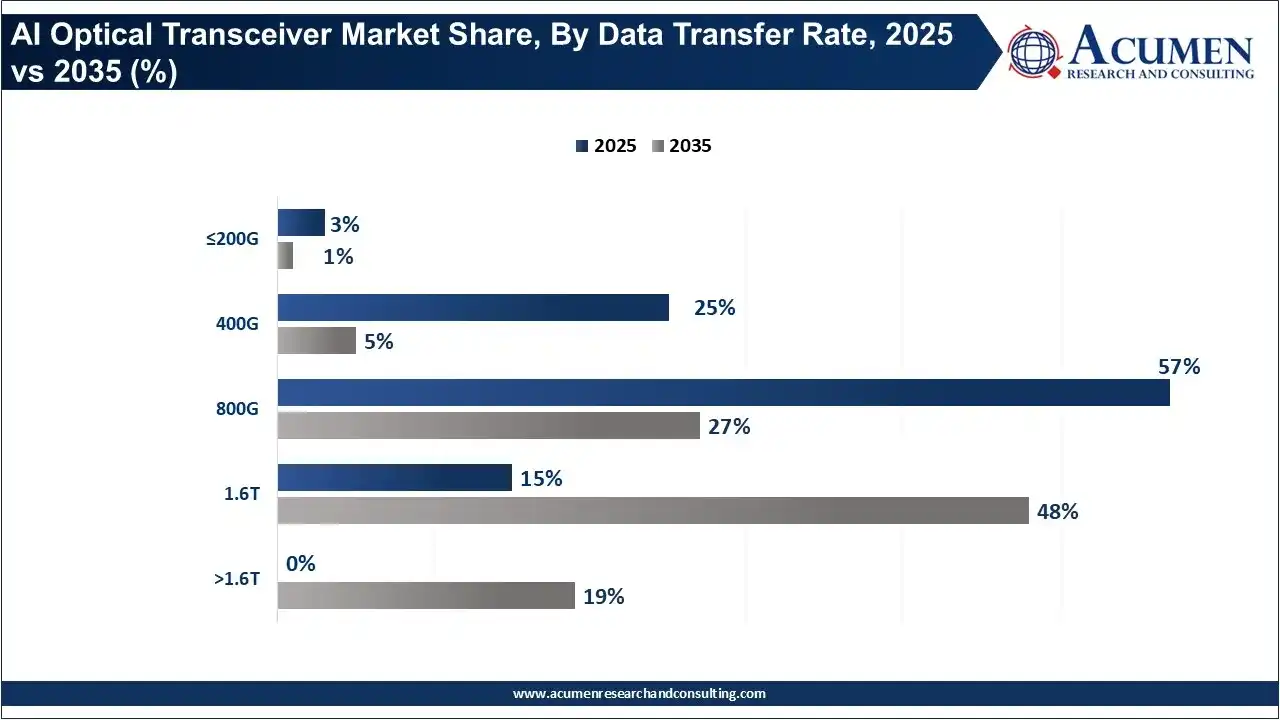
400G represented 25% of the market in 2025, making it the second-largest current speed category. The growth is consistent with the migration of high-performance data centers toward 800G and 1.6T architectures. 400G will nevertheless remain relevant in selected enterprise, cloud, telecom and less bandwidth-intensive applications, as well as in network environments where upgrading to the latest generation is not economically justified.
Application/Network Function Insights
Compute / AI fabric was the dominant application segment, representing 70% of the market in 2025. The segment is valued at approximately $9.47 billion in 2026 and is predicted to expand to $77.64 billion by 2035, exhibiting a CAGR of 26.3%. In order for GPU or other AI accelerator systems to work, compute infrastructure must be connected via sufficient network bandwidth.
AI training workloads generate massive east-west traffic as accelerators exchange model parameters, gradients and intermediate data. As clusters size grow, the optical network becomes more influential with respect to system performance; Therefore, the optics in AI fabrics are moving to 800G, 1.6T and even greater than 1.6T.
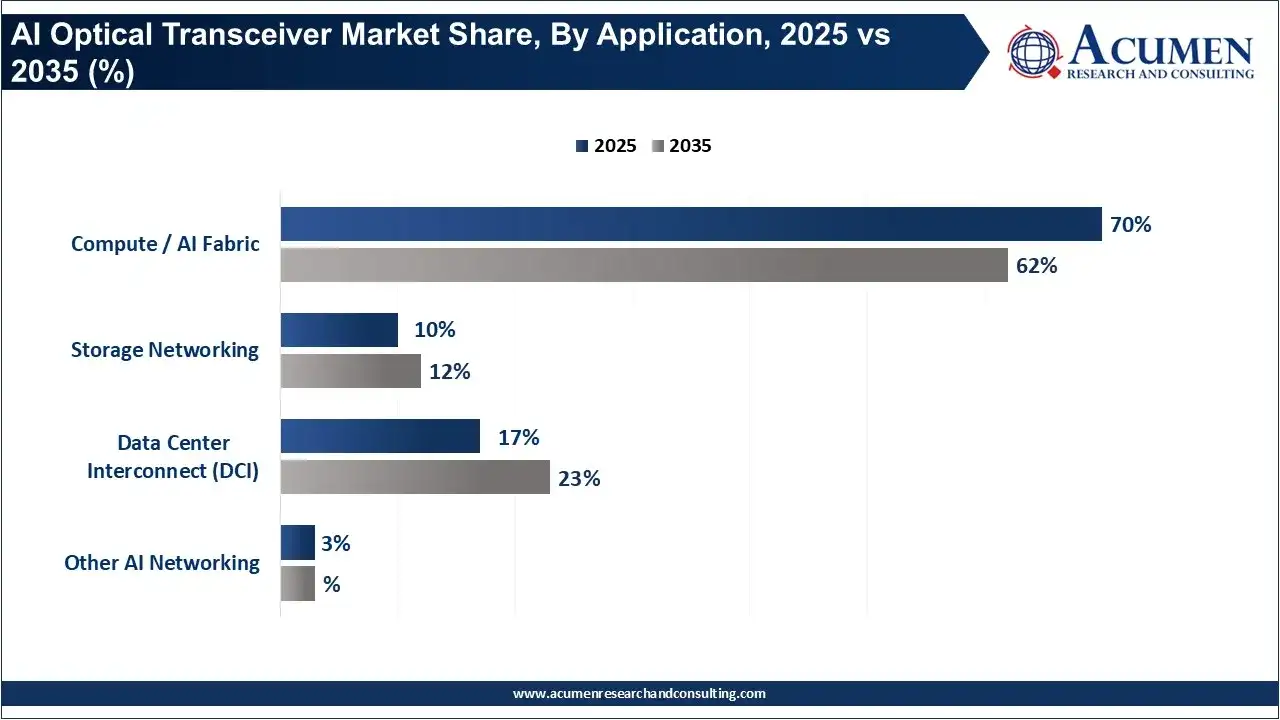
The data center interconnect segment is the fastest growing market segment with a CAGR of roughly 32.4% between 2026 and 2035. The segment increases from an estimated $2.30 billion in 2026 to nearly $28.80 billion by 2035. As organizations continue to invest in AI infrastructure, there is increased demand for connectivity beyond the individual data centers. Training, inference, model serving, distributed computing, workload balancing and even distributed disaster recover all need high-speed links within the data center campus and between metro or regional networks.
End User Insights
The largest segment in 2025 was hyperscale cloud service providers. Its outsized share, driven by the massive AI infrastructure they have deployed on their massive cloud platforms, can be explained as much by the sheer size of this infrastructure as it can by their role in defining the technological roadmap. The global hypercale companies (Amazon, Microsoft, Google, Alibaba, etc.) deploy optical transceivers in AI training clusters, data centers for public cloud customers, server access, internal data center storage and their public backbone network as well as in connections between data centers.
AI Optical Transceiver Market Share, By End User, 2025 (%)
| End User | Revenue Share, 2025 (%) |
|---|---|
| Hyperscale Cloud Service Providers | 58% |
| AI Infrastructure / Neocloud Providers | 12% |
| Colocation / Data Center Operators | 11% |
| Enterprise | 9% |
| Government / Research | 4% |
| Telecom / Network Operators | 6% |
AI infrastructure/ neocloud providers represented 12% of the market in 2025. This segment of the optical transceiver market is important because of rising demand among organizations unable to afford to build out large AI systems themselves but large enough to need high density AI networking that makes optical an essential part of their architecture, rather than a peripheral networking requirement.
Form Factor Insights
The OSFP family dominated the 2025 market with 65% share, reflecting its strong positioning in high-bandwidth AI and data-center networking applications. OSFP's large physical envelope provides advantages for thermal management and high-performance optical modules, making it well suited to high-power 800G and emerging 1.6T applications. Its dominance reflects the industry's movement toward higher bandwidth per module and increasingly demanding thermal requirements.
AI Optical Transceiver Market Share, By Form Factor, 2025 (%)
| Form Factor | Revenue Share, 2025 (%) |
|---|---|
| SFP-family | 2% |
| QSFP-family | 30% |
| OSFP-family | 65% |
| Other Pluggable | 1% |
| Embedded / Non-pluggable | 2% |
QSFP-family modules accounted for 30% of the market in 2025. The form factor benefits from a mature ecosystem and extensive deployment base across data centers and networking equipment. However, the physical and thermal requirements of next-generation AI networking may gradually favor larger form factors for the highest-speed applications.
Optical Technology Insights
EML-based technology dominated the AI optical transceiver market with 48% of the market in 2025. EML technologies offer high-speed optical transmission that is well suited for the high performance requirements and reach levels of modern data-center networks. EML technology becomes more meaningful for higher speed modules as transmission performance, reach and signal-integrity quality are much higher requirement for these modules.
This along with an active eco-system support and experience gained from deploying existing 800G and 1.6T optical systems for the growing demand, places EML technology in an favorable position.
AI Optical Transceiver Market Share, By Optical Technology, 2025 (%)
| Optical Technology | Revenue Share, 2025 (%) |
|---|---|
| VCSEL-based | 5% |
| EML-based | 48% |
| DML-based | 17% |
| Silicon Photonics-based | 27% |
| Coherent | 2% |
| Other / Emerging | 1% |
Silicon photonics accounted for 27% of the 2025 market, making it the second-largest optical technology. While its 2025 market share is not overwhelming, this technology is highly important for the AI optical transceivers market because silicon photonics technology provides scale and cost benefits for integrating increasing optical functions in such systems, thereby enabling the future of increased connectivity and performance at higher levels.
Transmission Reach Insights
Short reach (>100 m–2 km) dominated the market with 61% share in 2025, reflecting the critical role of high-speed optical connectivity within data centers and between closely located facilities. AI fabrics require enormous numbers of optical links connecting GPU servers, AI accelerators, leaf and spine switches, storage infrastructure, and other networking equipment. The rapid deployment of GPU-intensive clusters has therefore created strong demand for short-reach 400G and 800G transceivers, while the emergence of 1.6T architectures is expected to further increase bandwidth requirements across these connections.
AI Optical Transceiver Market Share, By Transmission Reach, 2025 & 2035 (%)
| Transmission Reach | Revenue Share, 2025 (%) | Revenue Share, 2035 (%) |
|---|---|---|
| Very Short Reach (≤100 m) | 8% | 5% |
| Short Reach (>100 m–2 km) | 61% | 48% |
| Medium Reach (>2–10 km) | 17% | 19% |
| Long Reach (>10–80 km) | 13% | 22% |
| Extended Reach (>80 km) | 1% | 6% |
With a moderate reach (> 2-10 km) to the infrastructure the space share represented 17% of the market in 2025 which will grow to 19% in 2035. These will increase in size once the AI infrastructure spread outside of data-center rooms and buildings. This form factor is applicable in data-center campuses, metropolitan computing, hyper-connectivity environments, disaster-recovery setups, or distributed AI-usage cases where compute and storage resources can be several kilometers apart from each other.
Regional Insights
What Made North America Dominate the AI Optical Transceiver Market in 2025?
North America represented he highest and largest regional market in 2025, at the same time accounting for 55% of global demand in 2025 which roughly converts to $ 5.78 million.. However, the region is expected to dominate in 2026, which will see the region acquire market share valued approximately $ 7.44 million. Strong links between its market dominance and cloud hyperscale providers, AI infrastructure providers, mega-scale data centers, GPU clusters, advanced networking ecologies can be cited for the region’s dominance.
More particularly, the United States itself is the central hub for high-speed optical connectives where AI training and inference architectures necessitate tightly-connected high radix Ethernet or proprietary switches and GPU servers. Also, as major AI infrastructure providers themselves dictate technology specifications for 800 G, 1.6T, the region serves a significant role in technology evolution for other segments, too.
How is Asia Pacific Seen to Grow in the Market by 2035?
By 2035 Asia Pacific will leap to be the largest regional market. Asia Pacific will account for 46% of the global market by 2035, an increase from its 35% position in 2025. This growth is being driven by ongoing massive build-outs of data centers, burgeoning cloud infrastructure, continued AI investments, a robust semiconductor ecosystem and rising digitalization across China, Japan, South Korea, Taiwan, Singapore, India and other Asian markets.
Furthermore, there is a significant strategic regional advantage due to the preponderance of Asian resources in our optical-component and electronics-ecosystem. As we shift beyond hyperscale infrastructure as the demand center for optical infrastructure and as AI increasingly permeates down to regional cloud providers, neo-clouds, sovereign AI efforts and the enterprise, Asia Pacific has great potential to grab an ever larger slice of the overall optical transceiver demand cake.
Latin America to Witness the Fastest Rate of Growth by 2035:
Although Latin America only accounted for a 1% share of the market in 2025, this value increases to 1.9% by 2035. The market is $2.38 billion in 2035, with a stated CAGR of 37.5%, this is the fastest percentage growth rate by region. This could stem from data-center modernization, the adoption of cloud services, an expansion of hyperscale footprint, regional colocation capacity, digital services and accelerated investment in AI-specific infrastructure.
Mexico and Brazil are also interesting to highlight due to their major digital infrastructure and connectivity corridors. However, given a small total existing installed base, any significant investment in new, AI specific-based data centres could represent high growth rates.
Which Countries Dominate Optical Component Manufacturing?
| Country | Key Position in Optical Component Manufacturing | Key Strengths |
|---|---|---|
| Japan | Leading high-value photonics manufacturing hub | Strong capabilities in lasers, optical components, precision manufacturing, photonics equipment, and advanced semiconductor-related technologies. |
| United States | Major technology and high-value component hub | Strong presence in EMLs, lasers, photonic integrated circuits, DSPs, optical engines, and advanced AI networking technologies; companies such as Coherent, Lumentum, Broadcom, and Applied Optoelectronics have significant capabilities. |
| South Korea | Major semiconductor and photonics manufacturing base | Benefits from its advanced semiconductor ecosystem, electronics manufacturing capabilities, and growing investment in AI and data-center infrastructure. |
| China | Dominant high-volume optical-module manufacturing base | Strong manufacturing scale, cost competitiveness, and rapidly expanding 400G/800G/1.6T optical-transceiver production, with companies such as Innolight and Eoptolink playing major roles. |
| Taiwan | Critical electronics, semiconductor, and optical manufacturing hub | Combines advanced semiconductor manufacturing, electronics supply chains, precision manufacturing, and optical-module production, making it an important part of the global AI networking supply chain. Applied Optoelectronics, for example, operates manufacturing and R&D facilities in Taiwan. |
Leading Manufacturers
- Coherent (Pennsylvania, U.S.)
- Lumentum (California, U.S.)
- Innolight Technology (Suzhou, China)
- Eoptolink Technology (Chengdu, China)
- Applied Optoelectronics (Texas, U.S.)
- Accelink Technologies (Wuhan, China)
- Hisense Broadband (Qingdao, China)
- Source Photonics (California, U.S.)
- Broadcom (California, U.S.)
- Cisco Systems (California, U.S.)
Latest Product Launches
- In March 2026, Coherent demonstrated multiple 1.6T pluggable transceivers at OFC 2026 using different optical technologies, including silicon photonics PICs, high-power InP continuous-wave lasers, 200G InP EMLs, and 200G GaAs VCSELs, highlighting the industry's movement toward multiple technological approaches for 1.6T AI connectivity.
- In April 2026, Lumentum highlighted two live NVIDIA 1.6T 2xDR4 OSFP implementations using different optical architectures, including an ultra-high-power laser feeding a silicon-photonics engine and an 8×200G architecture based on 200G EMLs.
Segments Covered
By Data Transfer Rate
- ≤200G
- 400G
- 800G
- 1.6T
- >1.6T
By Application / Network Function
- Compute / AI Fabric
- Storage Networking
- Data Center Interconnect (DCI)
- Other AI Networking
By End User
- Hyperscale Cloud Service Providers
- AI Infrastructure / Neocloud Providers
- Colocation / Data Center Operators
- Enterprise
- Government / Research
- Telecom / Network Operators
By Form Factor
- SFP-family
- QSFP-family
- OSFP-family
- Other Pluggable
- Embedded / Non-pluggable
By Optical Technology
- VCSEL-based
- EML-based
- DML-based
- Silicon Photonics-based
- Coherent
- Other / Emerging
By Transmission Reach
- Very Short Reach (≤100 m)
- Short Reach (>100 m–2 km)
- Medium Reach (>2–10 km)
- Long Reach (>10–80 km)
- Extended Reach (>80 km)
By Region
- North America
- Europe
- Asia-Pacific
- Latin America
- Middle East & Africa
Looking for discounts, bulk pricing, or custom solutions? Contact us today at sales@acumenresearchandconsulting.com
Frequently Asked Questions

Other Semiconductor and Electronics Reports
October 2018
December 2023
September 2022
July 2023