
Digital Twin in Pharmaceutical Manufacturing Market Size to Surge USD 10,156.87 Million by 2035; Growing at a CAGR of 32.3%
Published : 27 Nov 2026
Author : Lucas Hoffmann



What is the Digital Twin in Pharmaceutical Manufacturing Market Size?
The digital twin in pharmaceutical manufacturing market size was estimated at $598.50 million in 2025 and is projected to surge at $10,156.87 million by 2035; growing at a CAGR of 32.3% during the forecast period from 2026 to 2035. Market expansion is supported by pharmaceutical manufacturers' increasing adoption of smart manufacturing technologies, growing demand for real-time process monitoring, and the integration of artificial intelligence (AI), industrial IoT, and predictive analytics.
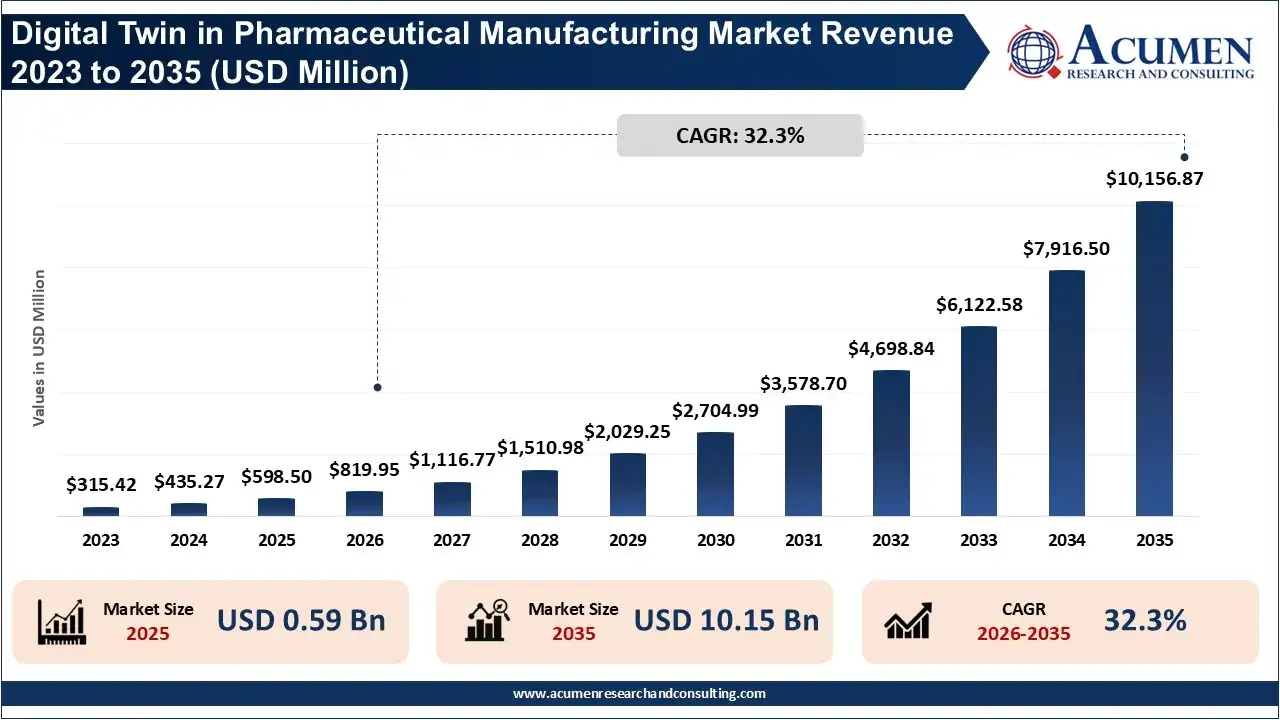
Digital Twin in Pharmaceutical Manufacturing Market Overview
The digital twin in pharmaceutical manufacturing market is gaining momentum as pharmaceutical and biopharmaceutical companies transition toward connected, data-driven production environments. Digital twins create virtual representations of manufacturing equipment, production processes, and facilities by integrating information from industrial sensors, Internet of Things (IoT) devices, manufacturing execution systems (MES), and process analytical technology (PAT). These virtual models enable manufacturers to monitor production conditions, simulate process changes, predict equipment failures, and evaluate operating parameters before implementing adjustments in physical facilities.
Digital Twin in Pharmaceutical Manufacturing Market Global Snapshot
- WuXi Biologics' PatroLab platform: WuXi Biologics introduced its PatroLab digital twin platform in 2025 to support predictive bioprocessing and biologics manufacturing. The platform combines Raman-based PAT, real-time process monitoring, machine learning, predictive modelling, and automated process control.
- Eli Lilly's digital twin-enabled manufacturing optimization, June 2026: Eli Lilly has been using digital twins to virtually simulate manufacturing lines, evaluate production bottlenecks, and optimize operating parameters before implementing physical changes.
- Johnson & Johnson's digital process twin implementation: Johnson & Johnson Innovative Medicine has used Siemens' Digital Process Twin to optimize the production of active pharmaceutical ingredients. According to Siemens, the pilot implementation reduced development time and overall costs by 35%, demonstrating the potential of digital process simulation to improve pharmaceutical production efficiency.
Digital Twin in Pharmaceutical Manufacturing Market Segmental Analysis
| Segment | Dominant category | 2025 share | Key growth factor |
|---|---|---|---|
| Component | Software | 68.0% | Demand for modelling, simulation, analytics, and optimization platforms |
| Digital Twin Type | Process Twins | 36.0% | Simulation and optimization of critical manufacturing operations |
| Deployment Mode | On-Premises | 42% | Data security, infrastructure control, and regulated operations |
| Product Type | Small-Molecule Drugs | 48% | Established production infrastructure and high manufacturing volumes |
| Application | Process Design, Scale-Up & Technology Transfer | 22% | Reduced scale-up risk and improved process reproducibility |
| Manufacturing Mode | Batch Manufacturing | 78% | Widespread batch production and demand for consistency |
| End User | Large Pharmaceutical & Biopharmaceutical Companies | 62% | Higher technology budgets and complex manufacturing networks |
Digital Twin in Pharmaceutical Manufacturing Market Regional Outlook
North America Dominates the Digital Twin in Pharmaceutical Manufacturing Market
North America dominated the digital twin in pharmaceutical manufacturing market with a 38.0% revenue share in 2025, generating USD 227.43 million. Regional leadership is supported by an established pharmaceutical and biotechnology ecosystem, advanced manufacturing infrastructure, strong digitalization investments, and the presence of major technology providers. The United States represents the primary contributor, with pharmaceutical manufacturers increasingly adopting digital twin platforms for process simulation, predictive maintenance, production monitoring, and manufacturing optimization.
The region benefits from substantial pharmaceutical research and development activity, biologics manufacturing investments, and the adoption of advanced production technologies. Companies are integrating digital twins with AI, industrial IoT, PAT, and manufacturing execution systems to improve operational visibility and production performance. The presence of large pharmaceutical companies, biotechnology developers, and contract development and manufacturing organizations (CDMOs) further supports implementation.
Asia-Pacific Expected to Register the Fastest Growth
Asia-Pacific is projected to be the fastest-growing regional market, registering a CAGR of 35.1% during 2026–2035. The region accounted for a 25.0% market share in 2025, generating USD 149.63 million, and is expected to increase its share to 31.0% by 2035, reaching USD 3,148.63 million.
Regional expansion is supported by growing pharmaceutical manufacturing capacity in China, India, Japan, and South Korea, alongside investments in biotechnology, generic drug production, and advanced manufacturing infrastructure. China is strengthening its position through large-scale pharmaceutical production, biologics manufacturing, and smart factory development.
India presents opportunities through its generic drug and active pharmaceutical ingredient manufacturing base, expanding CDMO sector, and increasing interest in digital manufacturing technologies. Japan and South Korea are also supporting adoption through investments in automation, precision manufacturing, robotics, and biopharmaceutical production.
Key Growth Opportunities and Future Outlook
The integration of artificial intelligence and machine learning with digital twin platforms represents a major growth opportunity. AI-enabled models can analyze historical and real-time manufacturing data to identify process variations, predict equipment performance, and simulate alternative operating conditions. Pharmaceutical companies can use these capabilities to anticipate production bottlenecks, improve process control, and reduce the time required to investigate manufacturing deviations.
The growing complexity of biologics, biosimilars, cell and gene therapies, and mRNA production is creating demand for more sophisticated process simulation technologies. Digital twins can model upstream and downstream bioprocessing operations, monitor critical process parameters, and support the evaluation of manufacturing conditions. WuXi Biologics' PatroLab platform illustrates how real-time monitoring, Raman-based PAT, machine learning, and predictive modelling are being combined to improve bioprocess development and manufacturing operations.
Leading Companies
- Siemens: Siemens provides digital process twin and simulation solutions for pharmaceutical process optimization, production engineering, and manufacturing scale-up. Its work with Johnson & Johnson Innovative Medicine demonstrates an application in active pharmaceutical ingredient production.
- Dassault Systèmes: Dassault Systèmes offers BIOVIA and DELMIA software portfolios supporting scientific modelling, process development, manufacturing simulation, and virtual production environments.
- Rockwell Automation: Rockwell Automation provides manufacturing execution, industrial control, and digital transformation technologies that support connected pharmaceutical production environments.
- Emerson: Emerson offers process automation, control systems, and industrial software capabilities supporting pharmaceutical process monitoring and operational optimization.
- Honeywell: Honeywell provides process control, manufacturing software, and digital transformation solutions for regulated pharmaceutical production facilities.
- ABB: ABB develops automation, control, and industrial digitalization solutions supporting asset performance, process monitoring, and manufacturing optimization.
- Schneider Electric: Schneider Electric provides industrial automation, energy management, and digital solutions for connected manufacturing and operational performance management.
- Körber: Körber offers pharmaceutical manufacturing software and automation solutions through its Werum PAS-X MES platform, supporting production execution and digital manufacturing workflows.
- PTC: PTC provides ThingWorx and digital thread technologies that enable industrial IoT connectivity, asset modelling, and digital twin development.
- WuXi Biologics: WuXi Biologics is advancing digital twin applications in bioprocess development and biologics manufacturing through its PatroLab platform.
Segments Covered
By Component
- Software (Modelling, Simulation & Analytics Platforms)
- Services (Implementation, Integration, Validation & Managed Services)
By Digital Twin Type
- Process Twins (Bioreactor, Crystallisation, Granulation & Continuous Lines)
- Equipment / Asset Twins
- Facility / Plant Twins
- Product Twins (Formulation & Drug Product)
- Supply Chain Twins
By Deployment Mode
- On-Premises
- Cloud
- Hybrid
By Product Type
- Small-Molecule Drugs (API & Finished Dosage)
- Biologics & Biosimilars
- Cell & Gene Therapies and mRNA
- Others (OTC, Nutraceuticals & Radiopharmaceuticals)
By Application
- Process Design, Scale-Up & Technology Transfer
- Real-Time Process Monitoring & Control (PAT, Advanced Process Control)
- Predictive Maintenance & Asset Performance
- Quality Management, Batch Release & Deviation Management
- Facility Design & Virtual Commissioning
- Production Planning & Scheduling
- Supply Chain & Inventory Optimisation
By Manufacturing Mode
- Batch Manufacturing
- Continuous Manufacturing
By End User
- Large Pharmaceutical & Biopharmaceutical Companies
- Mid-Size & Generic Manufacturers
- CDMOs / CMOs
- Biotech & Other Manufacturers
By Region
- North America
- Europe
- Asia-Pacific
- Latin America
- Middle East & Africa
Contact Us:
Mr. Richard Johnson
Acumen Research and Consulting
India: +91 8983225533