
Digital Twin in Pharmaceutical Manufacturing Market Size, Share, Forecast Report 2026 To 2035
Digital Twin in Pharmaceutical Manufacturing Market (By Component: Software, Services; By Digital Twin Type: Process Twins, Equipment / Asset Twins, Facility / Plant Twins, Product Twins, Supply Chain Twins; By Deployment Mode: On-Premises, Cloud, Hybrid; By Product Type: Small-Molecule Drugs, Biologics & Biosimilars, Cell & Gene Therapies and mRNA, Others; By Manufacturing Mode: Batch Manufacturing, Continuous Manufacturing; By End User; By Application) - Global Industry Analysis, Size, Share, Analysis, Trends and Forecast 2026 - 2035
- Last Updated: 13 Nov 2026
- Report Code: ARC4007
- Category: Healthcare and Pharmaceuticals
Digital Twin in Pharmaceutical Manufacturing Market Insights 2026 To 2035
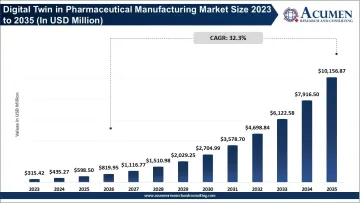
The digital twin in pharmaceutical manufacturing market size was valued at $598.50 million in 2025. The market is seen to reach at $10,156.87 million by 2035; expanding at a CAGR of 32.3% during the forecast period of 2026-2035. The market is expanding due to increasing pharmaceutical manufacturing digitalization, rising demand for real-time process optimization, growing adoption of AI-enabled predictive analytics, stricter quality requirements, and the need to reduce production costs, equipment downtime, and batch failures.
Market Size & Forecast
- Base Year Market Size (2025): $598.50 million
- Current Year Market Size (2026): $819.95 million
- Estimated Year Market Size (2035): $10,156.87 million
- Forecast Period CAGR (2026-2035): 32.3%
Key Takeaways
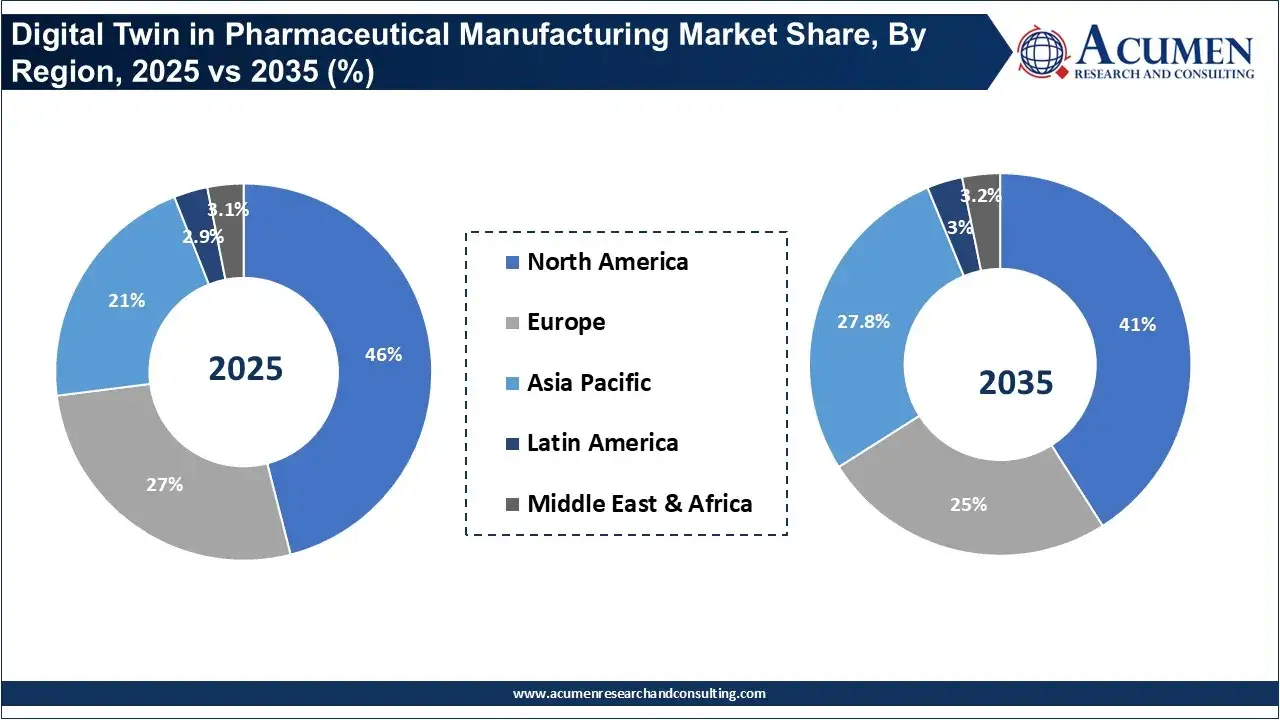
- By Region: North America dominated the regional segment with a 38.0% share in 2025, equivalent to USD 227.43 million. Its leadership is supported by an established pharmaceutical and biotechnology ecosystem, advanced manufacturing infrastructure, strong digitalization investments, and the presence of leading digital twin technology providers. Its share is projected to reach 34.0% by 2035.
- By Component: Software dominated the component segment with a 68.0% share in 2025, valued at USD 406.98 million. Its leadership reflects strong demand for digital twin modelling, simulation, real-time analytics, and process optimization platforms that help pharmaceutical manufacturers improve production efficiency, quality, and operational visibility.
- By Digital Twin Type: Process twins dominated the digital twin type segment with a 36.0% share in 2025, valued at USD 215.46 million. Their adoption is driven by the need to simulate and optimize critical pharmaceutical manufacturing operations, including bioreactor performance, crystallization, granulation, and production processes.
- By Deployment Mode: On-premises deployment dominated the deployment mode segment with a 42.0% share in 2025, valued at USD 251.37 million. Its leadership is supported by pharmaceutical manufacturers' requirements for data security, control over sensitive production information, integration with existing manufacturing infrastructure, and compliance with regulated operating environments.
- By Product Type: Small-molecule drugs dominated the product type segment with a 48.0% share in 2025, valued at USD 287.28 million. Their leadership is supported by established small-molecule manufacturing infrastructure, extensive production volumes, and the use of digital twins to improve process consistency, equipment performance, and manufacturing efficiency.
- By Application: Process design, scale-up, and technology transfer dominated the application segment with a 22.0% share in 2025, valued at USD 131.67 million. Demand is driven by the need to optimize manufacturing parameters, reduce scale-up risks, improve process reproducibility, and facilitate technology transfer between development and commercial production facilities.
- By Manufacturing Mode: Batch manufacturing dominated the manufacturing mode segment with a 78.0% share in 2025, valued at USD 466.83 million. Its leadership reflects the widespread use of batch-based production across pharmaceutical manufacturing and the growing application of digital twins to improve batch consistency, monitor process deviations, and optimize production performance.
- By End User: Large pharmaceutical and biopharmaceutical companies dominated the end-user segment with a 62.0% share in 2025, valued at USD 371.07 million. Their leadership is supported by larger technology budgets, complex manufacturing networks, established digital infrastructure, and increasing investments in data-driven production optimization.
Industry Overview
The digital twin in pharmaceutical manufacturing market is gaining traction as pharmaceutical companies increasingly adopt virtual representations of manufacturing equipment, production processes, and entire facilities to improve operational efficiency, product quality, and regulatory compliance.
Digital twin technology integrates real-time data from industrial sensors, Internet of Things (IoT) devices, manufacturing execution systems, and artificial intelligence (AI) platforms to simulate production environments, monitor equipment performance, and predict operational deviations. Its applications span drug substance manufacturing, drug product manufacturing, sterile processing, biopharmaceutical production, and continuous manufacturing.
Emerging Trends
- Increasing integration of artificial intelligence and machine learning with digital twin platforms for predictive process optimization and autonomous manufacturing.
- Growing adoption of digital twins for continuous pharmaceutical manufacturing and real-time process monitoring.
- Rising deployment of equipment-level and facility-level digital twins to improve asset utilization and manufacturing performance.
- Integration of digital twins with Manufacturing Execution Systems (MES), Laboratory Information Management Systems (LIMS), and Supervisory Control and Data Acquisition (SCADA) platforms.
- Increasing use of digital twins in biopharmaceutical manufacturing to simulate complex biological processes and optimize upstream and downstream operations.
- Growing adoption of digital twin technology for predictive quality management, process deviation detection, and batch consistency.
- Expansion of cloud-based digital twin platforms to support remote monitoring and centralized manufacturing intelligence.
Digital Twin Adoption Rate Across the Pharmaceutical Industry
- 17% of European pharmaceutical manufacturers surveyed reported currently using digital twins of their facilities, indicating relatively limited deployment across existing manufacturing infrastructure.
- 79% of surveyed European pharmaceutical companies reported leveraging digital twins in new projects to improve design collaboration and precision.
- 48% of BioPhorum survey respondents stated that their companies currently utilize digital twin technologies, although the survey identified differences in how organizations define and implement digital twins.
- 86% of BioPhorum respondents reported that their organizations had not been audited on digital twin technology, highlighting the gap between technology adoption and regulatory scrutiny.
- 35% of surveyed Indian life sciences manufacturers reported exploring digital twin and simulation tools, reflecting growing interest in advanced manufacturing technologies.
- 95% of surveyed Indian life sciences manufacturers were using or evaluating smart manufacturing technologies, including AI, automation, and digital twins.
- 33% of Indian life sciences companies reported that top leadership (CXOs) drives virtual twin initiatives, compared with 22% across the broader surveyed enterprise population.
Digital Twin in Pharmaceutical Manufacturing Dynamics
Growth Drivers
- Increasing Adoption of Industry 4.0 and Smart Manufacturing: Growing digital transformation across pharmaceutical manufacturing is accelerating the adoption of digital twin technologies. Pharmaceutical companies are integrating digital twins with industrial Internet of Things (IIoT), artificial intelligence, machine learning, and advanced analytics to create virtual representations of manufacturing equipment, production lines, and entire facilities. These technologies enable real-time process monitoring, operational optimization, and improved manufacturing efficiency.
- Rising Focus on Predictive Maintenance and Quality Management: Pharmaceutical manufacturers are increasingly adopting digital twins to monitor equipment conditions, identify performance deviations, and predict potential failures before they disrupt production. Integration with sensor networks and predictive analytics supports proactive maintenance, reduces unplanned downtime, and improves equipment utilization. Digital twins also facilitate continuous process verification and help manufacturers maintain consistent product quality.
Market Restraints
- High Initial Implementation and Integration Costs: Deploying digital twin solutions requires investments in industrial sensors, data acquisition systems, cloud or edge infrastructure, simulation software, and specialized technical expertise. Integrating these technologies with existing manufacturing execution systems (MES), enterprise resource planning (ERP), and supervisory control and data acquisition (SCADA) platforms can further increase implementation costs, particularly for pharmaceutical manufacturers operating legacy facilities.
- Limited Availability of Skilled Technical Professionals: Developing and maintaining pharmaceutical digital twins requires expertise across pharmaceutical engineering, process modeling, software development, data analytics, and regulatory compliance. The shortage of professionals capable of combining pharmaceutical manufacturing knowledge with advanced digital technologies can slow implementation and increase dependence on external technology providers and consulting services.
Key Opportunities
- Integration of Artificial Intelligence and Generative AI: Advancements in AI and machine learning create opportunities to enhance digital twin capabilities in pharmaceutical manufacturing. AI-enabled digital twins can analyze historical and real-time production data, identify process variations, simulate alternative operating conditions, and support predictive decision-making. Integration with generative AI can further improve scenario modeling, operational recommendations, and manufacturing knowledge management.
- Expansion of Continuous Pharmaceutical Manufacturing: The growing transition from traditional batch-based production toward continuous manufacturing creates opportunities for digital twin deployment. Virtual representations of continuous production systems can support real-time process optimization, material flow monitoring, quality prediction, and process parameter adjustments. These capabilities can improve production consistency, reduce material waste, and support advanced manufacturing operations.
Market Challenges
- Achieving Accurate Real-Time Model Synchronization: Maintaining alignment between physical pharmaceutical manufacturing systems and their virtual counterparts requires continuous data collection, accurate sensor readings, and frequent model updates. Incomplete datasets, sensor calibration issues, equipment variability, and process deviations can reduce model accuracy and limit the reliability of digital twin-generated predictions.
- Integrating Digital Twins Across Complex Pharmaceutical Value Chains: Pharmaceutical manufacturing facilities frequently operate multiple disconnected systems, legacy equipment, and specialized production platforms. Establishing interoperability across equipment manufacturers, automation systems, enterprise software, and quality management platforms remains challenging. The absence of standardized data architectures and integration frameworks can restrict the deployment of facility-wide digital twin ecosystems.
Regional Insights
Which Region Dominated the Digital Twin in Pharmaceutical Manufacturing Market in 2025?
North America dominated the digital twin in pharmaceutical manufacturing market with a 38.0% revenue share in 2025, generating USD 227.43 million. The region's leadership is supported by its established pharmaceutical and biopharmaceutical manufacturing infrastructure, strong presence of technology providers, and increasing investments in smart factory development.
Pharmaceutical manufacturers across the United States are adopting digital twin platforms to improve process monitoring, predictive maintenance, manufacturing automation, and quality management. The growing adoption of advanced manufacturing technologies, including artificial intelligence, industrial IoT, cloud computing, and process analytical technology, is further strengthening regional demand. Additionally, the presence of major pharmaceutical companies, biotechnology developers, and CDMOs supports investments in digital manufacturing transformation.
Which Region Is Expected to Register the Fastest Growth in the Digital Twin in Pharmaceutical Manufacturing Market?
Asia-Pacific is projected to be the fastest-growing regional market, registering a CAGR of 35.1% during 2026–2035. The region accounted for a 25.0% market share in 2025, generating USD 149.63 million, and is expected to increase its share to 31.0% by 2035, reaching USD 3,148.63 million. Regional expansion is supported by the growing pharmaceutical manufacturing capacity in China, India, Japan, and South Korea, alongside increasing investments in biotechnology, generic drug production, and advanced manufacturing infrastructure.
Pharmaceutical companies are progressively exploring digital twins to improve production efficiency, optimize manufacturing processes, and strengthen quality control across expanding facilities. The growing presence of CDMOs, increasing adoption of automation technologies, and development of smart pharmaceutical manufacturing facilities are also creating opportunities for digital twin providers.
Top Countries
| Country | Market position and key growth factors | Key pharmaceutical manufacturing strengths |
|---|---|---|
| United States | Leading market supported by pharmaceutical R&D investments, advanced manufacturing infrastructure, AI adoption, and strong presence of digital twin technology providers. | Biologics, advanced therapies, pharmaceutical innovation, process development, and smart manufacturing. |
| China | Growing market driven by large-scale pharmaceutical manufacturing, biotechnology investments, biologics production, and smart factory initiatives. | API production, biopharmaceutical manufacturing, vaccine production, and large-scale industrial automation. |
| Germany | Strong adoption supported by pharmaceutical engineering expertise, industrial automation, advanced manufacturing systems, and Industry 4.0 investments. | Pharmaceutical machinery, process engineering, precision manufacturing, and industrial automation. |
| Japan | Demand supported by pharmaceutical manufacturing modernization, robotics, industrial automation, and investments in advanced production technologies. | High-precision manufacturing, pharmaceutical robotics, advanced production systems, and quality control. |
| India | Emerging growth market driven by generic pharmaceutical manufacturing, expanding CDMO infrastructure, biotechnology investments, and pharmaceutical digitalization initiatives. | Generic drug production, APIs, contract manufacturing, vaccines, and cost-efficient pharmaceutical production. |
Segmental Insights
Component Insights
Software (Modelling, Simulation & Analytics Platforms): Software dominated the component segment with a 68.0% market share in 2025, generating USD 406.98 million in revenue. Pharmaceutical manufacturers increasingly deploy digital twin software for process simulation, real-time production monitoring, predictive analytics, and manufacturing optimization. These platforms enable manufacturers to create virtual representations of equipment, production processes, and pharmaceutical facilities, supporting process validation and operational decision-making.
Services (Implementation, Integration, Validation & Managed Services): Services represented the second-largest component category with a 32.0% market share in 2025, generating USD 191.52 million. Demand is supported by the technical complexity of integrating digital twin platforms with existing pharmaceutical manufacturing infrastructure, including MES, ERP, SCADA, and LIMS systems.
Digital Twin Type Insights
Process Twins (Bioreactor, Crystallisation, Granulation & Continuous Lines): Process twins dominated the digital twin type segment with a 36.0% share in 2025, generating USD 215.46 million. Their adoption is driven by the need to simulate, monitor, and optimize complex pharmaceutical production processes, including bioreactor operations, crystallization, granulation, and continuous manufacturing.
Digital Twin in Pharmaceutical Manufacturing Market Share, By Digital Twin Type, 2025 & 2035 (%)
| Digital Twin Type | Revenue Share, 2025 (%) | Revenue Share, 2035 (%) |
|---|---|---|
| Process twins | 36% | 33% |
| Equipment / asset twins | 22% | 19% |
| Facility / plant twins | 20% | 23% |
| Product twins | 12% | 13% |
| Supply chain twins | 10% | 12% |
Equipment / Asset Twins: Equipment and asset twins accounted for the second-largest share of 22.0% in 2025, generating USD 131.67 million. These solutions create virtual representations of individual manufacturing assets, including reactors, mixing systems, filling machines, compressors, and packaging equipment. Pharmaceutical manufacturers use equipment twins to monitor operational conditions, predict component failures, schedule maintenance, and improve equipment utilization.
Deployment Mode Insights
On-Premises: On-premises deployment dominated the segment with a 42.0% market share in 2025, generating USD 251.37 million. Pharmaceutical manufacturers continue to rely on locally hosted digital twin infrastructure to maintain greater control over sensitive production data, manufacturing systems, and regulated operational environments.
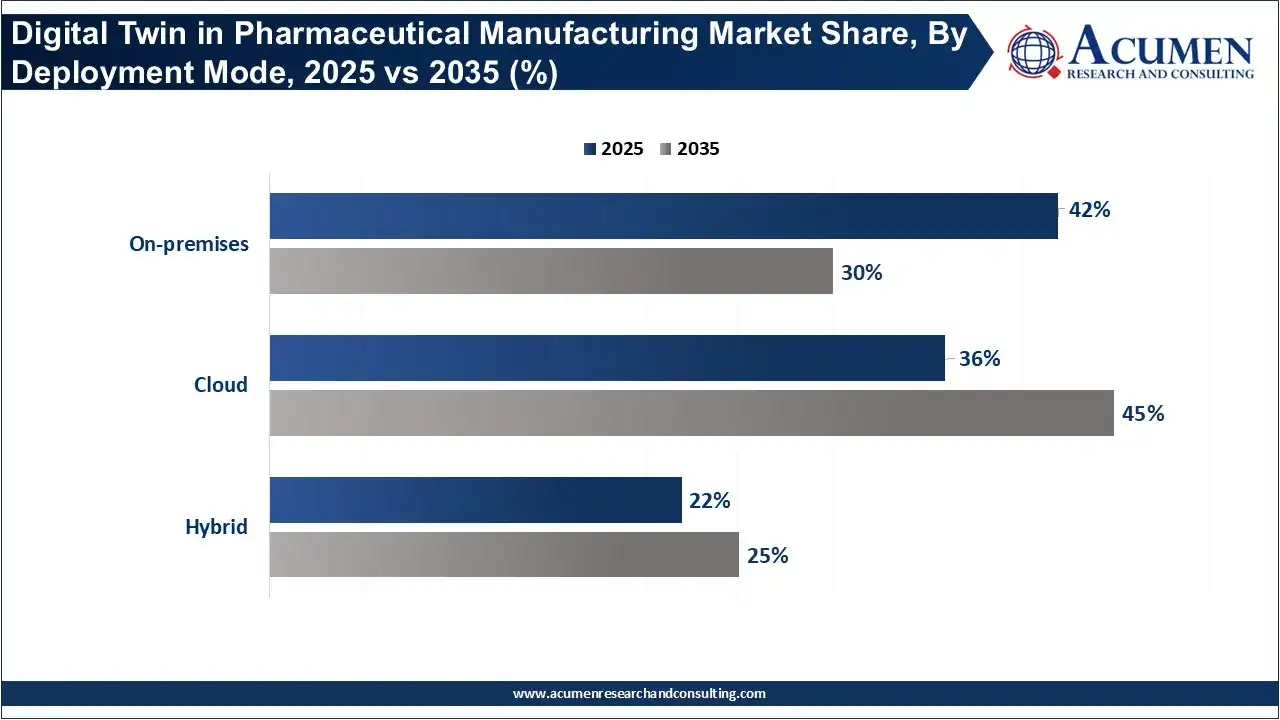
Hybrid: Hybrid deployment is projected to be the fastest-growing deployment category, registering a CAGR of 34.0% during 2026–2035. The segment generated USD 131.67 million in 2025 and is expected to reach USD 2,539.22 million by 2035. Hybrid models combine on-premises infrastructure with cloud-based computing, allowing pharmaceutical manufacturers to retain sensitive operational data locally while leveraging cloud resources for simulation, analytics, and enterprise-wide monitoring.
Product Type Insights
Small-Molecule Drugs (API & Finished Dosage): Small-molecule drugs dominated the product type segment with a 48.0% share in 2025, generating USD 287.28 million. Digital twins are increasingly used in small-molecule pharmaceutical production to optimize chemical synthesis, crystallization, granulation, blending, compression, and finished dosage manufacturing.
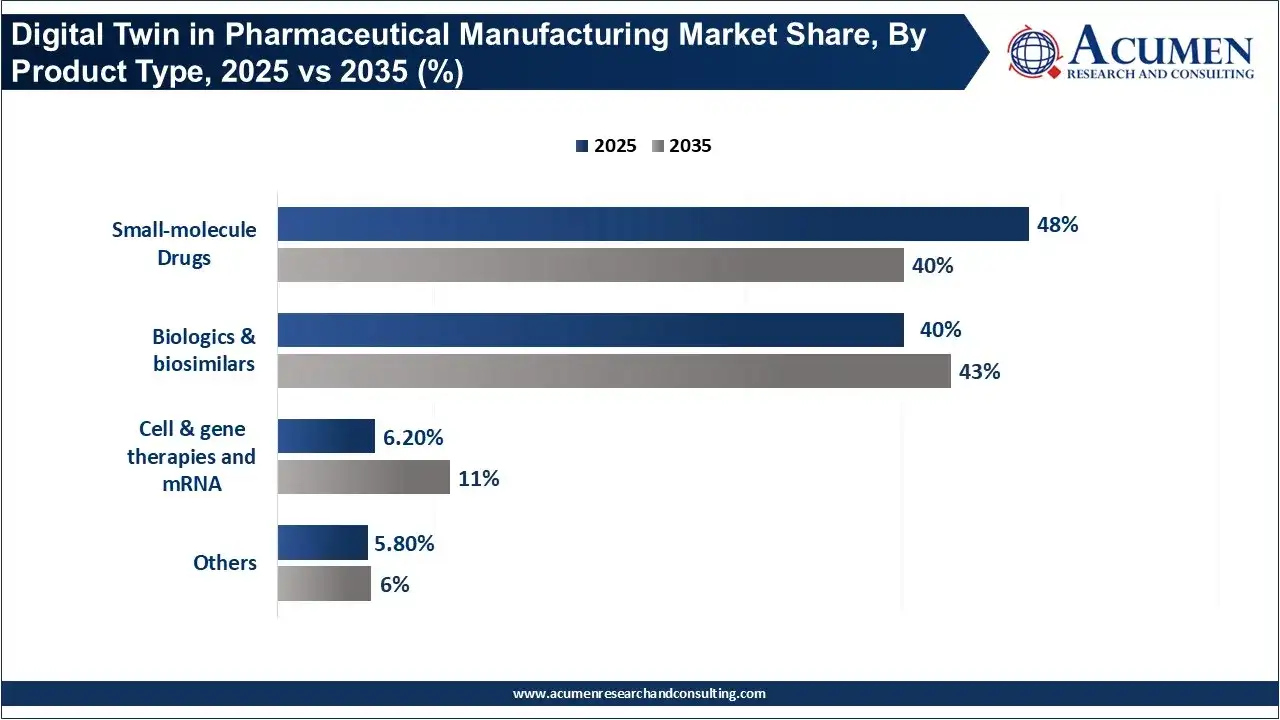
Cell & Gene Therapies and mRNA: Cell and gene therapies and mRNA represent the fastest-growing product type segment, registering a CAGR of 39.8% during 2026–2035. The segment generated USD 37.11 million in 2025 and is expected to reach USD 1,117.26 million by 2035. Growth is driven by the increasing complexity of advanced therapy manufacturing, demand for process reproducibility, and the need for precise monitoring of biological production parameters.
Application Insights
Process Design, Scale-Up & Technology Transfer: Process design, scale-up, and technology transfer dominated the application segment with a 22.0% market share in 2025, generating USD 131.67 million. These capabilities help reduce experimental requirements, improve scale-up predictability, and support consistent manufacturing outcomes. The segment is projected to reach USD 2,031.37 million by 2035, registering a CAGR of 31.0%.
Real-Time Process Monitoring & Control (PAT, Advanced Process Control): Real-time process monitoring and control represented the second-largest application category with a 20.0% share in 2025, generating USD 119.70 million. Demand is supported by increasing adoption of Process Analytical Technology (PAT), advanced process control, and connected manufacturing infrastructure. These capabilities support process consistency, improve manufacturing visibility, and strengthen quality management. The segment is expected to reach USD 2,234.51 million by 2035, registering a CAGR of 33.5%.
Manufacturing Mode Insights
Batch Manufacturing: Batch manufacturing dominated the manufacturing mode segment with a 78% market share in 2025, generating USD 466.83 million. Pharmaceutical manufacturers continue to rely on batch-based production across small-molecule drugs, biologics, sterile injectables, and finished dosage formulations. The segment is projected to reach USD 6,297.26 million by 2035, registering a CAGR of 29.2%.
Continuous Manufacturing: Continuous manufacturing represented the second-largest category with a 22% share in 2025, generating USD 131.67 million. Digital twins enable real-time simulation and optimization of continuous production lines, supporting process stability, manufacturing efficiency, and consistent product quality. The segment is expected to reach USD 3,859.61 million by 2035, registering the fastest CAGR of 39.5% during 2026–2035.
End User Insights
Large Pharmaceutical & Biopharmaceutical Companies: Large pharmaceutical and biopharmaceutical companies dominated the end-user segment with a 62.0% market share in 2025, generating USD 371.07 million. These companies are increasingly investing in digital twin technologies to modernize manufacturing infrastructure, optimize production processes, improve equipment reliability, and strengthen quality management across multiple facilities.
Digital Twin in Pharmaceutical Manufacturing Market Share, By Digital Twin Type, 2025 & 2035 (%)
| Digital Twin Type | Revenue Share, 2025 (%) | Revenue Share, 2035 (%) |
|---|---|---|
| Large Pharmaceutical & Biopharmaceutical Companies | 62% | 55% |
| Mid-size & Generic Manufacturers | 18% | 19% |
| CDMOs / CMOs | 14% | 18% |
| Biotech & Other Manufacturers | 6% | 7.20% |
CDMOs / CMOs: Contract Development and Manufacturing Organizations (CDMOs) and Contract Manufacturing Organizations (CMOs) are projected to represent the fastest-growing end-user category, registering a CAGR of 36.2% during 2026–2035. Growth is driven by increasing demand for flexible manufacturing capacity, multi-client production management, technology transfer, and improved facility utilization. Digital twins enable CDMOs to simulate manufacturing workflows, monitor equipment performance, optimize production scheduling, and support process consistency across different client programs.
Competitive Landscape
- Siemens (Germany)
- Dassault Systèmes (France)
- Rockwell Automation (United States)
- Emerson Electric (United States)
- Honeywell International (United States)
- ABB (Switzerland)
- Schneider Electric (France)
- Körber AG (Germany)
- WuXi Biologics (China)
- PTC Inc. (United States)
Recent Developments
- January 2026: WuXi Biologics launched PatroLab™, a digital twin platform designed to transform bioprocess development and biologics manufacturing. The platform integrates real-time process monitoring, Raman-based Process Analytical Technology (PAT), machine learning, predictive modelling, and automated control. It supports process optimization, early identification of manufacturing risks, improved batch consistency, and accelerated bioprocess development.
- December 2025: HP and mAbxience announced a collaboration to develop an AI-powered digital twin for monoclonal antibody and biosimilar manufacturing. The solution uses real production data and neural network models to simulate and optimize cell culture operations, improve production predictability, increase manufacturing efficiency, and reduce process variability.
Segments Covered
By Component
- Software (Modelling, Simulation & Analytics Platforms)
- Services (Implementation, Integration, Validation & Managed Services)
By Digital Twin Type
- Process Twins (Bioreactor, Crystallisation, Granulation & Continuous Lines)
- Equipment / Asset Twins
- Facility / Plant Twins
- Product Twins (Formulation & Drug Product)
- Supply Chain Twins
By Deployment Mode
- On-Premises
- Cloud
- Hybrid
By Product Type
- Small-Molecule Drugs (API & Finished Dosage)
- Biologics & Biosimilars
- Cell & Gene Therapies and mRNA
- Others (OTC, Nutraceuticals & Radiopharmaceuticals)
By Application
- Process Design, Scale-Up & Technology Transfer
- Real-Time Process Monitoring & Control (PAT, Advanced Process Control)
- Predictive Maintenance & Asset Performance
- Quality Management, Batch Release & Deviation Management
- Facility Design & Virtual Commissioning
- Production Planning & Scheduling
- Supply Chain & Inventory Optimisation
By Manufacturing Mode
- Batch Manufacturing
- Continuous Manufacturing
By End User
- Large Pharmaceutical & Biopharmaceutical Companies
- Mid-Size & Generic Manufacturers
- CDMOs / CMOs
- Biotech & Other Manufacturers
By Region
- North America
- Europe
- Asia-Pacific
- Latin America
- Middle East & Africa
Looking for discounts, bulk pricing, or custom solutions? Contact us today at sales@acumenresearchandconsulting.com
Frequently Asked Questions

Related Market Research Reports
September 2026
September 2022
March 2023
August 2026
June 2026
November 2026
July 2026
June 2026