
Medical Devices Market Size to Reach USD 1,091.74 billion by 2035, Reflecting a CAGR of 6.1%
Published : 02 Sep 2026
Author : Lucas Hoffmann



What is the Medical Devices Market Size?
The global medical devices market is projected to grow from USD 602.25 billion in 2025 to over USD 1,091.74 billion by 2035, reflecting a CAGR of 6.1% from 2026 to 2035. The growing global burden of chronic diseases and the rapidly aging population continue to serve as primary growth drivers for the medical devices market. According to the World Health Organization, non-communicable diseases account for nearly 74% of all global deaths, while the population aged 60 years and above is projected to exceed 2.1 billion by 2050, significantly increasing demand for diagnostic equipment, implantable devices, remote patient monitoring systems, and minimally invasive treatment technologies.
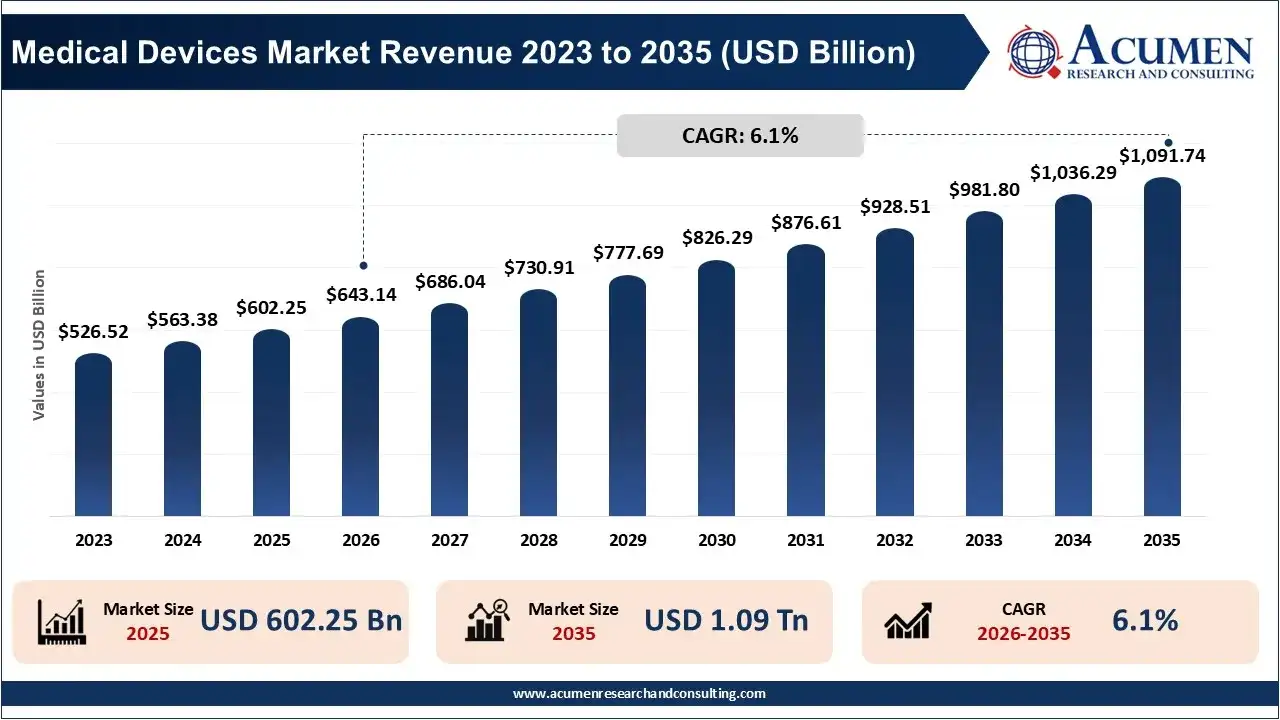
Medical Devices Market Statistics
- By product type, therapeutic devices held the largest market share of 34% in 2025. Rising prevalence of chronic diseases and expanding use of implantable, cardiovascular equipment, and therapeutic monitoring devices will continue to influence segment expansion. Product development and increasing use of minimally invasive treatment techniques will drive further market development.
- By product type, diagnostic devices garnered a 29% share of the market in 2025 and is predicted to attain 31% share by 2035, with a projected CAGR of 6.8% in the forecast period. Growing use of early detection diagnostics, point-of-care diagnostics, and AI-enhanced medical imaging techniques is a primary factor propelling market growth. Moreover, the continuing innovations in molecular diagnostics and digital medical imaging technologies will further bolster segment expansion.
- By product type, surgical and interventional devices represented a 24% share in the global medical devices market in 2025 and is projected to expand at a compound annual growth rate (CAGR) of 6.5%. Expansion in minimally invasive and robotic-assisted surgeries coupled with imaging-guided interventions have spurred the need for innovative surgical devices, and the rise in surgical procedures globally is expected to drive demand for such devices in the long term.
- By device class, the Class II (moderate-risk) segment held the leading share of 58% of the global medical devices market in 2025. This category comprises diverse diagnostic equipment, imaging systems, monitors, and infusion pumps frequently employed in healthcare facilities. Constant innovation and wider approvals across medical sectors continue to augment this market.
- By application, the cardiovascular diseases application accounted for a 24% market share in 2025. An escalating rate of heart disease across the globe and increasing demand for pacemakers, cardiovascular monitoring systems, stents, and procedures that are less intrusive contribute to market expansion. In addition, the increasing aged populace and lifestyle associated ailments continue to drive the market for years to come.
- The orthopedics application had the second largest market share of 15% in 2025. This is due to increasing number of orthopedic surgeries, osteoporosis cases, sports injuries and osteoarthritis. Rise in sports injuries, the aging population and increasing use of implants and orthopedic surgical instruments further propel segment growth.
- In the forecast period, neurology is expected to be the fastest growing application segment in the global medical devices market due to its growing application in the treatment of a wide range of neurological diseases such as Parkinson’s disease, epilepsy, and Alzheimer’s disease. In addition, growth in advanced neurostimulation device technology will augment the segment growth.
- By end user, hospitals occupied 52% of the market share in 2025. The hospital segment is likely to dominate the market for the next few years because hospitals offer higher quality treatments and have advanced equipment for the care of patients in emergency rooms or critically ill patients.
- Ambulatory surgical centers (ASCs) hold 12% of the market share in 2025, with the fastest-growing CAGR of 8.1%. The rise in the acceptance of outpatient surgical procedures in these facilities, with lower cost and shorter recovery times than hospitals.
How is Medical Devices Market Expanding?
The global medical devices market involves the development, manufacturing, marketing, sales, distribution, and servicing of medical instruments, devices, equipment, implants, software, diagnostic systems, and consumables. The scope of medical devices includes but is not limited to, medical and surgical equipment, diagnostic devices, cardiovascular devices, neurological devices, orthopedic implants, robotic surgery devices, monitoring devices, respiratory devices, diabetic monitoring devices, in vitro diagnostics (IVD) devices, in vivo diagnostics devices, implantable devices, wearable health devices, and home healthcare equipment.
These products are used in a wide array of health care settings such as hospitals, doctor’s offices, clinics, outpatient centers, labs, home care services, research facilities and the like, to diagnose diseases, prevent diseases, monitor a disease’s progress, and for the treatment or cure of disease. As cutting-edge technology like artificial intelligence, IoT devices, and robotic instruments are now in the process of enhancing the capabilities of such medical devices; innovation in medical technology is projected to become a highly impactful innovation sector in the next decade.
Will AI-Powered Smart Medical Devices Transform the Future of Healthcare Delivery?
One of the greatest opportunities for the global medical devices market is the rapid convergence of AI, connected medical devices, IoMT, digital therapeutics and remote patient monitoring. As the demand for healthcare providers leveraging intelligent diagnostic solutions, AI powered image management, wearable sensors and robotics for surgery and patient care grows, we are see the emergence of medical devices with better diagnostic and prediction capabilities to lower the rate of patient admissions and to enable tailored medicine for individual cases.
With healthcare shifting to home-based care models, the growth of smart medical devices that enable seamless real-time data collection with the capacity to operate from cloud platforms with intelligent clinical assistance tools, should gain momentum over the years. This progress toward digitization within the healthcare sphere represents potential growth for those in medical devices that continue to enhance digital health ecosystems, integrate interoperable platforms, improve security measures, and utilize the next generation of connected medical devices.
Medical Devices Market Regional Outlook
North America led the global medical devices market with a market share of 39% in 2025. The regional market was valued at $234.88 billion in 2025 and is expected to reach $390.84 billion by 2035, growing at a CAGR of 5.1% during the forecast period. The North American market is characterized by well-established healthcare infrastructure, high healthcare spending, fast adoption of innovative medical technologies, and a positive reimbursement scenario.
Ongoing investments in robotic surgery, AI-powered diagnostic tools, digital health solutions, wearables, and minimally invasive surgical procedures are driving the market.
Furthermore, the robust presence of key manufacturers and new product approvals contribute to the region's market dominance. The United States is the world's leading medical devices market due to its sophisticated healthcare system, vast network of hospitals, and strong medical technology innovation.
It is a frontrunner in robotic-assisted surgery, advanced imaging techniques, cardiovascular devices, and digital health technologies. Strict regulations, substantial R&D spending, and growing digital transformation of healthcare further fuel growth in the US medical devices sector.
Asia Pacific held a 24% share of the global market in 2025, and it is expected to witness the fastest growth rate with a CAGR of 7.8% during the forecast period. The Asia Pacific market was valued at $144.54 billion in 2025 and is forecast to reach $ 304.59 billion by 2035. Factors such as rapidly increasing urbanization, growing healthcare expenditure, wider health insurance coverage, and favorable government initiatives promoting indigenous medical device manufacturing are propelling the regional market.
Countries like China, India, Japan, and South Korea are making significant investments in improving healthcare infrastructure, digitizing hospitals, implementing AI-based diagnostics, and developing local manufacturing capabilities, making Asia Pacific the most dynamic market regionally.
Top Companies in the Medical Devices Market
The global medical devices market is very competitive, dominated by many global multinationals investing in the digital transformation of healthcare: medical devices technology, AI, robotics and minimally invasive surgical solutions. A small group of global medical device players like Medtronic, Johnson & Johnson MedTech, Abbott Laboratories, Boston Scientific, Stryker, GE HealthCare, Siemens Healthineers, Philips, Becton, Dickinson and Company and Zimmer Biomet have achieved a commanding market position, mostly through continued product innovation, acquisitions and global facility footprint expansion.
Global players are essential to bringing advanced, modern health systems to bear to create next-generation medical devices such as new diagnostic image, surgical robots, cardiac rhythm devices, implantable and other devices that manage and treat chronic conditions, orthopedic joint replacements and trauma solutions, diabetes solutions, and health information technology tools to support hospital and clinicians with AI for better medical decisions.
Segments Covered in the Report
By Product Type
- Diagnostic Devices
- Therapeutic Devices
- Surgical & Interventional Devices
- Patient Aids & Medical Supplies
By Device Class
- Class I (Low-risk Devices)
- Class II (Moderate-risk Devices)
- Class III (High-risk Devices)
By Application
- Cardiovascular Diseases
- Orthopedics
- Diagnostic Imaging
- Diabetes Care
- Neurology
- Respiratory Care
- Oncology
- Ophthalmology
- General Surgery
- Others
By End User
- Hospitals
- Ambulatory Surgical Centers (ASCs)
- Diagnostic Centers
- Specialty Clinics
- Home Healthcare Settings
- Academic & Research Institutes
By Region
- North America
- Europe
- Asia-Pacific
- Latin America
- Middle East & Africa
Contact Us:
Mr. Richard Johnson
Acumen Research and Consulting
India: +91 8983225533