
Generative AI Market Size, Share, Growth and Forecast 2026 To 2035
Generative AI Market (By Component: Software, Services; By Technology: Transformers, Generative Adversarial Networks (GANs), Diffusion Networks, Variational Auto-encoders; By Model: Multi-Modal Generative Models, Large Language Models, Image & Video Generative Models, Others; By Application: Predictive Analytics, Computer Vision, NLP, Robotics And Automation, Content Generation, Chatbots & Intelligent Virtual Assistants, Others; By End User: Media & Entertainment, BFSI, IT & Telecommunication, Healthcare, Automotive & Transportation, Others) - Global Industry Analysis, Size, Share, Analysis, Trends and Forecast 2026 - 2035
- Last Updated: 16 Feb 2026
- Report Code: ARC3091
- Category: ICT
Generative AI Market Size and Forecast 2026 - 2035
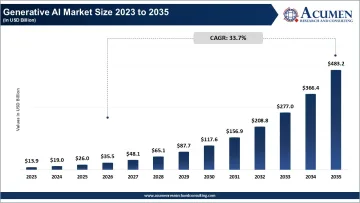
The global generative AI market is expected to grow from USD 26.02 billion in 2025 to USD 483.24 billion by 2035, at a staggering CAGR of 33.7% during the forecast period from 2026 to 2035. The growth of generative AI market is primarily attributed by rapid adoption of generative ai in enterprises to achieve automation and enhance productivity. Organizations are largely integrating generative AI in their work processes to automate content creation, documentation, customer support, and internal operations, thereby reducing operational costs.
Generative AI Market Highlights
- The global Generative AI Market is projected to reach USD 483.24 billion by 2035, growing at a CAGR of 33.7% from 2026 to 2035.
- In 2025, North America Generative AI Market was valued at approximately USD 10.93 billion.
- Asia-Pacific region is expected to witness fastest growth in generative AI adoption, registering a CAGR of 36.2% from 2026 to 2035.
- The software component held a significant share, accounting for 65% of the market in 2025.
- By technology, transformers segment dominated the market with around 41% market share in 2025.
- Growing adoption of AI-integrated solutions across numerous verticals is a prominent generative AI market trend that drives the industry demand.
- By models, the Large Language Models segment accounted for the largest share of 48% in 2025.
Generative AI Market Overview
Generative AI is a powerful new technology that creates new content rather than analyzing existing data. It refers to the creation of artifacts that previously required human intervention, enabling algorithms to generate realistic images, videos, and sounds. This technology is being tested in manufacturing for rapid prototyping and in businesses to enhance data for robotic process automation (RPA). Generative AI is transforming sectors such as art, design, and entertainment by producing original artwork, music, and interactive media. In healthcare, it aids with medication development and personalized therapy.
According to the IBM Center for the Business of Government, generative AI has great potential for altering government operations by increasing efficiency, improving decision-making, and providing better services to citizens. It may improve workflows, aid in digital transformation, and act as a user-friendly interface for complicated AI tools, making data-driven insights more accessible. However, successful deployment necessitates addressing issues such as data governance, ethical concerns, and worker training. Governments may maximize the potential of generative AI while avoiding associated risks by implementing strategic pathways and cultivating an innovative culture.
Generative AI Market Dynamics
Market Drivers
- Increasing adoption of AI in various industries
- Rising demand for machine learning and deep learning
- Growing need to optimize workflows across industries
- Integration of generative AI with internet of things (IoT) technologies
Market Restraints
- High implementation cost
- Lack of skilled workforce
- Limited interpretability and transparency of generative AI models
Market Opportunities
- Growing research & development activities in technology firms
- Extensive funding by private and public organization in AI
- Increasing focus on ethical and responsible AI development
Generative AI Market Report Scope
| Attribute | Details |
|---|---|
| Generative AI Market Size 2025 | USD 26.02 Billion |
| Generative AI Market Forecast 2035 | USD 483.24 Billion |
| Generative AI Market CAGR During 2026 - 2035 | 33.7% |
| Analysis Period | 2023 – 2035 |
| Base Year | 2025 |
| Forecast Data | 2026 – 2035 |
| Segments Covered | By Component, By Technology, By Model, By Application, By End-User, and By Geography |
| Regional Scope | North America, Europe, Asia Pacific, Latin America, and Middle East & Africa |
| Key Companies Profiled | Amazon Web Services, Inc., Adobe, D-ID, Genie AI Ltd., Google LLC, IBM, Microsoft, MOSTLY AI Inc., Rephrase.ai, and Synthesia |
| Report Coverage | Market Trends, Drivers, Restraints, Competitive Analysis, Player Profiling, Regulation Analysis |
Generative AI Market Insights
One of the major factors driving the growth of generative AI is the increasing complexity of information technology and other high-tech industries. For example, CompTIA's IT Industry Outlook 2025 emphasizes on the increasing complexity of information technology. As firms incorporate sophisticated technologies such as cloud computing and artificial intelligence, IT systems become more complex, demanding a strong infrastructure and qualified individuals to run them efficiently. This complication emphasizes the requirement of ongoing learning and adaptation within the IT staff in order to handle the changing technology environment. As a result, there is an increasing demand for solutions that may simplify IT processes and improve system efficiency. As these fields get more complicated, the demand for generative AI rises because it provides novel answers to complex issues.
Moreover, the healthcare industry is embracing AI at a rapid pace, creating a surge in demand for generative AI applications. As an illustration, Microsoft Corporation unveiled a groundbreaking model in March 2023 called Visual ChatGPT. This innovative creation integrates several visual foundation models, empowering users to engage with ChatGPT through intuitive graphical interfaces. Through Visual ChatGPT, users can seamlessly submit requests for tasks such as image generation and editing, ushering in a new era of interactive AI interaction. Generative AI technology is proving invaluable in combating issues like spam and phishing attacks, particularly in industries like banking, healthcare, media, and telecommunications.
However, despite these hurdles, the future looks promising. Generative AI is expected to become more accessible across all industries, driving down technology costs significantly. Already, major players like OpenAI have introduced groundbreaking tools like 'ChatGPT', revolutionizing human-like interactions and problem-solving.
Rising Demand for Machine Learning and Deep Learning Create Demand for Generative AI Industry
The growing need for machine learning and deep learning technologies is a major driver of the generative AI industry. According to the World Economic Forum, demand for AI and machine learning specialists is expected to rise by 40%, creating approximately 1 million new jobs, as AI and machine learning continue to change industries. Recent studies on Generative AI imply that it could have a significant impact on a wide range of job duties across industries.
Furthermore, deep learning models, such as generative adversarial networks (GANs) use generative AI techniques to generate realistic outputs including pictures, text, and sound. This is essential for a variety of applications, including picture and audio recognition, natural language processing, and creative content development. As businesses depend more on machine learning and deep learning for automation and optimization, the need for generative AI to enable these technologies rises, propelling market growth.
Generative AI Market Regional Analysis
- The North America generative AI market is expected to grow from USD 10.93 billion in 2025 to USD 184.12 billion by 2035, at a staggering CAGR of 32.2% during the forecast period from 2026 to 2035.
- The Europe generative AI market is expected to grow from USD 7.02 billion in 2025 to USD 125.16 billion by 2035, at a staggering CAGR of 33.1% during the forecast period from 2026 to 2035.
- The Asia-Pacific generative AI market is expected to grow from USD 5.72 billion in 2025 to USD 126.13 billion by 2035, at a staggering CAGR of 36.2% during the forecast period from 2026 to 2035.
In terms of regional segments, in 2025, North America emerged as the frontrunner in the global generative AI market, boasting the highest revenue and accounting for the market share of 42%. The region grapples with a surge in fraudulent activities, prompting industries to turn to generative AI solutions for robust fraud detection and prevention. Additionally, the presence of tech giants like Google, Meta, Microsoft, and IBM, renowned for their pioneering work in AI, further solidifies North America's dominance in this field. IBM and SAP SE announced a new chapter of their relationship in May 2024, with a focus on integrating generative AI capabilities and industry-specific cloud solutions to assist clients optimize business value. The collaboration intends to create generative AI tools for RISE and integrate AI into SAP's business processes, including cloud solutions and line-of-business apps. Initially, IBM will integrate AI throughout SAP's cloud products, which are all built on the SAP Business Technology Platform (SAP BTP). Moreover, the healthcare sector in North America is witnessing a rapid adoption of digitally advanced devices empowered by AI, driving market growth.
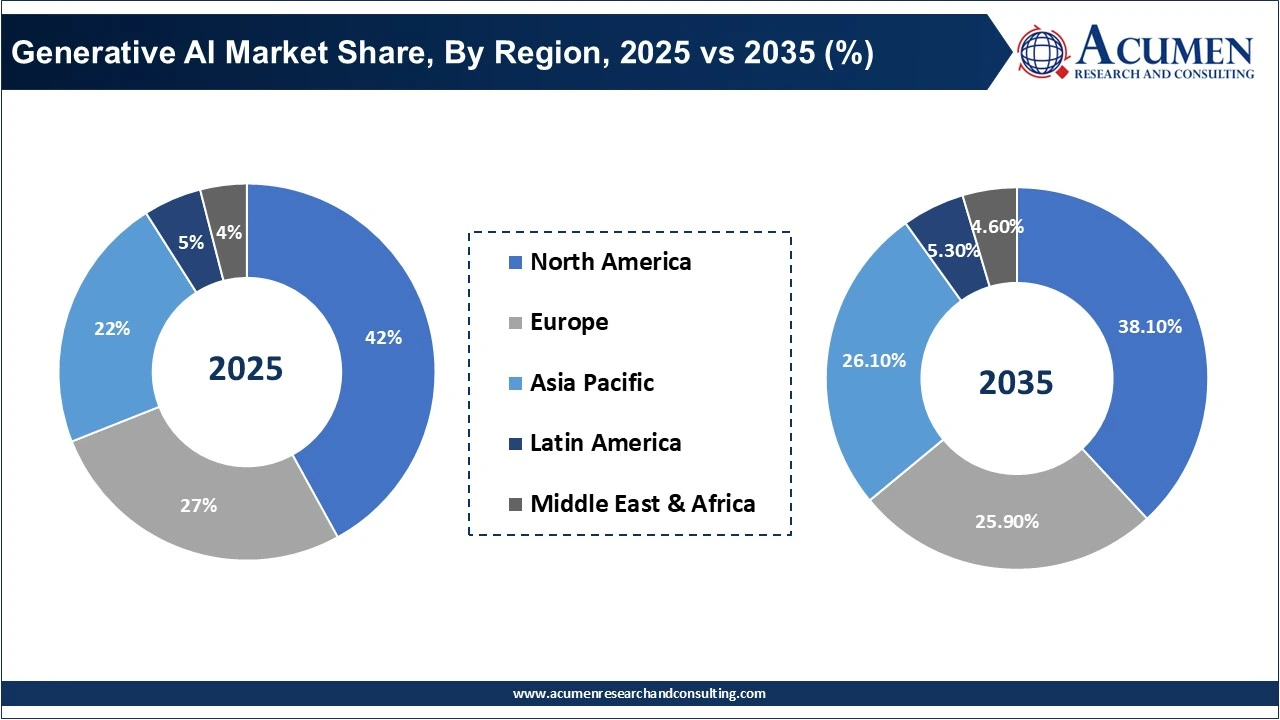
Looking ahead, the Asia-Pacific region is poised for remarkable growth at a CAGR of 36.2% during the period from 2026 to 2035. This surge can be attributed to a confluence of factors unique to the region. The widespread push towards digitization across various sectors, from finance to manufacturing, is creating a fertile ground for AI integration. Secondly, substantial investments are pouring into AI platforms, fueling innovation and expansion. For example, the BharatGen program, established in October 2024, aims to make generative AI available to residents in a variety of Indian languages. Science and Technology Minister Jitendra Singh referred to it as the world's first state-funded project of its sort. The Asia-Pacific region is witnessing a burgeoning ecosystem of AI startups, particularly in countries such as China, India, Japan, and South Korea., thus promising exponential growth in the coming years.
Generative AI Market Segmental Insights
The global generative AI market is split based on component, technology, model, application, end-user, and geography.
Component Insights
The software category emerged as the largest in 2025 within the sector, and it is projected to uphold its dominance in the foreseeable future. This commanding position is attributed to several key factors, including the surge in fraudulent activities, overestimated perceptions of AI capabilities, unforeseen results, and escalating apprehensions surrounding data privacy.
| Component | Market Share, 2025 (%) | Key Highlights |
|---|---|---|
| Software | 65% | Includes Generative AI platforms, models, APIs, enterprise suites, and subscription/usage revenue from cloud-based and on-premise solutions. Software captures the largest share due to recurring licensing and high adoption across industries. |
| Services | 35% | Consulting, integration, customization, training, and managed services support software deployment and value realization. Services are essential but represent a smaller share compared to core software revenue. |
In contrast, the service segment is poised for substantial expansion in the generative AI market forecast period, due to increased demand for personalized solutions and tailored support services. In April 2023, AWS introduced Amazon Bedrock, offering various generative AI services. This suite assists users in building chatbots, generating text, summarizing content, and classifying images based on prompts.
Technology Insights
Based on technology, the market is segmented into transformers, generative adversarial networks (GANs), diffusion networks, and variational auto-encoders,
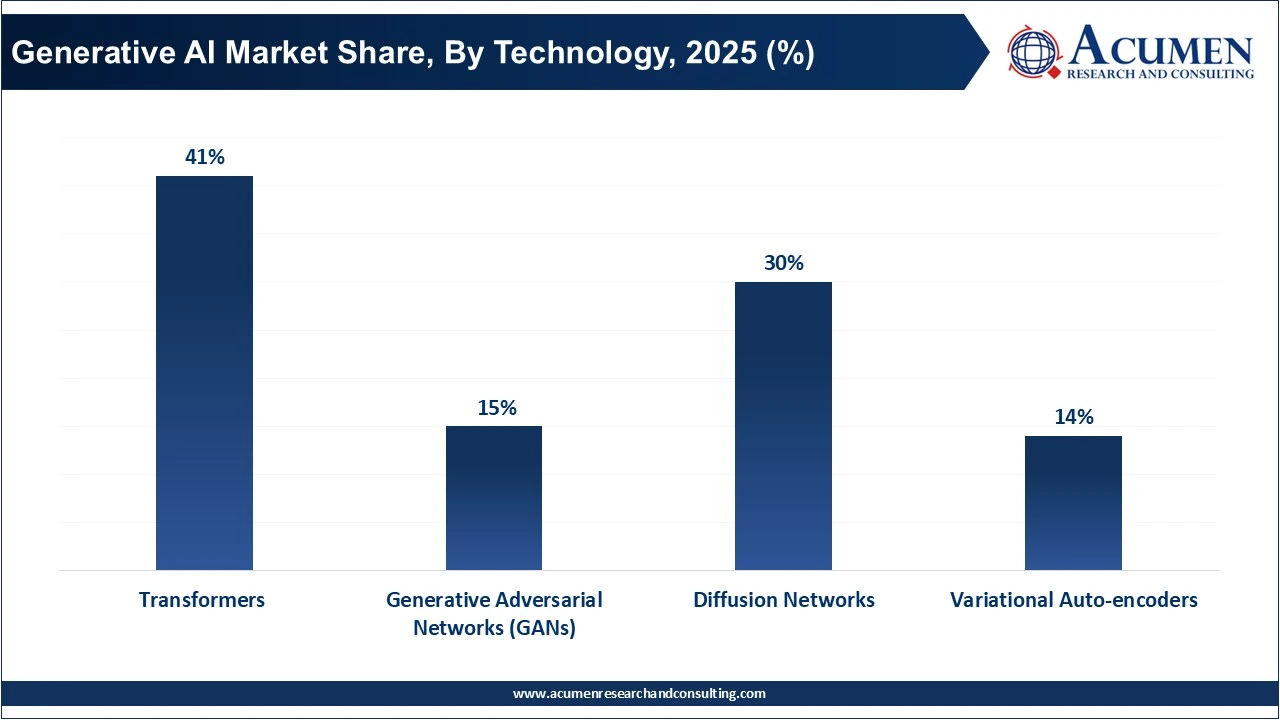
The generative AI market forecast indicates that the transformer sub-segment will emerge as a top revenue generator between 2025 and 2035, and it shows promising momentum moving forward. Transformers like LaMDA, GPT-3, and Wu-Dao excel in replicating cognitive attention and discerning the importance of various elements within input data. They undergo training to comprehend language or images, perform classification tasks, and generate text or imagery from extensive datasets.
| Technology | Market Share, 2025 (%) | Key Highlights |
|---|---|---|
| Transformers | 41% | Transformers power the majority of commercial generative AI models (LLMs, multimodal AI, text/code generation) and drive most enterprise AI revenue. |
| Generative Adversarial Networks (GANs) | 15% | Still used in niche applications (image synthesis, style transfer, domain adaptation), but relatively smaller share compared with transformers and diffusion models. |
| Diffusion Networks | 30% | Rapidly growing in visual content creation (images, video) and creative applications; strong adoption in media & design workflows. |
| Variational Auto-encoders | 14% | Play a role in representation learning and latent space generation, though limited direct commercial usage compared to transformers and diffusion approaches. |
Model Insights
The large language models (LLMs) category generates the most revenue in the generative AI market due to its wide range of applications and considerable influence across sectors. LLMs, such as GPT-4 and ChatGPT, are used in customer support, content production, coding assistance, and other applications, boosting demand in industries including as healthcare, banking, and entertainment. Their ability to interpret and generate human-like text makes them useful for automating complex processes, improving the user experience, and increasing productivity.
| Model | Market Share, 2025 (%) | Key Highlights |
|---|---|---|
| Multi-Modal Generative Models | 25% | Growing rapidly due to ability to generate across text, image, audio, and video (e.g., models combining vision + language). |
| Large Language Models | 48% | Dominant segment driven by text generation, chatbots, summarization, and enterprise deployments (e.g., GPT, BERT derivatives). |
| Image & Video Generative Models | 17% | Includes diffusion models, GANs used in creative design, media production, and visualization. |
| Others | 10% | Smaller categories such as code generation-specific models, music generators, specialized scientific data simulators. |
Furthermore, constant developments in natural language processing (NLP) and the integration of these models into enterprise solutions add to their market dominance, as firms engage substantially in using LLM capabilities to achieve a competitive advantage.
Application Insights
Content generation segment led the generative AI market application segment in 2025 with around 32% market share due to its extensive use in performing text-based tasks across media, design, and creative industries. NLP is another important application segment of Generative AI which enables applications like sentiment analysis, language translation, and information retrieval, providing valuable insights and improving communication efficiency. The integration of generative AI into customer service through chatbots and virtual assistants, as well as content generation, enhances user experience and operational efficiency. The growing demand for automated text analysis and conversational AI solutions drives Generative AI market leadership.
| Application | Market Share, 2025 (%) | Key Highlights |
|---|---|---|
| Predictive Analytics | 9% | Forecasting and insights in finance, supply chain, healthcare, and sales optimization using AI-based predictions. |
| Computer Vision | 12% | AI for image recognition, object detection, surveillance, quality inspection, and visual data interpretation. |
| NLP | 18% | Language understanding tasks including sentiment analysis, language translation, summarization, and semantic search. |
| Content Generation | 32% | AI-generated text, visuals, video, and audio for marketing, media, design, and creative industries. |
| Chatbots & Intelligent Virtual Assistants | 20% | Conversational agents for customer service, support, and enterprise help desks. |
| Others | 4% | Specialized domains such as AI in bioinformatics, music generation, AI-assisted software coding, and domain-specific simulations. |
End-User Insights
According to the generative AI market forecast, the media & entertainment sector has secured the leading share of around 23% in 2025 and is poised to sustain its prominence in the foreseeable future. The growing adoption of generative AI to craft highly impactful advertising campaigns is anticipated to fuel its demand within this industry. Conversely, the BFSI sub-segment is predicted to witness a significant growth trajectory from 2026-2035 driven by increasing need for advanced fraud detection and risk management solutions within the banking and financial sectors.
| End User | Market Share, 2025 (%) | Use Cases |
|---|---|---|
| Media & Entertainment | 23% | Content creation (text/image/video), personalization, gaming, VFX |
| BFSI | 18% | Fraud detection, predictive analytics, chatbots, document automation |
| IT & Telecommunication | 21% | AI-enabled services, automation, customer support, network optimization. |
| Healthcare | 15% | Medical imagery, diagnostics, clinical documentation, drug discovery |
| Automotive & Transportation | 12% | Autonomous driving data, simulations, predictive maintenance |
| Others | 11% | Retail, education, government, energy, manufacturing |
Generative AI Market Players
- Amazon Web Services, Inc.
- Adobe
- D-ID
- Genie AI Ltd.
- Google LLC
- IBM
- Microsoft
- MOSTLY AI Inc.
- Rephrase.ai
- Synthesia
Market Segmentation
By Component
- Software
- Services
By Technology
- Transformers
- Generative Adversarial Networks (GANs)
- Diffusion Networks
- Variational Auto-encoders
By Model
- Multi-Modal Generative Models
- Large Language Models
- Image & Video Generative Models
- Others
By Application
- Predictive Analytics
- Computer Vision
- NLP
- Robotics And Automation
- Content Generation
- Chatbots & Intelligent Virtual Assistants
- Others
By End User
- Media & Entertainment
- BFSI
- IT & Telecommunication
- Healthcare
- Automotive & Transportation
- Others
By Region
- North America
- U.S.
- Canada
- Europe
- U.K.
- Germany
- France
- Spain
- Rest of Europe
- Asia-Pacific
- India
- Japan
- China
- Australia
- South Korea
- Rest of Asia-Pacific
- Latin America
- Brazil
- Mexico
- Rest of LATAM
- The Middle East & Africa
- South Africa
- GCC Countries
- Rest of the Middle East & Africa (ME&A)
Looking for discounts, bulk pricing, or custom solutions? Contact us today at sales@acumenresearchandconsulting.com
Frequently Asked Questions

Other ICT Reports
February 2024
March 2025
April 2023
November 2023