
Gene Therapy CDMO Market Size, Share, Forecast Report 2026 To 2035
Gene Therapy CDMO Market (By Vector / Platform Type: Adeno-Associated Virus (AAV), Lentivirus, Adenovirus and Other Viral Vectors, Plasmid DNA, Non-Viral; By Service Type: Vector / Drug Substance Manufacturing, Process and Analytical Development, Fill-Finish, Testing and Release, Others; By Therapy Approach: In Vivo Gene Therapy, Ex Vivo Gene Therapy; By Production System: Transient Transfection, Stable Producer / Packaging Cell Lines, Baculovirus-Insect Cell (Sf9) Systems; By Development Phase: Preclinical, Clinical (Phase I–III), Commercial; By Therapeutic Indication: Oncology, Rare Genetic Disorders, Hematological Disorders, Ophthalmology, Neurology / CNS, Cardiovascular and Others; By End User: Small and Mid-Sized Biotechnology Companies, Large Pharmaceutical Companies, Academic and Non-Profit Institutions) - Global Industry Analysis, Size, Share, Regional Analysis, Trends and Forecast 2026 - 2035
- Last Updated: 17 Nov 2026
- Report Code: ARC4010
- Category: Healthcare and Pharmaceuticals
Gene Therapy CDMO Market Insights 2026 To 2035
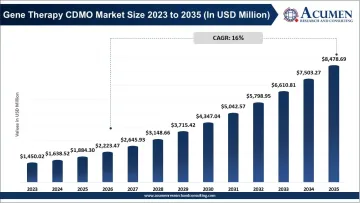
The global gene therapy CDMO market size was valued at $1,884.30 million in 2025 and is expected to surpass around $8,478.69 million by 2035; expanding at a CAGR of 16.0% during the forecast period from 2026 to 2035. The Gene Therapy CDMO Market is expanding due to increasing gene therapy research, rising demand for specialized viral vector manufacturing, growing pharmaceutical outsourcing, and the commercialization of advanced therapies. Investments in GMP facilities and scalable manufacturing technologies are further supporting market growth.
Gene Therapy CDMO Market Size & Forecast
- Base Year Market Size (2025): $1,884.30 million
- Current Year Market Size (2026): $2,223.47 million
- Estimated Year Market Size (2035): $8,478.69 million
- Forecast Period CAGR (2026-2035): 16%
- Leading Region: North America (revenue share 48%)
Key Takeaways
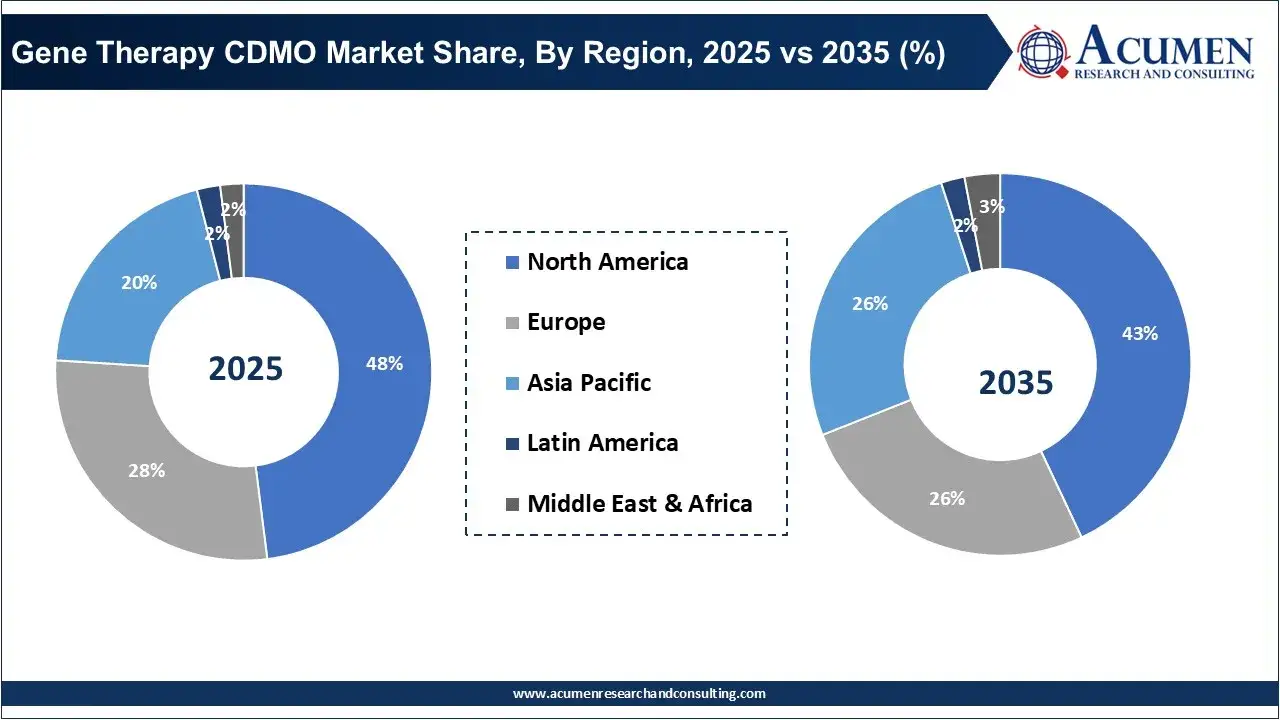
- By Region: North America dominated the regional segment with a 48.0% share in 2025, equivalent to USD 904.46 million, and is projected to reach USD 3,645.84 million by 2035 at a CAGR of 14.8%.
- By Vector / Platform Type: Adeno-associated virus (AAV) dominated the vector/platform type segment with a 44.0% share in 2025, generating USD 829.09 million, and is projected to reach USD 3,391.48 million by 2035 at a CAGR of 14.9%.
- By Service Type: Vector/drug substance manufacturing dominated the service type segment with a 52.0% share in 2025, valued at USD 979.84 million, and is projected to reach USD 4,239.35 million by 2035 at a CAGR of 15.6%.
- By Therapy Approach: In vivo gene therapy dominated the therapy approach segment with a 56.0% share in 2025, generating USD 1,055.21 million, and is projected to reach USD 5,256.79 million by 2035 at a CAGR of 17.2%.
- By Production System: Transient transfection dominated the production system segment with a 72.0% share in 2025, generating USD 1,356.70 million, and is projected to reach USD 4,663.28 million by 2035 at a CAGR of 12.9%.
- By Development Phase: Clinical development dominated the development phase segment with a 60.0% share in 2025, equivalent to USD 1,130.58 million, and is projected to reach USD 3,815.41 million by 2035 at a CAGR of 12.7%.
- By Therapeutic Indication: Oncology dominated the therapeutic indication segment with a 32.0% share in 2025, generating USD 602.98 million, and is projected to reach USD 2,543.61 million by 2035 at a CAGR of 15.3%.
- By End User: Small and mid-sized biotechnology companies dominated the end-user segment with a 66.0% share in 2025, generating USD 1,243.64 million, and are projected to reach USD 4,917.64 million by 2035 at a CAGR of 14.5%.
Gene Therapy CDMO Market Overview
The global gene therapy CDMO market is gaining momentum as pharmaceutical and biotechnology companies increasingly rely on specialized contract development and manufacturing organizations (CDMOs) to support the development, production, and commercialization of gene-based therapies. Gene therapy manufacturing involves complex processes, including vector design, plasmid DNA production, upstream and downstream processing, purification, analytical testing, and GMP-compliant manufacturing.
The growing pipeline of therapies targeting rare genetic disorders, oncology, neurological conditions, and inherited diseases is increasing demand for specialized manufacturing infrastructure and technical expertise. Additionally, the high capital investment, regulatory complexity, and technical requirements associated with establishing in-house manufacturing facilities are encouraging biotechnology developers to outsource production activities to experienced CDMO providers.
Gene Therapy Manufacturing Capacity and Infrastructure Analysis
- Clinical Development Pipeline: More than 3,200 cell and gene therapy clinical trials were recorded during 2018–2023, highlighting the growing requirement for specialized development, process optimization, and GMP manufacturing capabilities. The expanding clinical pipeline creates demand for manufacturing services across preclinical, early-stage, and late-stage development programs.
- Regulatory Manufacturing Infrastructure: As of May 15, 2025, the U.S. FDA had approved 45 cell and gene therapy products, while the European Medicines Agency had granted centralized authorization to 20 cell and gene therapy products classified as advanced therapy medicinal products (ATMPs). These figures cover combined advanced therapy categories, not exclusively gene therapies.
- Viral Vector Manufacturing Capacity: AAV and lentiviral vectors represent important manufacturing platforms in the gene therapy industry. Industry outsourcing surveys have indicated that 62% of respondents outsourced viral vector manufacturing capabilities to CDMOs, with the proportion expected to increase to 68% by 2026, reflecting the importance of external manufacturing partnerships.
- CDMO Outsourcing Infrastructure: Industry survey findings indicate that 44% of respondents used CDMOs to supplement existing internal manufacturing capabilities, approximately 25% lacked internal cell and gene therapy manufacturing capabilities, and around 20% outsourced all manufacturing activities. This demonstrates the importance of flexible outsourcing models.
- AAV Manufacturing Market Expansion: The global AAV vector manufacturing market was valued at approximately USD 1.0 billion in 2024 and is projected to reach USD 2.8 billion by 2030, registering a CAGR of 18.6% during 2025–2030. This growth reflects increasing demand for specialized vector production infrastructure, although the market includes manufacturing beyond outsourced CDMO services.
Gene Therapy CDMO Market Dynamics
Market Drivers
Increasing Gene Therapy Clinical Pipeline and Commercialization
- The growing number of gene therapy candidates targeting rare genetic disorders, oncology, and inherited diseases is increasing demand for specialized development and manufacturing services. As more candidates progress into advanced clinical trials, biotechnology companies require reliable GMP production capabilities, supporting long-term CDMO outsourcing demand.
Rising Outsourcing of Gene Therapy Manufacturing Activities
- Pharmaceutical and biotechnology companies are increasingly outsourcing complex manufacturing processes to specialized CDMOs to reduce infrastructure investments, access technical expertise, and accelerate development timelines. The growing need for viral vector production, analytical testing, and process optimization is further supporting demand for integrated manufacturing services.
Market Restraints
High Capital Investment and Manufacturing Costs
- Establishing gene therapy manufacturing facilities requires substantial capital investment in specialized equipment, cleanrooms, bioreactors, quality control infrastructure, and skilled personnel. High operating costs and complex production requirements can limit facility expansion, particularly for smaller CDMOs and emerging biotechnology manufacturing providers.
Complex Regulatory Requirements and Quality Standards
- Gene therapy manufacturing involves stringent regulatory requirements related to product characterization, potency testing, process validation, contamination control, and batch consistency. Maintaining compliance across different regulatory jurisdictions increases operational complexity and development costs, potentially delaying manufacturing timelines and commercialization activities.
Market Opportunities
Expansion of AAV and Lentiviral Vector Manufacturing Capabilities
- Increasing demand for viral vector-based therapies is creating opportunities for CDMOs to expand specialized AAV and lentiviral manufacturing facilities. Investments in high-yield production technologies, advanced purification systems, and scalable bioprocessing platforms can help manufacturers attract clinical-stage and commercial gene therapy development contracts.
Growing Demand for Integrated End-to-End Manufacturing Services
- Biotechnology companies increasingly require integrated services covering process development, plasmid DNA production, vector manufacturing, analytical testing, and commercial-scale production. CDMOs capable of offering coordinated development and manufacturing solutions can strengthen client relationships, improve technology transfer efficiency, and capture higher-value outsourcing opportunities.
Market Challenges
Manufacturing Scalability and Batch-to-Batch Consistency
- Maintaining consistent product quality while increasing manufacturing volumes remains a major challenge for gene therapy CDMOs. Variations in vector yield, product purity, potency, and process performance can affect production efficiency and regulatory compliance, particularly when transitioning from clinical-scale to commercial-scale manufacturing.
Capacity Utilization and Uncertain Commercial Demand
- Gene therapy CDMOs face challenges in balancing manufacturing infrastructure investments with uncertain clinical development outcomes and commercialization timelines. Delayed clinical trials, funding constraints, and changes in product demand can reduce facility utilization, increase operating costs, and negatively affect manufacturing profitability.
Gene Therapy CDMO Business Models and Revenue Streams
| Business model | Revenue generation mechanism | Key services | Primary customers |
|---|---|---|---|
| Fee-for-Service Model | Revenue generated through fixed charges for individual services or manufacturing activities. | Process development, analytical testing, vector production, and quality control. | Biotechnology startups and pharmaceutical companies. |
| Contract Manufacturing Model | Revenue generated through manufacturing agreements based on production volumes, batches, and agreed service requirements. | GMP viral vector manufacturing, plasmid DNA production, and commercial manufacturing. | Clinical-stage and commercial-stage biotechnology companies. |
| Integrated Development and Manufacturing Model | Revenue generated through bundled development and manufacturing contracts covering multiple stages of product development. | Process development, technology transfer, GMP manufacturing, testing, and fill-finish. | Pharmaceutical companies and advanced therapy developers. |
| Milestone-Based Contract Model | Revenue recognized against predefined development, regulatory, manufacturing, and project completion milestones. | Process validation, clinical batch production, technology transfer, and regulatory readiness. | Clinical-stage gene therapy developers. |
| Long-Term Manufacturing Partnership Model | Recurring revenue generated through multi-year manufacturing and supply agreements. | Commercial production, capacity reservation, quality management, and ongoing manufacturing support. | Pharmaceutical companies and commercial gene therapy manufacturers. |
Gene Therapy CDMO Market Segmental Insights
Vector / Platform Type Insights
Adeno-Associated Virus (AAV): AAV dominated the vector/platform type segment with a 44.0% share in 2025, generating USD 829.09 million. Its leadership is supported by widespread application in in vivo gene therapies, established manufacturing platforms, and increasing development of treatments for rare genetic and neurological disorders. The segment is projected to reach USD 3,391.48 million by 2035, with a 40.0% share and a CAGR of 14.9%.
Gene Therapy CDMO Market Share, By Vector / Platform Type, 2025 & 2035 (%)
| Vector / Platform Type | Revenue Share, 2025 (%) | Revenue Share, 2035 (%) |
|---|---|---|
| Adeno-associated virus (AAV) | 44% | 40% |
| Lentivirus | 24% | 22% |
| Adenovirus & other viral vectors | 8% | 6% |
| Plasmid DNA | 12% | 11% |
| Non-viral | 12% | 21% |
Lentivirus: Lentivirus accounted for the second-largest share of 24.0% in 2025, equivalent to USD 452.23 million. Its demand is supported by applications in ex vivo gene therapies, particularly in gene-modified cell treatments requiring efficient genetic material delivery. Increasing development of advanced therapies and demand for GMP-compliant lentiviral vector production are expected to support segment growth. Revenue is projected to reach USD 1,865.31 million by 2035, at a CAGR of 15.0%.
Service Type Insights
Vector / Drug Substance Manufacturing: Vector and drug substance manufacturing dominated the service type segment with a 52.0% share in 2025, equivalent to USD 979.84 million. Its leadership is supported by the technical complexity of viral vector production, increasing demand for AAV and lentiviral manufacturing, and the need for specialized upstream and downstream processing capabilities.
Gene Therapy CDMO Market Share, By Service Type, 2025 & 2035 (%)
| Service Type | Revenue Share, 2025 (%) | Revenue Share, 2035 (%) |
|---|---|---|
| Vector / drug substance manufacturing | 52% | 50% |
| Process & analytical development | 22% | 19% |
| Fill-finish | 10% | 11% |
| Testing & release | 11% | 13% |
| Others | 5% | 7% |
Process and Analytical Development: Process and analytical development accounted for the second-largest share of 22.0% in 2025, generating USD 414.55 million. Demand is supported by the need for process optimization, analytical method development, product characterization, and technology transfer across different clinical development stages. Increasing regulatory requirements for product quality and manufacturing consistency are expected to sustain demand.
Therapy Approach Insights
In Vivo Gene Therapy: In vivo gene therapy dominated the therapy approach segment with a 56% share in 2025, generating USD 1,055.21 million. Its leadership is supported by the increasing development of therapies that deliver genetic material directly into patients, particularly through AAV-based delivery platforms. Growing research into rare genetic disorders, neurological conditions, and other inherited diseases is supporting demand for specialized vector development and manufacturing.
Ex Vivo Gene Therapy: Ex vivo gene therapy accounted for a 44% share in 2025, generating USD 829.09 million. Its manufacturing demand is supported by the use of viral vectors to genetically modify cells outside the patient's body before reinfusion. Increasing development of gene-modified cellular treatments and demand for specialized vector production, process development, and quality testing are supporting the segment.
Production System Insights
Transient Transfection: Transient transfection dominated the production system segment with a 72% share in 2025, generating USD 1,356.70 million. Its leadership is supported by widespread use in AAV and lentiviral vector manufacturing, established HEK293 production platforms, and flexibility across different clinical development programs.
Stable Producer / Packaging Cell Lines: Stable producer and packaging cell lines accounted for a 16% share in 2025, equivalent to USD 301.49 million. The segment is expected to register the fastest growth, with a CAGR of 23.3% during 2026–2035. Increasing interest in consistent vector production, reduced reliance on repeated transfection processes, and improved manufacturing scalability is supporting adoption.
Development Phase Insights
Clinical (Phase I–III): The clinical development phase dominated the segment with a 60.0% share in 2025, generating USD 1,130.58 million. Its leadership is supported by the substantial manufacturing requirements of clinical trials, including GMP-compliant vector production, analytical testing, process validation, and batch release.
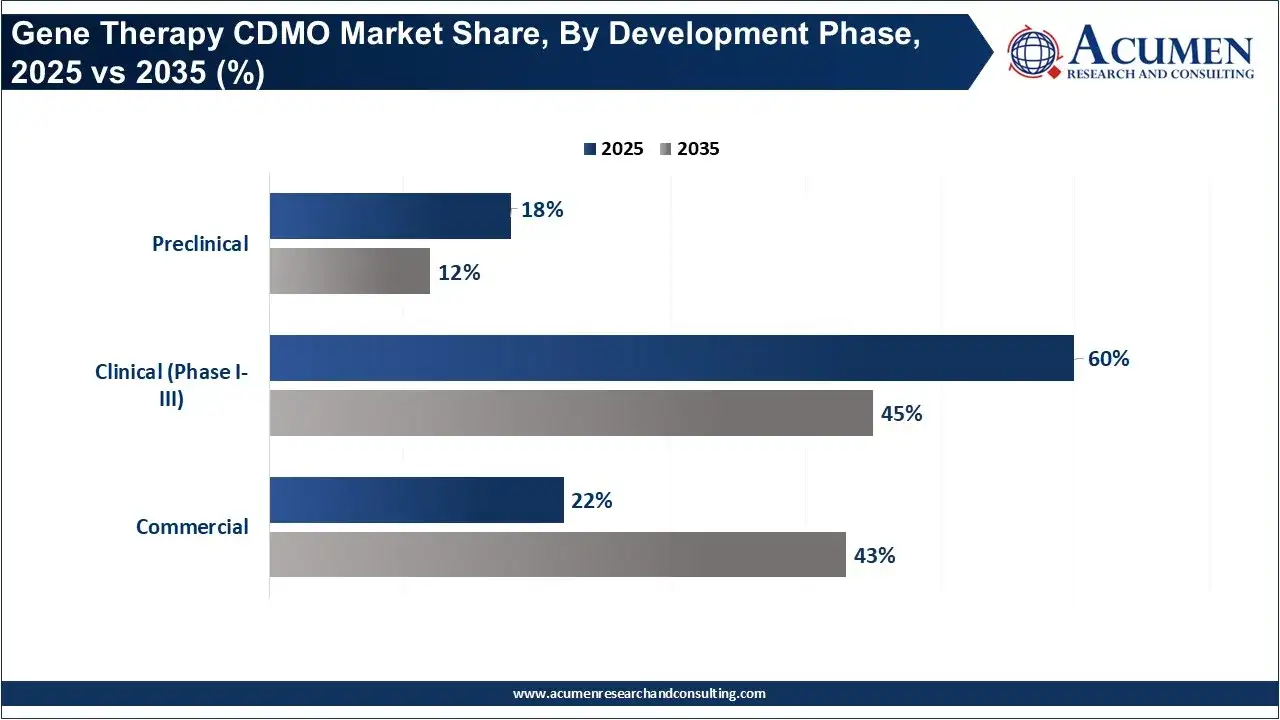
Commercial: The commercial segment accounted for a 22.0% share in 2025, generating USD 414.55 million. It is expected to be the fastest-growing development phase, registering a CAGR of 23.7% during 2026–2035. Increasing regulatory approvals, commercialization of gene therapies, and demand for consistent large-scale GMP production are expected to drive segment expansion.
Therapeutic Indication Insights
Oncology: Oncology dominated the therapeutic indication segment with a 32.0% share in 2025, generating USD 602.98 million. Its leadership is supported by increasing research into genetic approaches for cancer treatment, growing development of gene-modified cellular therapies, and demand for specialized viral vector manufacturing.
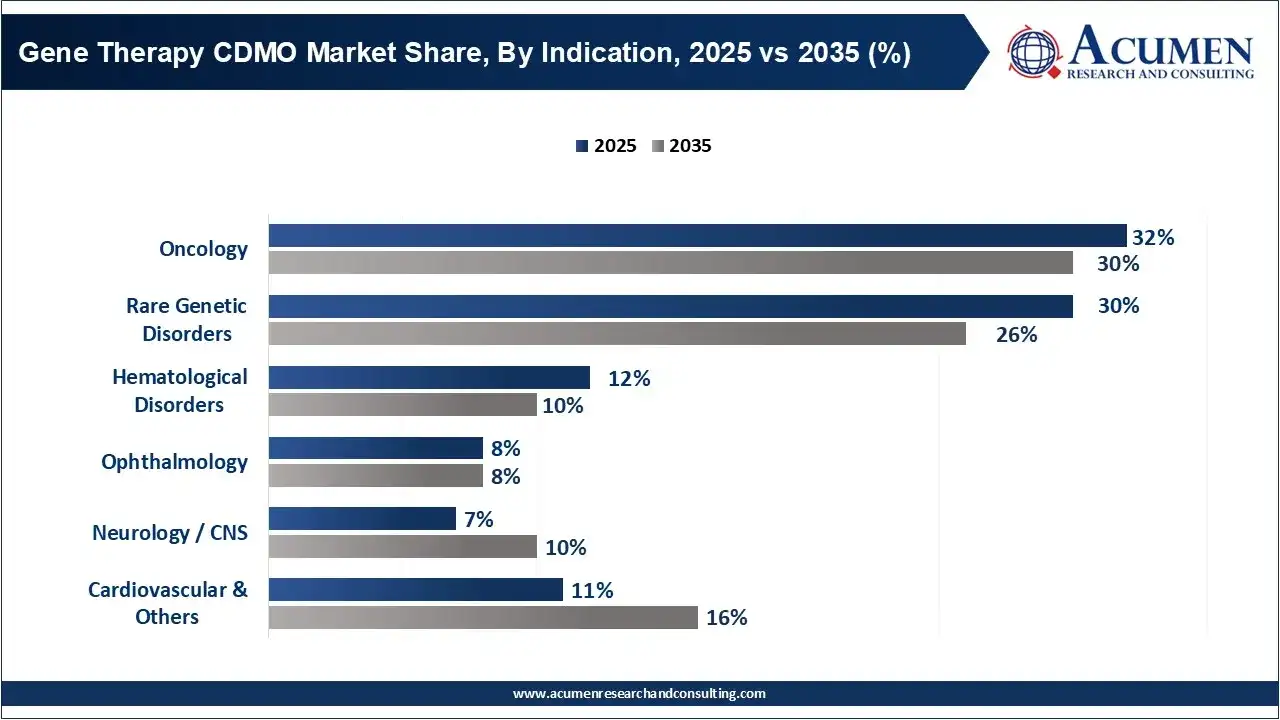
Rare Genetic Disorders: Rare genetic disorders accounted for the second-largest share of 30.0% in 2025, generating USD 565.29 million. Demand is supported by increasing development of therapies targeting inherited neuromuscular, metabolic, and lysosomal disorders. The need for specialized vector development, process optimization, and GMP manufacturing is creating opportunities for CDMOs supporting clinical and commercial gene therapy programs.
End User Insights
Small and Mid-Sized Biotechnology Companies: Small and mid-sized biotechnology companies dominated the end-user segment with a 66% share in 2025, generating USD 1,243.64 million. Their leadership is supported by extensive reliance on outsourced manufacturing, limited internal GMP infrastructure, and the need to access specialized viral vector production and analytical development capabilities.
Large Pharmaceutical Companies: Large pharmaceutical companies accounted for the second-largest share of 26% in 2025, generating USD 489.92 million. This segment is expected to register the fastest growth among end users, with a CAGR of 19.1% during 2026–2035. Its share is projected to increase to 34.0% by 2035, with revenue reaching USD 2,882.76 million.
Gene Therapy CDMO Market PESTLE Analysis
- Political Factors: Government funding, biotechnology policies, and domestic biomanufacturing initiatives influence gene therapy manufacturing investments and regional industry expansion.
- Economic Factors: High infrastructure costs, pharmaceutical R&D expenditure, venture capital funding, and manufacturing economics influence CDMO investment decisions.
- Social Factors: Increasing awareness of genetic disorders and demand for advanced treatments support gene therapy research and manufacturing requirements.
- Technological Factors: Advancements in viral vector engineering, bioprocessing, automation, and analytical technologies improve manufacturing efficiency and scalability.
- Legal Factors: Regulatory compliance, GMP standards, intellectual property protection, and clinical manufacturing guidelines influence CDMO operations and partnerships.
- Environmental Factors: Specialized cleanroom operations, biological waste management, energy consumption, and resource efficiency influence sustainable gene therapy manufacturing practices.
Gene Therapy CDMO Market Regional Insights
Which Region Dominates the Gene Therapy CDMO Market?
North America dominated the gene therapy CDMO market with a 48.0% share in 2025, generating USD 904.46 million. The region's leadership is supported by its established biotechnology ecosystem, strong pharmaceutical research and development expenditure, and extensive clinical development activities. The United States represents the primary market, supported by specialized viral vector manufacturing facilities, advanced GMP infrastructure, and the presence of major contract development and manufacturing organizations.
Increasing investments in AAV and lentiviral vector production, along with growing demand for process development, analytical testing, and commercial manufacturing services, are strengthening regional demand. Additionally, biotechnology startups increasingly rely on external manufacturing partners to access specialized production capabilities without establishing capital-intensive facilities.
Which Region Is Expected to Witness the Fastest Growth in the Gene Therapy CDMO Market?
The Middle East and Africa region is projected to register the fastest growth in the gene therapy CDMO market, with a CAGR of 20.7% during 2026–2035. The regional market is expected to increase from USD 46.69 million in 2026 to USD 254.36 million by 2035, with its share rising from 2.0% in 2025 to 3.0% by 2035. Growth is supported by increasing government investments in biotechnology, healthcare infrastructure modernization, and pharmaceutical manufacturing localization.
Countries such as Saudi Arabia and the United Arab Emirates are strengthening their life sciences ecosystems through investments in advanced healthcare technologies, research infrastructure, and international pharmaceutical partnerships. Increasing interest in domestic biopharmaceutical manufacturing and technology transfer is creating opportunities for specialized manufacturing providers.
Top Countries in Gene Therapy CDMO Market: Strategic Investment and Opportunity Analysis
- United States: The United States represents a major opportunity for gene therapy CDMO investments due to its established biotechnology ecosystem, extensive clinical development pipeline, pharmaceutical research expenditure, and advanced GMP manufacturing infrastructure. The presence of specialized vector manufacturing providers and strong venture capital activity supports demand for process development, AAV production, lentiviral manufacturing, and commercial-scale outsourcing services.
- China: China offers significant opportunities for gene therapy CDMO expansion through growing biotechnology investments, increasing clinical trial activity, and government support for domestic biopharmaceutical manufacturing. Investments in viral vector production facilities, advanced bioprocessing technologies, and integrated development capabilities are strengthening the country's manufacturing ecosystem. Domestic biotechnology companies also represent an important customer base for specialized outsourcing providers.
- United Kingdom: The United Kingdom presents attractive opportunities due to its established gene therapy research ecosystem, specialized biotechnology clusters, academic research institutions, and advanced therapy manufacturing infrastructure. Investments in GMP-compliant facilities and partnerships between biotechnology developers and manufacturing providers support demand for vector development, process optimization, analytical testing, and clinical manufacturing services.
- Germany: Germany offers investment opportunities through its strong pharmaceutical manufacturing base, biotechnology research capabilities, and established bioprocessing industry. The country's advanced industrial infrastructure and access to European pharmaceutical markets support the development of specialized gene therapy manufacturing facilities. Growing demand for GMP-compliant production, quality control, and technology transfer services creates opportunities for established and emerging CDMOs.
- Japan: Japan represents an emerging strategic market supported by government initiatives in regenerative medicine, advanced therapy research, and biotechnology commercialization. Its established pharmaceutical industry and specialized research infrastructure create opportunities for gene therapy CDMOs offering process development, vector manufacturing, and clinical production services. Increasing collaboration between domestic biotechnology companies and international manufacturing providers can further strengthen market development.
Gene Therapy CDMO Market Competitive Landscape
- Lonza (Switzerland)
- Thermo Fisher Scientific (United States)
- Oxford Biomedica (United Kingdom)
- AGC Biologics (Japan)
- Catalent (United States)
- Charles River Laboratories (United States)
- Genezen (United States)
- Viralgen (Spain)
- Andelyn Biosciences (United States)
- FUJIFILM Diosynth Biotechnologies (Japan)
Recent Developments
- In July 2026, OXB announced a GMP manufacturing partnership with Plowshare Therapies to support its AAV-based gene therapy program targeting rare genetic diseases. Under the agreement, OXB will provide process development and GMP manufacturing services through its FDA-approved commercial-scale viral vector manufacturing facility in Durham, North Carolina.
- In May 2026, Catalent and Elpida Therapeutics announced a strategic partnership to support late-stage manufacturing of Elpida's AAV9-based gene therapy candidate for Spastic Paraplegia Type 50 (SPG50). The agreement also grants Catalent exclusive manufacturing rights for Elpida's other AAV gene therapy pipeline programs, strengthening its position in specialized gene therapy manufacturing and commercial production services.
Segments Covered
By Vector / Platform Type
- Adeno-Associated Virus (AAV)
- Lentivirus
- Adenovirus and Other Viral Vectors (HSV, Retrovirus, Vaccinia)
- Plasmid DNA (GMP, as Starting Material or Product)
- Non-Viral (LNP-mRNA, Gene-Editing Payloads, Others)
By Service Type
- Vector / Drug Substance Manufacturing (Upstream and Downstream)
- Process and Analytical Development
Fill-Finish - Testing and Release (QC, Potency, Safety)
- Others (Regulatory/CMC Support, Storage and Logistics)
By Therapy Approach
- In Vivo Gene Therapy
- Ex Vivo Gene Therapy (Vectors for Gene-Modified Cell Therapies)
By Production System
- Transient Transfection (HEK293, Adherent and Suspension)
- Stable Producer / Packaging Cell Lines
- Baculovirus-Insect Cell (Sf9) Systems
By Development Phase
- Preclinical
- Clinical (Phase I–III)
- Commercial
By Therapeutic Indication
- Oncology
- Rare Genetic Disorders (Neuromuscular, Metabolic, Lysosomal)
- Hematological Disorders
- Ophthalmology
- Neurology / CNS
- Cardiovascular and Others (Including Common Diseases)
By End User
- Small and Mid-Sized Biotechnology Companies
- Large Pharmaceutical Companies
- Academic and Non-Profit Institutions
By Region
- North America
- Europe
- Asia-Pacific
- Latin America
- Middle East & Africa
Looking for discounts, bulk pricing, or custom solutions? Contact us today at sales@acumenresearchandconsulting.com
Frequently Asked Questions

Related Market Research Reports
January 2020
November 2026
November 2026
October 2026
June 2026
April 2024
June 2024
May 2023