
Co-Packaged Optics Market Size, Share, Forecast Report 2026 To 2035
Co-Packaged Optics Market (By Component: Optical Engines, External Laser Sources (ELS), Fiber Attach, Shuffles and Connectivity, Packaging, Assembly and Test; By Application: Scale-Out Switching, Scale-Up Interconnect, HPC, DCI and Other; By Port Speed: 800G and Below, 1.6T, 3.2T and Above, By Integration Platform, Silicon Photonics, InP, TFLN, VCSEL and Other; By End User: Hyperscale Cloud Providers, AI Infrastructure / Neocloud Providers and AI Labs, HPC, Government and Research, Enterprise, Telecom and Others) - Global Industry Analysis, Size, Share, Analysis, Trends and Forecast 2026 - 2035
- Last Updated: 20 Nov 2026
- Report Code: ARC4013
- Category: Semiconductor and Electronics
Co-Packaged Optics Market Size, and Forecast Report 2026 To 2035
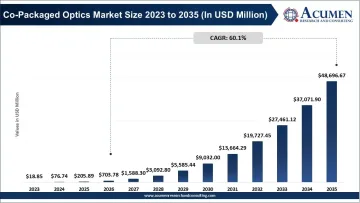
The global co-packaged optics market size was valued at USD 205.89 million in 2025 and is expected to reach around USD 48,696.67 million by 2035; expanding at a CAGR of 60.1% during the forecast period of 2026-2035. The co-packaged optics market is driven by rising AI data center investments, increasing bandwidth requirements, growing GPU interconnect traffic, and the need for energy-efficient optical communication. The transition toward 1.6T and 3.2T networking architectures is accelerating demand for integrated photonic solutions that overcome conventional electrical interconnect limitations.
Co-Packaged Optics Market Value & Projections
- Base Year Market Size (2025): $205.89 million
- Current Year Market Size (2026): $703.78 million
- Estimated Year Market Size (2035): $48,696.67 million
- Forecast Period CAGR (2026-2035): 60.1%
Key Takeaways
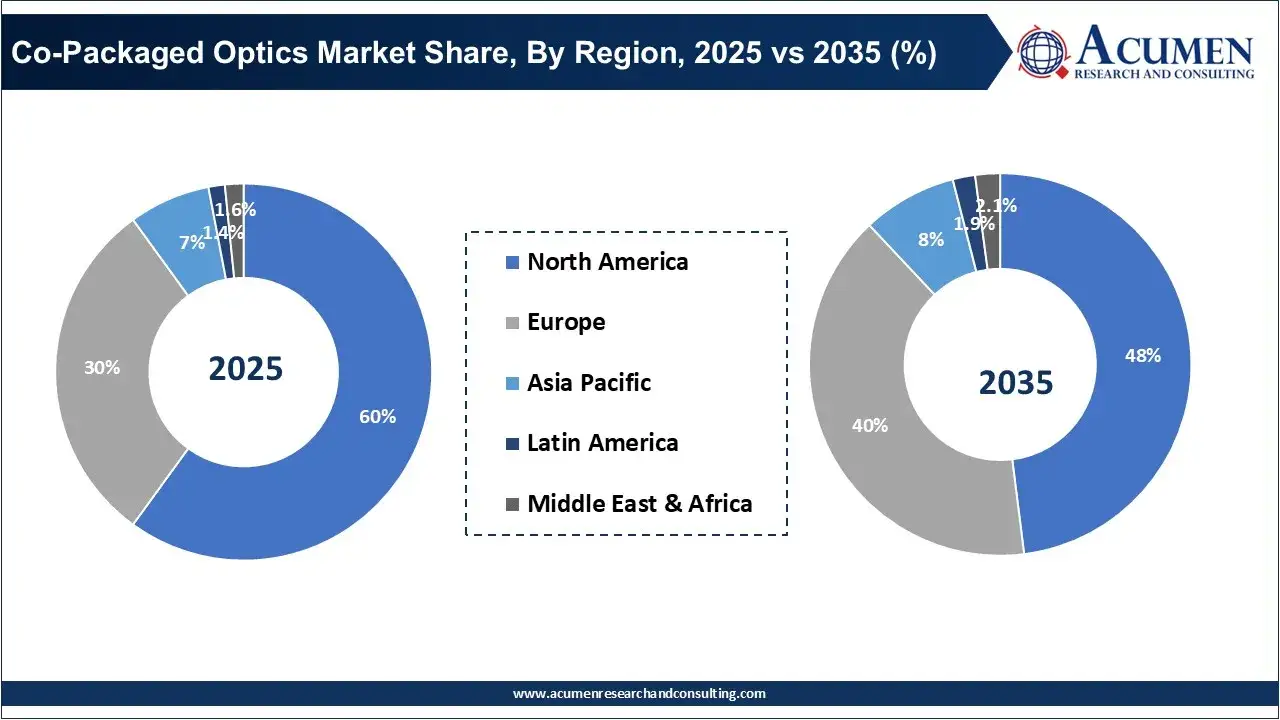
- By Region: North America dominated the regional segment with a 60% share in 2025, equivalent to USD 123.53 million. Its leadership is supported by established hyperscale cloud infrastructure, semiconductor capabilities, and strong investments in AI computing and advanced data centers.
- By Component: Optical engines dominated the component segment with a 62% share in 2025, valued at USD 127.65 million. Their dominance is supported by their central role in integrating photonic and electronic components for high-bandwidth optical communication.
- By Application: Scale-out switching dominated the application segment with an 86% share in 2025, generating USD 177.06 million. Its leading position is supported by early CPO adoption in Ethernet and InfiniBand switching architectures for hyperscale data centers.
- By Port Speed: 800G and below dominated the port speed segment with a 95% share in 2025, valued at USD 195.59 million. However, 3.2T and above is expected to be the fastest-growing category, supported by rising bandwidth requirements in next-generation AI infrastructure.
- By Integration Platform: Silicon photonics dominated the integration platform segment with a 92% share in 2025, generating USD 189.42 million. Its position is supported by semiconductor manufacturing compatibility, photonic integration capabilities, and scalability.
- By End User: Hyperscale cloud providers dominated the end-user segment with a 72% share in 2025, valued at USD 148.24 million. Their demand is driven by large-scale investments in cloud computing, AI data centers, and high-performance networking infrastructure.
Co-Packaged Optics Market Overview & Scope
The Co-packaged optics market is witnessing significant growth as data center operators, semiconductor manufacturers, and networking technology providers increasingly adopt optical connectivity solutions to address the bandwidth and power limitations of conventional pluggable transceivers. Co-packaged optics integrates optical engines, photonic integrated circuits, and electronic switching components within a common package or in close proximity, reducing electrical transmission distances and improving bandwidth density. The technology is gaining importance across hyperscale cloud infrastructure, artificial intelligence computing clusters, high-performance computing, and advanced Ethernet and InfiniBand switching systems.
The market encompasses optical engines, laser sources, fiber connectivity, packaging and testing solutions, alongside applications in scale-out switching, scale-up interconnects, and high-performance computing. North America currently represents the leading regional market, while Asia Pacific is strengthening its position through semiconductor manufacturing investments, photonics development, and advanced packaging capabilities.
Technology Landscape
- Silicon Photonics Integration: Silicon photonics is the primary integration platform for CPO architectures, enabling optical functions to be integrated with electronic components using semiconductor-compatible manufacturing processes. It supports compact optical engines, higher integration density, and scalable production.
- External Laser Source Technology: External laser sources provide continuous optical signals to photonic integrated circuits without requiring individual laser integration within every optical engine. This architecture supports improved thermal management, laser replacement, and operational reliability.
- Photonic Integrated Circuits (PICs): PICs combine optical components such as waveguides, modulators, and photodetectors on a single chip. They enable high-speed optical signal transmission and are central to developing compact, high-bandwidth CPO systems.
- Optical Engine Development: Optical engines integrate photonic integrated circuits with driver and transimpedance amplifier electronics to convert electrical signals into optical signals and vice versa. Their performance directly influences bandwidth, energy consumption, and transmission efficiency.
- Advanced Semiconductor Packaging: Advanced packaging technologies enable optical engines and switching ASICs to operate within a closely integrated package. 2.5D and 3D integration approaches, interposers, and heterogeneous integration are important technologies supporting CPO development.
Manufacturing and Supply Chain Analysis
| Supply Chain Stage | Key Activities | Major Components / Technologies |
|---|---|---|
| Raw Material Procurement | Sourcing semiconductor wafers, optical materials, substrates, and specialty materials | Silicon wafers, indium phosphide, lithium niobate, glass substrates |
| Semiconductor Fabrication | Manufacturing electronic and photonic integrated circuits | Switching ASICs, PICs, driver ICs, TIA chips |
| Optical Component Manufacturing | Production of optical signal generation, modulation, and detection components | Lasers, modulators, photodetectors, VCSELs |
| Optical Engine Integration | Integration of PICs with electronic driver and receiver components | Optical engines, PICs, driver/TIA electronics |
| External Laser Source Manufacturing | Development of centralized optical power generation systems | Continuous-wave lasers, laser arrays, laser modules |
| Advanced Packaging and Assembly | Integration of optical engines and switching ASICs within common packages | 2.5D packaging, 3D integration, interposers, heterogeneous integration |
| Fiber Attach and Connectivity | Optical coupling, fiber alignment, and connectivity assembly | Fiber arrays, fiber shuffles, optical connectors, detachable couplers |
Co-Packaged Optics Market Dynamics
Growth Drivers
- Increasing AI Data Center Bandwidth Requirements: The rapid expansion of generative AI, large language models, and GPU-based computing clusters is increasing communication traffic between processors and networking systems. Co-packaged optics enables higher bandwidth density and shorter electrical signal paths, supporting faster data transmission and improved energy efficiency across hyperscale data center infrastructure.
- Growing Demand for Energy-Efficient Optical Interconnects: Conventional pluggable optical transceivers face increasing power consumption and electrical signal integrity challenges as data rates increase. CPO integrates optical engines closer to switching ASICs, reducing electrical transmission distances and potentially lowering system-level power consumption while supporting higher port densities and next-generation networking architectures.
Restraints
- High Manufacturing Complexity and Integration Costs: CPO manufacturing requires precise integration of photonic integrated circuits, electronic components, optical fibers, and switching ASICs within compact packages. Specialized equipment, advanced packaging processes, and stringent alignment requirements increase manufacturing costs, creating barriers for smaller manufacturers and limiting widespread commercialization.
- Thermal Management and Maintenance Challenges: Integrating optical components near high-power switching processors creates thermal management difficulties that can affect laser stability and optical performance. Additionally, replacing or repairing individual optical components within integrated packages can be more complicated than servicing conventional pluggable transceivers, increasing operational concerns among data center operators.
Key Opportunities
- Commercialization of 1.6T and 3.2T Optical Connectivity: The transition toward 1.6T and 3.2T networking architectures creates significant opportunities for CPO manufacturers. Increasing bandwidth requirements across AI accelerator clusters and hyperscale computing infrastructure are encouraging investments in advanced optical engines, high-speed photonic integrated circuits, and next-generation switching platforms.
- Expansion of Silicon Photonics and Advanced Packaging Ecosystems: Growing investments in silicon photonics fabrication, heterogeneous integration, and advanced semiconductor packaging are creating opportunities for technology developers and manufacturing service providers. Foundries, OSAT companies, and optical component suppliers can benefit from increasing demand for scalable CPO production, specialized assembly, and precision optical testing.
Challenges
- Standardization and Interoperability Limitations: Differences in optical interfaces, packaging architectures, fiber connectivity, and external laser configurations can create interoperability challenges across CPO platforms. The absence of widespread standardized implementations may increase integration complexity, restrict multi-vendor compatibility, and slow procurement decisions among hyperscale cloud operators and networking equipment manufacturers.
- Scaling Manufacturing Yield and Reliability: Achieving consistent manufacturing yields requires precise optical alignment, reliable fiber attachment, effective thermal management, and rigorous testing across integrated components. Defects in any individual component can affect overall package performance, making large-scale production difficult and increasing the importance of automated assembly and advanced quality-control systems.
Co-Packaged Optics Market Segmental Insights
Component Insights
Optical Engines (PIC + Driver/TIA Electronics): Optical engines dominated the component segment with a 62% share in 2025, generating USD 127.65 million. Their leading position is supported by their central role in integrating photonic integrated circuits with electronic driver and transimpedance amplifier components to enable high-bandwidth optical communication. Increasing demand for higher data throughput, lower power consumption, and reduced signal transmission distances within AI infrastructure is strengthening adoption.
External Laser Sources (ELS): External laser sources represented the second-largest component category, accounting for 17.0% of the market in 2025, equivalent to USD 35.00 million. ELS architectures provide centralized laser generation, allowing optical engines to operate without integrating individual laser sources into every optical module. Their adoption is supported by the potential to improve laser reliability, simplify thermal management, and facilitate maintenance in high-density data center environments.
Co-Packaged Optics Market Share, By Component, 2025 (%)
| Component | Revenue Share, 2025 (%) | Revenue Share, 2035 (%) |
|---|---|---|
| Optical Engines | 62% | 58% |
| External laser sources (ELS) | 17% | 17% |
| Fiber attach, shuffles and connectivity | 12% | 13% |
| Packaging, assembly and test | 9% | 12% |
Packaging, Assembly and Test: Packaging, assembly and test is expected to be the fastest-growing component category, registering a projected CAGR of 64.7% between 2026 and 2035. Its growth is associated with increasing manufacturing complexity, precision fiber alignment requirements, thermal management challenges, and the need for reliable optical-electrical integration.
Application Insights
Scale-Out Switching (Ethernet / InfiniBand Switches): Scale-out switching dominated the application segment with an 86% share in 2025, generating USD 177.06 million. Its dominance reflects the early commercialization and adoption of co-packaged optics in high-performance Ethernet and InfiniBand switching architectures. Increasing deployment of AI data centers, distributed computing infrastructure, and high-performance networking systems is supporting demand for higher-bandwidth switching solutions.
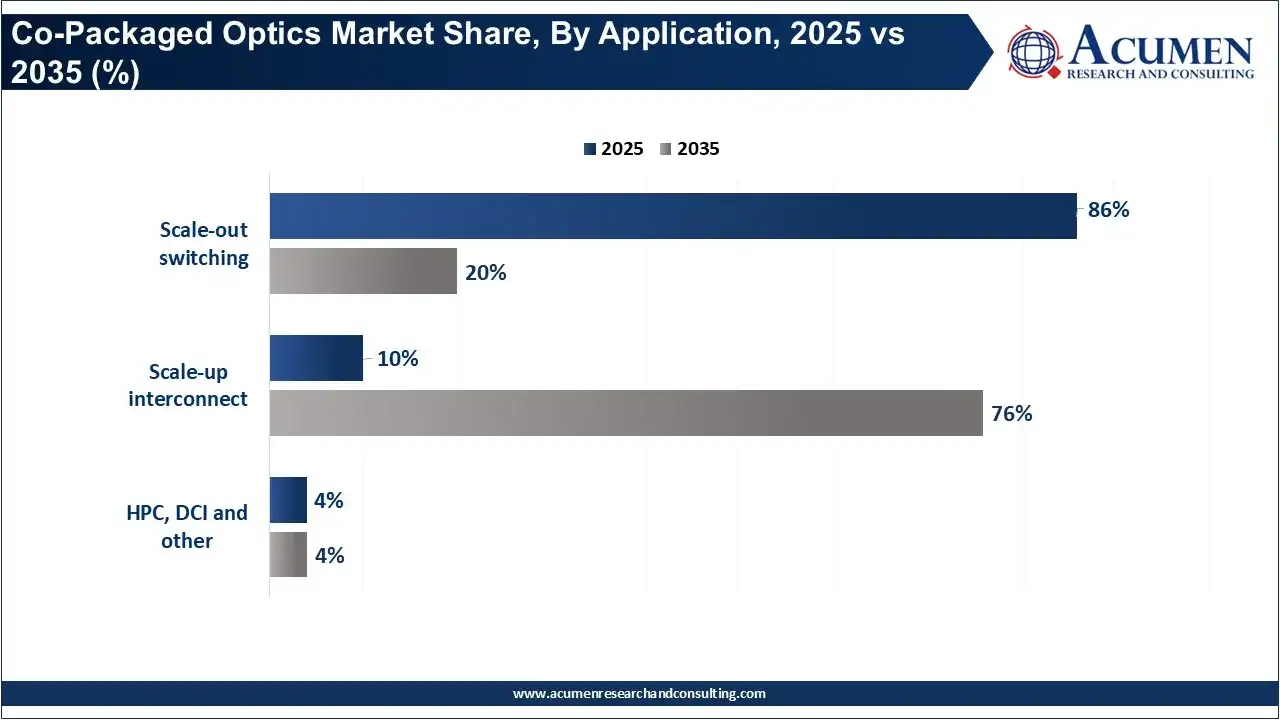
Scale-Up Interconnect (XPU-to-XPU Optical I/O): Scale-up interconnect represented the second-largest application category in 2025, accounting for a 10.0% share and generating USD 20.59 million. The segment is gaining importance as AI accelerators, GPUs, and other processing units require increasingly high-speed communication with one another. Optical I/O can support higher bandwidth density, longer reach, and improved energy efficiency compared with conventional electrical interconnects in demanding computing architectures.
Port Speed Insights
800G and Below: The 800G and below category dominated the port speed segment with a 95% share in 2025, generating USD 195.59 million. Its leading position reflects the initial adoption of co-packaged optics in high-speed data center switching infrastructure, where 800G and lower-speed configurations provide an established deployment pathway. Existing networking ecosystems, compatibility considerations, and the gradual transition toward higher-capacity architectures support demand for this category.
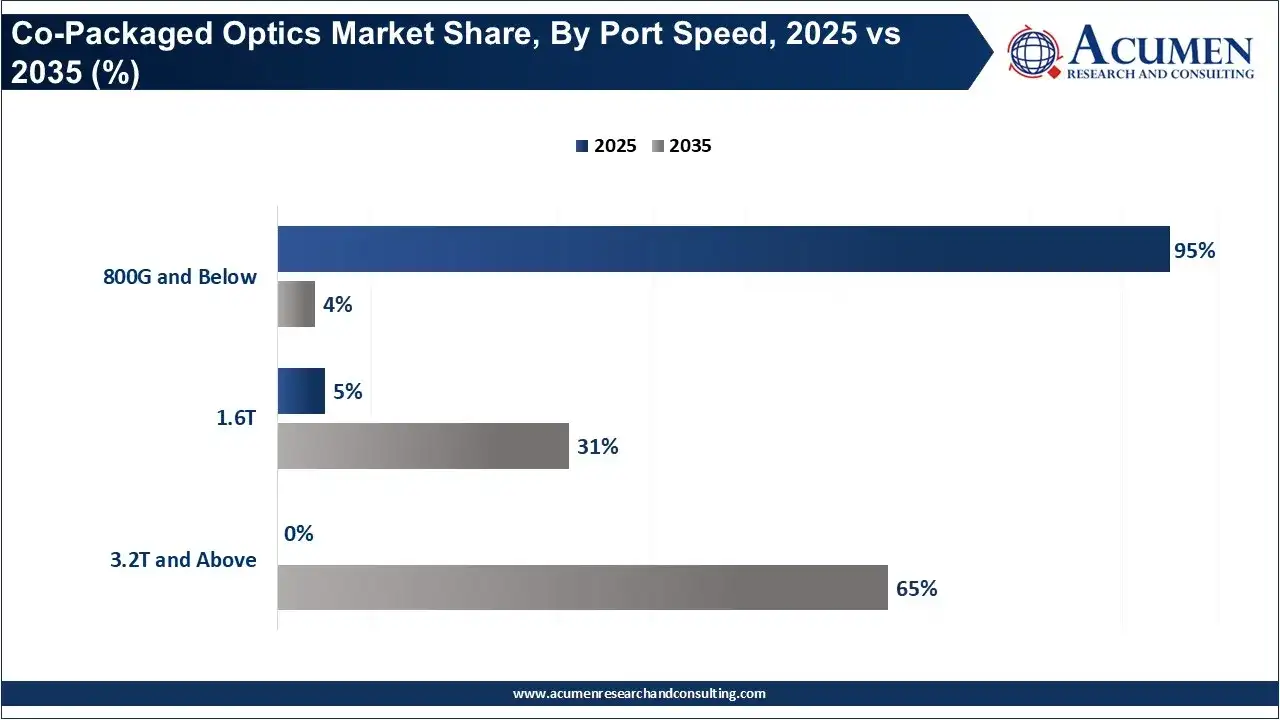
1.6T: The 1.6T category represented the second-largest port speed segment in 2025, accounting for a 5% share and generating USD 10.29 million. Increasing requirements for higher switching capacity and bandwidth density are supporting the transition toward 1.6T optical connectivity.
Integration Platform Insights
Silicon Photonics: Silicon photonics dominated the integration platform segment with a 92% share in 2025, generating USD 189.42 million. Its leading position is supported by its compatibility with established semiconductor manufacturing processes, integration capabilities, and potential for scalable production of photonic components. Silicon photonics enables the integration of optical functions with electronic systems, supporting compact architectures and high-bandwidth communication. Its growing relevance in AI data centers and advanced optical interconnects is expected to sustain its market leadership.
InP, TFLN, VCSEL and Other: The InP, TFLN, VCSEL and other category represented the second-largest integration platform segment, accounting for an 8% share in 2025 and generating USD 16.47 million. These technologies offer complementary capabilities in light generation, modulation, and optical transmission, supporting different performance requirements across co-packaged optical architectures. Their application in specialized optical components is expected to contribute to the diversification of CPO integration approaches.
End User Insights
Hyperscale Cloud Providers: Hyperscale cloud providers dominated the end-user segment with a 72% share in 2025, generating USD 148.24 million. Their leading position is driven by large-scale investments in cloud computing infrastructure, AI data centers, and high-performance networking equipment. These providers require high-bandwidth, energy-efficient optical connectivity to manage increasing data traffic across distributed computing environments.
HPC, Government and Research: HPC, government and research represented the second-largest end-user category in 2025, accounting for a 12.0% share and generating USD 24.71 million. Demand is supported by the growing use of high performance computing systems in scientific research, national laboratories, advanced simulations, and government-backed computing infrastructure. These environments require high-speed data communication between processing units to support computationally intensive workloads.
Co-Packaged Optics Market Share, By End User, 2025 (%)
| End User | Revenue Share, 2025 (%) | Revenue Share, 2035 (%) |
|---|---|---|
| Hyperscale cloud providers | 72% | 60% |
| AI infrastructure / neocloud providers and AI labs | 10% | 22% |
| HPC, government and research | 12% | 8% |
| Enterprise, telecom and other | 6% | 10% |
AI Infrastructure / Neocloud Providers and AI Labs: AI infrastructure, neocloud providers and AI labs are expected to be the fastest-growing end-user category, registering a projected CAGR of 72.6% from 2026 to 2035. The expansion of generative AI, large language models, and GPU-as-a-service platforms is increasing demand for specialized computing infrastructure with high-bandwidth interconnects.
Co-Packaged Optics Market Regional Insights
Why Does North America Dominate the Co-Packaged Optics Market?
North America dominated the regional segment with a 60.0% share in 2025, equivalent to USD 123.53 million. Its leadership is supported by the strong presence of hyperscale cloud providers, advanced semiconductor companies, optical networking technology developers, and major AI infrastructure investors.
The United States plays a central role in regional demand through investments in large-scale data centers, GPU clusters, cloud computing platforms, and next-generation networking infrastructure. Increasing requirements for high-bandwidth connectivity and energy-efficient data transmission are encouraging technology providers to explore co-packaged optics as an alternative to conventional pluggable optical transceivers.
The region also benefits from an established ecosystem of photonic integrated circuit developers, semiconductor manufacturers, and optical component suppliers. Collaboration between technology companies and data center operators is supporting the development and evaluation of advanced CPO architectures.
Which Region Is Expected to Witness the Fastest Growth in the Co-Packaged Optics Market?
Latin America is expected to be the fastest-growing regional market, registering a projected CAGR of 65.0% from 2026 to 2035. Although its market share was relatively small at 1.4% in 2025, representing USD 2.88 million, increasing investments in digital infrastructure and data center development are creating opportunities for advanced optical connectivity technologies.
The expansion of cloud computing services, growing enterprise digitalization, and increasing demand for AI-enabled applications are encouraging infrastructure providers to upgrade networking capabilities. Brazil and Mexico are emerging as important markets for data center investment and cloud infrastructure expansion, supporting the long-term development of high-performance networking ecosystems.
Competitive Landscape
- Broadcom Inc.: Broadcom develops co-packaged optics solutions integrated with high-performance Ethernet switching platforms, including its Tomahawk and other networking technologies, targeting higher bandwidth density and improved power efficiency in AI data centers.
- NVIDIA Corporation: NVIDIA is advancing CPO-enabled networking through its Spectrum-X Photonics Ethernet and Quantum-X Photonics InfiniBand platforms, designed to support high-bandwidth AI infrastructure and large-scale accelerated computing clusters.
- Cisco Systems, Inc.: Cisco participates in the CPO ecosystem through its optical networking research, silicon photonics capabilities, and development of high-performance switching and data center connectivity technologies.
- Marvell Technology, Inc.: Marvell develops optical interconnect, silicon photonics, and custom connectivity solutions for cloud data centers, focusing on high-bandwidth and energy-efficient communication architectures.
- Coherent Corp.: Coherent supplies silicon photonics, indium phosphide lasers, VCSELs, external laser sources, and optical components that support next-generation co-packaged optics architectures.
- Lumentum Holdings Inc.: Lumentum develops advanced optical components, laser technologies, and photonic solutions supporting high-speed optical interconnects and next-generation data center networking applications.
- Taiwan Semiconductor Manufacturing Company Limited (TSMC): TSMC contributes to the CPO ecosystem through silicon photonics manufacturing, advanced semiconductor packaging, and integration technologies designed to bring optical connectivity closer to computing silicon.
- Ayar Labs, Inc.: Ayar Labs develops co-packaged optical I/O solutions, including its TeraPHY optical engines and SuperNova external laser sources, targeting high-bandwidth connectivity for AI accelerator clusters.
- Lightmatter, Inc.: Lightmatter develops its Passage 3D co-packaged optics platform, integrating silicon photonics and advanced packaging to enable high-bandwidth, low-power communication between AI processors and networking systems.
- GlobalFoundries Inc.: GlobalFoundries develops silicon photonics manufacturing platforms and CPO solutions, including its SCALE optical module platform, to support scalable optical interconnect deployment in AI data centers.
Recent Developments
- October 2026: NVIDIA and Siliconware Precision Industries (SPIL), an ASE Technology subsidiary, announced an expansion of optical engine assembly capacity in Taiwan to support increasing demand for next-generation AI networking systems. The companies initiated low-volume production in Q3 2026 and are targeting a significant production ramp by 2027, strengthening the manufacturing ecosystem for CPO solutions.
- September 2026: Coherent Corp. announced the launch of PhotonLink, an integrated optics platform designed to support co-packaged optics, near-packaged optics, and emerging chip-to-chip connectivity. The platform combines silicon photonics, indium phosphide lasers, VCSEL arrays, optical fibers, detectors, and precision assembly capabilities to address growing optical connectivity requirements in AI data centers.
Segments Covered
By Component
- Optical Engines (PIC + Driver/TIA Electronics)
- External Laser Sources (ELS)
- Fiber Attach, Shuffles and Connectivity
- Packaging, Assembly and Test
By Application
- Scale-Out Switching (Ethernet / InfiniBand Switches)
- Scale-Up Interconnect (XPU-to-XPU Optical I/O)
- HPC, DCI and Other
By Port Speed
- 800G and Below
- 1.6T
- 3.2T and Above
- By Integration Platform
- Silicon Photonics
- InP, TFLN, VCSEL and Other
By End User
- Hyperscale Cloud Providers
- AI Infrastructure / Neocloud Providers and AI Labs
- HPC, Government and Research
- Enterprise, Telecom and Other
By Region
- North America
- Asia Pacific
- Europe
- Latin America
- Middle East & Africa
Looking for discounts, bulk pricing, or custom solutions? Contact us today at sales@acumenresearchandconsulting.com
Frequently Asked Questions

Related Market Research Reports
June 2024
October 2023
November 2026
September 2026
August 2026
August 2026
August 2026
August 2026