
Sterile Injectables CDMO Market Size, Share, Forecast Report 2026 To 2035
Sterile Injectables CDMO Market (By Molecule Type: Large Molecules, Peptides & Oligonucleotides, Small Molecules; By Dosage Form / Container: Liquid Vials, Lyophilized Vials, Prefilled Syringes, Cartridges, Ampoules, IV Bags & Others; By Service Type: Commercial Fill-Finish Manufacturing, Clinical-Trial Fill-Finish & Supply, Formulation & Process Development, Analytical & QC Testing, Packaging, Labelling & Device Assembly; By Route of Administration: Subcutaneous, Intravenous, Intramuscular, Others; By Therapeutic Area: Oncology, Metabolic & Endocrine, Infectious Diseases, Immunology & Autoimmune, Central Nervous System, Cardiovascular, Others; By Manufacturing Technology: Conventional Cleanroom / RABS Filling, Isolator-Based Aseptic Filling; By Client Type: Large Pharmaceutical Companies, Mid-Size Pharma & Generic Injectable Companies, Small & Emerging Biotech Companies, Government, Academic & Other Clients) - Global Industry Analysis, Size, Share, Regional Analysis, Trends and Forecast 2026 - 2035
- Last Updated: 19 Nov 2026
- Report Code: ARC4012
- Category: Healthcare and Pharmaceuticals
Sterile Injectables CDMO Market Size, Forecast Report 2026 To 2035
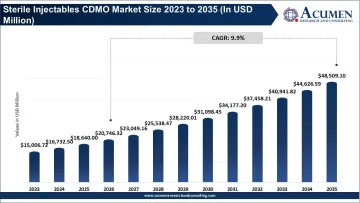
The global sterile injectables CDMO market size was valued at $18,640 million in 2025 and is projected to reach $48,509.10 million by 2035; expanding at a CAGR of 9.9% during the forecast period of 2026-2035. The market is driven by increasing pharmaceutical outsourcing, rising biologics and injectable drug demand, expanding prefilled syringe adoption, growing complexity of sterile formulations, and pharmaceutical companies' investments in flexible, compliant manufacturing capacity.
Key Takeaways
- By region: North America dominated the regional segment with a 36.0% share in 2025, generating USD 6,710.40 million in revenue. Asia-Pacific is projected to be the fastest-growing region, registering a 12.8% CAGR from 2026 to 2035.
- By molecule type: Large molecules dominated the segment with a 50.0% share in 2025, driven by demand for biologics, monoclonal antibodies, and vaccines.
- By dosage form/container: Liquid vials led the segment with a 34.0% share in 2025, supported by their widespread use in injectable drug manufacturing. Prefilled syringes ranked second with a 26.0% share.
- By service type: Commercial fill-finish manufacturing dominated the segment with a 52.0% share in 2025, reflecting sustained outsourcing demand for large-scale sterile drug production.
- By route of administration: Subcutaneous injections led the segment with a 38.0% share in 2025, supported by the growing use of self-administered injectable therapies.
- By therapeutic area: Oncology dominated the segment with a 30.0% share in 2025, driven by demand for injectable cancer therapies and biologic treatments.
- By manufacturing technology: Conventional cleanroom/RABS filling dominated the segment with a 58.0% share in 2025. Isolator-based aseptic filling is projected to grow fastest, at a 14.2% CAGR from 2026 to 2035.
- By client type: Large pharmaceutical companies dominated the segment with a 46.0% share in 2025, reflecting their substantial injectable drug portfolios and established CDMO outsourcing relationships.
Industry Overview
The sterile injectables CDMO market comprises contract development and manufacturing organizations that provide pharmaceutical companies with specialized development, formulation, aseptic processing, fill-finish, inspection, packaging, and commercial manufacturing services for injectable drug products. These organizations support the production of sterile formulations across vials, prefilled syringes, ampoules, and cartridges, serving small-molecule drugs, biologics, vaccines, biosimilars, and specialty therapeutics.
The market plays a critical role in the pharmaceutical supply chain by enabling companies to access qualified manufacturing infrastructure, specialized technical expertise, and regulatory-compliant production capabilities without making equivalent investments in their own facilities. Increasing complexity in injectable formulations, growing demand for biologics and advanced drug delivery systems, and the need for reliable sterile manufacturing are strengthening the role of CDMOs across clinical development and commercial production.
Industry Trends and Technology Developments
- Transition toward isolator-based manufacturing: CDMOs are increasingly adopting advanced isolator systems to reduce human intervention, improve contamination control, and strengthen aseptic manufacturing reliability.
- Growing adoption of prefilled syringe manufacturing: Demand for convenient, ready-to-administer injectable formats is encouraging investments in specialized syringe filling, assembly, inspection, and packaging capabilities.
- Expansion of biologics fill-finish capacity: Increasing production of monoclonal antibodies, vaccines, biosimilars, and other biologics is driving demand for specialized sterile processing infrastructure.
- Integration of robotic and automated filling systems: Automated material handling, robotic filling operations, and closed manufacturing processes are improving production consistency and reducing manual intervention.
Regulatory and Quality Compliance Landscape
| Regulatory framework | Key requirements | Implications for sterile injectables CDMOs |
|---|---|---|
| U.S. FDA: 21 CFR Parts 210 and 211 | Establishes current Good Manufacturing Practice (cGMP) requirements for drug manufacturing, processing, packaging, testing, and quality control. | Requires documented manufacturing procedures, qualified personnel, controlled facilities, validated processes, appropriate testing, and quality unit oversight. |
| FDA Aseptic Processing Guidance (2004) | Provides guidance for sterile drug products manufactured through aseptic processing, including facility design, personnel practices, environmental monitoring, sterilization, and process controls. | CDMOs must establish contamination prevention systems, monitor cleanroom environments, qualify aseptic operations, and maintain process controls. |
| EU GMP Annex 1: Manufacture of Sterile Medicinal Products | Establishes requirements for contamination control strategies, cleanroom classification, aseptic processing, environmental monitoring, sterilization, and personnel qualification. Fully applicable since August 25, 2024. | Requires documented contamination control strategies, risk-based facility and process controls, qualified equipment, and robust environmental monitoring. |
| ICH Q9(R1): Quality Risk Management | Establishes principles and tools for identifying, evaluating, controlling, communicating, and reviewing pharmaceutical quality risks. | Supports risk-based decisions in facility design, technology transfer, process validation, supplier qualification, and manufacturing operations. |
| ICH Q10: Pharmaceutical Quality System | Defines a lifecycle-based pharmaceutical quality system covering process performance, product quality, corrective and preventive actions, change management, and continuous improvement. | Requires CDMOs to maintain effective quality management systems and clear quality responsibilities across outsourced manufacturing relationships. |
| PIC/S GMP Guide: Annex 1 | Provides harmonized GMP expectations for sterile medicinal product manufacturing, aligned with the revised EU Annex 1 requirements. | Supports consistent sterile manufacturing practices across participating regulatory jurisdictions and strengthens inspection readiness. |
Sterile Injectables CDMO Market Dynamics
Drivers
- Growing Demand for Biologics and Injectable Therapeutics: Increasing prevalence of chronic diseases, cancer, autoimmune disorders, and other complex health conditions is driving demand for biologics, monoclonal antibodies, vaccines, and injectable therapies. These products often require specialized sterile manufacturing capabilities, aseptic processing, and advanced fill-finish infrastructure, encouraging pharmaceutical companies to outsource production to specialized contract development and manufacturing organizations (CDMOs).
- Increasing Pharmaceutical Outsourcing Activities: Pharmaceutical and biotechnology companies are increasingly outsourcing sterile injectable development and manufacturing to reduce capital expenditure, improve operational flexibility, and accelerate product commercialization. CDMOs offer specialized manufacturing facilities, regulatory expertise, formulation development, and fill-finish capabilities, enabling drug developers to focus on research, clinical development, and commercialization.
- Expansion of Injectable Drug Pipelines: Growing development of oncology drugs, biosimilars, peptide therapeutics, and other injectable formulations is increasing demand for specialized sterile manufacturing services. The complexity of modern drug pipelines, combined with stringent sterility requirements and specialized packaging needs, is encouraging pharmaceutical companies to partner with CDMOs offering integrated development and commercial manufacturing capabilities.
Restraints
- High Capital Investment and Infrastructure Requirements: Sterile injectable manufacturing requires specialized cleanrooms, aseptic filling lines, isolator systems, sterilization equipment, and advanced quality-control infrastructure. Establishing and maintaining these facilities involves substantial capital expenditure, operational costs, and continuous technology upgrades, creating financial barriers for new entrants and smaller CDMOs.
- Stringent Regulatory Compliance Requirements: Sterile injectable CDMOs must comply with rigorous Good Manufacturing Practice (GMP) requirements, contamination-control standards, environmental monitoring protocols, and regulatory inspection procedures. Maintaining compliance across different markets increases documentation, validation, testing, and operational costs while creating challenges for companies seeking to expand manufacturing capabilities.
Opportunities
- Expansion of Biologics and Biosimilar Manufacturing: Increasing commercialization of monoclonal antibodies, recombinant proteins, biosimilars, and other biologic therapeutics creates opportunities for CDMOs with specialized sterile injectable capabilities. Investments in advanced aseptic processing, cold-chain-compatible manufacturing, and biologic fill-finish facilities can help service providers attract pharmaceutical and biotechnology clients with complex manufacturing requirements.
- Growing Demand for Pre-Filled Syringes and Advanced Drug Delivery Systems: Increasing adoption of self-administration therapies, biologics, and chronic disease treatments is creating opportunities for CDMOs offering pre-filled syringe, cartridge, and auto-injector filling services. These delivery formats improve dosing convenience, reduce administration errors, and support the commercialization of patient-centric injectable drug products.
- Expansion of Manufacturing Capacity and Geographic Diversification: Pharmaceutical companies are increasingly seeking diversified manufacturing partnerships to strengthen supply-chain resilience and reduce dependence on limited production locations. This creates opportunities for sterile injectable CDMOs to expand facilities, establish regional manufacturing networks, and develop specialized fill-finish capabilities across North America, Europe, and Asia-Pacific.
Challenges
- Preventing Microbial Contamination and Maintaining Sterility: Microbial contamination remains one of the most critical risks in sterile injectable manufacturing. CDMOs must maintain strict environmental controls, validated sterilization procedures, personnel hygiene, and contamination-control strategies throughout production. Even isolated contamination incidents can result in batch recalls, regulatory scrutiny, production shutdowns, and reputational damage.
- Managing Capacity Constraints and Production Complexity: Increasing demand for specialized injectable manufacturing can create capacity limitations, particularly for high-potency drugs, biologics, and complex formulations. CDMOs must balance production schedules, equipment utilization, batch sizes, and client requirements while maintaining stringent quality standards and minimizing manufacturing bottlenecks.
Sterile Injectables CDMO Market Segmentation Insights
Molecule Type Insights
Large Molecules: Large molecules dominated the molecule type segment with a 50.0% share in 2025, generating USD 9,320.00 million in revenue. The segment is projected to reach USD 26,680.00 million by 2035, registering a CAGR of 10.9% from 2026 to 2035. Demand is supported by increasing production of monoclonal antibodies, therapeutic proteins, vaccines, and advanced biologics. These products require specialized formulation, aseptic processing, cold-chain handling, and stringent quality controls, strengthening demand for experienced sterile injectables CDMOs.
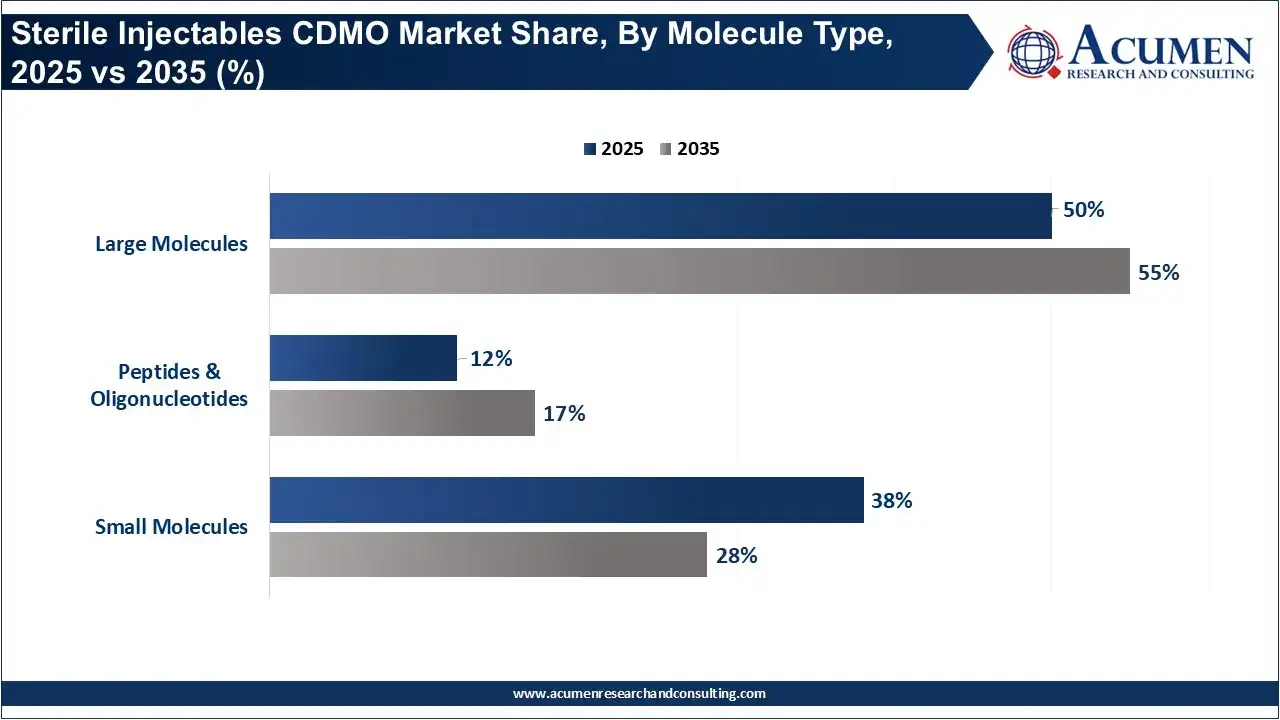
Small Molecules: Small molecules represented the second-largest category, accounting for a 38.0% share in 2025 and generating USD 7,083.20 million in revenue. The segment is expected to reach USD 13,582.55 million by 2035 at a CAGR of 6.5%. Its established position reflects the extensive use of injectable small-molecule formulations across oncology, infectious diseases, emergency medicine, and hospital-based treatments. Generic injectable production and continued demand for established sterile formulations support CDMO activity.
Dosage Form / Container Insights
Liquid Vials: Liquid vials dominated the dosage form segment with a 34.0% share in 2025, generating USD 6,337.60 million in revenue. The segment is projected to reach USD 13,582.55 million by 2035 at a CAGR of 7.8%. Their widespread use across vaccines, biologics, oncology drugs, antibiotics, and hospital-administered injectable medicines supports their leading position. Established filling infrastructure and compatibility with a broad range of injectable formulations continue to sustain demand.
Sterile Injectables CDMO Market Share, By Dosage Form, 2025 (%)
| Dosage Form | Revenue Share, 2025 (%) | Revenue Share, 2035 (%) |
|---|---|---|
| Liquid vials | 34% | 28% |
| Lyophilised vials | 14% | 13% |
| Prefilled syringes | 26% | 30% |
| Cartridges | 12% | 15% |
| Ampoules | 5% | 3% |
| IV bags & others | 9% | 11% |
Prefilled Syringes: Prefilled syringes represented the second-largest category, accounting for a 26.0% share in 2025 and generating USD 4,846.40 million in revenue. The segment is expected to reach USD 14,552.73 million by 2035, registering a CAGR of 11.5%. Adoption is supported by demand for convenient, ready-to-administer drug delivery, reduced preparation requirements, dosing accuracy, and self-administration. Growth in biologics, autoimmune treatments, and metabolic therapies is encouraging CDMOs to expand specialized syringe filling and assembly capacity.
Service Type Insights
Commercial Fill-Finish Manufacturing: Commercial fill-finish manufacturing dominated the service type segment with a 52.0% share in 2025, generating USD 9,692.80 million in revenue. The segment is projected to reach USD 24,254.55 million by 2035 at a CAGR of 9.5%. Its leadership reflects pharmaceutical companies' reliance on CDMOs for validated, large-scale sterile production, including vial, syringe, and other injectable formats. Growing commercial demand for biologics, specialty drugs, and established injectable medicines supports recurring manufacturing contracts.
Formulation & Process Development: Formulation and process development represented the second-largest service category, accounting for a 16.0% share in 2025 and generating USD 2,982.40 million in revenue. The segment is expected to reach USD 8,246.55 million by 2035, registering a CAGR of 10.6%. Increasing complexity in biologics, peptides, and other injectable formulations is driving demand for formulation optimization, process characterization, scale-up, and technology transfer services. Early-stage development support also helps pharmaceutical companies prepare products for clinical and commercial manufacturing.
Packaging, Labelling & Device Assembly: Packaging, labelling, and device assembly are projected to be the fastest-growing service category, registering a CAGR of 11.2% during 2026–2035. Its share is expected to increase from 8.0% in 2025 to 9.0% by 2035, with revenue reaching USD 4,365.82 million. Growth is supported by increasing adoption of prefilled syringes, autoinjectors, and other combination products. Pharmaceutical companies increasingly require integrated packaging, labelling, serialization, and device assembly capabilities to support regulatory compliance and commercial distribution.
Route of Administration Insights
Subcutaneous: Subcutaneous administration dominated the route of administration segment with a 38.0% share in 2025, generating USD 7,083.20 million in revenue. The segment is projected to reach USD 22,314.19 million by 2035, registering a CAGR of 12.0%. Its leadership is supported by the growing use of self-administered injectable therapies, including biologics, autoimmune treatments, insulin, and GLP-1 medicines.
Intravenous: Intravenous administration represented the second-largest category, accounting for a 36.0% share in 2025 and generating USD 6,710.40 million in revenue. The segment is expected to reach USD 15,037.82 million by 2035 at a CAGR of 8.3%. Its established position is supported by the use of intravenous formulations in oncology, hospital-based treatments, infectious diseases, critical care, and biologic therapies.
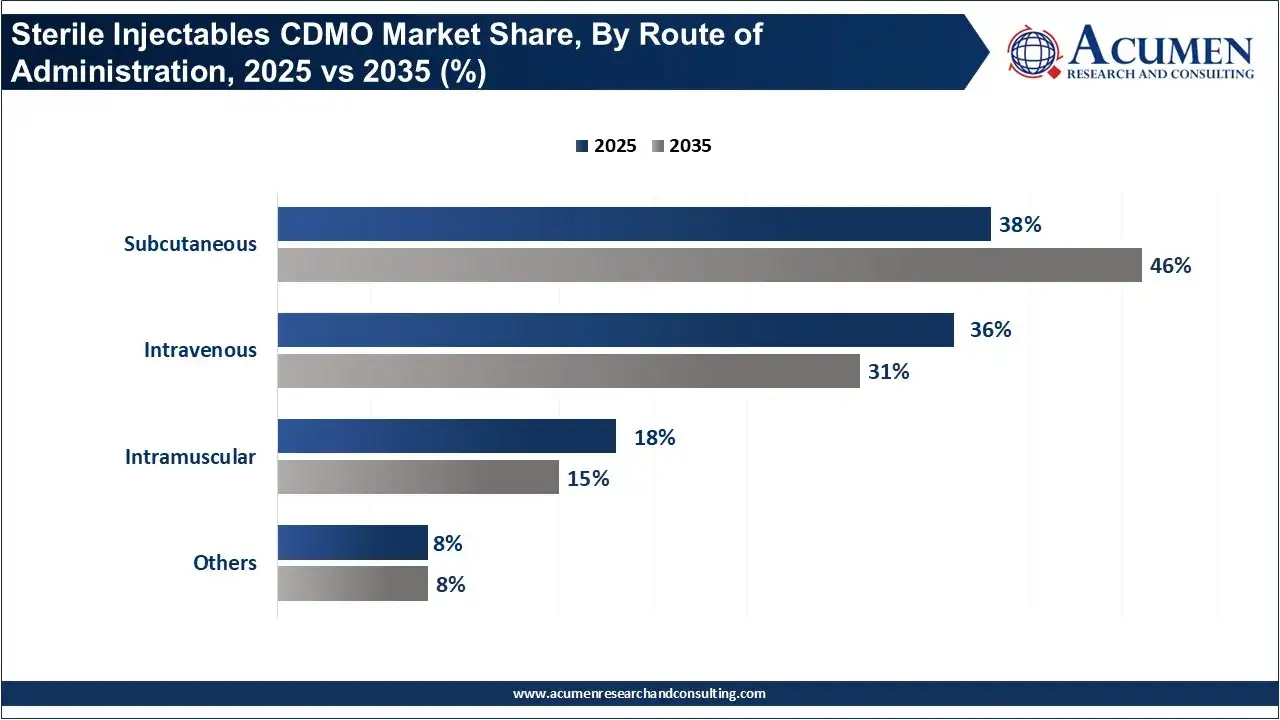
Intramuscular: Intramuscular administration accounted for an 18.0% share in 2025, generating USD 3,355.20 million in revenue. The segment is projected to reach USD 7,276.36 million by 2035 at a CAGR of 7.9%. Demand is supported by vaccines, long-acting injectable medicines, and treatments requiring administration into muscle tissue. Its growth is linked to continued vaccine production and the development of extended-release injectable formulations.
Therapeutic Area Insights
Oncology: Oncology dominated the therapeutic area segment with a 30.0% share in 2025, generating USD 5,592.00 million in revenue. The segment is projected to reach USD 14,067.64 million by 2035 at a CAGR of 9.5%. Increasing use of injectable chemotherapy, monoclonal antibodies, immunotherapies, and targeted cancer treatments is supporting demand. The complexity of oncology formulations and stringent sterility requirements encourage pharmaceutical companies to partner with specialized CDMOs for development and commercial fill-finish operations.
Sterile Injectables CDMO Market Share, By Therapeutic Area, 2025 (%)
| Therapeutic Area | Revenue Share, 2025 (%) | Revenue Share, 2035 (%) |
|---|---|---|
| Oncology | 30% | 29% |
| Metabolic & Endocrine | 14% | 19% |
| Infectious Diseases | 14% | 11% |
| Immunology & Autoimmune | 12% | 12% |
| Central Nervous System | 7% | 8% |
| Cardiovascular | 6% | 5% |
| Others | 17% | 16% |
Metabolic & Endocrine: Metabolic and endocrine therapies are projected to be the fastest-growing therapeutic category, registering a CAGR of 13.2% during 2026–2035. Its market share is expected to increase from 14.0% in 2025 to 19.0% by 2035, with revenue reaching USD 9,216.73 million. Growth is driven by increasing demand for injectable diabetes and obesity treatments, particularly GLP-1-based therapies. Rising treatment adoption and the need for scalable peptide manufacturing, sterile filling, and prefilled delivery systems are creating significant opportunities for CDMOs.
Manufacturing Technology Insights
Conventional Cleanroom / RABS Filling: Conventional cleanroom and RABS filling dominated the manufacturing technology segment in 2025, accounting for a 58.0% share and generating USD 10,811.20 million in revenue. The segment is projected to reach USD 18,433.46 million by 2035 at a CAGR of 5.3%. Its established installed base, existing manufacturing infrastructure, and continued use across qualified sterile production facilities support its market position.
Isolator-Based Aseptic Filling: Isolator-based aseptic filling is projected to be the fastest-growing and largest manufacturing technology segment by 2035. It accounted for 42.0% of the market in 2025, generating USD 7,828.80 million, and is expected to increase its share to 62.0% by 2035. Revenue is projected to reach USD 30,075.64 million at a CAGR of 14.2%. Adoption is supported by improved separation between operators and sterile processes, reduced contamination risks, automation opportunities, and the industry's increasing focus on contamination control strategies.
Client Type Insights
Large Pharmaceutical Companies: Large pharmaceutical companies dominated the client type segment with a 46.0% share in 2025, generating USD 8,574.40 million in revenue. The segment is projected to reach USD 20,373.82 million by 2035 at a CAGR of 8.9%. Their leadership reflects substantial commercial product portfolios, established outsourcing relationships, and demand for reliable large-scale manufacturing capacity.
Sterile Injectables CDMO Market Share, By Client Type, 2025 (%)
| Client Type | Revenue Share, 2025 (%) | Revenue Share, 2035 (%) |
|---|---|---|
| Large pharmaceutical companies | 46% | 42% |
| Mid-size pharma & generic injectable companies | 22% | 20% |
| Small & emerging biotech companies | 26% | 32% |
| Government, academic & other clients | 6% | 6% |
Small & Emerging Biotech Companies: Small and emerging biotechnology companies represented the second-largest client category, accounting for a 26.0% share in 2025 and generating USD 4,846.40 million in revenue. The segment is expected to reach USD 15,522.91 million by 2035, registering a CAGR of 12.2%. These companies often depend on external partners for formulation development, clinical supply, technology transfer, and commercial manufacturing because they have limited internal infrastructure.
Sterile Injectables CDMO Market Regional Insights
Which Region Dominated the Sterile Injectables CDMO Market in 2025?
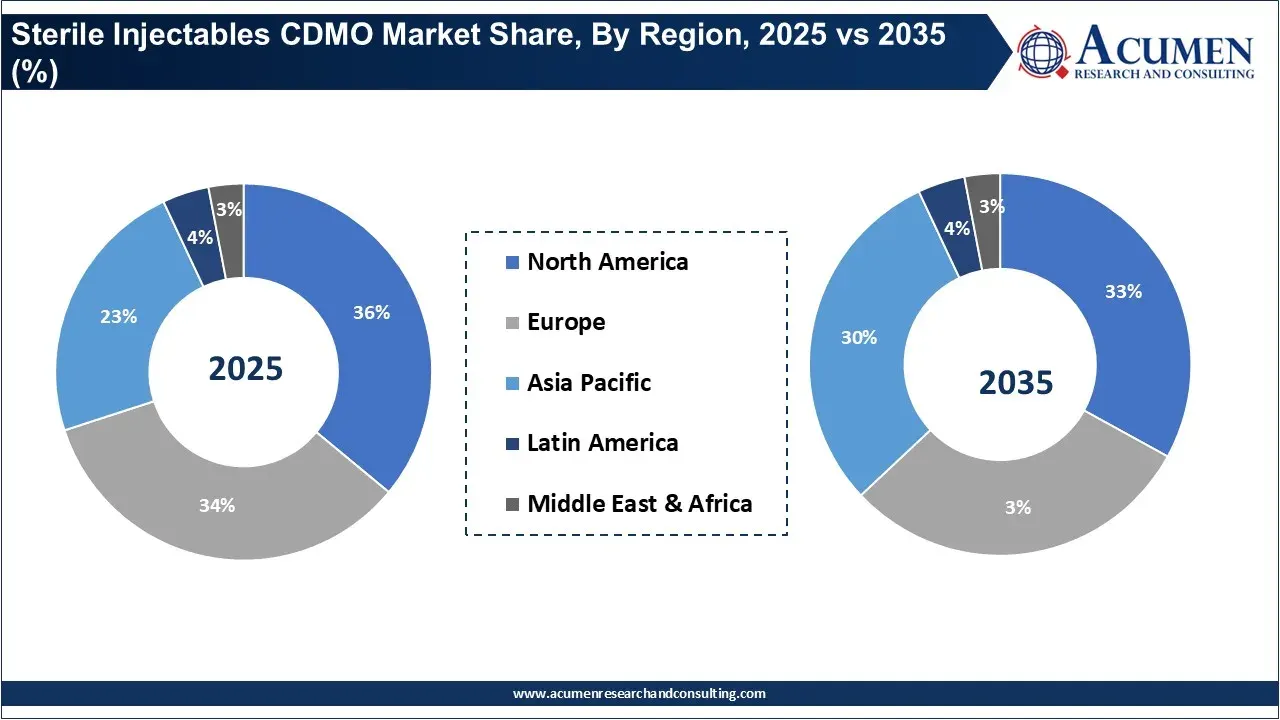
North America dominated the sterile injectables CDMO market with a 36.0% share in 2025, generating USD 6,710.40 million in revenue. The regional market is projected to reach USD 16,008.00 million by 2035, registering a CAGR of 8.9% during 2026–2035. Its leadership is supported by a well-established pharmaceutical and biotechnology industry, high biologics development activity, and substantial outsourcing demand for clinical and commercial manufacturing.
The United States remains the primary contributor, supported by established CDMO infrastructure, pharmaceutical innovation, and demand for advanced aseptic fill-finish capabilities. Canada also contributes through its pharmaceutical manufacturing and biotechnology ecosystem. North America benefits from investments in isolator-based filling, prefilled syringe production, lyophilization, and specialized injectable manufacturing. Europe ranked as the second-largest regional market in 2025, accounting for a 34.0% share and generating USD 6,337.60 million.
Which Region Is Expected to Be the Fastest-Growing in the Sterile Injectables CDMO Market?
Asia-Pacific is projected to be the fastest-growing regional market, registering a CAGR of 12.8% from 2026 to 2035. The region accounted for a 23.0% share in 2025, generating USD 4,287.20 million in revenue, and is expected to reach USD 14,552.73 million by 2035. Its market share is projected to increase to 30.0% by the end of the forecast period. Growth is supported by expanding pharmaceutical manufacturing capacity, increasing biotechnology investment, competitive production costs, and rising demand for outsourced sterile manufacturing. China, India, Japan, South Korea, and Singapore are important contributors to the regional market.
Country-Level Analysis
- United States: The United States represents a major market for sterile injectables CDMO services, supported by a large pharmaceutical and biotechnology industry, high demand for biologics, and extensive outsourcing of clinical and commercial manufacturing. Demand is particularly strong for aseptic fill-finish, prefilled syringes, vials, lyophilization, and high-potency injectable products.
- Germany: Germany is a prominent sterile injectables manufacturing hub in Europe, supported by established pharmaceutical infrastructure, advanced engineering capabilities, and stringent quality standards. The country has a strong presence of specialized CDMOs offering aseptic filling, vial manufacturing, prefilled syringe production, and pharmaceutical packaging. Investments in new sterile manufacturing facilities and advanced filling technologies are strengthening its position in the European market.
- Switzerland: Switzerland holds a significant position in the sterile injectables CDMO industry due to its pharmaceutical innovation ecosystem, specialized manufacturing expertise, and concentration of established pharmaceutical companies. Demand is supported by biologics, complex injectable formulations, and high-value pharmaceutical outsourcing.
- India: India is emerging as an important sterile injectables CDMO destination, supported by cost-competitive manufacturing, an established pharmaceutical production base, and increasing investments in regulated-market capabilities. Domestic manufacturers are expanding aseptic filling, lyophilization, vial, and prefilled syringe capabilities to serve international pharmaceutical customers.
Competitive Landscape
- Lonza
- Vetter Pharma
- Simtra BioPharma Solutions
- Thermo Fisher Scientific (Patheon)
- PCI Pharma Services
- CordenPharma
- Recipharm
- Boehringer Ingelheim
- FAMAR
- Aenova Group
- Ajinomoto Bio-Pharma Services
- Alcami
- Grand River Aseptic Manufacturing
- Siegfried
- Bora Pharmaceuticals
Investment and Recent News Analysis
- September 2026: CordenPharma announced an €80 million investment in sterile injectable manufacturing expansion in Italy. The investment will expand its Caponago facility near Milan through additional manufacturing infrastructure and aseptic fill-finish capabilities. The project includes the acquisition of an adjacent 11,000-square-meter commercial building and 26,000 square meters of land, supporting increased production capacity for injectable products.
- September 2026: Biodeal Pharmaceuticals acquired a sterile injectable manufacturing facility in Paonta Sahib, India. The acquisition of Biological E.'s facility strengthens Biodeal's sterile injectable CDMO platform and expands its manufacturing capabilities for regulated international markets. The approximately 14-acre facility has an annual manufacturing capacity of around 135 million units and supports vial-based general injectables and carbapenem products.
Segments Covered
By Molecule Type
- Large Molecules (mAbs, Proteins, Vaccines, Cell and Gene Therapies)
- Peptides & Oligonucleotides (Including GLP-1s)
- Small Molecules
By Dosage Form / Container
- Liquid Vials
- Lyophilized Vials
- Prefilled Syringes
- Cartridges (Pens and Autoinjector Cartridges)
- Ampoules
- IV Bags & Others (BFS, Ophthalmic, Dual-Chamber)
By Service Type
- Commercial Fill-Finish Manufacturing
- Clinical-Trial Fill-Finish & Supply
- Formulation & Process Development
- Analytical & QC Testing
- Packaging, Labelling & Device Assembly
By Route of Administration
- Subcutaneous
- Intravenous
- Intramuscular
- Others (Intravitreal, Intradermal, Intrathecal)
By Therapeutic Area
- Oncology
- Metabolic & Endocrine (Diabetes, Obesity)
- Infectious Diseases (Vaccines, Anti-Infectives)
- Immunology & Autoimmune
- Central Nervous System
- Cardiovascular
- Others (Rare Diseases, Ophthalmology, Hematology)
By Manufacturing Technology
- Conventional Cleanroom / RABS Filling
- Isolator-Based Aseptic Filling
By Client Type
- Large Pharmaceutical Companies
- Mid-Size Pharma & Generic Injectable Companies
- Small & Emerging Biotech Companies
- Government, Academic & Other Clients
By Region
- North America
- Europe
- Asia-Pacific
- Latin America
- Middle East & Africa
Looking for discounts, bulk pricing, or custom solutions? Contact us today at sales@acumenresearchandconsulting.com
Frequently Asked Questions

Related Market Research Reports
November 2026
November 2026
October 2026
June 2026
March 2020
November 2026
November 2026
October 2026